


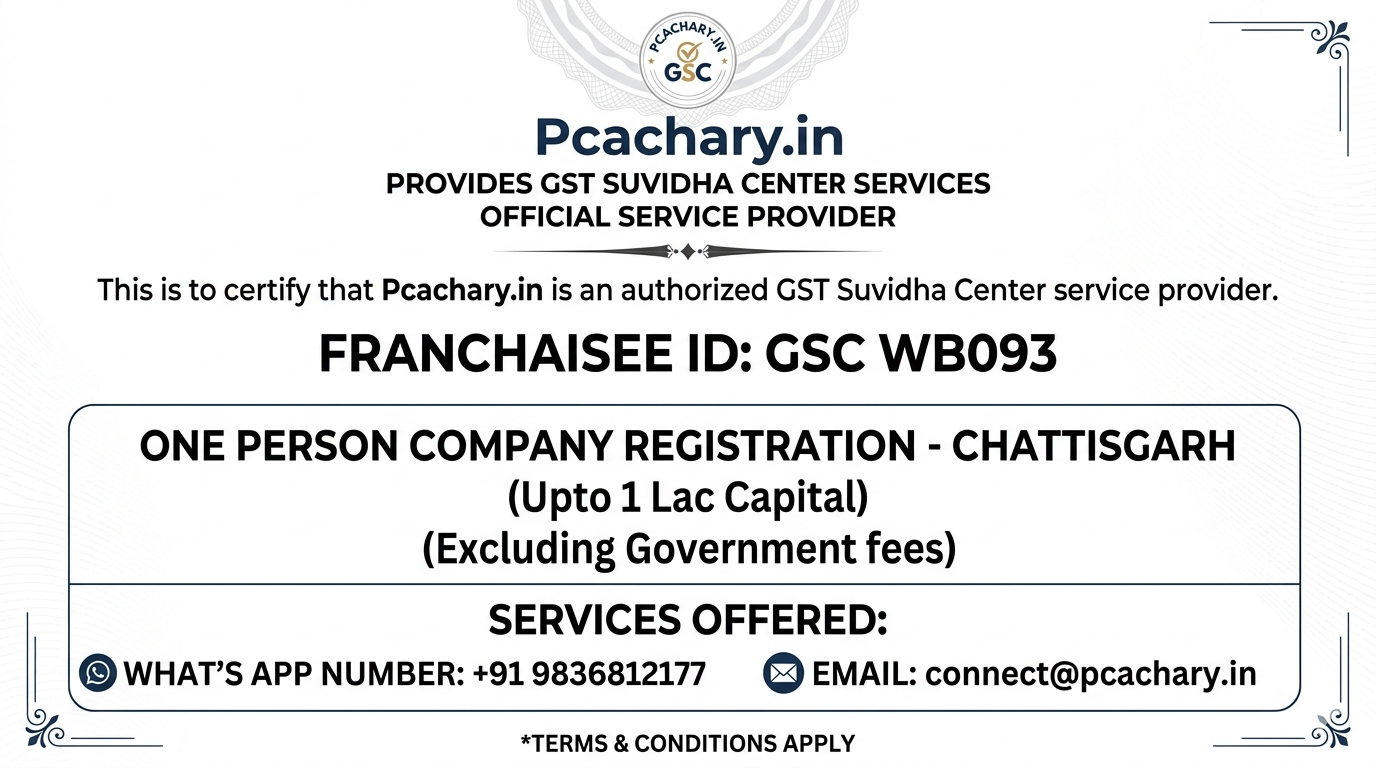

This comprehensive guide outlines the process, benefits, and legal framework for establishing a One Person Company (OPC) in Chhattisgarh, specifically tailored for entrepreneurs looking to leverage the GST Suvidha Center ecosystem.
1. Introduction to the One Person Company Model
The introduction of the One Person Company (OPC) under the Companies Act, 2013, revolutionized the Indian corporate landscape. Before this, a single entrepreneur wishing to start a business with limited liability was forced to find a partner to meet the minimum requirement of two directors and two shareholders for a Private Limited Company. The OPC model changed this by allowing a single individual to act as both the director and the sole shareholder.
In a state like Chhattisgarh, which is rapidly becoming a hub for industrial and digital services, the OPC structure offers a unique blend of solo control and corporate standing. When managed through a professional facilitator like the GST Suvidha Center (Franchisee ID: GSC WB093), the complexity of registration is significantly reduced.
2. Why Choose an OPC in Chhattisgarh?
Chhattisgarh offers a fertile ground for startups, especially in the service and digital sectors. Choosing an OPC structure provides several distinct advantages:
- Limited Liability Protection: The most significant benefit is that the owner’s personal assets (home, car, savings) are protected. The liability of the member is limited to the unpaid subscription money. If the business faces losses or legal suits, the owner is not personally responsible for the company’s debts.
- Separate Legal Entity: An OPC is a legal person in the eyes of the law. It can sue and be sued in its own name, own property, and enter into contracts. This builds immense trust with vendors and clients compared to a traditional proprietorship.
- Perpetual Succession: Unlike a proprietorship, which ends with the death of the owner, an OPC continues to exist. The owner must nominate a person during incorporation who will take over the company in the event of the owner’s death or disability.
- Ease of Compliance: While an OPC must follow certain rules, it enjoys several exemptions under the Companies Act. For instance, it is not required to hold an Annual General Meeting (AGM), and the signing of financial statements is simplified.
3. The Role of the GST Suvidha Center
Navigating the MCA (Ministry of Corporate Affairs) portal can be daunting for a first-time business owner. This is where the expertise of a verified service provider becomes invaluable. By utilizing the services of the GST Suvidha Center with Franchisee ID GSC WB093, you ensure that your documentation is handled by professionals who understand the nuances of both state-specific and central regulations.
The service provided through Pcachary.in focuses on a “one-stop” approach. From obtaining Digital Signature Certificates (DSC) to drafting the Memorandum of Association (MOA), every step is meticulously managed to avoid technical rejections from the Registrar of Companies (ROC).
4. Eligibility and Naming Conventions
To start an OPC in India, the following criteria must be met:
- Only a natural person who is an Indian citizen and resident in India is eligible to incorporate an OPC.
- The person cannot incorporate more than one OPC or be a nominee in more than one OPC.
- Minor children cannot become members or nominees.
Choosing a Name
The name of your company must be unique and not resemble any existing company or trademark. In the case of an OPC, the suffix “(OPC) Private Limited” is mandatory. For example, if your chosen name is “Indira Digital Services,” the full legal name will be “Indira Digital Services (OPC) Private Limited.”
5. Understanding the Capital Structure
This specific service package is designed for companies with an Authorized Capital of up to 1 Lakh. Capital is the amount of money the company is legally allowed to raise by issuing shares to its member.
It is important to note that while the professional service fee covers the filing, documentation, and processing, Government Fees are excluded. These fees (Stamp Duty and MCA Filing fees) vary based on the state. For Chhattisgarh, stamp duties are calculated based on the authorized capital and the location of the registered office.
6. Steps for Incorporation
Phase 1: Digital Documentation
The first step is obtaining a Digital Signature Certificate (DSC). Since all filings are electronic, the director needs a DSC to sign the e-forms.
Phase 2: Name Approval (RUN – Reserve Unique Name)
We submit up to two preferred names to the MCA for approval. Once the name is reserved, it remains valid for 20 days, during which the incorporation documents must be filed.
Phase 3: The SPICe+ Form
The MCA has introduced an integrated form called SPICe+ (Simplified Proforma for Incorporating Company Electronically Plus). This single application covers:
- Company Incorporation
- DIN (Director Identification Number) allotment
- PAN (Permanent Account Number) application
- TAN (Tax Deduction and Collection Account Number) application
- EPFO and ESIC registration
- GSTIN (optional but recommended)
Phase 4: Appointment of Nominee
A unique feature of the OPC is the Nominee. You must provide the name of a person who will take charge of the company in your absence. This requires the nominee’s written consent in Form INC-3.
7. Post-Incorporation Formalities
Once the Certificate of Incorporation (COI) is issued, the journey has just begun. You must:
- Open a Bank Account: Use the COI and PAN to open a corporate current account.
- Issue Share Certificates: The company must issue share certificates to the subscriber within 60 days.
- Commencement of Business: File Form INC-20A within 180 days of incorporation to declare that the subscriber has paid the value of shares.
8. Compliance Calendar
Maintaining an OPC requires periodic filings to keep the company in “Active” status:
- Form AOC-4: For filing financial statements (Balance Sheet and Profit & Loss Account).
- Form MGT-7A: An abridged annual return specifically for OPCs and small companies.
- Income Tax Returns: Mandatory filing every year before the deadline (usually September 30th).
9. Contact and Service Details
For entrepreneurs in Chhattisgarh looking to professionalize their business journey, the GST Suvidha Center provides end-to-end support. Our team ensures that your “One Person Company” is built on a solid legal foundation, allowing you to focus on growth while we handle the paperwork.
Service Provider Details:
- Franchisee ID: GSC WB093
- Website: Pcachary.in
- Email: connect@pcachary.in
- WhatsApp: +91 9836812177
By choosing the OPC route with a capital of up to 1 Lakh, you are taking a cost-effective step toward corporate credibility. Let us help you navigate the digital landscape of Indian business registration with ease and transparency.


Reviews
There are no reviews yet.