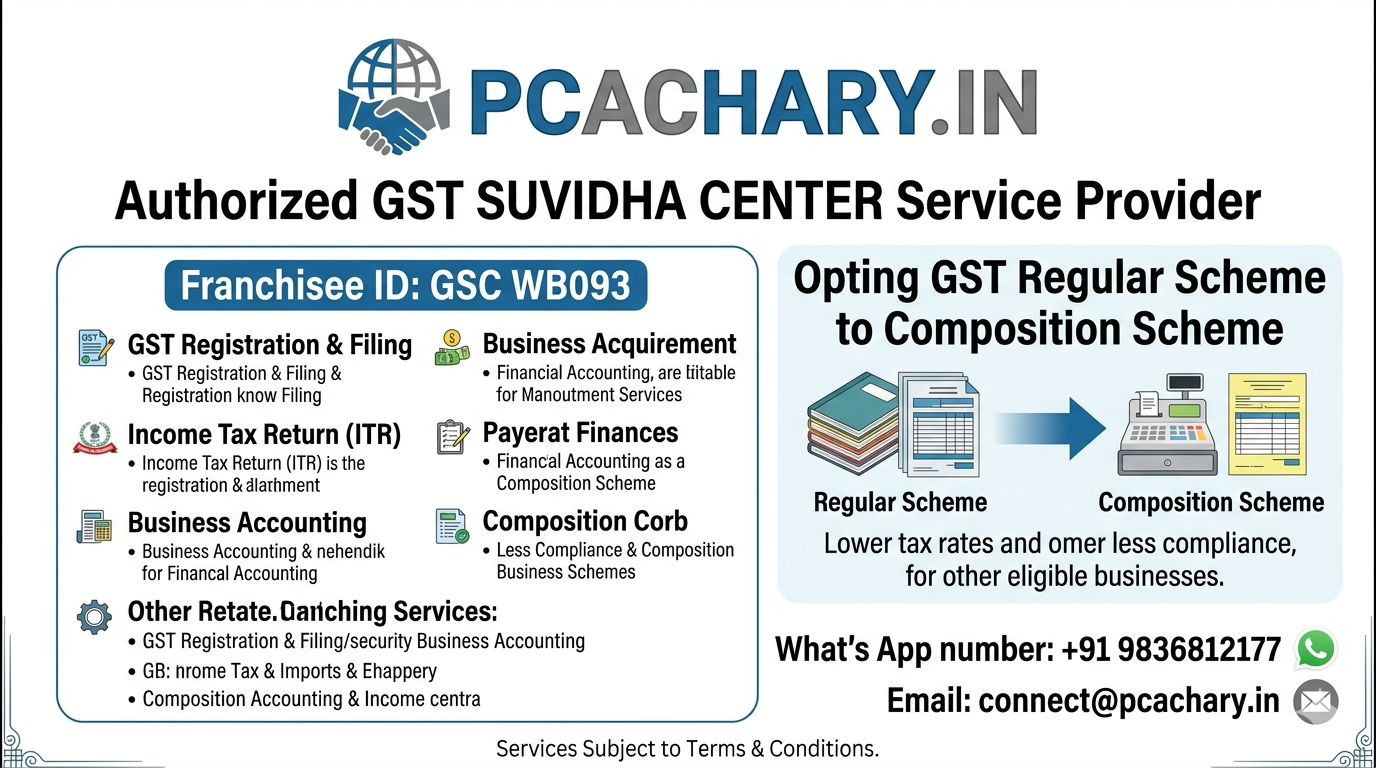
Comprehensive Guide to Transitioning from GST Regular Scheme to Composition Scheme
The Goods and Services Tax (GST) framework in India is designed to be a comprehensive, multi-stage, destination-based tax that is levied on every value addition. While the standard “Regular Scheme” is the default for most businesses, the Government of India introduced the Composition Scheme as a simplified alternative for small and medium enterprises (SMEs). This scheme is specifically crafted to reduce the compliance burden and provide a more manageable tax structure for businesses with a lower turnover.
If you are a business owner operating under the Regular Scheme and find the monthly filing of GSTR-1 and GSTR-3B, along with the detailed maintenance of records, to be overwhelming, transitioning to the Composition Scheme might be a strategic move. This document explores the intricate details of opting from the GST Regular Scheme to the Composition Scheme, outlining eligibility, benefits, limitations, and the procedural steps involved.
Understanding the Two Pillars: Regular vs. Composition
To make an informed decision, one must first understand the fundamental differences between these two tax structures.
1. The Regular Scheme
Under the Regular Scheme, a taxpayer is required to maintain detailed records of every purchase and sale. They are eligible to claim Input Tax Credit (ITC), which allows them to offset the tax paid on purchases against the tax liability on sales. However, this comes with the requirement of filing multiple returns every month (or quarterly under the QRMP scheme) and ensuring that every invoice is matched correctly in the GST portal.
2. The Composition Scheme
The Composition Scheme is a “lump sum” tax payment method. Instead of calculating tax on every individual item sold, a business pays a fixed percentage of its turnover as tax. While this significantly simplifies accounting, the major trade-off is the loss of Input Tax Credit. A composition dealer cannot collect GST from their customers, nor can they claim credit for the taxes paid to their suppliers.
Why Transition? The Strategic Advantages
Transitioning to the Composition Scheme is not merely a change in tax filing; it is a shift in business operations. Here are the primary reasons why businesses choose to opt for this path:
- Simplified Compliance: Perhaps the most significant benefit is the reduction in paperwork. Instead of detailed monthly returns, composition dealers file one quarterly statement (CMP-08) and one annual return (GSTR-4).
- Lower Tax Rates: For manufacturers and traders, the tax rate is as low as 1%. For restaurants not serving alcohol, it is 5%, and for other service providers, it is 6%. This can lead to better profit margins if the business operates in a sector where ITC is not a major factor.
- High Liquidity: Since taxes are paid at a lower rate and only on a quarterly basis, businesses often find they have more working capital available for daily operations.
- Competitive Pricing: Since you aren’t charging GST to your end consumers, your “sticker price” can often be lower than that of a regular dealer, which is particularly advantageous in B2C (Business-to-Consumer) markets.
Eligibility Criteria for Transition
Not every business can opt for the Composition Scheme. The GST law provides strict guidelines on who can participate:
- Turnover Limit: For most states, the aggregate turnover in the preceding financial year must not exceed ₹1.5 Crores. For North-Eastern states and Himachal Pradesh, this limit is ₹75 Lakhs. For service providers opting under the specific notification for services, the limit is ₹50 Lakhs.
- Nature of Business: You must not be a manufacturer of certain notified goods like ice cream, pan masala, tobacco, or aerated water.
- Inter-State Restrictions: A composition dealer cannot make inter-state outward supplies. If your business model involves shipping goods to other states, you must remain in the Regular Scheme.
- E-commerce Limitations: Generally, supply through e-commerce operators who are required to collect TCS (Tax Collected at Source) disqualifies a business from the Composition Scheme.
The Procedural Roadmap: How to Opt-In
The transition from Regular to Composition cannot be done at any random time during the year. It must be initiated at the beginning of a financial year.
Step 1: Filing Form GST CMP-02
The taxpayer must intimate the government of their intent to switch by filing Form GST CMP-02 on the GST Common Portal. This must be done prior to the commencement of the financial year for which the option is being exercised.
Step 2: Reversal of Input Tax Credit (ITC-03)
This is the most critical technical step. When you move from Regular to Composition, you are no longer entitled to the ITC you have already claimed on the stock currently in your possession. You must file Form GST ITC-03 within 60 days of the commencement of the financial year. This form calculates the tax on:
- Inputs held in stock.
- Inputs contained in semi-finished or finished goods held in stock.
- Capital goods (after reducing the value by a prescribed percentage).
The equivalent amount must be paid either through the electronic credit ledger or the electronic cash ledger.
Professional Assistance for a Seamless Transition
Navigating the complexities of GST laws requires precision. Errors in filing CMP-02 or ITC-03 can lead to penalties, interest, or the cancellation of your registration. Professional facilitators ensure that your business remains compliant while you focus on growth.
Pcachary.in serves as a bridge between the complex regulatory environment and your business needs. As an authorized service provider for the GST SUVIDHA CENTER, we possess the technical infrastructure and expertise to handle your transition from the Regular Scheme to the Composition Scheme with absolute accuracy.
We operate under the recognized Franchaisee ID GSC WB093, ensuring that all services provided are verified and within the official framework of GST Suvidha providers. Whether it is calculating the ITC reversal or ensuring your quarterly CMP-08 filings are timely, our team is dedicated to your financial health.
Detailed Service Features
When you choose to partner with us for your GST needs, you receive a comprehensive service package:
- Eligibility Audit: We analyze your previous year’s turnover and business nature to ensure you qualify for the scheme, preventing future legal complications.
- Application Management: We handle the filing of CMP-02 and all associated documentation on the GST portal.
- Stock Valuation & ITC Reversal: Our experts help you value your current inventory and calculate the exact amount of ITC that needs to be reversed, ensuring you don’t pay a paisa more than required.
- Continuous Compliance: Beyond the transition, we manage your quarterly liability statements and annual returns.
Contact Information
We believe in accessible and transparent communication. If you are considering a transition to the Composition Scheme or require any other GST-related services, please reach out to us through the following channels:
- Website: Pcachary.in
- WhatsApp: +91 9836812177
- Email: connect@pcachary.in
Limitations to Consider
While the Composition Scheme is beneficial, it is important to be aware of its restrictions to avoid “buyer’s remorse” after the transition:
- No Tax Collection: You cannot issue a “Tax Invoice.” Instead, you must issue a “Bill of Supply.” You cannot charge GST to your customers.
- No ITC for Customers: Because you aren’t charging GST, your B2B (Business-to-Business) customers cannot claim any Input Tax Credit on the purchases they make from you. This might make you less attractive to large corporate clients.
- Inter-State Barrier: As mentioned, you cannot sell goods across state lines. If your business grows and you want to expand to another state, you will have to switch back to the Regular Scheme.
Conclusion
Opting from the GST Regular Scheme to the Composition Scheme is a major decision that can lead to significant peace of mind and simplified business management. However, the requirement to reverse ITC and the restrictions on inter-state trade mean that it requires a careful cost-benefit analysis.
At Pcachary.in, operating with Franchaisee ID GSC WB093, we are committed to helping small businesses thrive by removing the burden of tax compliance. Our goal is to ensure that your transition is smooth, legal, and beneficial to your bottom line.
For professional guidance and expert execution of your GST transition, visit Pcachary.in or connect with us directly via WhatsApp at +91 9836812177. You can also send your queries to connect@pcachary.in. Let us handle the complexities of the GST Suvidha Center services while you focus on what you do best—running your business.

Reviews
There are no reviews yet.