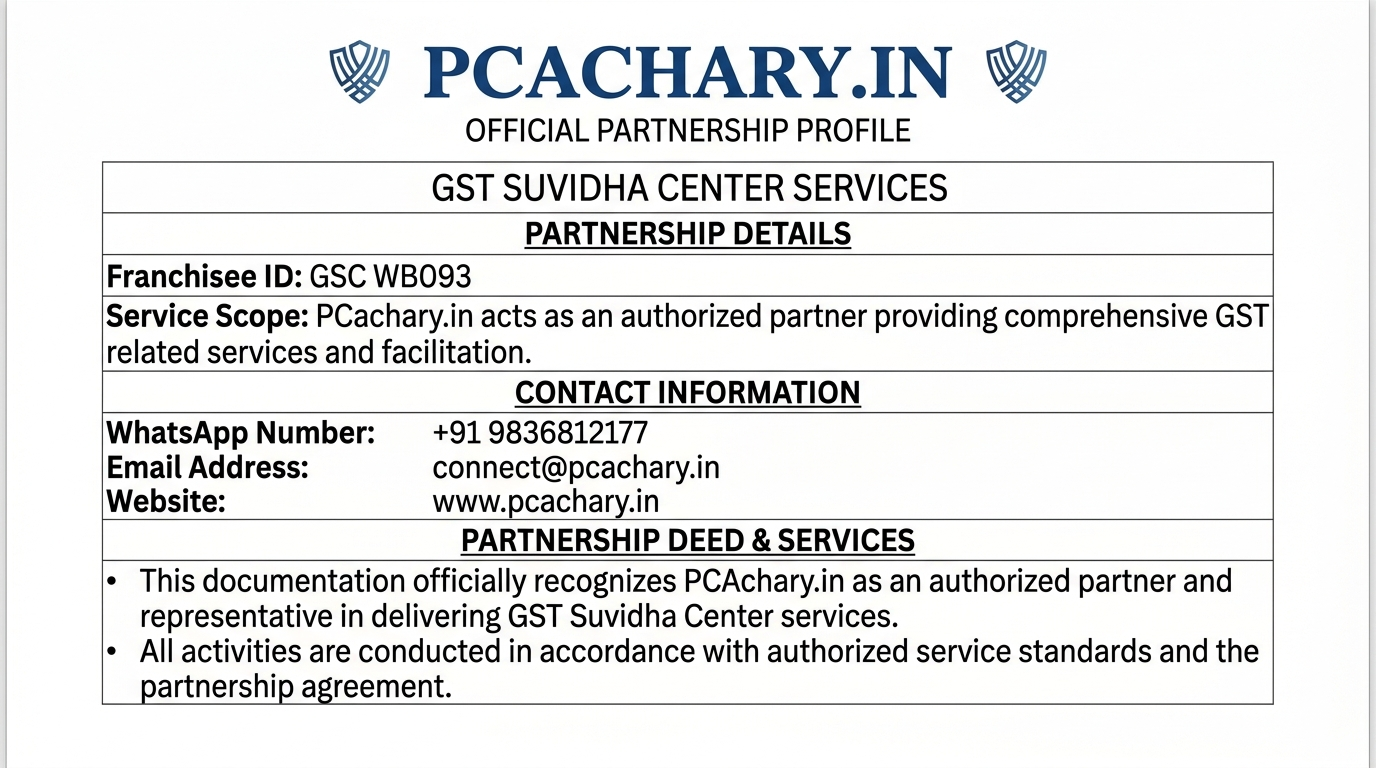
This comprehensive guide explores the intricacies of Partnership Deeds in the context of Indian business law, specifically designed for entrepreneurs seeking professional assistance through Pcachary.in, an authorized GST Suvidha Center (Franchisee ID: GSC WB093).
For direct inquiries, you can reach out via WhatsApp or email at connect@pcachary.in.
1. Introduction to Partnership Deeds
A Partnership Deed is the foundational constitution of a partnership firm. When two or more individuals come together to carry out a business with the intent to share profits, they form a partnership. While the Indian Partnership Act, 1932, does not strictly mandate a written agreement, relying on oral agreements is a significant risk.
A written Partnership Deed serves as a legal roadmap, detailing the rights, liabilities, and duties of each partner. At Pcachary.in, we specialize in drafting robust deeds that safeguard your business interests while ensuring compliance with GST and regulatory frameworks.
2. Why Your Business Needs a Partnership Deed
The primary purpose of a deed is to prevent future disputes. Without a clear document, the “implied” rules of the Partnership Act take over, which may not align with your specific business goals.
- Conflict Resolution: It provides a clear mechanism for settling internal disagreements.
- Legal Proof: It acts as an official document for opening bank accounts and obtaining registrations like GST.
- Defined Roles: It prevents “lazy partner” syndrome by explicitly stating who is responsible for what.
- Profit Sharing: It removes ambiguity regarding how money is distributed.
3. Essential Components of a Partnership Deed
When you consult with the experts at GST Suvidha Center (GSC WB093), we ensure your deed covers these critical sections:
A. Firm Details
- Name of the Firm: Choosing a name that is not identical to existing trademarks.
- Place of Business: The principal place of business and any branch offices.
- Nature of Business: A clear description of the trade, manufacturing, or service being provided.
B. Partner Information
- Personal Particulars: Full names, addresses, and contact details of all partners.
- Duration of Partnership: Whether the partnership is “At Will” (can be dissolved anytime) or for a “Fixed Term.”
C. Financial Clauses
- Capital Contribution: How much money each partner is bringing to the table.
- Interest on Capital: Whether partners will receive interest on their initial investment.
- Profit and Loss Ratio: The exact percentage each partner receives. This is vital for tax calculations.
- Drawings: Limits on how much money a partner can withdraw for personal use.
D. Operational Clauses
- Management Rights: Who has the authority to sign contracts or hire employees?
- Banking Operations: Which partners are authorized to operate the firm’s bank accounts?
- Admission and Retirement: The process for bringing in a new partner or allowing one to leave.
4. The Registration Process
While the deed is a private contract, registering the firm with the Registrar of Firms (RoF) provides significant legal advantages. Unregistered firms cannot sue third parties in court for breach of contract.
Pcachary.in assists in:
- Drafting the deed on appropriate Stamp Paper.
- Obtaining the signatures of all partners in the presence of witnesses.
- Notarizing the document.
- Filing Form No. 1 with the Registrar of Firms.
5. Integrating GST Suvidha Center Services
Operating as a GST Suvidha Center (Franchisee ID: GSC WB093), we understand that a Partnership Deed is just the first step. Once the deed is ready, your firm will require:
- PAN and TAN Registration: Essential for tax filing.
- GST Registration: Necessary if your turnover exceeds the threshold or if you engage in interstate trade.
- E-way Bill Generation: For the movement of goods.
Our center at Pcachary.in provides an end-to-end ecosystem where your legal drafting and tax compliance are handled under one roof.
6. Common Pitfalls to Avoid
Many entrepreneurs try to use “cookie-cutter” templates found online. This is a mistake. A poorly drafted deed can lead to:
- Tax Inefficiencies: Failure to mention “Partner Salary” or “Interest on Capital” can result in higher taxable income for the firm.
- Dissolution Deadlocks: If a partner passes away or wants out, the business might be forced to shut down if the deed doesn’t specify a “Succession Clause.”
- Liability Issues: Not defining the limits of “Mutual Agency” can make you liable for another partner’s personal debts.
7. How to Get Started with Pcachary.in
Drafting a Partnership Deed requires a balance of legal knowledge and business intuition. Our team is ready to assist you in creating a document that is both legally sound and practically viable.
Step-by-Step Engagement:
- Consultation: Reach out to us at +91 9836812177 via WhatsApp.
- Data Collection: Provide us with the basic details of your partners and business goals.
- Drafting: Our experts will prepare a custom draft for your review.
- Finalization: We assist with stamp duty, notarization, and further business registrations.
8. Conclusion
A partnership is like a marriage; it requires trust, but it also requires a “pre-nuptial” agreement in the form of a Partnership Deed. By choosing Pcachary.in and our GST Suvidha Center (GSC WB093), you are ensuring that your business starts on the strongest possible legal footing.
Contact Information Summary
- Website: Pcachary.in
- GST Suvidha Center ID: GSC WB093
- WhatsApp: +91 9836812177
- Email: connect@pcachary.in
Don’t leave your business’s future to chance. Secure your partnership today with professional drafting services. For any further details or to start your registration process, please contact us immediately.
Reviews
There are no reviews yet.