
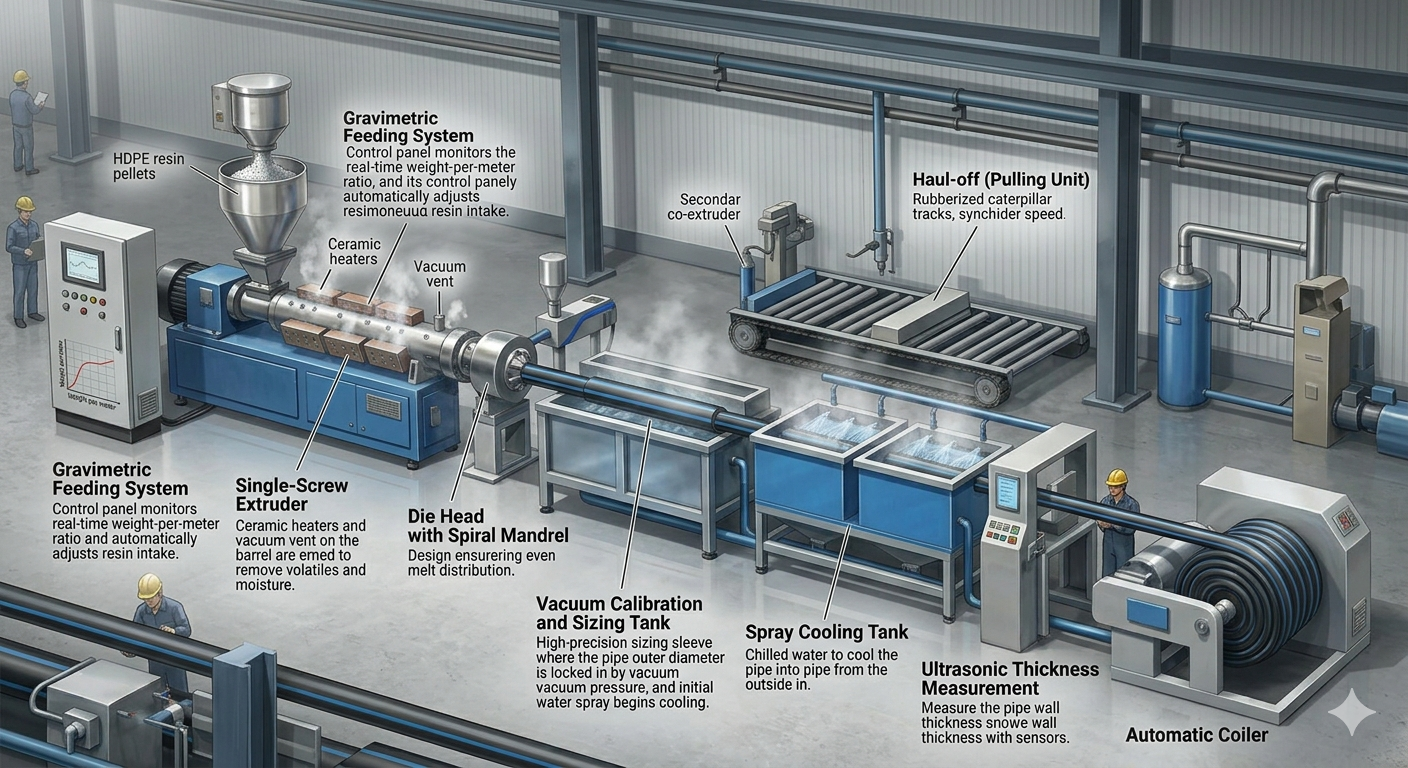
The production of High-Density Polyethylene (HDPE) water pipes using modern extrusion lines is a continuous, highly automated process. Modern systems prioritize wall-thickness precision, energy efficiency, and material homogenization.
Here is the step-by-step production process:
1. Raw Material Handling and Feeding
The process begins with HDPE resin pellets. Modern machines utilize a Gravimetric Feeding System. This system weighs the material in real-time, ensuring a precise mass flow rate. If the line speed changes, the feeder automatically adjusts the resin intake to maintain a constant weight-per-meter ratio, which is critical for meeting international pressure standards.
2. Plasticization (The Extruder)
The pellets enter the Single-Screw Extruder. Modern extruders use high-efficiency “barrier” screws and grooved feed barrels.
- Heating: A series of ceramic heaters melt the resin.
- Shearing: The screw rotates, creating friction and “shear,” which ensures the polymer chains are thoroughly mixed and thermally stable.
- Degassing: A vacuum vent on the barrel removes moisture and volatiles to prevent bubbles or “pitting” in the final pipe.
3. The Pipe Die Head
The molten HDPE (melt) is forced into the Die Head. Modern lines often use a Spiral Mandrel Die. This design ensures the melt is distributed evenly in a circular shape without “spider lines” (weak points where the melt flows around internal supports).
- Co-extrusion: If the pipe requires a colored stripe (e.g., blue for potable water), a smaller secondary extruder injects colored HDPE into the die head simultaneously.
4. Vacuum Calibration and Sizing
Once the melt exits the die, it is still soft. It enters the Vacuum Calibration Tank.
- Sizing: The pipe passes through a high-precision sizing sleeve.
- Vacuum Pressure: A vacuum is created inside the tank, which pulls the outside of the soft pipe against the sizing sleeve, locking in the exact outer diameter.
- Initial Cooling: Water spray begins the solidification process while the pipe is under vacuum.
5. Cooling Stage
Because HDPE retains heat, the pipe then travels through several Spray Cooling Tanks. These tanks use chilled water at controlled temperatures to cool the pipe from the outside in, preventing internal stresses that could cause the pipe to warp or crack later.
6. Haul-off (Pulling Unit)
The Haul-off unit uses rubberized “caterpillar” tracks to pull the pipe through the entire line. It is synchronized perfectly with the extruder speed. In modern production, sensors detect the pulling tension to ensure the pipe isn’t stretched, which would thin the walls.
7. Ultrasonic Thickness Measurement
Before the pipe is finished, it passes through an Ultrasonic Scanner. This device measures the wall thickness at multiple points around the circumference without touching the pipe. If any section is too thin or too thick, the system sends a signal back to the gravimetric feeder to adjust the extrusion parameters automatically.
8. Cutting and Winding
- Cutting: For large diameters, a planetary saw or a “chipless” cutter slices the pipe into straight lengths (usually 6 or 12 meters). The planetary saw rotates around the pipe to ensure a perfectly square cut.
- Coiling: For smaller diameters (up to 110mm or 125mm), the pipe is wound onto large drums by an Automatic Coiler.
9.Quality Control
The production of High-Density Polyethylene (HDPE) pipes is a high-precision operation. When using modern, automated extrusion lines, Quality Control (QC) is not just a final inspection—it is an integrated, multi-stage protocol that ensures the pipe meets international standards like ISO 4427 or ASTM D3035.
Here is the complete testing process, broken down by production phase:
1. Pre-Production: Raw Material Validation

Before the machine even starts, the “ingredients” must be verified. Modern machines are sensitive to variations in resin quality.
- Melt Flow Rate (MFR) Test: Ensures the raw HDPE granules have the correct viscosity for extrusion. If the MFR is off, the wall thickness will be inconsistent.
- Density Test: Confirms the material is truly “high-density.”
- Moisture Content Analysis: Using infrared moisture analyzers to ensure granules are dry; excess moisture causes “silver streaks” or bubbles in the pipe wall.
2. In-Process (Online) Monitoring
Modern extrusion lines utilize Industry 4.0 sensors to perform non-destructive testing in real-time.
- Ultrasonic Wall Thickness Measurement: As the pipe exits the vacuum tank, ultrasonic sensors rotate around the pipe to measure wall thickness and eccentricity at every millimeter.
Counterpoint: While sensors are highly accurate, they require constant calibration against physical manual measurements to avoid “sensor drift.” - Gravimetric Control: The machine automatically adjusts the screw speed and haul-off speed based on the weight of the material being consumed to maintain a constant weight-per-meter.
- Laser Diameter Control: Non-contact laser gauges measure the outside diameter (OD) continuously to ensure it stays within tolerance.
Counterpoint: While sensors are highly accurate, they require constant calibration against physical manual measurements to avoid “sensor drift.”
3. Physical & Dimensional Testing (Post-Production)
Once the pipe is cut to length, samples are taken to the lab for “Type Testing.”
Test Type | Description | Purpose |
|---|---|---|
Visual Inspection | Checking for a smooth finish, absence of pits, and uniform color. | Identifies heat degradation or internal impurities. |
Dimensional Check | Using Pi-tapes and digital calipers to verify OD and wall thickness. | Validates the accuracy of the online ultrasonic sensors. |
Heat Reversion | Placing a pipe sample in an oven at 110°C. | Measures internal stress; if the pipe shrinks too much, the extrusion speed was too high. |
4. Short-Term Mechanical Testing
These tests simulate the immediate stresses the pipe will face during installation and early service.
- Carbon Black Dispersion: A thin slice of pipe is viewed under a microscope. Carbon black must be uniformly distributed to provide UV protection.
- Tensile Strength & Elongation: The pipe material is pulled until it breaks. HDPE should exhibit high “ductility,” meaning it stretches significantly before snapping.
- Ring Stiffness: Essential for buried pipes; it measures the pipe’s ability to resist external crushing loads.
5. Long-Term Integrity: Hydrostatic Pressure Test
This is the “Gold Standard” of HDPE testing.
- Internal Pressure Test: Samples are capped and submerged in a water bath at specific temperatures (usually 20°C and 80°C) while pressurized.
- Requirement: The pipe must hold a specific hoop stress for 100 or 1,000 hours without leaking or bursting.
- Logic Check: Modern labs use automated multi-station pressure benches that log data every second, eliminating the risk of manual record falsification.
6. Traceability & Marking
Every meter of pipe produced by a modern machine is inkjet-printed with a “Birth Certificate”:
- Manufacturer name and Grade (e.g., PE100).
- Standard Dimension Ratio (SDR) and Pressure Rating (PN).
- Batch Number & Time Stamp: This allows the QC team to trace a failure back to the specific hour of production and the specific silo of raw material used.
