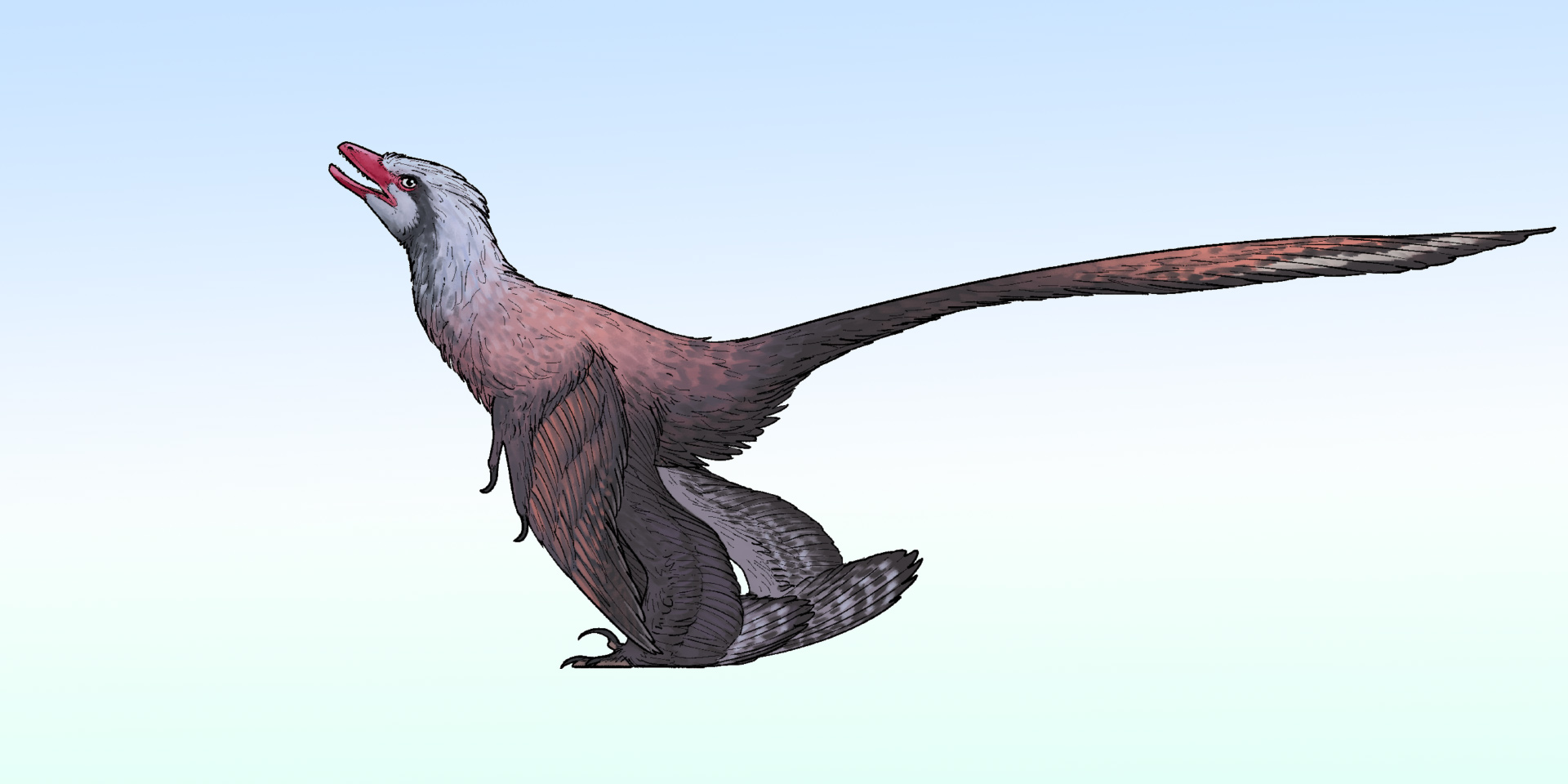
A new genus and species of four-winged pennaraptoran dinosaur from the Early Cretaceous of northern China is adding another twist to the story of how birds evolved from their dinosaur ancestors, according Dr. Xing Xu, a paleontologist with the Institute of Vertebrate Paleontology and Paleoanthropology at the Chinese Academy of Sciences.
The newly-identified dinosaur species lived in what is now China about 120 million years ago (Early Cretaceous epoch).
Scientifically named Changzhousaurus sinensis, the animal measured roughly 34 cm (13 inches) in total body length, placing it among the smallest known non-avian theropods.
Despite its small size, the species combined anatomical features seen across several branches of the bird-like dinosaur family tree.
Changzhousaurus sinensis was likely an early-diverging member of the deinonychosaur lineage, a group of pennaraptoran dinosaurs that includes dromaeosaurs and troodontids.
“Pennaraptora comprises several recently discovered small clades (e.g., Unenlagiinae, Microraptorinae, Scansoriopterygidae, Anchiornithinae, and Halszkaraptorinae) as well as four long-recognized major groups (i.e., Oviraptorosauria, Dromaeosauridae, Troodontidae, and Avialae),” Dr. Xu wrote in his paper.
“Over the past three decades, spectacular fossils from both the newly recognized minor clades and the long-established major pennaraptoran groups have substantially filled morphological gaps among major pennaraptoran lineages, yielded the earliest known fossil record of feathers, documented the earliest instances of theropod flight, uncovered unexpected morphologies and ecological adaptations, and evidenced a rapid radiation of Pennaraptora during the Middle Jurassic.”
“Notably, these fossils have substantially advanced our understanding of avian origins, revealing that pennaceous feathers, aerodynamic behaviors, and other hallmarks once considered exclusive to Avialae occur in other pennaraptoran groups.”
“However, numerous critical issues remain unresolved, including those related to reconstructing pennaraptoran phylogeny, behavior, and ecology — as well as the interpretation of individual morphological characters.”
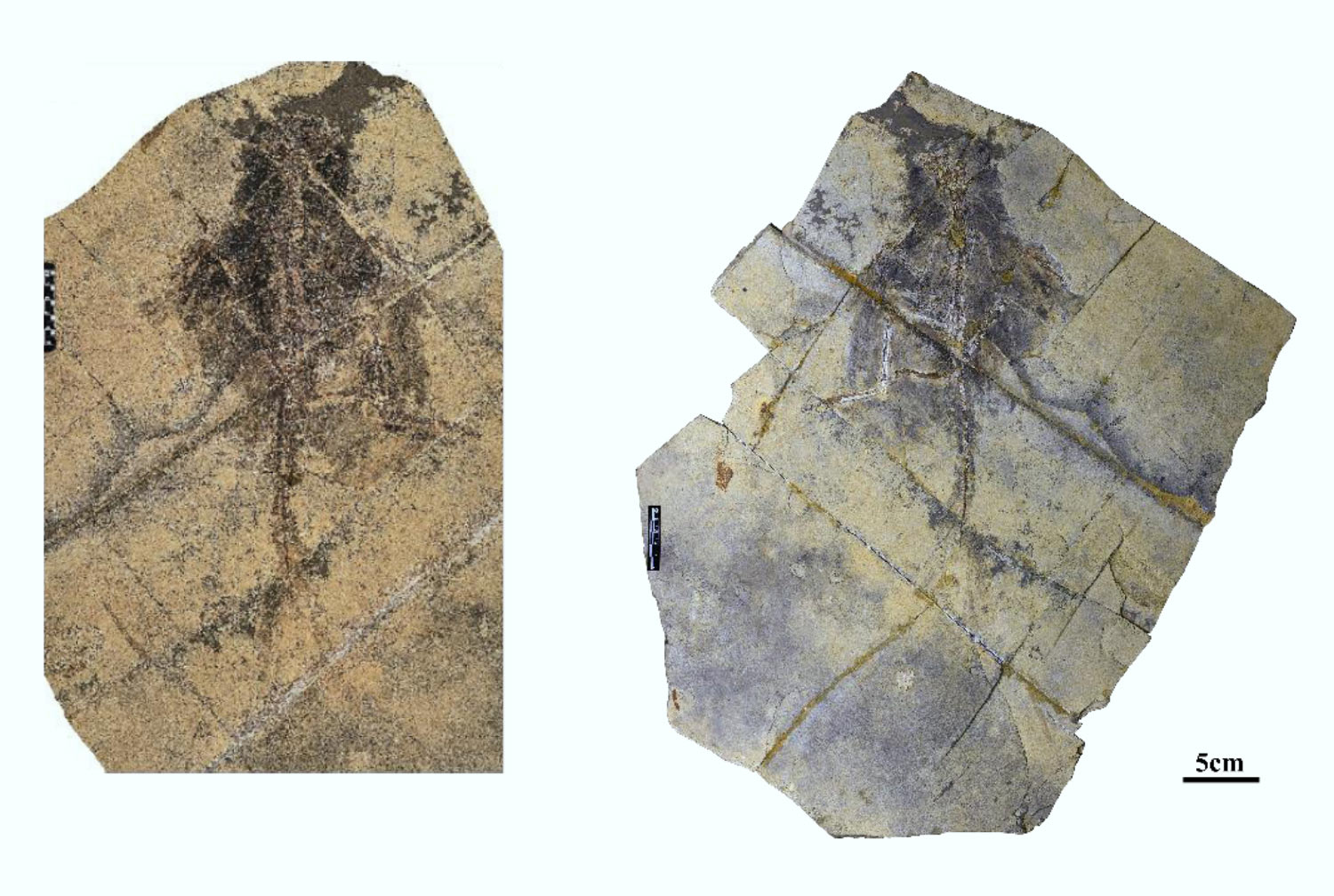
The holotype specimen of Changzhousaurus sinensis, slab and counter slab. Image credit: Xing Xu, doi: 10.19615/j.cnki.2096-9899.260616.
The fossilized remains of Changzhousaurus sinensis were recovered from the fossil-rich Jiufotang Formation of western Liaoning province.
Preserved on a slab and a counter slab, the specimen represents a nearly complete skeleton along with extensive plumage covering its body.
Changzhousaurus sinensis possessed approximately 16 highly elongated tail feathers — about four times femoral length, far more than comparable dinosaurs — that superficially resembled the ornamental tail plumes of a peacock.
The dinosaur also carried unusually large wings. Its primary flight feathers measured about 12 cm (4.7 inches) long, proportionally exceeding those of other known non-avian pennaraptorans.
The finding suggests that feathered wing area and arm length did not always evolve together, challenging simple assumptions about the origins of flight-related structures.
Large feathers were also present on its feet, reinforcing evidence that some bird-like dinosaurs possessed four-winged body plans.
“This discovery underscores the complexity of early pennaraptoran evolution and raises several conceptual and methodological issues in pennaraptoran research,” Dr. Xu wrote in the paper.
“These issues include how to recover a robust pennaraptoran phylogeny, how to infer the aerial behavior and habitat ecology of early-diverging pennaraptorans, and how to define feathers and birds.”
The paper was published online in the journal Vertebrata PalAsiatica.
_____
Xing Xu. 2026. A new feathered dinosaur from Early Cretaceous of northern China highlighting the complexity of early pennaraptoran evolution and comments on several relevant conceptual and methodological issues. Vertebrata Palasiatica, in press; doi: 10.19615/j.cnki.2096-9899.260616
[Disclaimer: The content in this RSS feed is automatically fetched from external sources. All trademarks, images, and opinions belong to their respective owners. We are not responsible for the accuracy or reliability of third-party content.]
Source link