
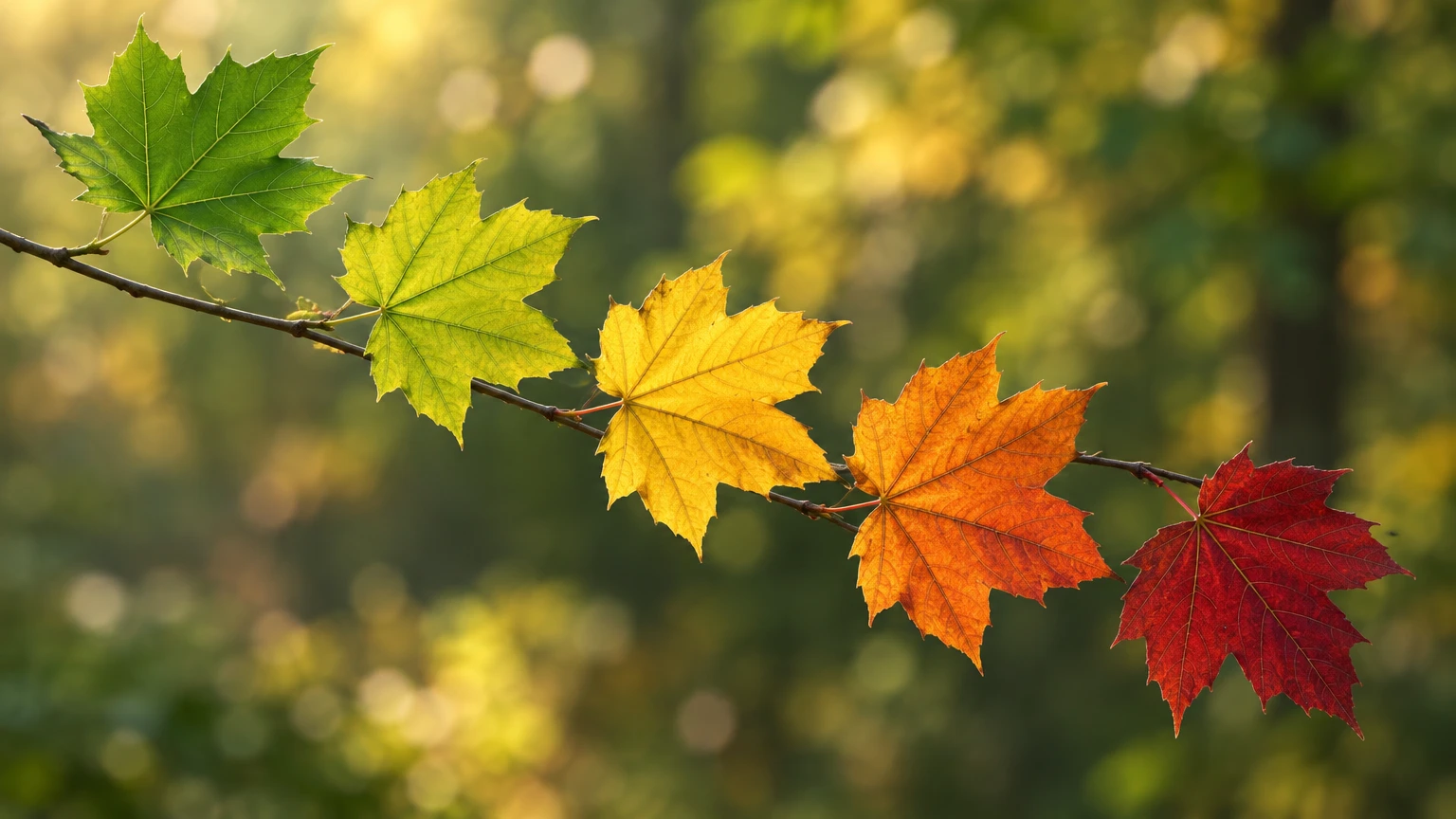
A green leaf can look like a permanent part of a tree, until its colour begins to change. A canopy becomes gold, a single branch turns crimson, or dry leaves gather beneath a tree that was green only weeks earlier. These changes are not simply nature painting over an old surface. They reflect a changing balance of pigments, the gradual retirement of a leaf and the tree’s response to its environment.
The familiar autumn display of temperate forests offers a useful starting point. But it is not a universal calendar. Across tropical and subtropical regions, including much of India, rainfall, dry seasons and individual species can produce very different patterns.
The green machinery inside a leaf
Leaves contain pigments: molecules that absorb particular wavelengths of light. Chlorophyll gives most healthy foliage its dominant green appearance and helps capture the light energy used in photosynthesis. Through this process, plants use carbon dioxide and water to make sugars, releasing oxygen along the way.
A growing leaf does not contain a permanent, unchanging supply of chlorophyll. The pigment is continually broken down and replaced. During active growth, the balance generally favours a strong green colour. Other pigments are present too, but their colours can be hidden by the abundance of chlorophyll. According to the US Forest Service’s explanation of autumn colour, chlorophyll and carotenoids coexist in leaf cells during the growing season.
Why yellow and orange become visible
Carotenoids contribute yellow and orange hues. When chlorophyll declines as a leaf ages, their colours can become easier to see. This helps explain why a leaf may turn golden without needing to manufacture an entirely new yellow colouring at the last moment.
The change is a shift in the mixture we can see, not a rigid sequence that every leaf follows. Species differ in their pigment composition, and neighbouring leaves may experience different light, temperature and moisture conditions. A yellow birch leaf and an orange maple leaf need not arrive at their colours in exactly the same way.
Red is more than green fading away
Many red and purple autumn colours involve anthocyanins. Unlike the carotenoids already present in growing green leaves, anthocyanins are often newly produced during autumn in species that develop red foliage. Their formation is influenced by conditions within the leaf, including sugars and light.
That distinction matters: saying that every autumn colour was hidden beneath green all summer is too simple. A scientific review of autumn colours distinguishes the exposure of existing yellow-orange pigments from the active production of red-purple pigments. Researchers have investigated several possible roles for anthocyanins, including protection against light-related stress. Those explanations should not be reduced to a single proven purpose shared by every species.
Brown is different again. As leaf tissues deteriorate, tannins and remaining compounds can contribute brown tones. A brown leaf is not necessarily a leaf that has passed through a brilliant red stage.
The seasonal signals—and the influence of weather
For many temperate deciduous trees, shortening days and lengthening nights help coordinate the approach to winter. Temperature and soil moisture influence how the process unfolds, while inherited differences help explain why species change at different times.
Sunny days followed by cool, non-freezing nights can favour strong red colour in suitable species. Frost is not a necessary first step: seasonal colour can develop before freezing weather arrives. Drought, unusual warmth, storms and other stresses can change the timing or shorten a display. The result is not identical from year to year, even in the same woodland.
Nor does every tree follow the same strategy. Evergreen plants retain foliage across seasons, but they still replace individual leaves. “Evergreen” does not mean that a particular leaf lives forever or never changes colour.
Colour change and leaf fall are connected
Seasonal leaf ageing is called senescence. Before a leaf is shed, a tree can recover some useful nutrients from it. Changes at the base of the leaf stalk eventually help separate the leaf from the twig and protect the remaining plant.
The Forest Service describes a developing separation layer and changes in the movement of fluids into and out of the leaf. These processes connect the colour display to the preparation for leaf fall. The leaf is part of a living system reorganising its resources, not merely a decoration losing its paint.
Once on the ground, fallen leaves continue to matter. Decomposition returns nutrients to the soil, and leaf litter supports organisms involved in that recycling. The colourful canopy and the quieter forest floor belong to the same cycle.
Why an Indian landscape may tell a different story
It would be misleading to apply the timing of a North American or European autumn to all of India. The country includes contrasting climates and vegetation types, from high-elevation temperate forests to tropical seasonal and evergreen forests. A single month cannot describe leaf change everywhere.
In tropical dry forests, many trees shed leaves during the dry season. A Smithsonian-hosted overview of tropical seasonal forests explains how rainfall seasonality shapes forest rhythms and describes South Indian dry-forest trees producing new leaves before the rains. Timing varies among forests and species; new foliage does not always wait for the first rain.
For an observer in Odisha or another monsoonal region, the useful question is therefore not simply “Has autumn arrived?” It is “Which tree is this, and what seasonal conditions is it responding to?” A yellowing leaf alone cannot establish whether the cause is normal ageing, seasonal shedding, water stress or another problem.
A simple way to watch the science
Choose a safely accessible tree and observe it over several weeks without plucking leaves. Note the date, recent weather, whether the whole canopy is changing and whether new leaves are appearing while older ones fall. Compare sunny and shaded branches where they are visible from the ground.
This small record reveals a central lesson: leaves do not all change colour for one reason or on one timetable. Their colours express chemistry, species differences and local seasons working together.
Sources and reading
Sources consulted on 20 October 2026. This is an original educational explanation, not a report of a newly announced scientific discovery.
- US Forest Service: Science of Fall Colors — pigments, seasonal signals, weather and leaf separation.
- Unravelling the evolution of autumn colours: an interdisciplinary approach — scientific review of pigment differences and proposed biological functions, hosted by US Forest Service Research and Development.
- Tropical Seasonal Forest — Smithsonian-hosted reference explaining tropical rainfall seasonality and differing leaf cycles.
Featured-image provenance: original AI-generated editorial illustration created for this article. It represents contrasting leaf colours, not a documentary photograph or a measured sequence of one leaf changing over time.
Disclaimer
This content is a collection of ancient history,books and various articles and collection of library and news and other post ; all details may not be the same. Readers are requested to verify the information themselves. Readers are not allowed to take any disciplinary action; content is only for educational purposes. If readers do not agree about the contents, they may send a personal comment to my personal email ID: achary.purna@gmail.com
