
District Overview & Geography
Balangir is a district of western Odisha whose character is made by contrasts: broad cultivated plains and stony uplands, intensely hot summers and green monsoon hills, medieval temple landscapes and a still-vigorous cycle of village ritual. Its headquarters, Balangir town, is the natural base for journeys to Patnagarh, Titilagarh, Khaprakhol and the archaeological landscape around Ranipur Jharial. The district covers 6,575 square kilometres and is bounded by Bargarh to the north, Subarnapur and Boudh to the east, Kalahandi to the south and Nuapada to the west. The official district profile places it between roughly 20°11′ and 21°05′ north latitude, a position that helps explain both its Deccan-plateau terrain and its western Odisha climate. Government of Odisha district profile
The land is often described in two broad physical zones. The west and south are more undulating, with isolated hills and broken forest; the north and east open into plains. Gandhamardan, the prominent hill range at the district’s north-western side, is the visual anchor of this geography. Harishankar lies on its Balangir side, while Nrusinghanath is across the hill in Bargarh district; they belong to one cultural landscape but should not be confused as attractions in the same district. The official disaster-management plan describes Gandhamardan as a natural boundary in the west and north-west and records the district as part of the crystalline Deccan plateau. Balangir district disaster management plan
Rivers are equally important to orientation. Balangir is associated with the Ang and Tel river systems; the Tel marks or approaches parts of the district’s south-eastern setting, while streams descending from uplands feed local drainage. The Sukhtel, Lanth and Sonegarh are among the tributary streams named in official material. These are not merely lines on a map: seasonal water shapes farming, the location of settlements and the experience of travel. In the rains, channels and low crossings can change quickly; in the dry season, the same terrain can appear spare and wide open.
The climate demands realistic planning. Government information notes a recorded range from 16.6°C to 48.7°C and average rainfall of 1,215.6 mm, while the district plan characterises March to June as hot and November to February as cool. Government of Odisha district profile The figures are useful as a warning rather than a promise of conditions on any particular day. October through February is generally the most comfortable period for heritage walks, temple visits and road circuits. Monsoon travel can be beautiful, especially around Gandhamardan, but requires slower road journeys and caution around streams. Summer can be rewarding for travellers with a specific cultural purpose, but it is not the season to underestimate heat, dehydration or exposed archaeological sites.
Forest is part of Balangir’s identity, but it should be approached with care rather than treated as a backdrop for unregulated adventure. The district gazetteer records sal forest, low mixed forest, alluvial mixed forest, teak and bamboo as vegetation categories. It also discusses historical references to animals including sambar and deer, but historical gazetteer accounts are not evidence that every species remains readily visible today. Odisha District Gazetteer: Bolangir Visitors should remain on publicly permitted routes, avoid disturbing wildlife, never enter forest land after dark without authorisation, and seek local advice before attempting walks beyond temple or village areas.
Balangir’s food culture follows this agrarian setting. Rice remains fundamental, while western Odisha meals often make room for seasonal greens, lentils, roasted or pounded preparations and fermented or dried accompaniments. A visitor may encounter pakhala in hot weather, santula-style vegetable dishes, mudhi, local sweets or seasonal household cooking. These are living food traditions rather than a fixed restaurant checklist. Ask vendors and hosts what is freshly prepared, respect dietary boundaries at religious places, and avoid assuming that every community dish is available on demand.
Mythological & Historical Significance
A good Balangir itinerary needs two ways of reading the past: historical evidence and remembered sacred geography. The latter is powerful, but it should not be presented as documentary proof. Gandhamardan is associated in regional belief with the Ramayana story of the mountain of healing herbs carried by Hanuman. The association gives the hills great devotional force and supports a widespread reputation for medicinal plants. It is best understood as belief and cultural memory, not as a verifiable event in the historical record.
The documented political history of the district is closely tied to the former Patna State. The Government of Odisha’s history page identifies Patna as an important western Odisha state under the Chauhans from the fourteenth century. Ramai Deo is credited there with founding the kingdom of Patna, whose capital was Patnagarh. In the middle of the sixteenth century, Balaram Deo shifted the capital to Balaramgarh, later known as Balangir. History of Balangir district That narrative gives present-day Balangir town a political genealogy: it was not simply a later administrative centre, but part of the rearrangement of a regional court and state.
The subsequent story is one of changing imperial administrations. The official account traces Patna State through Maratha possession, East India Company control and British-era administrative transfers. Chauhan rule ended with the merger of Patna State with Odisha on 1 January 1948; Rajendra Narayan Singh Deo was its last ruler. The former states of Kalahandi, Patna and Sonepur initially formed Balangir-Patana district. On 1 November 1949, Patna and Sonepur together became Balangir district, and the later separation of Sonepur and Birmaharajpur created Subarnapur district on 1 April 1993. History of Balangir district This chronology matters because visitors often encounter conflicting dates on official pages. One district overview describes Balangir district as formed on 1 November 1949, while the culture page foregrounds the 1 January 1948 merger of the feudatory states. These are not necessarily competing claims: they refer to different stages in the administrative reorganisation. It is more accurate to state both stages than to compress them into one anniversary.
Ranipur Jharial takes the visitor much farther back, into the early-medieval religious world of stone shrines, sculpture and tantric practice. The site is often called Soma Tirtha in local and devotional accounts, and Odisha Tourism identifies it as one of the state’s major archaeological and spiritual places. Its mix of Shaiva, Vaishnava, Buddhist and tantric associations is significant, but it should not be reduced to an exotic label. What survives is a material landscape of worship and artistic production in which several religious traditions intersected. Odisha Tourism: Ranipur Jharial
The district’s popular lore also speaks of seven maidens skilled in tantric practice. The official history page presents this as a belief about the land’s tantric influence, not as an independently established historical fact. History of Balangir district That distinction is worth preserving. Folklore tells us how a place has been imagined and revered; inscriptions, architecture, archaeological investigation and securely dated objects tell us different kinds of historical information.
Balangir’s cultural calendar is rooted in household, agricultural and temple life. Nuakhai is especially important in western Odisha as a celebration associated with the new harvest. The district administration also lists Sital Sasthi, Bhaijiuntia, Puajiuntia, Shiv Ratri mela, Patakhanda Jatra and Sharabana Purnima among locally observed occasions. Culture and heritage, Balangir district Dates can vary by lunar calendar, locality and temple practice. Travellers planning a festival visit should confirm the year’s programme locally rather than relying on generic calendar listings.
Tourist Destinations & Hidden Gems
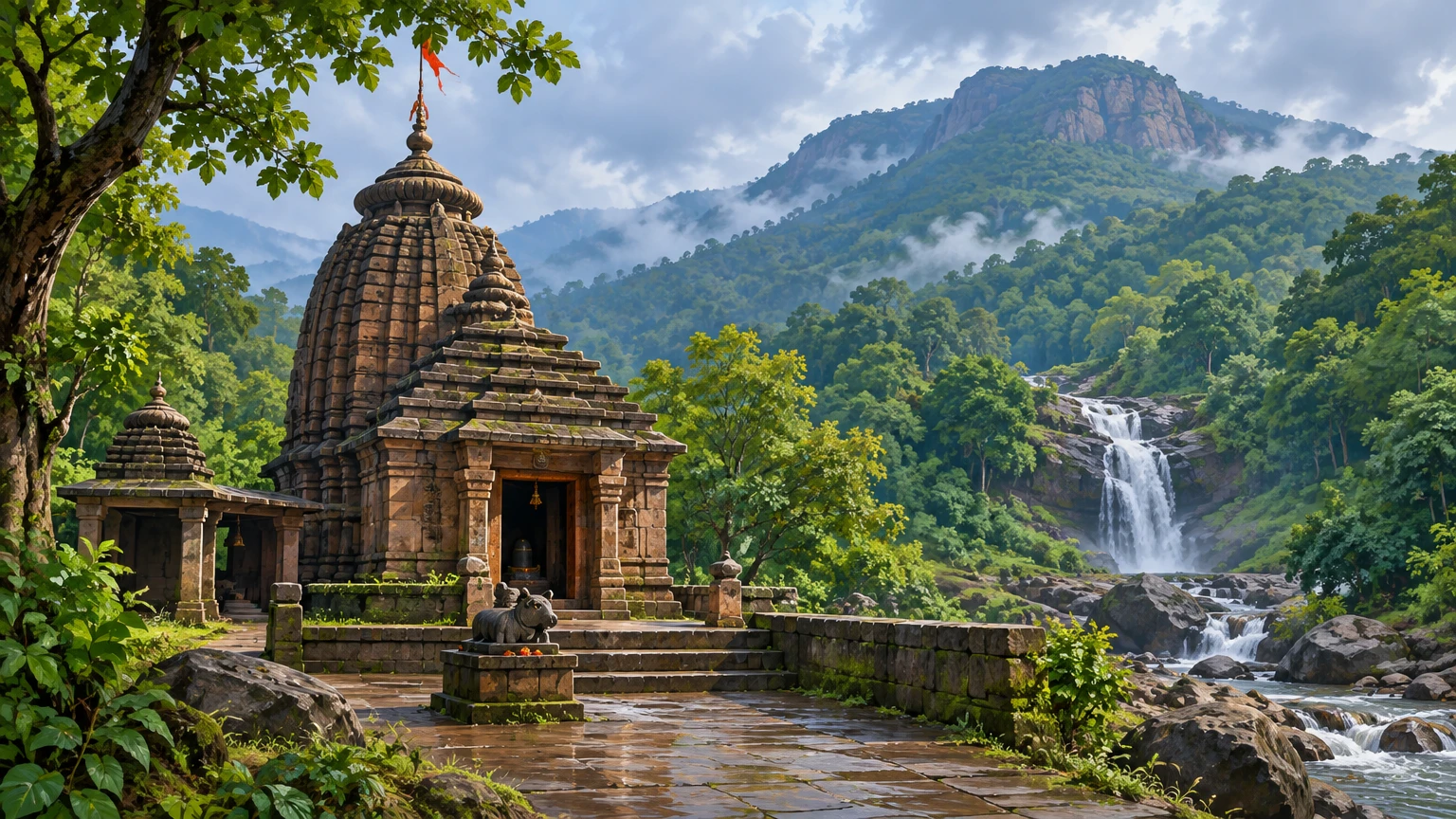
Harishankar is Balangir’s most evocative meeting of hill, water and worship. Located at Khaprakhol on the southern slopes of Gandhamardan, the shrine is dedicated to Harishankar, a form understood through the conjunction of Hari, Vishnu, and Hara, Shiva. Odisha Tourism describes it as a Shaiva-Vaishnava confluence set among forested hills, with a perennial waterfall central to its atmosphere. Harisankar Temple and Gandhamardan foothills The right way to experience it is unhurriedly: temple first, then the sound and course of water, the slope, rocks and forest edge.
The waterfall setting should not invite careless behaviour. Rock can be slippery, water levels can change after rain, and a sacred landscape is not a swimming pool. Wear footwear suitable for wet stone, keep children close, do not climb beyond maintained paths and do not leave plastic, food waste or ritual packaging in the watercourse. The quiet of the place is part of its value. Harishankar is especially appealing after the monsoon and through the cooler months, though visitors should check local conditions before setting out in heavy rain. Ranipur Jharial, in the Bangomunda area of Balangir district and reported about 26 kilometres from Kantabanji, rewards a different pace of looking. Odisha Tourism’s broad Patnagarh route description should not be mistaken for a precise location; confirm the approach locally before travelling. The celebrated Chausathi Yogini shrine is circular and open to the sky, a rare hypaethral form associated with the Yogini cult. Odisha Tourism calls it one of India’s few surviving circular open-air Yogini temples and notes the surrounding concentration of ancient Shiva shrines and sculpture. Odisha Tourism: Ranipur Jharial Its significance lies as much in form as in faith: the open circular enclosure, individual niches and weathered stone demand close, respectful attention.
This is an archaeological setting, not a stage set. Do not touch carvings, make offerings where prohibited, climb structures, scratch names into stone or fly drones without permission. Photography may be welcome in some areas but should never impede worshippers or custodians; ask before photographing people. The best light is often gentler early or late in the day, but travellers should not treat this observation as permission to enter before access is allowed. Confirm current arrangements locally, particularly during festivals or conservation work.
The wider Ranipur Jharial area includes Someswar and other historic shrines, while Odisha Tourism’s older interpretive material mentions Indralath, a brick temple a short distance from the Yogini complex. Ranipur Jharial Chausath Yogini Claims about counts, dates and attribution at such sites vary between tourism summaries and scholarly accounts. For a serious visit, observe what is present, read onsite interpretation if available and avoid repeating dramatic stories as settled archaeology.
Patnagarh, the former capital of Patna State, adds the courtly and devotional layer that complements Balangir town. The district tourism listing highlights the Patneswari Temple among its principal religious sites. Tourist places, Balangir district The attraction here is not a single monument detached from context, but the sense of an older capital whose sacred institutions were bound to the polity of Patna. Visitors should dress modestly, remove footwear where required and recognise that temple spaces are active places of worship rather than heritage displays alone.
Bhima Dunguri, under Deogaon block, is a quieter natural-and-cultural stop. The district administration describes a forest-encircled hilly area with scattered natural caves, about 28 kilometres from Balangir town, and notes the local Girigobardhan Puja observance. Bhima Dunguri “Hidden gem” is often used carelessly; Bhima Dunguri is better described as a locally meaningful landscape that deserves preparation. Go in daylight, use the road and routes known to residents, do not enter caves that appear unstable, and avoid visiting alone.
Kumuda Pahad and Jogisarada offer further evidence that Balangir’s tourism is dispersed through small sacred landscapes rather than concentrated in a single urban circuit. The district lists Kumuda Pahad as a hilly religious place associated with Dhabaleswar and Jogisarada for its Jogeswar Temple. Tourist places, Balangir district These work best as additions to a road journey, not as targets to rush through. Ask locally about route condition, worship protocols and whether any gathering may affect access.
Gaikhai, a minor irrigation project around 30 kilometres from Balangir town, is listed by the district as a scenic place ringed on three sides by hills. Tourist places, Balangir district It can be a pleasant landscape pause, particularly in suitable weather, but visitors should not assume boating, swimming or shore access is authorised. Water bodies serving irrigation have changing operational and safety conditions; admire them from permitted public areas and follow local notices.
Turekela is included in the district tourism list as a natural and adventure-oriented location. Older official descriptions make broad wildlife claims, but they are not a substitute for current forest-authority guidance. Tourist places, Balangir district Do not seek wildlife through off-road driving, baiting or unsanctioned night excursions. The district tourism listing does not itself establish an authorised safari, bookable nature camp or guide arrangement. Confirm the specific operator, access permissions and current facilities before making plans.
In Balangir town itself, the most valuable experiences may be ordinary: a morning market, a conversation about Nuakhai preparations, a meal at a modest local eatery, or time at a temple precinct where everyday devotion continues. The historical Koshal Kala Mandal, established in 1940 under Rajendra Narayan Singh Deo to promote dance, music and sport, represents the district’s institutional cultural memory. Culture and heritage, Balangir district Seek out public programmes only when announced; do not promise yourself a performance merely because an institution exists.
Recent News & Tourism Developments
The most consequential verified tourism development concerns Ranipur Jharial. On 11 August 2025, Deputy Chief Minister Pravati Parida visited the site and announced a first-phase development package of ₹87.93 crore, according to a report published by OrissaPOST on 12 August 2025. The report says officials presented a detailed project report and identifies the funding as an announced allocation for development works. OrissaPOST, 12 August 2025
Visitors should read this carefully. An announcement is not proof that every proposed facility is complete, open or appropriate for immediate use. Heritage development can involve tendering, conservation approvals, design changes and phased construction. A 2026 tender listing reported infrastructure-development packages for Ranipur Jharial as under financial evaluation in September and October 2026, which suggests a project process was continuing rather than providing evidence of finished works. Tenderkart listing This is useful background, but it is not an official completion certificate. Check with district tourism offices or local authorities before planning around new amenities.
Rail access has also received attention. The New Indian Express reported on 16 July 2026 that Balangir railway station, redeveloped under the Amrit Bharat Station Scheme, was scheduled for dedication on 17 July after upgrades including a new station building, foot overbridge with lift, improved platforms, waiting areas and redesigned approach and parking areas. The New Indian Express, 16 July 2026 For the traveller, the sensible claim is that station redevelopment was reported as completed and due for dedication in July 2026; platform arrangements, train halts and local onward transport should still be checked close to departure.
A local report dated 23 July 2026 stated that an OSRTC Volvo service linking Puri and Harishankar had been launched, with an inaugural journey marked at Patnagarh. Pragativadi, 23 July 2026 Because bus operations can be revised, this should be treated as a reported service launch rather than a guaranteed timetable for October. Confirm directly with OSRTC or the relevant booking channel before making a connection-dependent itinerary.
As of this edition date, 19 October 2026, no later independently verified completion update for the Ranipur Jharial package was found in the sources reviewed for this article. That absence should not be read as evidence that no work has happened; it simply means travellers should avoid presenting the announced project as a completed attraction.
Traveler Essentials
Balangir is reached most practically by rail and road. Balangir railway station is the district’s principal rail arrival point for many itineraries, while road links connect the town with Patnagarh, Titilagarh, Kantabanji and other western Odisha centres. Odisha Tourism identifies Veer Surendra Sai Airport at Jharsuguda as the nearest airport for Harishankar, and Balangir railway station as the rail approach. Harisankar Temple and Gandhamardan foothills “Nearest” does not mean effortless: onward road travel remains substantial, so plan an arrival with daylight time in hand.
For Ranipur Jharial, Odisha Tourism recommends road access via Patnagarh and describes Balangir Junction as about 104 kilometres away. Odisha Tourism: Ranipur Jharial Distances are aids to route planning, not estimates of travel time. Road condition, weather, village traffic, festival activity and breaks can all alter a journey. Hire a vehicle from a reputable operator, or use public transport only when you have confirmed the current route and last return option. Avoid relying on assumed bus frequency for an isolated evening return.
For a first visit, Balangir town is a practical base. Give Harishankar and Patnagarh their own road day, and allow a separate day for Ranipur Jharial in the Bangomunda–Kantabanji area, rather than assuming the latter is a short detour from Patnagarh. Add Bhima Dunguri, Jogisarada or Gaikhai only if time, weather and local transport are favourable. This itinerary does not require hurried long-distance trekking or crossing into adjacent districts. If combining Harishankar with Nrusinghanath, remember that Nrusinghanath is in Bargarh district and plan it as an inter-district trip.
Carry drinking water, sun protection, a charged phone, modest clothing for shrines and small cash for ordinary purchases where digital payment may not be dependable. Mobile signal can weaken outside town centres. Tell someone where you are going if travelling independently, especially during monsoon. Do not enter watercourses, caves or forest paths merely because they appear accessible. At temples, follow queues, photography rules and instructions from priests or staff. During festivals, expect crowds and altered traffic arrangements. For current visitor assistance, Odisha Tourism lists its Balangir office near RTO Chowk on Titilagarh Road and publishes a district tourism contact. Odisha Tourism offices For medical emergencies, Odisha Tourism lists the District Headquarters Hospital in Balangir and advises dialling 108 for ambulance support. Odisha Tourism hospitals and emergency information These are starting points, not a substitute for travel insurance, a personal medical kit or updated local advice.
Most of all, travel through Balangir with patience. Its rewards are rarely about a single dramatic viewpoint. They lie in the relationship between a temple and its hill, an open-air Yogini shrine and its archaeological terrain, a former princely capital and today’s town, a harvest festival and the fields that make it meaningful. Responsible visitors leave room for that complexity: they distinguish legend from history, accept local limits, and let the district set the pace.
Publishing Metadata & Tagging
- Group: Odisha Tourism
- Section/Category: Society And Culture
- Destination: https://pcachary.in
- District: Balangir
- Edition: 2026-10-19
- Cycle: 1
- Tags: Odisha Tourism; Balangir; Society And Culture
Sources and evidence check
- Government of Odisha, Balangir district profile — undated official page, checked 19 October 2026.
- Government of Odisha, History of Balangir district — undated official page, checked 19 October 2026.
- Government of Odisha, Culture and heritage — undated official page, checked 19 October 2026.
- Government of Odisha, Tourist places and Bhima Dunguri — undated official pages, checked 19 October 2026.
- Government of Odisha, Balangir district disaster management plan — PDF, checked 19 October 2026.
- Government of Odisha, Odisha District Gazetteer: Bolangir — historical reference PDF, checked 19 October 2026.
- Odisha Tourism, Harisankar Temple and Gandhamardan foothills — undated official page, checked 19 October 2026.
- Odisha Tourism, Ranipur Jharial — undated official page, checked 19 October 2026.
- OrissaPOST, “Dy CM announces Rs 87.93cr package for Ranipur Jharial” — 12 August 2025, checked 19 October 2026.
- The New Indian Express, “Revamped Balangir railway station to be unveiled by PM Modi on July 17” — 16 July 2026, checked 19 October 2026.
- Pragativadi, “Volvo Bus Service Launched Between Puri and Harishankar” — 23 July 2026, checked 19 October 2026.
Additional route cross-check: OrissaPOST, 12 August 2025, places Ranipur Jharial about 26 km from Kantabanji: https://www.orissapost.com/dy-cm-announces-rs-87-93cr-package-for-ranipur-jharial/ . Tenderkart’s 2026 project listing locates it in Bangomunda block; the Odisha Tourism page’s near-Patnagarh description is imprecise: https://tenderkart.in/authority/odisha-tourism-devl-corp/result .
Disclaimer
This content is a collection of ancient history,books and various articles and collection of library and news and other post ; all details may not be the same. Readers are requested to verify the information themselves. Readers are not allowed to take any disciplinary action; content is only for educational purposes. If readers do not agree about the contents, they may send a personal comment to my personal email ID: achary.purna@gmail.com
