
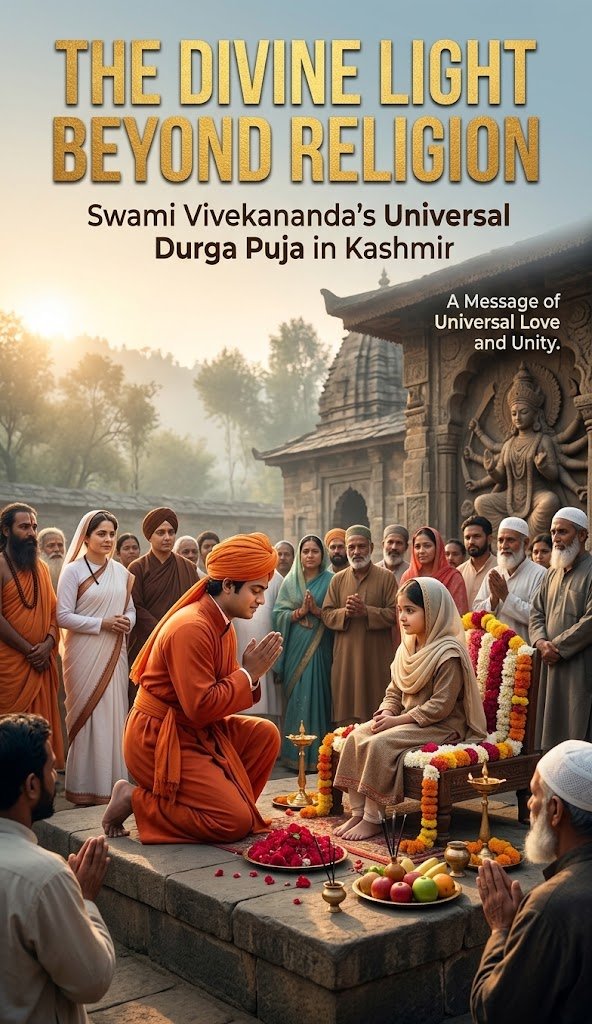
Every year, as the rhythmic beat of the dhak (traditional drums) echoes across temples and the fragrance of incense fills the autumn air, millions gather to celebrate Durga Puja. The festival marks the victory of the Mother Goddess—the ultimate symbol of strength (Shakti), compassion, and divinity. While millions perform rituals following ancient scriptures, few stories shine as brightly as an extraordinary event from 1898, when Swami Vivekananda radically redefined worship by discovering Goddess Durga in the innocent face of a young Muslim girl in the valley of Kashmir.
This profound event—written about by social thinkers, historians, and monks like Sister Nivedita—remains one of the greatest real-life testaments to universal love, human dignity, and true spirituality.
In this article, we delve deep into the journey, philosophy, and history behind Swami Vivekananda’s Durga Puja, exploring how a simple act of worship shattered centuries of religious dogma and left behind a timeless message for humanity.
The Historical Background: 1898 and the Kashmir Pilgrimage
To truly understand this event, one must step back into the late 19th century.
Following his triumphant return from the Chicago Parliament of Religions in 1893, Swami Vivekananda spent years traveling across the length and breadth of India. From Kanyakumari—where he sat on the holy rock in meditation—to the northern snow-capped peaks of the Himalayas, Swamiji was on a mission to awaken the soul of India.
+—————————————————————–+
| SWAMI VIVEKANANDA’S TRAJECTORY |
| |
| Kanyakumari (Southern Tip) ——-> Kashmir Valley (North) |
| [Deep Meditation] [Kshir Bhawani Temple] |
| | |
| v |
| Universal Kumari Puja |
+—————————————————————–+
By 1898, Swamiji, accompanied by his disciples—including the Irish seeker Sister Nivedita (Margaret Elizabeth Noble)—traveled across Kashmir. The journey was not merely geographical; it was an intense spiritual movement. Swamiji’s health was fragile, but his mind burned with an unquenchable desire to witness the Living God (Daridra Narayana) in every human soul, regardless of caste, creed, gender, or belief.
The Journey: From Kanyakumari to the Kashmir Valley
The newspaper clipping depicted above captures this journey in moving Odia prose (titled “Swami Vivekananda’nk Durga Puja” by Pradeep Kumar Ray).
After spending nearly six months on a arduous walking pilgrimage (Padayatra), Swamiji reached the picturesque valley of Kashmir in October. Exhausted, fatigued, and physically frail, his body sought rest, but his soul remained endlessly vigilant.
While resting on a stone slab in the valley near the sacred shrine of Kshir Bhawani (Kheer Bhawani), Swamiji observed local children playing nearby. Among them was a four-year-old girl—the daughter of a local Muslim boatman (Shikara wala).
                THE SCENE AT KSHIR BHAWANI
                ===========================

                    [ The Sacred Shrine ]
                             |
       +---------------------+---------------------+
       |                                           |
[ Swami Vivekananda ]                   [ 4-Year-Old Kashmiri Girl ]
(Meditation & Rest) (Boatman’s Daughter)
| |
+———————+———————+
|
“Maa Durga Has Revealed Herself”
The Moment of Revelation: “I Have Found My Mother!”
As the Odia account narrates, Swamiji watched the young child interact with her mother. The mother handed the child a small vessel of food. The little girl, with pure innocence, shared her food with a playmate and fed a small portion to a roaming animal.
In that selfless act of unconditional sharing, Swamiji saw a flash of the Divine Mother.
He suddenly stood up, overwhelmed with tears of bliss, and exlaimed:
“Sister, I have found her! I have found my Mother Durga!”
Sister Nivedita was astonished and asked: “Swamiji, what have you found?”
Swamiji replied with deep reverence:
“Look at this child! She has no malice, no ego, no division in her heart. She shares her food with everyone around her. She is Shiva, she is Durga, she is my Motherland incarnate!”
Challenging Orthodoxy: The Kumari Puja Ritual
In orthodox Hindu traditions, Kumari Puja—the ritualistic worship of a young girl as the manifestation of Goddess Durga during Navratri/Durga Puja—was historically performed strictly adhering to rigid caste and lineage rules.
Swamiji announced his intention to perform Kumari Puja right there in Kashmir, using the local boatman’s four-year-old daughter as the deity.
+———————————————————————–+
| CONTRAST IN WORSHIP |
+———————————————————————–+
| Traditional Orthodox View | Swami Vivekananda’s Universal View |
+———————————-+————————————+
| • Restricted by Caste & Pedigree | • Seeing Divinity in All Beings |
| • Ritualistic Exclusion | • Radical Inclusivity & Love |
| • Divine confined to idols | • Living Human as the Divine Ideal |
+———————————-+————————————+
Local conservative scholars and orthodox priests raised objections. They confronted Swamiji, asking:
- “How can you worship a child who does not belong to the high-caste Hindu lineage?”
- “How can a Muslim child sit upon the holy altar of Maa Durga?”
Swamiji’s response, recorded in history and retold through generations, was a thunderous proclamation of Vedantic truth:
“You judge Mother Durga by her outer clothing! You see Hindu clothes or Muslim clothes, but I see my Mother! In her eyes, there is no Hindu and no Muslim—there is only pure, unblemished Divinity.”
The Morning of the Puja: Humanity Above Dogma
The next morning, at the sanctuary near Kshir Bhawani, a sight unfolded that would forever change the history of modern Indian spirituality.
- The Preparation: The young Kashmiri girl was brought to the shrine. Sister Nivedita helped arrange the ceremonial offerings—fresh flowers, sandalwood paste, incense, and lamps.
- The Altar: The girl was seated on the consecrated seat (Asana) reserved for the Goddess.
- The Worship: Swami Vivekananda, the great Hindu monk who had mesmerized the Western world at Chicago, knelt down before the four-year-old child. He washed her small feet with holy water, applied chandan (sandalwood) to her forehead, offered red flowers, and bowed his head in deep prayer.
             ========================================
             THE HISTORIC KUMARI PUJA OF KASHMIR (1898)
             ========================================

                 Officiant : Swami Vivekananda
                 Acolyte   : Sister Nivedita
                 Diety     : Kashmiri Muslim Child
                 Location  : Kshir Bhawani / Kashmir
                 Message   : Universal Brotherhood & Love
This grand worship was not a mere symbolic gesture; it was the practical implementation of Advaita Vedanta—the belief that the supreme spiritual reality resides equally within every single living soul regardless of outer labels.
Key Lessons from Vivekananda’s Universal Vision
Swami Vivekananda’s act carries profound lessons for the contemporary world:
1. Practical Vedanta (Pratyaksha Brahma)
Swamiji taught that God is not confined to stone idols or temple walls. To serve and respect human beings—especially the innocent, the underprivileged, and the marginalized—is the highest form of worship (Jiva Seva is Shiva Seva).
2. Breaking Barriers of Religion and Caste
By worshipping a child from a different faith during Hinduism’s most sacred ritual, Swamiji showed that true religion unites people through love rather than dividing them through dogma.
3. Elevating Womanhood (Nari Shakti)
Kumari Puja emphasizes that every girl child represents the cosmic power (Shakti) of the divine. Respecting, educating, and protecting girl children is essential to the spiritual and social progress of any civilization.
Table: Key Attributes of Swami Vivekananda’s Philosophy
| Aspect | Conventional Dogma | Vivekananda’s Universal Vision |
|---|---|---|
| Concept of God | Limited to specific shrines & rituals | Present in all living beings (Sarva-bhuta) |
| Kumari Puja | Lineage and caste-restricted | Open to all, seeing pure divinity in innocence |
| Social Outlook | Division by creed and birth | Harmony, unity, and mutual respect |
| Primary Duty | Self-preservation & ritual observance | Service to humanity (Seva) |
A Legacy That Endures Today
More than a century later, Swamiji’s act continues to inspire society. Across India, families and cultural organizations have periodically drawn inspiration from this 1898 event, choosing young girls across different social and religious backgrounds for Kumari Puja during Durga Ashtami to champion social harmony and unity.
As we reflect on the true meaning of Durga Puja, Swami Vivekananda’s historic worship in Kashmir stands as a beacon of light. It reminds us that behind every ritual lies a single message: Love, Unity, and the Universal Divinity of All Creation.

