
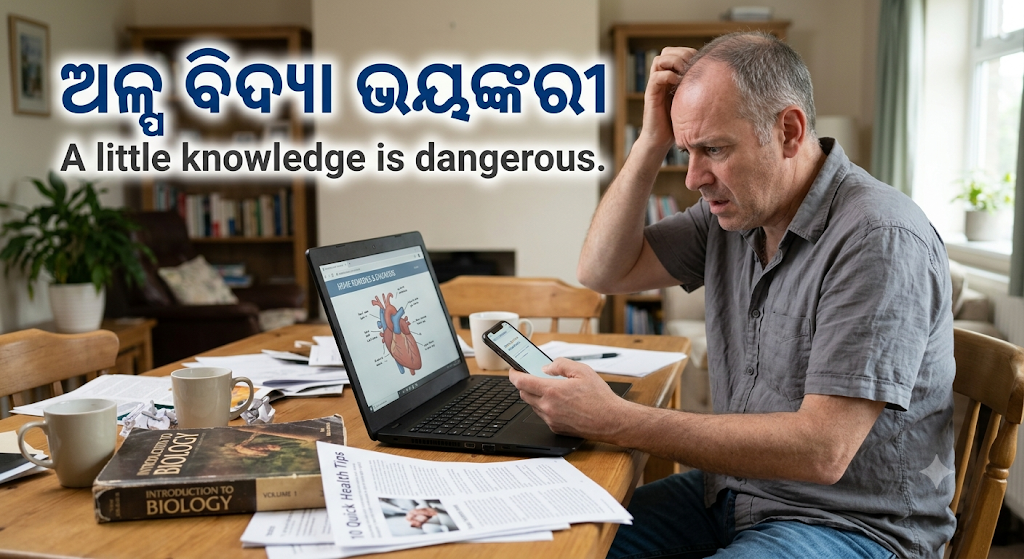
- ଅଳ୍ପ ବିଦ୍ୟା ଭୟଙ୍କରୀ (Alpa bidya bhayankari)
- Literal: A little knowledge is dangerous.
- Meaning: People with shallow knowledge often cause harm by acting like experts.
The Odia proverb “ଅଳ୍ପ ବିଦ୍ୟା ଭୟଙ୍କରୀ” (Alpa bidya bhayankari) is one of the most widely used warnings in Eastern philosophy and linguistics. Translating literally to “A little learning is dangerous” (similar to Alexander Pope’s famous line, “A little learning is a dangerous thing”), it describes a highly volatile human condition: the intersection of shallow understanding and supreme confidence.
Ignorance itself is rarely the primary source of disaster. A completely ignorant person knows they do not know; consequently, they remain quiet, step aside, or seek professional guidance. True expertise is also safe, as it is tempered by years of study, systematic testing, and an acute awareness of personal limits.
The real danger lies in the middle. The “Alpa Bidya” (the partially educated person) has acquired just enough vocabulary, concepts, or basic steps to believe they have mastered a discipline. Unaware of the vast, unseen complexities beneath the surface, they act with a reckless authority that can cause catastrophic damage.
Part 1: The Traditional Folktale of the Village Vaidya and the Half-Educated Son
To explore this proverb’s origin, we must visit an old Odia story set in the rural heartlands of coastal Odisha. It is a tale of a well-meaning father, an arrogant son, and the severe cost of premature confidence.
The Legacy of Vaidya Harihar
In the prosperous village of Srijang, there lived an exceptionally skilled traditional healer (Vaidya) named Harihar. For over forty years, Harihar served as the backbone of the region’s health. He had studied ancient Sanskrit texts, memorized the properties of hundreds of forest herbs, and mastered the delicate art of reading a patient’s pulse (Nadi Pariksha).
Harihar was incredibly humble. If a case was beyond his understanding, he would openly say, “This is outside my knowledge; you must travel to the city hospital.” He knew that medicine was a vast ocean, and he was merely a collector of shells along its shore.
Harihar had a son named Madhab. Unlike his quiet, studious father, Madhab was impatient, loud, and loved the admiration of his peers. He wanted the respect and money his father earned, but he despised the long years of reading dry manuscripts and grinding bitter roots under hot suns.
The “Alpa Bidya” is Born
One summer, Harihar fell ill with a mild fever and had to rest. Seeing an opportunity to prove his capability, Madhab volunteered to run the village clinic.
To prepare, Madhab spent exactly three days flipping through his father’s palm-leaf manuscripts. He memorized a few basic terms:
- Vata, Pitta, and Kapha: The three bodily humors.
- Haritaki and Bahada: Common digestive herbs.
- Anjana: Medicinal eye drops.
With this superficial knowledge, Madhab felt invincible. He sat in his father’s wooden chair, wore a long cotton shawl, and assumed a highly authoritative tone.
On his first day, a farmer named Balaram arrived with a severe, burning stomach ache. Balaram had been working in the fields under a scorching 42°C sun.
Madhab placed his fingers on Balaram’s wrist, closed his eyes, and pretended to read the pulse. Remembering a single sentence from a manuscript page he had glanced at the night before—“Heat in the abdomen requires cooling”—Madhab confidently declared:
“Your Pitta (fire element) has risen to dangerous levels due to the sun. You must consume a concentrated potion of dry ginger, black pepper, and raw garlic to burn away the excess impurities.”
Balaram was hesitant. He knew that ginger and pepper were highly heating spices, but Madhab spoke with such intense authority and used such complex terminology that the simple farmer did not dare to question him.
The Catastrophe
Balaram went home and drank the concentrated hot spice potion. Within two hours, his stomach lining was severely irritated. The minor heat exhaustion he originally suffered turned into acute gastritis, leading to severe vomiting of blood. The family rushed Balaram back to the clinic in a state of collapse.
Hearing the commotion, the weak and ailing Vaidya Harihar dragged himself out of his room. He took Balaram’s pulse, touched his cold forehead, and immediately realized what had happened.
“You gave him highly acidic, heating spices for a condition of severe dehydration and heat stroke!” Harihar yelled at his son. “You have burnt his internal linings!”
Harihar quickly administered cool coconut water infused with sandalwood paste and sweet candy sugar to coat the stomach and save the farmer’s life. It took three days of constant care to stabilize Balaram.
The Lesson of the Pulse
Once Balaram was out of danger, Harihar called Madhab into the clinic. He laid out the ancient palm-leaf manuscripts on the table.
[ THE DANGER ZONE OF KNOWLEDGE ]
Level 1: Absolute Ignorance (Safe)
“I do not know how to heal. I will call a doctor.”
|
v
Level 2: Shallow Knowledge / “Alpa Bidya” (DANGEROUS)
“I read three pages of a book. I am a master healer!”
|
v
Level 3: Deep Mastery (Safe)
“I have studied for 40 years. I know my limits.”
Harihar looked into his son’s eyes and said:
“My son, you learned the names of three herbs and thought you had mastered Ayurvedic science. You did not know that the same herb which acts as a nectar in winter becomes a poison in the height of summer. You did not know how to measure the strength of the patient’s heart before administering a heavy dose. Your shallow learning almost cost a man his life. Remember this forever: ଅଳ୍ପ ବିଦ୍ୟା ଭୟଙ୍କରୀ (A little learning is a dangerous, terrifying thing).”
Shamed and deeply humbled, Madhab packed away his pride. He realized that true knowledge cannot be bypassed with shortcuts, and he spent the next fifteen years quietly studying under his father before he ever treated another patient.
Part 2: The Modern Psychological Frame: The Dunning-Kruger Effect
To understand how this ancient Odia proverb translates into modern cognitive science, we must look at a famous psychological study conducted in 1999 by social psychologists David Dunning and Justin Kruger.
They documented a cognitive bias now known globally as the Dunning-Kruger Effect.

This psychological model perfectly maps the anatomy of Alpa Bidya:
- Mount Stupid: This is the initial peak on the graph. When a person first starts learning about a topic (whether it’s stock trading, nutrition, or AI), their confidence skyrockets. Because they know so little, they lack the capacity to see how much they don’t know. They feel like experts. This peak is the exact domain of Alpa Bidya.
- The Valley of Despair: As a person continues to study, they begin to realize the massive scale of the subject. Their confidence plunges to zero as they realize, “I actually know nothing.”
- The Slope of Enlightenment / Plateau of Sustainability: Through years of quiet, hard work, their confidence slowly climbs back up, this time backed by genuine, tested competence.
The proverb Alpa Bidya Bhayankari is a direct warning against the people standing on the peak of “Mount Stupid” who make life-altering decisions for themselves and others while believing they are at the pinnacle of expertise.
Part 3: How “Alpa Bidya” Rules Our Modern Lifestyle
We live in an era characterized by the democratization of information. The internet has put the entirety of human knowledge into our pockets. However, it has also put the entirety of human misinformation there as well.
Because we can access any topic in three seconds, we have developed a false sense of cognitive security. We mistake access to information for the assimilation of knowledge.
Here is how this shallow understanding causes real-world harm across various sectors of modern life.
4. Modern Medicine and “Doctor Google”
The medical field is perhaps the most vulnerable victim of Alpa Bidya in the 21st century.
The Rise of Self-Diagnosis and Self-Medication
In the past, if you felt ill, you visited a doctor who had spent at least a decade in intense study and clinical residency. Today, the moment a person feels a slight twitch in their muscle or a headache, they type the symptoms into a search engine.
Within five minutes of reading forum posts and blogs, the user reaches a conclusion. They fall into one of two dangerous traps:
- Unnecessary Panic: They mistake a benign, minor symptom for a terminal illness, leading to intense psychological stress and unnecessary medical expenses.
- Dangerous Self-Medication: This is the modern equivalent of Madhab’s hot spice potion. A person reads a single article online suggesting that a certain vitamin, steroid, or antibiotic cured a specific symptom. Without understanding contraindications, dosage calculations, kidney filtration rates, or liver enzymes, they purchase these drugs over-the-counter or online and self-administer them.
[ THE FINANCIALLY DANGEROUS CYCLE ]+————————————————————–+
| |
v |
[TikTok/Instagram Video] -> [Basic Terminology] -> [Huge Leverage] -> [Market Crash]
(1-minute tip on Crypto/ (Belief that they (Investing life (Ruined savings,
Options Trading) understand risk) savings instantly) extreme debt)
The “Get-Rich-Quick” Illusion
A young person watches a 60-second video on TikTok or Instagram reels. A charismatic “finfluencer” explains a basic trading concept—such as “leverage,” “short selling,” or “crypto staking.” The concepts are presented in a highly simplified, exciting manner.
The viewer, now standing proudly on the peak of “Mount Stupid,” believes they have cracked the code to financial freedom. They do not understand:
- Macroeconomic cycles and interest rate decisions.
- Liquidity pools, counterparty risks, or regulatory compliance.
- Advanced mathematical risk management and position sizing.
With just a tiny fraction of financial knowledge, they invest their life savings, use high-leverage accounts, or convince their friends and family to join their investment circle. When the market inevitably shifts or a volatile asset crashes, their entire portfolio is wiped out in minutes.
The ease of accessing trading platforms has made the Alpa Bidya of finance a highly destructive economic force.
6. Diet, Wellness, and the “Biohacking” Obsession
The modern wellness industry is currently worth trillions of dollars, largely fueled by highly simplified, trendy scientific terms that are weaponized by social media personalities.
+————————————————————————–+
| THE ANATOMY OF WELLNESS FADS |
+————————————————————————–+
| 1. The Buzzword: |
| “Autophagy,” “Cortisol Spike,” “Dopamine Detox,” or “Alkaline Diet.” |
| |
| 2. The Shallow Action: |
| Extreme water fasting, cutting entire food groups, or drinking raw clay. |
| |
| 3. The Unseen Consequences: |
| Severe electrolyte imbalances, metabolic damage, and eating disorders. |
+————————————————————————–+
The Misuse of Complex Biology
A wellness influencer reads an abstract of a single scientific study on mice regarding “autophagy” (the body’s process of clearing out damaged cells). Without reading the full methodology, understanding human metabolic differences, or consulting a dietitian, they publish a viral video claiming: “Fasting for 72 hours straight is the ultimate cure for all cellular diseases!”
Millions of followers, possessing only a shallow understanding of human nutrition, immediately adopt this extreme routine. They cut out entire food groups, engage in dangerous fasting regimens, or consume massive doses of unregulated supplements.
Rather than achieving health, many end up with severe electrolyte imbalances, hormonal disruptions, muscle loss, and eating disorders. They took a complex biological process, simplified it into a catchy buzzword, and applied it to a highly complex system (the human body) with zero professional oversight.
7. The Corporate Workplace and “The Agile Certifications”
Even in the professional corporate world, Alpa Bidya creates massive systemic inefficiencies. This is particularly visible in the rise of short-term professional certifications.
The Two-Day “Master”
An employee attends a two-day workshop and receives a certificate designating them as a “Scrum Master,” “Agile Coach,” or “Six Sigma Green Belt.” They have memorized the basic terminology, the daily stand-up formats, and the software boards.
However, they completely lack a deep understanding of organizational psychology, team dynamics, software architecture, or long-term product strategy.
When this individual is placed in charge of a massive, multi-million dollar engineering project, they often try to apply the simplified rules they learned in their two-day course with rigid, unyielding dogmatism. They focus heavily on the rules rather than the intent, creating massive administrative bottlenecks, destroying team morale, and delaying critical software delivery.
They are certified on paper, but their shallow practical experience makes them a highly disruptive element within a complex system.
Part 4: Deep Psychological Analysis: Why is “Alpa Bidya” So Dangerous?
Why does a tiny bit of knowledge make us so confident, while knowing absolutely nothing makes us cautious? Psychologists and philosophers point to three distinct cognitive traps:
1. The Illusion of Explanatory Depth
If you ask an average person, “Do you know how a zipper works?” they will confidently say, “Yes, of course.” However, if you hand them a pen and paper and ask them to write down the exact mechanical steps, ratios, and tooth-interlocking physics of a zipper, they will quickly realize they have no idea.
This is the Illusion of Explanatory Depth. We mistake our familiarity with an object or concept for a functional, mechanical understanding of how it actually works.
2. The Absence of Meta-Cognition
Meta-cognition is the ability to analyze your own thinking—it is “knowing what you know, and what you do not know.”
A true expert has high meta-cognition. They understand the boundaries of their knowledge. A person with shallow knowledge lacks this meta-cognitive ability. Because they don’t know what they don’t know, they genuinely believe their tiny slice of information represents the entire universe of the subject.
3. The “Instant Gratification” Culture
We live in an era that despises slow growth. We want six-pack abs in six days, financial freedom in six weeks, and professional expertise in a weekend seminar. This impatience makes us highly receptive to simplified, neat answers that ignore messy, complex realities. We prefer the comfortable lie of a simple solution over the difficult truth of a complex problem.
Part 5: Cultivating the Antidote: Intellectual Humility
To protect yourself from falling into the trap of Alpa Bidya, and to shield your life from the influence of others who suffer from it, you must actively cultivate Intellectual Humility.
+———————————————————————–+
| THE INTELLECTUAL HUMILITY CHECK |
+———————————————————————–+
| Step 1: The “Teach a Child” Test |
| Try to explain the concept in simple words without using buzzwords. |
| If you can’t, you don’t fully understand it. |
| |
| Step 2: Seek Out Disagreement |
| Find qualified experts who disagree with your current stance. Read |
| their arguments to see if your theory holds up under pressure. |
| |
| Step 3: Always State Your Limitations |
| Get comfortable saying: “I have read a bit about this, but I am not |
| an expert. My understanding is limited to…” |
+———————————————————————–+
1. Run the Richard Feynman Test
The legendary physicist Richard Feynman believed that true mastery of a subject means being able to explain it to an 8-year-old child using simple, everyday language.
If you can only explain a concept using complex, technical buzzwords or jargon, you likely do not understand it deeply. You are merely parroting words. If you find yourself in this position, step back and admit that your knowledge is still in its infancy.
2. Respect the Complexity of Systems
Whether you are dealing with your physical body (medicine/nutrition), your savings (finance), or your professional projects (workplace), always assume that the system is incredibly complex and has many moving parts. Before you make a decision based on an article or video, ask yourself: “What are the second-order and third-order consequences of this action that I might be missing?”
3. Normalize “I Don’t Know”
The three most liberating words in the human language are: “I don’t know.” Say them often. Saying “I don’t know” is not an admission of weakness; it is the essential first step toward genuine learning. It clears away the fragile, fake confidence of Alpa Bidya and opens the door for real, deep competence to take root.
Conclusion: The Timeless Relevance of Odia Wisdom
The ancient rishis and community elders of Odisha who coined the proverb “ଅଳ୍ପ ବିଦ୍ୟା ଭୟଙ୍କରୀ” understood a fundamental constant of the human mind: our ego grows far faster than our wisdom.
It takes only a few days to gather enough facts to sound clever, but it takes a lifetime of dedicated study, quiet observation, and hard-earned experience to become truly wise.
In our hyper-connected, fast-paced modern world, this proverb is more relevant than ever. It serves as an essential psychological safety valve. It challenges us to look past the superficial noise of social media, to question our own rapid assumptions, and to approach the vast, beautiful complexity of life with the quiet, respectful humility of a lifelong student.

1 Comment
I really value your piece of work, Great post.