
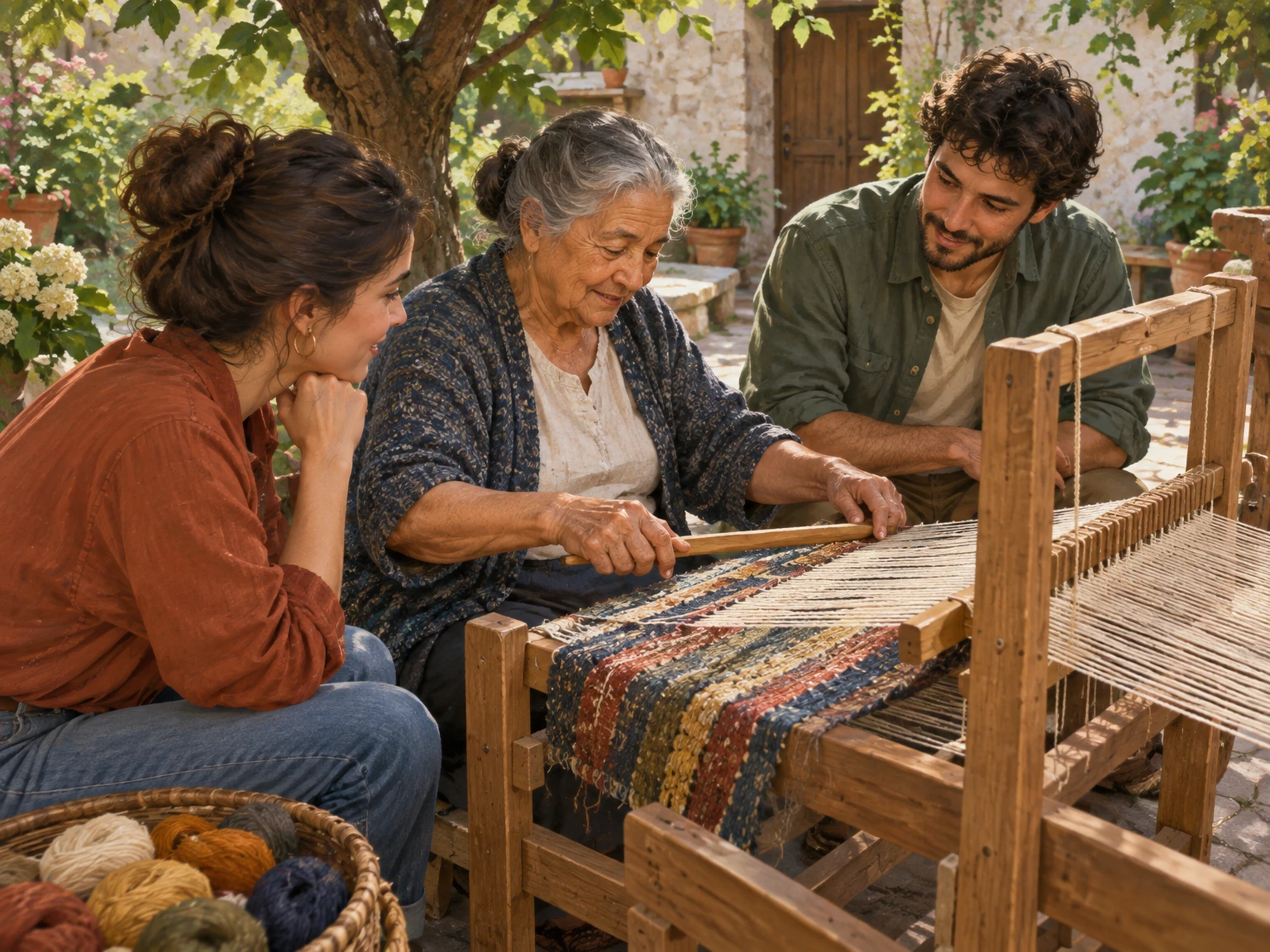
A woven basket can survive in a cupboard long after its maker has gone. The knowledge needed to choose its materials, prepare the fibres, judge their tension and teach another pair of hands is a different kind of inheritance. It lives through people doing things together. A song remembered at a family gathering, a craft learned beside an experienced practitioner and a story adapted for a new audience all reveal this difference between preserving an object and sustaining a practice.
UNESCO describes intangible cultural heritage as traditions and living expressions passed between generations. Its account includes oral traditions, performing arts, social practices, rituals, festive events, knowledge concerning nature and the universe, and the skills involved in traditional crafts. This article explains that framework without claiming to describe any particular community’s complete experience. The everyday situations below are illustrative examples, not reports of named projects or evidence that a practice has received UNESCO recognition. They help make the principles concrete while leaving authority with the people concerned.
More than a monument or an object
A building can provide a setting for heritage, and a collection can preserve objects associated with it. Neither necessarily contains the full practice. A musical instrument matters not only because of its shape but because someone knows how to make, tune, play and interpret it. A festive meal can involve knowledge of ingredients, timing, language, hospitality and relationships. Looking only at the finished product can hide the skill, cooperation and meaning that made the event possible.
The word intangible does not mean immaterial in the sense of having no practical needs. Crafts require tools and materials. Performances need places and time. People may need access to water, land, gathering spaces or instruments. UNESCO’s ethical principles explicitly recognize access to the objects, cultural and natural spaces and places of memory needed for expression. A safeguarding plan that records a song while ignoring the loss of its gathering place may preserve a trace while leaving the living practice under pressure.
It is therefore useful to ask two connected questions. What things help this practice happen, and what relationships keep its knowledge moving? A museum display can answer part of the first question, but the second often requires listening to practitioners. Their explanations may reveal seasonal work, informal teaching or social responsibilities that a visitor would never infer from an object alone. The visible result is an entry point into understanding, not a substitute for the people who give it meaning.
Traditional, contemporary and living
Heritage is easily imagined as something belonging to a distant past. UNESCO instead emphasizes that intangible cultural heritage can be traditional, contemporary and living at the same time. Rural and urban communities both create and transmit meaningful practices. Migration, new materials, changing work patterns and new forms of communication can affect how that transmission happens. A practice does not become irrelevant simply because its participants use a phone, live in a city or adapt their meeting times.
Change also does not automatically mean that every adaptation is harmless. Practitioners may disagree about what should remain stable, what can be adjusted and what threatens a practice’s viability. Those disagreements deserve attention rather than an outsider’s quick verdict. An educational article can explain that traditions evolve without deciding on behalf of a community which particular changes it should accept. The distinction is important: recognizing dynamism is not permission to redesign someone else’s heritage for convenience or commercial appeal.
A useful starting question is not whether a practice looks exactly as it did in an imagined golden age. Ask who continues it, how they understand its history, what opportunities they have to transmit it and what changes they consider appropriate. This shifts attention from a frozen picture to an ongoing relationship. It also avoids treating living people as performers required to satisfy a visitor’s expectations about the past. Their present lives belong in the account.
Recognition begins with communities
UNESCO’s explanation is explicit that intangible cultural heritage must be recognized as such by the communities, groups or individuals who create, maintain and transmit it. An outsider cannot simply assign that identity on their behalf. Researchers, schools, governments and cultural organizations may contribute knowledge or support, but their involvement does not replace community recognition. A striking photograph or an enthusiastic travel description cannot establish what a practice means to the people concerned.
The word community should not be used as though it always identifies one uniform opinion. Different practitioners, generations, families or groups can have different experiences. Some people may have a public teaching role while others hold knowledge that is shared only in particular settings. Someone who is highly visible online may not speak for everyone involved. A respectful inquiry asks how decisions are made and whose perspectives are missing rather than choosing the easiest person to quote as a universal representative.
This matters even for a small local article. Before describing a practice, a writer can distinguish an individual’s account from a collective position. They can identify what was observed, what was explained and what remains uncertain. They should avoid converting one conversation into a sweeping claim about all members of a group. Precision about the scope of evidence is not merely a technical writing habit. It helps prevent the misrepresentation that occurs when varied lives are compressed into a single appealing story.
Learning happens through participation
Some knowledge can be written as instructions, but many skills depend on attention developed through practice. A learner watches a hand movement, tries it, receives a correction and gradually notices differences that were previously invisible. The experienced practitioner may adjust an explanation to the learner’s material, pace or purpose. This interaction is not simply the delivery of a fixed package of facts. It can involve judgment, confidence, memory and ways of working with others.
Consider an illustrative weaving lesson. A written description may name a pattern, but a learner still needs to recognize when a strand is too tight, how moisture changes its behaviour and how to repair an uneven section. A video can help show the movement, yet it may not answer the question arising from the learner’s own mistake. Different forms of documentation can support one another. None should automatically be presented as a complete replacement for sustained opportunities to learn with knowledgeable people.
Time is part of this process. A single demonstration can generate interest without establishing a continuing learning relationship. If safeguarding is the goal, it is worth asking whether learners can return, whether teachers have the resources to continue and whether practice fits into ordinary life. A crowded festival photograph says little about these conditions. The less dramatic work between public events may be where transmission is actually sustained, and it deserves recognition alongside the finished performance.
Language carries more than labels
Oral traditions and expressions are one of UNESCO’s broad examples of living heritage. Stories, songs and other spoken forms can carry vocabulary, humour, references and relationships that are not fully transferred by a short summary. Translation can open access, but it also involves choices. A translated line may explain the literal action while losing a wordplay or a form of address. A careful presentation can acknowledge that limitation without suggesting that communication across languages is impossible.
For an educational project, retaining original terms where appropriate and inviting a knowledgeable explanation can be more informative than forcing every idea into a familiar category. Consent and access restrictions still apply. The fact that a phrase is interesting does not establish a right to record or publish it. If a speaker offers a translation for a specific audience, the writer should clarify whether that permission includes other uses rather than assuming that all future circulation is acceptable.
Language is also learned in context. A young person may understand a story differently after participating in the event where it is usually told. Removing a fragment from its setting can change what an audience thinks it means. Providing context does not require publishing restricted details. It can mean explaining the limits of the presentation, avoiding invented interpretations and making clear that a brief excerpt represents only part of a larger practice. Honesty about partial understanding supports respectful curiosity.
Consent is an ongoing relationship
UNESCO’s ethical principles call for transparent collaboration, dialogue, negotiation and consultation, contingent on free, prior, sustained and informed consent. These words describe more than obtaining a quick signature after a camera is already running. People need to understand what is proposed, how material may be used and what participation involves. The appropriate process depends on the context and those involved; this overview is not a legal consent form or jurisdiction-specific legal advice.
An illustrative documentation project can separate several decisions. Does someone agree to an interview? May it be recorded? May the recording be publicly posted, translated or used in a paid product? Are there parts that should remain private? Agreement to one of these does not automatically answer the others. Raising these questions early makes collaboration clearer. It also gives people a meaningful opportunity to shape the work rather than merely react to a finished product they did not help define.
Sustained consent matters because projects and circumstances can change. A recording intended for a small workshop may later attract attention from a much larger audience. A platform may offer reuse in ways participants never considered. The ethical question is not solved by pointing to the original conversation and refusing further discussion. A responsible project plans how questions, corrections and requests will be handled over time. This is part of maintaining a relationship, not an administrative obstacle to producing attractive material.
Respecting boundaries around access
Not every practice or item of knowledge is intended for unrestricted public access. UNESCO’s principles say customary practices governing access should be respected even when they limit wider public access. An observer may therefore be welcome at one event but not another, allowed to watch but not record, or invited to learn a general explanation without receiving restricted details. These boundaries should not be treated as a challenge to overcome for a more exclusive story.
Digital technology can make boundaries harder to maintain. A short clip can be copied, separated from its explanation and recirculated to an audience very different from the original one. Blurring a face does not necessarily remove every identifying detail. Before publication, collaborators can consider whether the combination of place, voice, objects and context reveals more than intended. Technical convenience does not determine what is appropriate to share. Sometimes the respectful outcome is a written overview or no public record at all.
A visitor can apply the same principle without managing a formal project. Ask before recording, follow the conditions given and avoid posting material merely because other people appear to be doing so. Do not pressure a practitioner to disclose something that has already been declined. Respectful curiosity includes accepting that an explanation may have limits. Learning that such limits exist can itself improve understanding by challenging the assumption that everything meaningful must be made available to every audience.
Benefits, credit and material conditions
UNESCO’s ethical principles recognize the moral and material interests of communities and individuals arising from the use, research, documentation, promotion or adaptation of their heritage. Public attention can produce opportunities, but it can also generate value for people far removed from the practitioners. A project should ask who receives payment, credit, access to the results and influence over later uses. Visibility alone is not a reliable substitute for these practical questions.
For an illustrative craft exhibition, a fair discussion might include how makers are named, whether descriptions are accurate, what happens to photographs and whether the event’s timetable allows meaningful participation. A fee or a credit line may address one concern without resolving all of them. The aim is not to prescribe one universal arrangement. It is to avoid assuming that a project automatically benefits practitioners because its organizers describe it as cultural promotion or education.
Material conditions can affect whether teaching continues. Practitioners may need time away from other paid work, suitable spaces or access to materials. Young learners may face costs or travel barriers. These issues should not disappear behind a romantic description of dedication. Cultural work involves labour and real choices. Acknowledging that labour can support a more realistic conversation about continuity than expecting people to preserve knowledge indefinitely while everyone else enjoys its results without responsibility.
Tourism, performance and context
A performance presented to visitors can be meaningful, enjoyable and economically useful. It should not automatically be dismissed as inauthentic. At the same time, the demands of a visitor programme can influence duration, timing, selection and explanation. A short stage presentation may reveal only one part of a practice that has other functions in community life. An honest description distinguishes the setting of the presentation from the broader tradition rather than claiming that the two are identical.
UNESCO’s principles identify decontextualization, commodification and misrepresentation as potential threats that communities should help define and address. The word potential matters. An outsider should not declare that every commercial use is damaging or that every new audience is beneficial. Practitioners’ own assessments, along with the actual effects, belong at the centre. A good question is what this particular arrangement changes, who decides those changes and how the benefits and burdens are distributed.
Visitors can contribute through ordinary choices. Read the explanation provided, recognize a demonstration as a demonstration, buy with attention to the maker’s account and avoid demanding a simplified performance of a stereotype. Do not assume that clothing, age or an attractive setting proves expertise. Where information is uncertain, it is better to describe what is known than to invent a long history to make an encounter sound more special. Respect does not need exaggeration.
Safeguarding is not freezing
If living heritage depends on continued practice and transmission, safeguarding cannot be reduced to preventing all change. UNESCO emphasizes its dynamic nature and cautions against authenticity and exclusivity becoming obstacles. Communities may choose new teaching arrangements or adapt a practice to new circumstances. An inherited skill can remain meaningful while its social setting develops. The relevant question is how continuity is understood and sustained, not whether every visible detail stays permanently fixed.
This perspective also leaves room for disagreement and evaluation. A change may make learning more accessible while creating another difficulty. A new venue may welcome a wider audience but reduce access for some practitioners. A recording may support distant learners while encouraging people to treat it as the only authoritative version. No single description settles these trade-offs in advance. Transparent discussion helps identify what matters, what can be revised and what should not be sacrificed for a convenient public image.
A practical safeguarding effort can begin modestly: understand the current practice, ask practitioners about pressures, identify what they want to continue and consider support that responds to those priorities. The answer may be less glamorous than a new digital archive. It could concern regular space, materials or opportunities to learn. These examples are possibilities, not a diagnosis of any named community. The people involved must determine whether such measures address their circumstances.
Documentation is a tool, not the whole outcome
A recording, inventory or photograph can preserve useful evidence and help people teach, remember or communicate. It can also become detached from the relationships that produced it. An archive is not automatically a living practice, and a large number of files is not proof of successful transmission. A project should be clear about what its documentation can and cannot do. This protects both the people represented and audiences tempted to mistake a fragment for a complete account.
Good documentation includes context appropriate to the agreed use. That might involve identifying who is speaking, when an account was made, which version is being described and what limits apply to interpretation. Uncertainty should remain visible. If two accounts differ, a writer need not force them into a single story merely to create a smooth narrative. Differences may be important evidence about change, memory or perspective, and should be handled with care rather than presented as a sensational conflict.
Returning results to participants is another useful question. Can they access the recordings, read the descriptions and raise corrections? Is the format usable for the people whose knowledge made the project possible? A file stored in a distant institution may be technically preserved while practically inaccessible to them. Thinking about access from the beginning can prevent that mismatch. The value of a record depends partly on who can use it and on what terms, not simply on whether it exists.
Learning across differences without ranking people
UNESCO connects understanding living heritage with intercultural dialogue and mutual respect. This does not require treating every practice as interchangeable. Differences can be discussed carefully without ranking communities as more advanced, more authentic or more worthy of attention. Its ethical principles say people should assess the value of their own heritage rather than being subjected to external judgments of worth. A familiar practice does not become less meaningful because a visitor finds it ordinary.
Similar expressions can exist in neighbouring places or across long distances. Migration and exchange can produce connections that do not fit tidy boundaries. UNESCO describes intangible heritage as inclusive rather than a test of exclusive ownership based on resemblance alone. For an educational writer, this is a reason to avoid simplistic claims that a shared feature proves copying or establishes a unique origin. Historical questions need evidence; visual similarity by itself rarely supplies the full explanation.
A reader can practise this approach by asking descriptive questions before evaluative ones. Who participates, what knowledge is passed on, how is it learned and what do participants consider important? These questions encourage attention to actual lives. They also help resist the pressure to turn every cultural encounter into a competition for the oldest, rarest or most spectacular example. Living heritage can be valuable because it sustains connection and knowledge, even when no superlative makes it into a headline.
A thoughtful next encounter
The next time you encounter a public craft demonstration, story event or performance, consider looking beyond the finished display. Listen for how participants describe the practice and its teaching. Notice which questions are welcomed and which boundaries are stated. Distinguish your own impression from what someone actually explained. If you write about the encounter, make the scope clear. A single afternoon can support a thoughtful account without claiming mastery of an entire cultural world.
For teachers, visitors and writers alike, the strongest habit is to keep people at the centre. Ask how knowledge moves, who has authority to speak, what conditions support participation and how the work can avoid misrepresentation. Objects, archives and stages remain important, but they serve a larger relationship. Living heritage continues when people have meaningful opportunities to practise, interpret and transmit what they recognize as theirs. Understanding that continuity begins with attention, humility and respect for their choices.
Sources and illustration
- UNESCO: What is Intangible Cultural Heritage?
- UNESCO: Ethical Principles for Safeguarding Intangible Cultural Heritage
Illustration: original AI-generated editorial artwork of intergenerational weaving instruction, not a documentary photograph or a depiction of a named community. No text is included in the image.
This content is a collection of ancient history,books and various articles and collection of library and news and other post ; all details may not be the same. Readers are requested to verify the information themselves. Readers are not allowed to take any disciplinary action; content is only for educational purposes. If readers do not agree about the contents, they may send a personal comment to my personal email ID: achary.purna@gmail.com
