
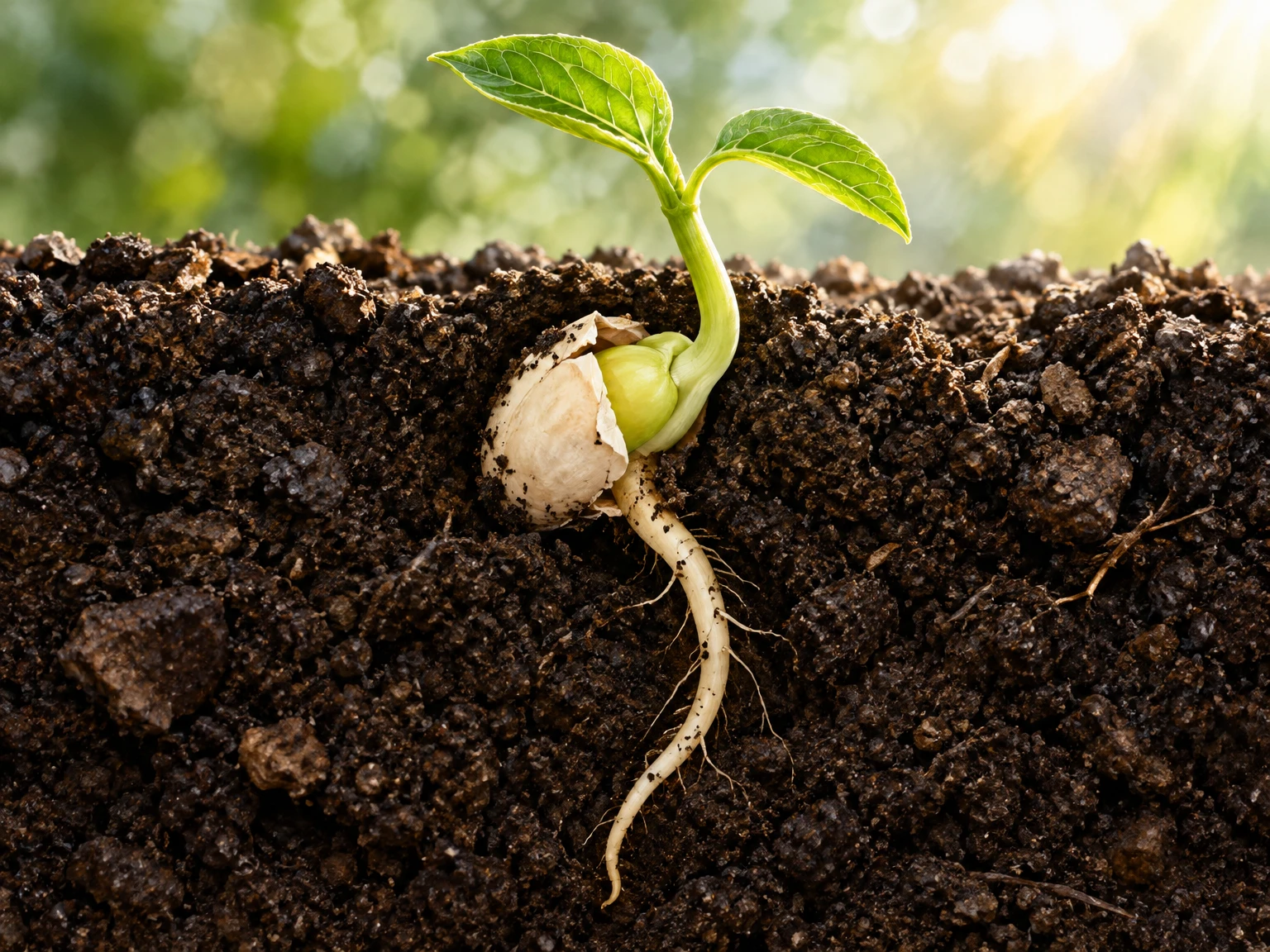
A seed is easy to mistake for an inactive speck. It can sit in a packet, disappear into soil or travel unnoticed on an animal, apparently unchanged. Yet inside a viable seed is a living embryo with a particular history and a set of biological constraints. Its next step depends on more than the arrival of a little water. The environment must permit germination, and in some species internal or covering structures must also change before growth can proceed. Understanding those distinctions reveals why sowing is not a simple switch from dry object to miniature plant.
This article explains seed germination and dormancy as biological processes rather than offering a universal planting recipe. It draws on Royal Botanic Gardens, Kew research and seed conservation guidance. Different species, populations and seed lots can behave differently. A method suitable for a familiar garden crop can fail for a wild tree, and a treatment used by trained seed scientists may be unsafe or destructive when improvised at home. The useful starting point is curiosity about the particular seed, not confidence that every seed needs the same treatment.
A living beginning in a protective package
The embryo is the young plant within a seed. Depending on the species, stored reserves may be held in specialized tissues or in the embryonic seed leaves called cotyledons. Covering structures help protect this living material during development, dispersal and the interval before germination. What people casually call a seed can also include parts of a fruit. This matters because a barrier outside the true seed may influence water entry or the physical emergence of the young root. Recognizing the structure helps avoid explanations based only on outward size or hardness.
A seed's reserves support early development before the seedling can rely fully on photosynthesis. They are not an unlimited food supply. A seedling growing in unsuitable conditions can use its reserves without becoming established. This is one reason germination and successful recruitment are different outcomes. Seeing a root emerge is an important observation, but it does not show that a healthy adult plant will follow. Establishment also requires appropriate light, moisture, nutrients, space and protection from hazards that vary with the habitat and the plant's stage of development.
Germination is a process, not a promise
In seed testing, visible emergence of the embryonic root, or radicle, is a commonly used sign that germination has occurred. The precise assessment used in a nursery or formal seed test may include further criteria for normal seedlings. It is therefore important to state what is being counted. A report that says half the seeds germinated is incomplete without information about the number tested, the observation period and the definition of success. The same seed lot could produce different recorded results under a short classroom observation and a carefully designed conservation test.
The sequence begins with water uptake and the resumption of processes that support growth. Cells must function, reserves must become available, and the embryo must be capable of extending through its covering structures. These events are affected by environmental conditions and by the seed's physiological state. A dry seed becoming swollen is not proof that it will complete germination. Conversely, a seed showing no visible change after several days is not automatically dead. It may be slow, dormant, held under unsuitable conditions or damaged; observation alone may not distinguish these possibilities.
Water opens a door, but excess closes another
Water uptake, often called imbibition, is central to the transition from a dry seed to active growth. However, the amount of water available and the way it is supplied matter. A moist surface and a flooded container are not equivalent environments. Waterlogged conditions can limit the availability of oxygen around many terrestrial seeds. Kew's technical guidance emphasizes the combination of moisture, temperature, light and gases, rather than treating moisture as the only requirement. More water is not a dependable remedy for every failure to germinate.
There are exceptions that prevent a simple rule from becoming universal. Kew notes that germination in some aquatic species can be promoted by anaerobic conditions. That does not mean a household experiment should drown an unidentified seed. It means ecology matters: plants adapted to different habitats encounter different opportunities and constraints. When interpreting a test, record whether seeds were on moist paper, in an aerated growing medium or submerged. The description makes the result more informative and helps distinguish a biological response from an accidental change in the test environment.
Temperature tells more than warmth alone
Temperature affects the rate and possibility of germination, but warmer is not always better. A species may germinate over a limited range, and conditions outside that range can prevent growth or harm seeds. The temperature that feels comfortable to a person is not necessarily appropriate for a seed from a different habitat. Scientists choose test conditions using information about the species and its natural emergence season. A published protocol is useful because it connects the test to prior evidence rather than relying on a single household observation.
Daily temperature fluctuations can also provide information. Seeds near the soil surface may encounter a different pattern of warming and cooling from deeply buried seeds. Kew identifies alternating temperature as one of the possible environmental cues relevant to testing. A constant indoor temperature may therefore fail to reproduce something important about the natural setting. This does not establish that every seed requires alternating temperatures. It shows why recording both the range and pattern of temperatures is more informative than writing only that seeds were kept somewhere warm.
Light is a cue as well as an energy source
People often associate light with the needs of green leaves. In germination, it can also function as an environmental signal before a seedling has expanded its leaves. Some small seeds respond to light in ways related to their position close to the surface. Kew's guidance links light and temperature cues with the limited resources of small seeds, which may be unable to emerge successfully from deep burial. Covering such seeds heavily can change both their physical challenge and the signals they receive.
Other species may germinate better in darkness, and many familiar seeds do not require the same specific light conditions. The correct conclusion is not that all seeds should be left uncovered or buried deeply. It is that sowing depth and light exposure should be species-specific. In a comparison, transparent and opaque containers can differ in temperature as well as illumination. If several factors change together, a difference in germination cannot confidently be assigned to light alone. Careful experimental design matters even when the equipment is simple.
Dormancy differs from an unfavorable environment
A viable, non-dormant seed may fail to germinate because the external conditions are unsuitable. Dormancy adds another layer: the seed does not germinate even when some apparently favorable conditions are supplied, because its own state or structures impose a barrier. This distinction explains why simply adding water and warmth may not be sufficient. It also prevents a common mistake in interpreting unsuccessful tests. Failure to germinate under one set of conditions does not identify the cause or establish the absence of living tissue.
Dormancy is not a conscious decision. Describing seeds as waiting or waking is a convenient metaphor for biological responses shaped by evolution and development. Different dormancy mechanisms can make germination more likely after particular environmental sequences. Those responses may spread emergence over time or align it with conditions suitable for seedlings. Whether that timing proves beneficial in a specific year depends on what actually happens afterward. A cue associated with favorable conditions is not a guarantee that rain, temperature or competing vegetation will remain suitable.
Covering structures can control water entry
Physical dormancy involves a covering structure that prevents water uptake. A hard-looking seed is not automatically physically dormant, however, and a small scratch is not a universal solution. Seed structure, location of the embryo and known species behavior all matter. Scientists can use carefully chosen scarification methods to make an impermeable covering permeable. Kew's technical sheet explains that the treatment must avoid damaging the radicle. A successful treatment changes the barrier while preserving the living tissues needed for growth.
The same guidance mentions heat and chemical methods used in specialist work, while noting the risk of damage. Those methods should not be turned into casual instructions for children or inexperienced growers. Boiling water, strong acids and cutting tools introduce hazards as well as biological uncertainty. For an educational activity, choose a familiar species with a safe published sowing method rather than attempting to force an unknown wild seed to germinate. Learning why a barrier exists is valuable without carrying out every laboratory technique used to investigate it.
Physiological dormancy can depend on seasonal history
Some seeds require changes within their physiological state before they can germinate over an appropriate range of conditions. Cold or warm stratification can help release certain forms of dormancy by holding hydrated seeds under particular conditions. The seasonal analogy is useful: a period resembling winter or summer can alter later responses. But the appropriate duration and temperature depend on the species and seed lot. A refrigerator is not a universal substitute for an entire natural history, and chilling cannot revive a seed that is no longer viable.
Kew reports that some tree species need sequences of warmth and cold, sometimes repeated over months or years. This is very different from a fast classroom sprouting exercise. An experiment stopped after a week could overlook a perfectly viable but deeply dormant seed. Conservation researchers therefore combine prior knowledge, testing and patient observation. Their aim is not merely to obtain the quickest possible result. It is to understand how a particular seed lot responds and how that knowledge can support propagation, conservation or restoration without wasting irreplaceable material.
After-ripening is not the same as storage forever
In some species, a period of dry after-ripening can change dormancy. That statement should not be confused with the idea that all seeds improve when left in a drawer. Storage conditions influence longevity, and seeds differ greatly in how they tolerate drying and temperature. A seed lot may lose viability while another becomes more readily germinable. The two processes can occur on different timescales. Without records, a later test may reveal a changed result but leave the reason unclear.
For that reason, collection and storage histories are part of the evidence. Useful records include the plant identity, collection date, location, maturity, cleaning method and subsequent conditions. A packet marked only with a common name leaves substantial uncertainty. Even correctly named seeds can differ because of the conditions experienced by the parent plants or the point at which they were collected. A germination test is not simply a judgment on a species. It is an observation about particular material under stated conditions at a stated time.
Why timing matters in the wild
A seedling cannot move away from a poor starting place. Germinating during a brief warm spell may expose it to frost later, while emerging too late can leave little time before drought or competition intensifies. Dormancy and environmental sensitivity can help shape the timing of emergence. They are part of the connection between a plant's life cycle and the seasonal patterns of its habitat. This connection is especially important when people try to restore vegetation, because the presence of viable seeds alone does not ensure successful regeneration.
Seed banks in soil can also include seeds that remain available across more than one season, although persistence varies among species and sites. A disturbed patch of ground may produce seedlings from material not recently shed. That possibility does not justify assuming every bare area contains an abundant reserve of native plants. Land-use history, soil conditions, seed predation and past vegetation all matter. Restoration planning needs evidence about the site and target species, not a general expectation that nature will always supply the desired plants once disturbance occurs.
Climate change can disrupt a familiar sequence
Kew's 2024 account of research on UK trees describes how warming winters may affect the chilling periods involved in germination. It discusses species such as black alder and birches, while emphasizing different responses and ongoing investigation. Seeds may fail to receive the conditions associated with their full germination potential, or emerge at times that expose seedlings to later hazards. These examples concern particular temperate trees and research settings. They should not be presented as proof that every tree worldwide responds identically.
The broader lesson is about interacting stages. A change in winter conditions can influence dormancy, while a later dry period affects seedling survival. Looking only at the first visible root misses that chain of consequences. Researchers test seed lots under different conditions and use the results to inform models and conservation decisions. Models are tools for examining possible responses, not exact predictions for each seed. Local climate, population differences and the quality of the underlying data affect how confidently findings can be applied elsewhere.
A careful classroom observation
A modest germination activity can teach more than a dramatic attempt to make every seed sprout. Begin with a known, suitable species and fresh material intended for planting, following safe packet instructions. Keep the observation separate from food preparation: treated planting seeds and experimental sprouts should not be eaten. Use clean equipment, ordinary safe materials and appropriate supervision. If mold develops, avoid unnecessary handling and dispose of the material safely. An educational activity should not create a health hazard merely to produce a visible result.
Choose one question that the setup can actually address. For example, compare two stated moisture conditions while keeping species, seed lot, container, temperature and observation period as similar as practical. Record the number of seeds in each group and the criterion used for germination. A single seed in each condition makes a lively demonstration, but gives weak evidence about typical behavior. Replication helps reveal variability. It does not remove all sources of error, and the results should still be described as a limited observation rather than a universal law.
Counting without misleading yourself
Suppose a hypothetical test places twenty seeds in one condition and twenty in another. If twelve in the first group and eight in the second show radicles by the chosen day, the observed proportions are sixty and forty percent. The difference is real as a description of those groups, but it does not by itself establish why it occurred. Seed variation, uneven moisture, temperature gradients and chance could contribute. Repeating the comparison and keeping better records can help assess whether the pattern is consistent.
Time should be part of the record, not an afterthought. Count at planned intervals and distinguish newly germinated seeds from those already counted. A treatment might change how quickly emergence occurs without changing the eventual proportion. A short observation could therefore make a slow group appear unsuccessful. Conversely, counting a damaged or abnormal seedling as established exaggerates the result. Clear definitions let another reader understand exactly what the data show, and prevent an appealing photograph from replacing the evidence collected across the whole test.
Diagnosing a failure requires more than patience
When seeds do not germinate, investigate plausible causes without assigning one prematurely. Was the material correctly identified? Was it mature when collected? Has it been stored appropriately? Were the supplied conditions supported by a relevant protocol? Is dormancy expected? Kew's seed-testing approach begins with research and uses further assessment of ungerminated seeds where appropriate. Some diagnostic methods are destructive or require specialist interpretation. A casual observer may need to leave the cause unresolved rather than announcing that every ungerminated seed is dead.
Avoid compensating for uncertainty by changing everything at once. Repeated soaking, heating, cutting and moving can damage material and make the outcome uninterpretable. If seeds are rare or of conservation importance, seek qualified guidance before using them in experiments. Do not collect from protected populations or remove seeds from places where permission is required. Propagation is not automatically conservation. The origin, genetic suitability and ecological consequences of planting matter, especially when material is moved between regions or into natural habitats.
From germination to an established plant
Once a root emerges, the requirements do not stop. Seedlings must maintain water balance, develop access to resources and survive their surroundings. An ideal germination environment can become unsuitable if it is kept unchanged during later development. Crowding, poor aeration and abrupt changes in exposure can all influence results. Nursery practice therefore involves more than achieving an impressive germination percentage. It includes handling living seedlings at vulnerable stages and matching care to their biological needs.
This also changes how success should be communicated. A conservation project may need evidence of surviving, appropriately sourced plants in a suitable habitat, not simply the number of seeds that split open in a laboratory. A school exercise may aim only to observe a root and shoot safely. Both are legitimate aims when stated accurately. Problems arise when an intermediate result is presented as the final outcome. Good botanical reasoning follows the organism through the stage relevant to the question rather than ending the story at the most photogenic moment.
Better questions before the next sowing
The most useful lesson from seed biology is a habit of asking specific questions. What species and seed lot are involved? Which conditions and seasonal sequences are supported by evidence? What exactly counts as germination in this test? How will later establishment be assessed? These questions replace a vague desire to wake seeds quickly with a clearer investigation. They also make unsuccessful attempts informative, because a well-described result can reveal a limit or suggest a better comparison instead of disappearing into a story about bad luck.
A seed is neither an inert object nor a tiny adult waiting to unfold on command. It is a living stage with protective structures, resources and responses connected to a particular ecology. Water, gases, temperature, light and dormancy interact; their importance differs across species and circumstances. Respecting those differences makes growing more thoughtful and scientific claims more accurate. The first leaf becomes more interesting when we understand the conditions and histories that allowed it to appear, and the further challenges that still lie between emergence and a flourishing plant.
Reading a seed packet as a scientific record
A planting packet often compresses complex knowledge into a few lines. Read the species name, sowing season, depth and expected emergence time together rather than selecting one instruction in isolation. An expected range is not a deadline after which every unresponsive seed can be declared lifeless. Packaging can also distinguish treated material, batch information or storage advice. Keep those details with any observation notes. If an experiment succeeds unusually quickly, that record helps explain what was actually used instead of attributing the result to an improvised technique alone.
Published recommendations may describe conditions for cultivation rather than the full natural range of a species. A garden variety selected for predictable emergence is not necessarily representative of its wild relatives. Equally, a conservation paper may investigate dormancy mechanisms rather than provide a convenient household planting method. Ask what the source was designed to establish and whether its materials resemble yours. This makes research more useful, not more intimidating: you can identify which advice applies, which remains uncertain and which methods are best left to specialist facilities.
Comparing results fairly
Suppose two small batches produce different numbers of seedlings. Before crediting a treatment, check whether the batches began with comparable seed lots and equal numbers of seeds. A difference of one seed means something different in a sample of five than in a sample of one hundred. Record both the count and the denominator, and keep the observation period consistent. Otherwise a batch watched for longer may appear more successful simply because late germination had time to occur. An apparent pattern is a reason for a better comparison, not immediate proof of a universal method.
Variation within a batch can also be informative. Some seeds may germinate earlier than others even when they share a container. Reporting only the first appearance hides that spread. A simple dated tally preserves the sequence without claiming that every seed had identical requirements or history. For conservation collections, specialist protocols go further than this household record; their purpose includes reproducibility and careful use of limited material. For an ordinary learner, the transferable principle is to describe what happened clearly before trying to explain why it happened.
Sources and further reading
- Royal Botanic Gardens, Kew: A rude awakening, the risks of climate change for sleeping seeds (2024)
- Kew Technical Information Sheet 13b: Germination testing, environmental factors and dormancy-breaking treatments (2022)
Illustration: original AI-generated editorial artwork showing a conceptual germinating seed, not a documentary photograph or a scientific specimen diagram. No text is included in the image.
This content is a collection of ancient history,books and various articles and collection of library and news and other post ; all details may not be the same. Readers are requested to verify the information themselves. Readers are not allowed to take any disciplinary action; content is only for educational purposes. If readers do not agree about the contents, they may send a personal comment to my personal email ID: achary.purna@gmail.com
