
A beginning in Lumbini
Before he became known as the Buddha, the awakened one, Buddhist tradition remembers him as Siddhartha Gautama, a child of the Shakya community. His story begins in the foothill region along the northern edge of the Ganges basin, in what is now southern Nepal. His birthplace, Lumbini, remains a place of pilgrimage where archaeology and religious memory meet.
This series follows that life chronologically. It also keeps two kinds of evidence distinct: the material traces of early Buddhist devotion and the narratives preserved in Buddhist literature. Both matter, but they do not answer every historical question in the same way. A sacred birth story can tell us how communities understood the Buddha without providing a contemporary record of the event.
What the birthplace tells us
UNESCO identifies Lumbini, in Nepal’s Terai plains, as the Buddha’s birthplace. One of its most important surviving witnesses is the pillar erected by the Mauryan emperor Ashoka in the third century BCE. Its inscription identifies the place with the Buddha’s birth. UNESCO dates the pillar to 249 BCE.
The pillar is important evidence for an early identification of the birthplace, but it is not an eyewitness account of the birth itself. The sacred area also contains the Maya Devi Temple remains, the Shakya Tank, and the remains of monasteries and stupas. Together, they document Lumbini’s long life as a centre of pilgrimage.
Lumbini should not be confused with Kapilavastu. Lumbini is associated with the birth; Kapilavastu is associated with the Shakya community and the setting of Siddhartha’s youth. The distinction helps us follow the narrative without turning every place connected to his childhood into the same location.
Why the dates differ
A precise birth year cannot be presented as settled historical fact. UNESCO’s World Heritage description uses 623 BCE. The widely repeated chronology of approximately 563–483 BCE is another familiar dating scheme. Britannica explains that scholars have also placed the Buddha’s life about a century later than that scheme.
These differences reflect problems in reconstructing ancient chronology, not several different founders. Much of the biographical literature was written down centuries after the Buddha’s lifetime. This article therefore leaves the birth year open rather than selecting one traditional date and presenting it as undisputed. The surviving evidence supports a historical teacher, while many details of his personal chronology remain debated.
Names, community and belonging
Gautama is the Sanskrit form of his family or clan name; Gotama is the corresponding Pali form. Siddhartha, or Siddhattha in Pali, is the personal name commonly given in his biographies. Britannica translates it as “he who achieves his aim.” Shakyamuni, another familiar name, means “the sage of the Shakya clan.” Buddha is a title associated with awakening, rather than the name by which a newborn child was known.
Traditional accounts place his family among the ruling Shakyas and describe a Kshatriya, or warrior-class, background. Yet the political world behind the familiar palace story needs care. Britannica describes the possibility of tribal republics governed by councils of elders or elected leaders, and notes that the grand palaces described in traditional biographies are not evident in the archaeological remains.
Calling Siddhartha a prince is therefore a familiar way of retelling the tradition, not proof that he inherited a large centralized kingdom. Nor does a warrior-class background establish that he ruled, commanded an army or fought battles. Later articles in this series will distinguish political context and inner conflict from any claim about personal military action.
The family remembered in tradition
Buddhist biographical tradition names his father as Shuddhodana, often written Suddhodana, and his mother as Maha Maya. The familiar narrative calls them king and queen. These titles belong to the inherited account and should be read alongside the more cautious historical picture of Shakya political organization.
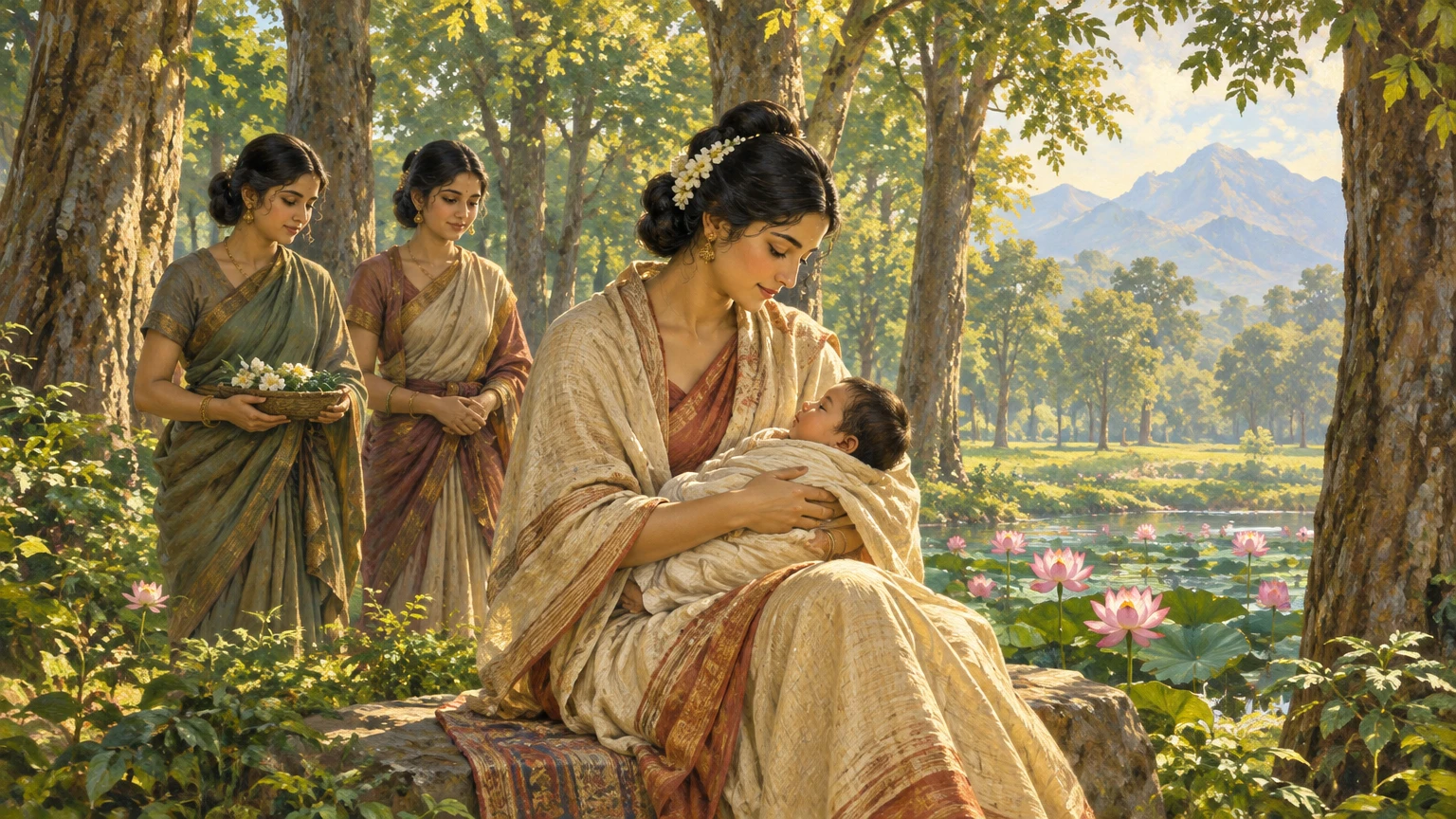
The birth narratives describe Maya’s auspicious dream of a white elephant and a birth in the Lumbini grove. Some accounts tell of the infant taking seven steps. These are religious narratives with a long life in Buddhist art and devotion; they are not events that archaeology has independently demonstrated.
Tradition says Maya died shortly after the birth and that her sister Mahaprajapati, also known as Mahapajapati Gotami, brought up the child. Her place in the story reminds us that the early life was not only a tale of a father and an heir. It was also a story of maternal loss and care within an extended family.
The later family narrative introduces his wife Yashodhara, also spelled Yasodhara, and their son Rahula. Their lives belong to the next stages of the story rather than to the moment of birth. Details such as exact marriage ages vary between retellings, so this opening article does not treat a single version as an independently established family record.
Reading the beginning without losing its meaning
The story of Siddhartha’s origins has endured because it places the search for understanding within an ordinary human framework: birth, family, belonging and the vulnerability of life. Its religious imagery gives that beginning cosmic significance, while historical inquiry asks what can actually be recovered from texts, places and inscriptions.
We do not have to collapse one approach into the other. Respecting a tradition includes identifying it honestly as tradition. Respecting history includes admitting where the evidence ends. Lumbini’s early inscriptional witness and the much richer biographical stories can be read together without treating them as equally direct evidence.
The next chapter turns to youth and the privileged life associated with Kapilavastu: how the traditional accounts describe comfort, education and family expectations, and why those accounts set the stage for renunciation.
Sources
- UNESCO World Heritage Centre — Lumbini, the Birthplace of the Lord Buddha
- Encyclopaedia Britannica — Buddha: general considerations and historical context
- Encyclopaedia Britannica — The life of the Buddha
- BBC Teach — Life of the Buddha: A spiritual journey
This content is a collection of ancient history,books and various articles and collection of library and news and other post ; all details may not be the same. Readers are requested to verify the information themselves. Readers are not allowed to take any disciplinary action; content is only for educational purposes. If readers do not agree about the contents, they may send a personal comment to my personal email ID: achary.purna@gmail.com
