
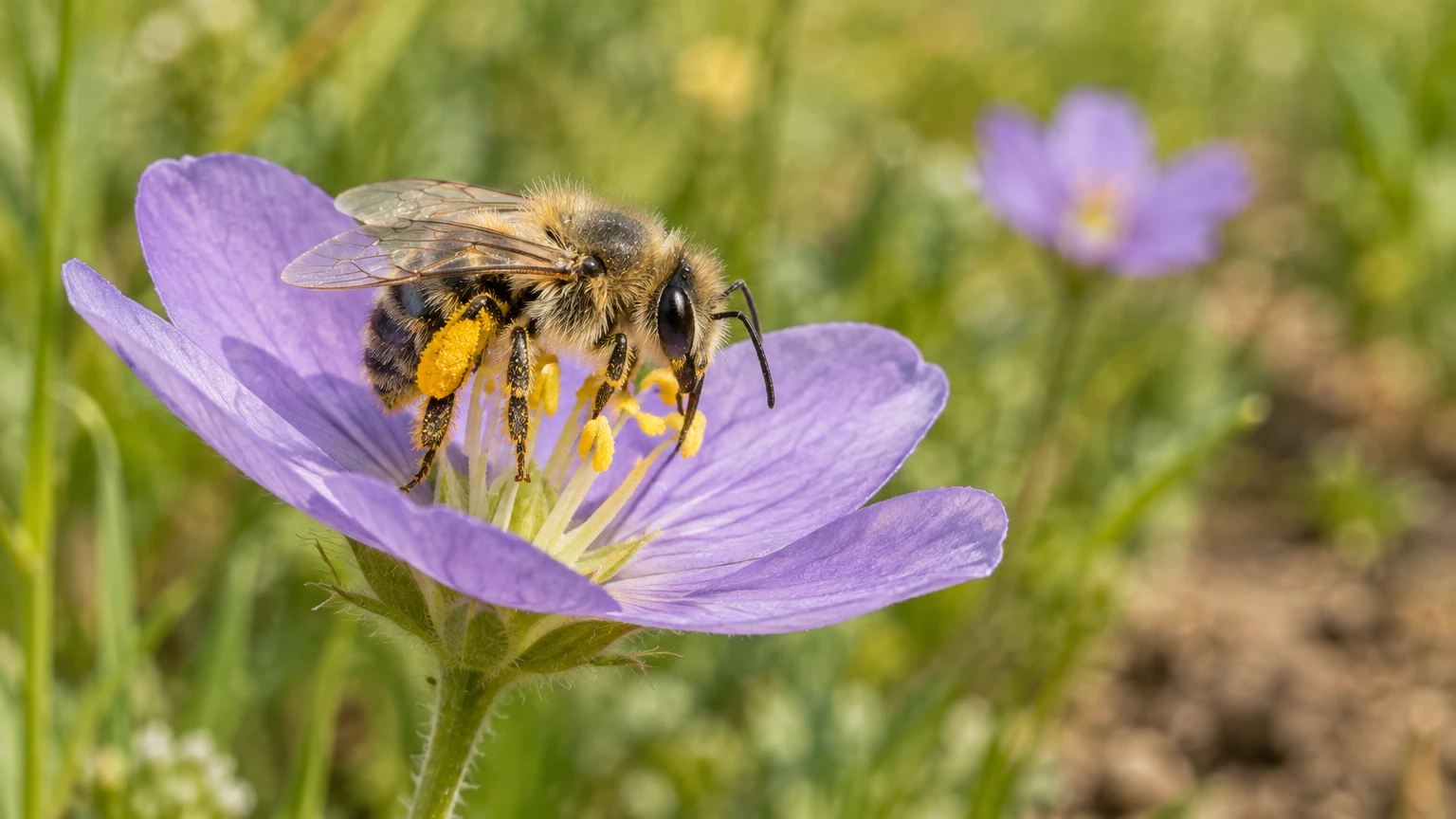
A bee disappearing into a small hole in the soil can be easy to misunderstand. It may look as though an entire colony is hidden beneath the path. In many cases, however, the insect is a female working on her own nest. She collects food, prepares protected spaces for offspring and lays eggs without a queen directing thousands of workers. Her story is not an exception to the bee world. Solitary living is an important part of bee diversity, even though honeybees dominate familiar pictures of what a bee should be.
Watching these insects carefully changes the questions we ask about conservation. Flowers matter, but so do the places where bees nest and the periods when adults are not visible. A tidy landscape can provide a spectacular afternoon display of blossoms while offering very little support for the rest of a bee’s life. Understanding that life does not require handling nests or identifying every insect to species. It begins with noticing how feeding, reproduction, seasons and habitat fit together, while recognizing that different species solve these problems differently.
This article explains the general biology of solitary bees and uses North American conservation guidance from the Xerces Society as a clearly regional example. It is not a field identification guide for India, Rwanda or any other particular country. Species, flowering seasons and appropriate habitat management vary locally. The principles help readers ask better questions; local entomologists, extension services and conservation organizations can supply the details that a particular place requires.
Solitary does not mean isolated
The word solitary describes the organization of nesting and reproduction, not a rule that every bee must live far from every other bee. Several females may establish nests close together because the same bank has suitable soil, warmth and drainage. A busy patch can therefore contain many independent nests. Each female may still be responsible for provisioning her own offspring. A crowd at a nesting site is not, by itself, evidence of a honeybee-like colony or a shared store of honey.
Bee social organization is more varied than a simple division between solitary insects and honeybees suggests. Some species share entrances or show other forms of social behavior. Bumblebees and honeybees also have important differences from one another. The useful starting point is to avoid transferring the life history of one familiar species onto every striped visitor. Observe who enters, what they carry and whether the same individual repeatedly returns. Those details can suggest questions, although reliable identification often requires features that cannot be seen from a casual photograph.
Nor does solitary mean unimportant. An individual female can make many flower visits while collecting food for successive offspring. A population of such females contributes to the movement of pollen across a landscape without producing a marketable jar of honey. Evaluating bees only by honey production misses their biological role. It also encourages the mistaken idea that adding managed hives automatically supplies everything that wild bee communities need. Habitat for existing wild species deserves attention on its own terms.
The bee and the flowering plant
Flowers offer resources, but a bee does not visit them with the deliberate purpose of helping a plant reproduce. It seeks food. Nectar supplies sugars, while pollen provides nutrients used especially in raising young. During visits, pollen can move from the structures that produce it to receptive parts of another compatible flower. That movement may contribute to fertilization and the production of seeds. The plant and bee interact through their own immediate needs, creating an ecological relationship rather than a conscious partnership.
Not every visit is equally useful to a plant. The insect must contact the right structures, and the pollen must reach a suitable recipient. Different flowers package their rewards in different ways. Body size, hair, behavior and the timing of activity can influence how a visitor uses them. This is one reason a diverse flower patch can support a different set of insects from a uniform planting. The shape of the flower matters alongside the amount of color that a human observer sees.
Pollination should also be distinguished from the whole process of growing a crop. Water, soil conditions, temperature, pests, plant variety and management still matter. Some plants depend heavily on animal visitors; others rely on wind or can reproduce in other ways. There is no sound reason to promise a fixed increase in every garden’s harvest simply because a few bees are observed. A more defensible conclusion is that protecting diverse pollinators supports an important ecological process whose consequences depend on the plants and setting.
A nest is more than a hole
A nesting female needs a place where developing offspring can remain protected after she has finished her work. Some solitary bees excavate soil. Others use existing cavities in stems, wood or other materials. The Xerces Society’s North American guidance describes a large majority of the region’s native bees as ground nesters, with the remainder largely associated with above-ground cavities. That regional pattern is useful, but it should not be treated as a census of bees in every continent or every garden.
A ground nest usually contains more structure than the opening suggests. Passageways lead to brood cells, each a space prepared for an offspring. Depending on the species, a female may line, partition or close these spaces with materials she gathers or produces. Above-ground nesters also divide cavities into cells. Materials and construction methods vary, so a neat row of identical tubes cannot represent the requirements of all solitary bees. Soil texture, moisture, exposure and cavity dimensions can each limit which species can use a location.
For an observer, this creates an important boundary. Digging up a nest to find out what is happening can destroy the very process being studied. A small entrance is evidence of activity, not an invitation to investigate with a trowel. Watching from a distance and recording return trips is less disruptive. If a nesting aggregation creates a genuine conflict with essential access or building work, seek locally appropriate advice before intervening. Assumptions about an insect’s identity are a poor basis for removal.
Provisioning: tomorrow’s meals prepared today
A solitary bee female typically gathers food for an offspring before sealing its cell. Repeated trips bring pollen and nectar into the nest, forming a stored provision. An egg is placed in association with that food, and the developing larva later feeds on it. Unlike a bird repeatedly returning with meals to a growing chick, the mother may never interact with that offspring again. Much of her investment is therefore concentrated in preparing a suitable cell and supplying it adequately at the start.
This arrangement explains why a flowering landscape must offer usable resources during the female’s active period. She is not simply maintaining herself. Each successful nest cell represents repeated flights, collection and construction. A long trip to scattered flowers can impose different demands from a short trip to a rich patch, although actual consequences depend on the species and landscape. Resource quality and timing matter as well as the number of blossoms. A mass of flowers unavailable to that bee is not equivalent to a usable food supply.
It also explains why photographs can be misleading. Pollen carried on an insect’s body may be food being transported, pollen that will be transferred during visits, or both. Different bees transport pollen in different ways. Some carry conspicuous loads on legs; others use hairs elsewhere. A picture of a yellow patch is not enough to establish species or pollination effectiveness. Images are useful starting evidence, but observations of behavior and expert identification provide a stronger foundation for biological conclusions.
Four stages, very different lives
Bees undergo complete metamorphosis: egg, larva, pupa and adult. The familiar flying insect is only one stage. The larva develops within a protected cell and consumes its provision. During the pupal stage, the body is reorganized into the adult form. Details of timing vary among species and environmental conditions. Some bees pass an unfavorable season at a particular immature stage, while others may already be adults within the nest before emerging when conditions are suitable.
The visible flight period can therefore represent a small portion of an individual’s existence. Xerces describes many North American solitary bees as spending roughly eleven months in the nest and only a few weeks active as adults. These are illustrative life-history patterns, not a timetable applicable to every bee. A species with a different climate, generation cycle or overwintering stage may differ substantially. The important lesson is that absence from flowers does not necessarily mean absence from the habitat. Developing bees may remain beneath the observer’s feet.
That hidden life changes how we think about seasonal maintenance. Removing stems or disturbing soil after the last flowers fade may affect insects that are no longer visibly active. Conversely, a management practice appropriate to one nesting group may offer little to another. The practical response is not to freeze an entire property indefinitely. It is to identify habitat features, retain a range where feasible, and obtain local guidance before scheduling major disturbance in known nesting areas.
Seasons connect emergence and flowers
An adult bee needs to emerge when suitable food is available and weather allows activity. Temperature, rainfall and seasonal flowering patterns influence those opportunities. Some species have relatively short flight seasons, while others are active for longer or have more than one generation. A garden that looks full of life in one month may contain a serious resource gap in another. Supporting bees therefore involves a sequence of usable flowers rather than a single spectacular peak chosen for a photograph.
A simple flowering record can reveal that sequence. Record which plants are flowering each week and whether insects actually visit them. Include patches beyond formal beds, such as flowering shrubs or suitable spontaneous vegetation where management allows it. Note dry spells and other disruptions. Such records do not prove that every visitor receives enough food, but they make a landscape’s timing visible. They can also prevent unnecessary purchases of plants that merely add more flowers to an already crowded seasonal window.
Local native plants can be valuable components of habitat, particularly where local insects have close relationships with particular plants. Yet a universal list of best flowers is unlikely to work across continents, soils and climates. Check regional recommendations, avoid invasive species, and select plants appropriate to the site. A sound planting decision considers ecological suitability and long-term survival, not only whether a nursery label displays a bee symbol. A dead or unsuitable planting provides little lasting support.
Specialists and generalists
Some bees collect pollen from a relatively restricted set of plants; others use a wider range. These differences help explain why replacing a varied landscape with a few abundant flowering species may not support the same community. A generalist may find alternatives that a specialist cannot use. Conservation is consequently not just a question of increasing the total number of flowers. It also involves retaining the relationships between particular insects and the plants on which their reproduction depends.
Specialization should not be inferred casually from seeing a bee on one flower. An observer’s schedule, the available plants and the insect’s current task all shape the encounter. A bee may visit nectar sources different from its preferred pollen sources. Repeated observations across a season are more informative than a single afternoon. Expert species identification and established life-history information are needed before confidently describing a particular bee as a specialist. Curiosity is useful; confident labels without sufficient evidence are not.
For habitat planning, diversity is a reasonable response to uncertainty. Maintain a range of locally appropriate flower types and flowering times rather than assuming that one fashionable plant will serve every insect. Include nesting conditions as a separate consideration. A specialist whose food plant is abundant may still lack a place to reproduce. Likewise, a perfect cavity surrounded by unsuitable vegetation may not be useful. Habitat works through combinations of resources, not through isolated products marketed as complete solutions.
Nesting features and the temptation to overbuild
Bee hotels can make some cavity-nesting behavior visible, but they are not substitutes for an entire habitat. They serve only species able to use the offered cavities. They do not provide soil for ground nesters, and their success depends on design, placement and appropriate maintenance. Concentrating many nests can also create management responsibilities. Before buying or constructing a large installation, consult guidance that addresses local species, suitable materials and the care required after the attractive first season.
Often the first useful step is to recognize existing features. A sunny bank, a patch of suitable undisturbed soil or standing plant stems may already provide nesting opportunities. Protecting such features can be more relevant than adding elaborate structures. However, not every bare patch is a nesting site, and bare soil itself is not a universal prescription. Erosion, accessibility, safety, weeds and local climate still need consideration. Good habitat advice is specific enough to acknowledge those competing practical needs.
The same principle applies to tidiness. Complete removal of every hollow stem or all small patches of unplanted ground can simplify a site in ways that matter to insects. Selective maintenance can retain useful features while keeping paths and essential areas functional. Mark known nest locations so that maintenance staff understand why a small area has been left. Clear communication is often more effective than expecting everyone to recognize a biological feature that looks, at first glance, like unfinished gardening.
Pesticide exposure is a landscape issue
Pollinators can encounter pesticides through direct contact, residues on plants and contaminated resources. Risk depends on the substance, exposure, timing, application and organism. It is inaccurate to describe every product as equally hazardous or every use as equally safe. For household readers, the practical educational principle is to avoid unnecessary treatments, identify the actual pest problem and consider nonchemical methods where appropriate. Any pesticide use must follow the applicable label and local rules, with qualified advice when needed.
Flowering plants deserve particular care because they attract insects while also potentially carrying residues. Neighboring land uses can matter too; a small habitat patch does not exist independently of its surroundings. Conversations among gardeners, grounds staff and land managers can help prevent contradictory actions, such as planting pollinator habitat and then routinely treating it without considering visitors. Specific application recommendations require local expertise and the actual product label, not a generic internet calendar or an assumption that evening treatment removes every risk.
Avoid treating a bee sighting as proof that no exposure problem exists. Conversely, a quiet afternoon is not proof of poisoning. Weather, flowering, species timing and observation effort all influence what is visible. If unusual mortality is found, document location, time and circumstances without making unsupported accusations. Local environmental or agricultural authorities may have procedures for investigation. Careful evidence is more useful than a dramatic explanation chosen before the likely alternatives have been considered.
Observe without turning curiosity into disturbance
A short observation session can teach more than repeatedly chasing an insect for a perfect photograph. Choose a flower patch, remain still and record visits over a fixed period. Note date, weather, flowering plants and the broad kinds of visitors you can distinguish. Avoid handling bees or blocking nest entrances. People with known sting-allergy concerns should follow their clinician’s advice and use appropriate precautions; this article does not offer medical guidance or a guarantee about any insect’s behavior.
Keep observation and identification separate in your notes. “Small dark bee entered soil opening carrying pollen” is an observation. A species name is an interpretation requiring evidence. Photographs from several angles can help an expert, but some identifications still cannot be resolved from images. Citizen-science platforms can be useful learning spaces when their uncertainty is respected. A suggested identification is not equivalent to a laboratory determination, and an artificial-intelligence image match should not be treated as the final authority.
Repeat the same method across several weeks. Consistency makes changes easier to interpret than a collection of unrelated snapshots. You may discover that different visitors replace one another as flowers change, or that one patch is busy only during particular hours. The goal is not to claim a complete biodiversity survey from a few sessions. It is to build a reliable record of a small part of the local landscape and learn which further questions deserve specialist attention.
Reading the landscape rather than counting a product
Imagine two neighboring gardens. One contains a large flowering display for a few weeks but has continuous mulch, sealed surfaces and no retained stems. The other has a less dramatic display spread across the season, together with suitable undisturbed nesting features. It would be premature to declare a winner without knowing the species and observing their use. The comparison nevertheless shows why counting flowers on one afternoon cannot describe the whole habitat. Different resources solve different parts of the life cycle, and their availability must overlap in a useful way.
A site assessment can separate those resources on a simple sketch. Mark flower patches and their flowering periods. Mark possible nesting features without claiming that every one is occupied. Mark places where maintenance, foot traffic or water runoff may create conflict. This separates observation from opportunity and from risk. It also makes a conversation with a local specialist more productive, because the specialist receives information about actual conditions rather than a request for a universal list of plants or nest boxes.
Consider the surrounding area without assuming access to it. Nearby flowering trees or uncultivated edges may influence visits, but private land and protected areas must be respected. A bee crossing a boundary does not authorize an observer to enter it. Where several land managers are willing to cooperate, exchanging flowering and maintenance information may reveal useful connections between patches. The goal is continuity of suitable resources, not a claim that one household can independently control the whole landscape or determine the future of every pollinator population.
Finally, evaluate changes over a suitable period. A new planting may need time to establish, and a season of unusual weather can affect both flowers and insects. Keep records of what was changed as well as what was seen. Do not interpret every increase in visits as proof of the intervention or every decrease as its failure. Weather, observation effort and neighboring land use remain alternative explanations. A modest, repeatable observation is more useful than an impressive claim that cannot be separated from those influences.
A year-round view of conservation
Supporting solitary bees means connecting adult food, reproductive effort and the hidden development of the next generation. No single flower, purchased shelter or social-media checklist can guarantee that connection. A more useful approach begins with the site: what flowers when, where nesting is possible, what disturbance occurs and how treatments are decided. Small changes can then be chosen for a biological reason, with outcomes observed rather than assumed.
The most valuable shift may be intellectual. Bees are not interchangeable units, and a honeybee colony is not the template for every species. A solitary female’s repeated trips, carefully provisioned cells and seasonal appearance reveal a different organization of life. Once that pattern becomes visible, an apparently empty patch of ground or an old stem can look less like waste space and more like part of a living system. Conservation becomes the work of keeping that system connected across time.
Sources and scope
Sources checked on 20 October 2026. This is original educational synthesis, not copied source text. Practical examples are illustrative; research findings are not guarantees for every individual or setting.
- Xerces Society, Farming for Bees: Guidelines for Providing Native Bee Habitat on Farms (2015; North American scope)
- Xerces Society, Pollinator Conservation
Illustration provenance
Original AI-generated educational illustration of a bee collecting pollen on a purple flower; not a documentary photograph or species-identification image. The featured artwork was generated specifically for this article and inspected as free of text, titles, overlays and captions inside the image.
This educational disclaimer does not remove readers’ legal rights or guarantee immunity from legal claims.
This content is a collection of ancient history,books and various articles and collection of library and news and other post ; all details may not be the same. Readers are requested to verify the information themselves. Readers are not allowed to take any disciplinary action; content is only for educational purposes. If readers do not agree about the contents, they may send a personal comment to my personal email ID: achary.purna@gmail.com
