
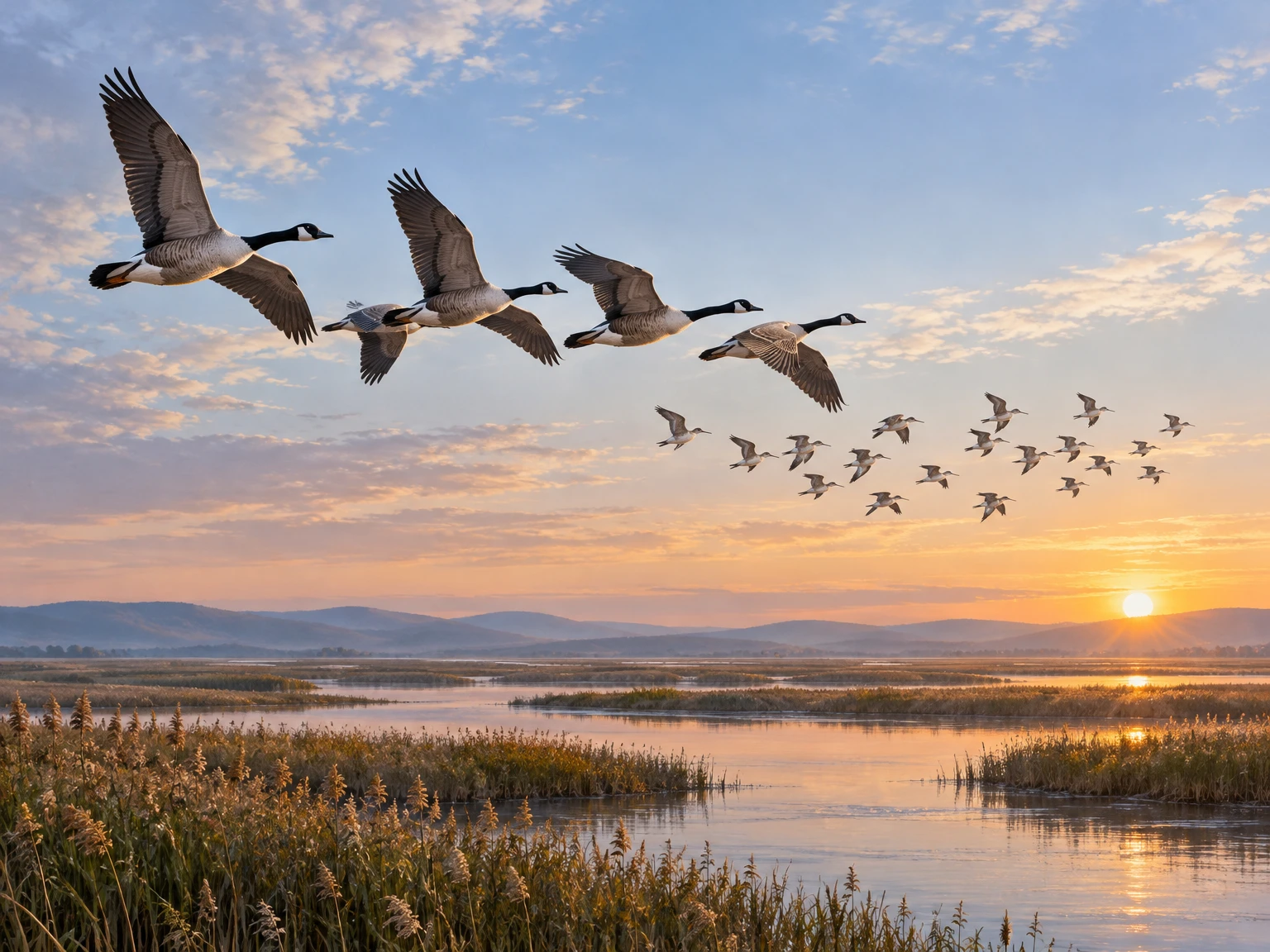
Introduction: A journey shaped by seasons
Across a quiet night, birds may rise from wetlands, forests, grasslands, and shorelines and travel toward places they have never visited. Their journeys are not all alike. Some species cross continents and oceans; others move a short distance down a mountain slope, shift between nearby habitats, or travel only in years when food becomes scarce. Some individuals of a partly migratory species leave while others stay. Migration is best understood as a recurring, large-scale movement that helps animals use resources distributed unevenly through space and time, rather than as a single route or a simple escape from winter.
For birds, the annual cycle links breeding grounds, nonbreeding grounds, and the places used along the way. These stages form one ecological story: the food and habitat that support a bird in one season may be far from the resources it needs in another. The Cornell Lab of Ornithology’s overview, The Basics of Bird Migration, describes how changing resources, navigation, and varied movement patterns shape this phenomenon. This article explains those ideas through the biology of migration: why birds move, how bodies prepare, what guides a route, why stopovers matter, how researchers study flights, and what conservation can do to protect an interconnected journey.
1. What counts as migration?
Migration is a regular, large-scale movement by a population, often between breeding and nonbreeding areas. It is not simply any movement. A bird commuting between a nest and a feeding patch is moving, but that daily trip is not normally called migration. A seasonal movement that repeatedly takes a population between regions, or between elevations, is different because it is tied to an annual pattern of life and resource use.
There is no single distance threshold that neatly separates migrant from resident. A short-distance migrant might shift from a high-elevation breeding area to a lower valley where winter food is available. A medium-distance migrant can travel a few hundred miles. Long-distance migrants may cross countries, continents, or oceans. The same broad label can cover very different physical challenges: a waterfowl species may follow a chain of wetlands, while a small songbird may cross a wide front of land at night. Even within one species, individuals may differ in their destinations, timing, and likelihood of moving.
Birds can also be partial migrants: some members of a population migrate and others remain in place. The balance may vary with age, sex, food supply, weather, or conditions in a particular year. Irruptive movements, by contrast, can happen irregularly when resources fluctuate, as with some northern seed-eating birds. Nomadic species may wander in search of food without a predictable annual round trip. These distinctions matter because a map of a species’ range cannot by itself tell us whether every bird travels, when it moves, or which route it follows.
2. Why leave a familiar place?
Migration allows birds to exploit changing opportunities. Food, safe nesting locations, daylight, and weather do not remain constant across seasons. In northern spring, plants grow and insects become abundant; these seasonal pulses can provide rich food for adult birds and their young. Some northern regions also offer broad nesting habitat during the breeding season. As conditions change later in the year, birds may move to areas where food remains available or where their particular feeding strategy is more workable.
It is tempting to describe migration simply as an escape from cold. Temperature can matter, and winter can make conditions difficult, but cold alone is not a complete explanation. The decisive issue may be whether food is available to meet a bird’s needs. The Cornell Lab notes that many birds, including hummingbirds, can tolerate freezing temperatures when adequate food is available. A bird that can find enough energy in a cold landscape may remain, while another species whose prey disappears must move. The reasons also vary among species and individuals, so no one explanation fits every journey.
Migration carries costs. A long flight consumes energy, exposes birds to storms and predators, and depends on suitable places to rest. The advantage is that a bird may access resources that would otherwise be unavailable at one place throughout the year. This is a trade-off, not a guarantee of success. Evolution has favored different solutions: resident birds, short-distance movers, seasonal migrants, and nomads are all strategies shaped by ecological circumstances. Understanding which resource a species is following helps researchers interpret when and where it travels.
3. The annual cycle is more than two endpoints
Maps often emphasize a breeding range and a winter range, but an annual journey has more than two important locations. It includes spring migration, a breeding season, autumn migration, and a nonbreeding season. Some birds spend weeks or months moving between destinations; others cover a great distance in a small number of flights. The places used between endpoints can be crucial because they supply food and shelter at the exact time a bird needs to rebuild energy or wait for safe weather.
A bird may use different routes in spring and autumn. Winds, day length, food timing, geography, and the locations of safe stopovers can differ by season. Some species travel along broadly defined flyways, while others cross a wide front and shift their path as conditions change. A flyway is not a narrow highway in the sky. It is better understood as a broad movement system connecting breeding areas, stopovers, and nonbreeding grounds. Birds using one system may spread across a region, converge at bottlenecks, or rely on a network of sites whose importance changes with the season.
That annual perspective changes how we think about conservation. Protecting one nesting forest cannot secure a migrant if its wintering habitat is lost or if an essential wetland stopover is degraded. The well-being of a population can depend on many sites separated by national borders and thousands of kilometres. The migration route is a chain of habitats, not merely a line between two dots. If a link weakens, birds may have fewer places to rest, feed, or wait for favorable conditions.
4. Timing: internal programs meet external cues
Departure is not a simple response to a calendar date. Birds combine internal seasonal programs with environmental information. Day length is a reliable cue because it changes predictably through the year. Temperature, rain, wind, food availability, and local habitat conditions can influence the timing of an individual’s movement. The way those signals interact varies among species. Some details of migratory timing remain under study, and researchers avoid treating one cue as a universal trigger.
Many birds undergo physiological and behavioral changes before migration. They increase feeding and store energy, often as fat, which can provide substantial fuel for flight. Their bodies may alter the balance of tissues to support the coming effort. A migratory bird is not simply a normal bird flying farther; it prepares for a demanding period through changes in appetite, energy storage, and flight readiness. The Smithsonian Migratory Bird Center’s educational account, Have Wings, Will Travel: Avian Adaptations for Migration, describes these adaptations and the way energy reserves support travel.
Fat is especially useful because it is an energy-dense fuel, but carrying it also changes a bird’s mass and the energy needed for takeoff. A bird’s reserves therefore reflect a balance between preparation and the cost of carrying extra weight. Some migrants build large reserves before a long flight or a difficult crossing. Others can feed along the way and may travel in shorter stages. The strategy depends on body size, flight style, food, weather, distance, and whether safe landfall is available. The same species may adjust its departure or stopover behavior when conditions differ from one year to another.
5. Flight is an athletic and aerodynamic problem
Flight lets birds travel over barriers that stop many land animals, but sustained flight is mechanically expensive. Wing shape, body mass, muscle performance, and the air through which a bird moves all matter. Many migratory birds have wings adapted for efficient travel, and strong flight muscles power repeated flapping. Some species use soaring flight to exploit rising air; others rely on flapping flight for long stretches. A bird’s anatomy cannot be reduced to one perfect migration design because species use different habitats, feeding methods, and flight tactics.
Before departure, a migrant must acquire enough energy to travel while retaining the ability to maneuver, land, and respond to changing conditions. Long overwater or desert crossings can limit opportunities to stop, making fuel reserves particularly important. Yet a journey is rarely a single uninterrupted marathon for all species. Many birds travel in stages, feeding and resting at stopovers. The Blackpoll Warbler is a notable example of a small songbird undertaking a demanding overwater flight; research summarized by the Smithsonian describes the extraordinary endurance involved. Such examples illustrate the capacity of some migrants, not a template for every bird.
Weather can assist or obstruct flight. Tailwinds may reduce the energy required to move in a preferred direction, while headwinds can slow progress or make travel more costly. Storms can force birds to land in unsuitable places or delay departure. Birds may wait for favorable conditions, alter altitude, or adjust their route. These choices depend on their physical condition and the availability of safe alternatives. A migration strategy is therefore dynamic: body preparation creates capacity, but the atmosphere and landscape influence how that capacity can be used.
6. Navigation: several senses, not one magic compass
Migration poses a puzzle: how can a bird travel far from familiar territory and later return? Research points to a combination of cues rather than a single universal navigation device. Birds can use the sun, the pattern of stars, landmarks, and Earth’s magnetic field. The importance of each cue may differ among species, age groups, and circumstances. A young bird making its first migration may not have a learned map of the route, while an experienced adult can combine inherited orientation with memory of past journeys.
Sun and star cues can provide directional information, but they require the bird to interpret them in relation to time and position. Landmarks such as coastlines, valleys, ridges, or river systems may help a bird maintain a route during daylight. Experiments and observations have also examined magnetic sensitivity in birds, though the mechanisms and how the cues are integrated remain subjects of scientific research. It is important not to overstate what is known: birds navigate successfully, but scientists are still investigating the sensory processes behind that success.
Smell may also contribute to orientation for some species, with particularly well-known research involving homing pigeons. A cue useful to one kind of bird in one context need not be decisive for another. Navigation can be affected by clouds, light pollution, unfamiliar terrain, storms, and the availability of visual landmarks. Young migrants may rely on different information than adults. The Cornell Lab overview summarizes the variety of compass cues and notes that the full navigational story is not completely understood. This uncertainty is not a weakness in the evidence; it is a reminder that animal navigation is complex and that active research refines our explanations.
7. Night flights and the use of darkness
Many songbirds migrate at night, though migration is not exclusively nocturnal. Raptors, waterfowl, swallows, and other groups may move by day, and different species use different schedules. Night travel can offer several advantages: cooler, more stable air, fewer active predators in some settings, and time to feed during daylight. It can also allow birds to orient using stars or other cues in a darker sky. These are possible benefits rather than a single explanation for all nocturnal flight.
For people, a night migration can be invisible. Weather radar provides one way to observe broad movements of birds aloft. BirdCast uses weather surveillance radar and forecasts to estimate nocturnal migration intensity in the United States. Its forecast map guide explains that the maps predict migration by birds actively flying, not the number of birds on the ground. The forecasts are updated periodically and are based on relationships between weather variables and past radar-detected movement. They offer a useful view of large-scale patterns, but they are not a species-by-species census or a guarantee that an individual bird will take a particular path.
Artificial light can complicate nighttime movement. Brightly lit structures may attract or disorient birds, increasing the risk of collision, especially in poor weather. A radar map can reveal broad pulses of movement and areas where migration may overlap with rain, but it does not replace local observation or prove what species are present. Nighttime migration makes clear why conservation can involve people far from a bird’s breeding or wintering range: building lights, tall structures, and habitat decisions can affect birds in transit.
8. Flyways, corridors, and broad fronts
Some migrants follow recognizable flyways, especially waterfowl and shorebirds that move among wetlands, coasts, and other feeding sites. Flyways can channel birds through particular regions, peninsulas, coastlines, mountain passes, or other geographic features. These locations may concentrate large numbers because the landscape offers a good crossing point, a reliable food source, or the last safe place before a difficult flight. Other birds move in broad fronts rather than following a narrow corridor. Many small songbirds can spread over wide areas, then gather locally at favorable feeding habitat.
Flyways are ecological networks. They connect breeding habitat to stopovers and nonbreeding areas, with each site serving different functions. A coastal woodland can be vital after a long flight over water. An inland riparian corridor can provide shade, insects, fruit, and shelter in an otherwise dry landscape. Wetlands can support feeding and rest for waterbirds. The best route is not always a straight line; birds may make detours to follow favorable winds, avoid barriers, or reach resources that improve the odds of continuing.
Because routes can span countries and continents, no single protected area can safeguard the entire journey. Migratory birds may depend on the decisions of land managers, communities, governments, and conservation groups along the route. BirdLife International describes migratory conservation as a coordinated effort across flyways. That perspective also helps avoid a misleading idea that birds simply travel from a “good” place to another “good” place. The value of a site depends on timing, species, conditions, and how it connects to the rest of the annual cycle.
9. Stopover sites: refuelling stations and safe havens
A stopover is a place where a migrant pauses during a journey. Birds may rest, feed, recover from flight, wait for weather, or replenish energy. For long-distance travelers, stopover sites can determine whether a journey is feasible. The Smithsonian Migratory Bird Center’s article Travel Alert for Migratory Birds: Stopover Sites in Decline explains that birds need food, shelter, and water along the way and that different routes depend on specific landscapes.
Stopover habitat is not interchangeable. A tired bird needs places where it can land safely, find appropriate food, avoid excessive disturbance, and remain until conditions improve. A patch that looks green to a person may have little value if it offers no suitable food or cover. Conversely, a small stretch of vegetation may be important if it is the only usable site along a long crossing. Birds can be selective when weather and energy reserves permit; the condition of the bird, wind direction, habitat quality, and food supply can all affect where it stops and how long it stays.
For shorebirds, exposed mudflats and shallow wetlands can provide invertebrate prey. For forest songbirds, trees and shrubs can offer insects, fruit, and shelter. Riparian corridors and hedgerows may function as stepping stones through modified landscapes. Some stopovers are used for brief periods; others support longer recovery. The challenge for conservation is to protect both prominent concentrations and less conspicuous sites that may be essential to birds using a particular route. A bird that arrives late, depleted, or unable to find adequate food may begin the next stage in poor condition, which can affect later survival and breeding success.
10. Migration risks and human-made hazards
Migration is demanding even without human impacts. Birds encounter storms, strong winds, predators, hunger, and the difficulty of finding suitable places to land. Their success depends on a chain of decisions and conditions: whether they can store sufficient energy, whether weather allows safe movement, whether stopovers remain available, and whether the destination still contains the resources they need. Natural hazards vary from year to year, and a route that is favorable in one season may be dangerous in another.
Human activity adds additional risks. Collisions with windows, towers, and other structures can kill birds, especially when artificial lighting and bad weather combine. Habitat conversion can remove feeding and resting sites. Wetland drainage, forest loss, agricultural intensification, pollution, and disturbance can reduce the quality of habitat along a route. Climate change can shift the timing of seasonal resources and alter habitat distribution. These pressures may interact: a bird facing a longer flight because one stopover has been lost has less margin for a storm or headwind.
BirdLife International’s September 2026 report on migratory birds states that 45 percent of migratory bird species are in decline and one in nine is threatened with extinction. It identifies pressures including invasive species, agricultural intensification, climate change, and unsustainable hunting. This is a reported global assessment, not a statement that every migrant is declining at the same rate. It underscores why researchers and conservation organizations emphasize whole-route planning. A single intervention may help, but persistent threats at several points can undermine that progress.
11. Climate, seasonality, and changing timing
Bird migration is closely linked to seasonal cycles of food and habitat. When spring warmth, plant growth, insect emergence, or water availability shifts, the timing of resources may shift too. A migrant that reaches a breeding area after its best feeding window may have less opportunity to raise young successfully. A bird that departs too early could encounter poor weather or scarce food; one that leaves too late may face a compressed breeding season. These relationships are species-specific and vary by region, so broad claims must be supported by local evidence.
Climate change can affect several stages of a migrant’s annual cycle at once. Conditions on breeding grounds, stopovers, and nonbreeding grounds may change differently. A species may respond to one cue while its food source responds to another, creating a mismatch. Rising seas can affect coastal wetlands, while drought can reduce water in inland stopover habitat. Extreme weather can make migration more difficult or change the availability of food. BirdLife’s review discusses how climate pressures combine with habitat loss and other threats across flyways, rather than acting in isolation.
Not every population will respond in the same way. Some birds can adjust departure dates, use alternative sites, or change routes; others may have less flexibility because they depend on a specialized habitat or a narrow seasonal window. A range map drawn from past observations may not represent the current situation perfectly. Digital monitoring and repeated observations help scientists track change over time, but comparisons must account for survey effort and detection. Conservation planning therefore benefits from current data and local knowledge, not from assuming that past patterns will persist unchanged.
12. How scientists study migration
Tracking a tiny bird across a continent is difficult. Traditional banding places a uniquely numbered band on a bird’s leg; if the bird is later recaptured or observed, researchers learn something about its movement. Banding has contributed greatly to migration science, but recovery opportunities can be rare and uneven. New tools have expanded the picture. Lightweight geolocators can estimate location from light levels, GPS devices can provide more precise positions when size and power constraints permit, and automated radio-telemetry networks can detect tagged individuals near receiver stations.
Weather radar observes large numbers of birds as they move through the atmosphere. Radar can reveal when migration is intense and how movements relate to weather, but it often cannot identify every species in the air. eBird, a community-science platform, provides many observations that can help map species distributions over time. Researchers combine these data with tracking, banding, radar, habitat maps, and models to understand routes and seasonal changes. Each method has limitations, and the strongest conclusions often come from combining independent lines of evidence.
The U.S. Geological Survey describes work using radar and the Motus Wildlife Tracking Network to study movements and stopovers among birds. Radar can show broad patterns of movement, while tags can reveal the paths of individual birds. These scales answer different questions. A radar image may show a region-wide pulse, but not which individual birds made it; a tag may follow one bird closely, but cannot by itself describe the whole population. Migration science is therefore a process of matching tools to questions, checking uncertainty, and refining the interpretation as new data become available.
13. What migration maps can—and cannot—tell us
Maps make migration visible, but they simplify complex movements. A line drawn between breeding and wintering ranges can hide the time spent at stopovers, the variation among individuals, and the differences between spring and autumn routes. A population-level map summarizes patterns; it does not imply that every bird follows the same path. Models can estimate where birds are likely to occur in a given week, but estimates remain dependent on the observations and assumptions used to build them.
BirdCast’s forecast maps are one example of a carefully scoped tool. They estimate nocturnal migration intensity for birds in active flight, using weather forecasts and historical radar observations. The maps are useful for anticipating broad movements in the United States, particularly in the radar network’s coverage area. They do not predict exact numbers on the ground, identify all species present, or provide a global forecast for every flyway. Their published documentation explains these boundaries and the relationship between weather and predicted intensity.
eBird Status and Trends maps offer another approach, using observations and models to describe changing distribution through the year. Such maps can help birders plan when to look for a species and help researchers ask questions about seasonal patterns. But observations depend on where people watch, what they can identify, and how much effort is made. Models help address gaps but do not eliminate uncertainty. Readers should interpret maps as evidence-based tools with a defined scope, not as perfect real-time tracking of every individual bird.
14. Conservation across an entire route
Effective conservation must consider the full annual cycle. Protecting breeding habitat is essential, but it cannot compensate for the loss of a critical stopover or wintering site. Coordinated work can include maintaining wetlands, restoring native vegetation, protecting forests and grasslands, reducing disturbance at important feeding grounds, and designing buildings and lighting to lower collision risks. The right action depends on the species, region, and documented pressure. Conservation plans should be guided by evidence rather than by a generic checklist applied everywhere.
International cooperation matters because migratory birds cross borders without regard for them. Flyway initiatives can help countries share information and coordinate protection of connected sites. Communities and landowners can contribute by conserving habitat, restoring native plants, and supporting monitoring. Cities can reduce unnecessary light at night during peak migration periods and adopt building practices that reduce collision risk. Wetland management can preserve the shallow water and food resources used by waterbirds. These measures are most useful when they address a demonstrated need and are maintained over time.
BirdLife International’s 2026 report notes that coordinated action can improve outcomes, citing multi-country work for Egyptian Vultures as an example of a breeding-population decline being halted. That example does not mean every population will respond identically; it illustrates that collaboration across a species’ range can matter. Conservation success depends on identifying the right pressures, implementing practical actions, and measuring whether bird populations and habitat conditions improve. Migrants remind us that local stewardship and international cooperation are complementary parts of the same task.
15. Observing migration responsibly
Birdwatchers can learn a great deal by observing seasonal changes. A notebook that records date, location, habitat, weather, and identification confidence can make observations more useful. Community-science submissions, such as carefully documented checklists, can help build a broader picture of where birds occur. Respect for wildlife comes first: observers should avoid approaching nests, flushing resting flocks, playing disruptive calls, or entering protected areas without permission. A good observation should not interfere with the animal’s need to feed, rest, or avoid predators.
Migration is variable, so one unusual sighting should not be treated as proof of a new trend. Local weather, food availability, and the timing of seasonal movements can produce short-term changes. Repeated observations across years are more informative, particularly when effort is described. Birders should also be mindful of the limits of their tools. Forecast maps can suggest when nocturnal movement may be strong, but they do not guarantee a spectacular morning at a particular site. Range maps can guide expectations, but they may lag behind a shifting distribution.
At home, native plants can provide food and shelter for birds moving through a neighborhood, while a reliable water source can be useful during dry conditions. Window treatments and reduced nighttime lighting can address common hazards. These steps do not replace habitat protection at larger scales, and a feeder does not remove the need for natural food and safe habitat. They are practical contributions that fit within a broader approach. The most useful response is often to connect personal action with local conservation programs and the scientific monitoring that reveals which places and species need attention.
Conclusion: a connected life in motion
Bird migration is not a single feat of endurance but a set of strategies for living in a changing world. Birds differ in whether they migrate, how far they travel, what cues shape departure, and how they navigate. Their journeys depend on energy, weather, suitable habitat, and the availability of stopovers. Research has revealed more through banding, tracking devices, radar, and community observations, while important questions about routes, timing, and sensory mechanisms remain open.
The greatest lesson is that the journey has no disposable segments. Breeding grounds, nonbreeding areas, and places used in between all belong to the same annual cycle. Protecting connected habitats, reducing avoidable hazards, monitoring populations, and coordinating across borders can improve the prospects for migratory birds. Following their movements also shows how closely wildlife depends on seasonal resources and intact landscapes—and how conservation can succeed when it addresses the whole route rather than only its most visible endpoint.
Sources and further reading
- Cornell Lab of Ornithology, The Basics of Bird Migration: How, Why, When, and Where.
- Smithsonian Migratory Bird Center, Have Wings, Will Travel: Avian Adaptations for Migration.
- Smithsonian Migratory Bird Center, Travel Alert for Migratory Birds: Stopover Sites in Decline.
- BirdCast, Forecast Maps: Methods and Interpretation.
- BirdLife International, Birds Are Running Out of Places to Land: 45% of Migratory Bird Species Now in Decline, 11 September 2026.
- U.S. Geological Survey, Movements and Migratory Stopovers Among Birds Using Radar and Motus Tracking.
This content is a collection of ancient history,books and various articles and collection of library and news and other post ; all details may not be the same. Readers are requested to verify the information themselves. Readers are not allowed to take any disciplinary action; content is only for educational purposes. If readers do not agree about the contents, they may send a personal comment to my personal email ID: achary.purna@gmail.com
