




Chapter 1: The Global Landscape of the Footwear Industry (2026 Survey)
The global footwear market in 2026 is defined by a paradox: a slowing macro-economy in Western markets contrasted by an explosion of technical innovation in manufacturing hubs like India and Southeast Asia.
1.1 Material Trends: The Rise of Advanced EVA
According to the latest industry surveys, EVA (Ethylene Vinyl Acetate) remains the dominant material for the mass-market and athletic segments. However, the formulation has shifted. Nearly 28% of manufacturers are now integrating “Innovative Foam Materials” that prioritize high energy return and carbon-footprint reduction.
1.2 Consumer Demographics
The survey data highlights a critical shift in leadership. For the first time, brands focusing on lifestyle-comfort are outperforming pure-performance brands. This places immense pressure on Quality Control departments to ensure that mass-produced EVA shoes—often viewed as “value” products—meet “premium” durability standards.
Chapter 2: The Science of EVA Injection Molding
To understand the cooling requirements, one must first understand the molecular behavior of EVA during the injection process.
2.1 The Injection Phase
EVA is a copolymer that becomes extremely tacky when heated. In the injection machine, it is typically processed at temperatures between 160°C and 190°C. When the molten EVA hits the mold, it undergoes a “micro-cell” expansion.
2.2 Why Post-Molding Time is Non-Negotiable
Unlike PVC or TPR, EVA is a “living” material for several hours after it leaves the machine. It possesses thermal memory. If an EVA shoe is moved to a cold storage or packed too quickly, the cells inside the foam can collapse or over-expand, leading to:
- Size variance: The left shoe becoming smaller than the right.
- Warpage: The sole curving upwards (rocker effect) unintentionally.
- Shrinkage: A loss of up to 5% of total volume if not stabilized.
Chapter 3: QA Policy for EVA Storage & Stabilization
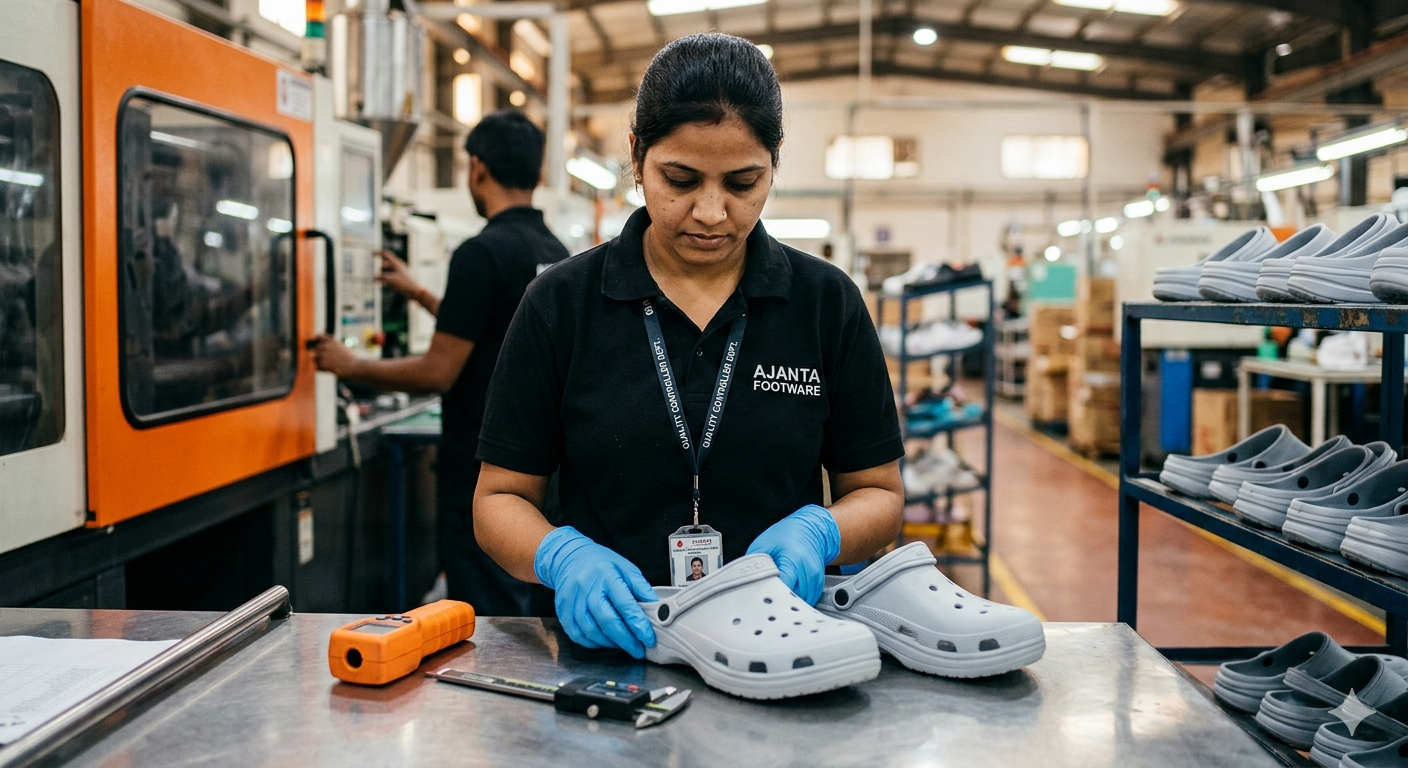
As per the rigorous QA Policy of Ajanta Footwear, the Quality Controller (QC) must enforce a “Static Period” for all molded components.
3.1 The 2-to-4-Hour Window: The Golden Rule
The QC department mandates a minimum of 2 to 4 hours of open-air storage. This is not merely a “cooling” phase; it is a Stabilization Phase.
Factors that Dictate Stabilization Time:
- Compound Density: High-density EVA (used for work boots) retains heat longer than low-density “cloud” foam.
- Cross-Linking Agents: The chemical “bridge” being formed between polymers requires time to reach equilibrium.
- Atmospheric Pressure: In high-altitude factories, cooling occurs faster, but stabilization takes longer due to gas expansion within the cells.
3.2 Environmental Standards for Storage
The storage area must be:
- Well-Ventilated: To carry away residual gases (fumes) from the blowing agents.
- Shielded from Direct Sunlight: UV rays can trigger premature yellowing on the “tacky” surface of freshly molded EVA.
- Temperature Controlled: Ideally maintained at 25°C to 30°C. Extreme cold can “shock” the material, making it brittle.
Chapter 4: The QC Checklist for Finishing & Trimming
Once the stabilization clock hits the 4-hour mark, the Quality Controller moves the batch to the Finishing Department.
4.1 Trimming and Deflashing
In EVA injection, “flash” (excess material) is common at the mold parting lines.
- QC Requirement: Tools must be sharp to avoid “tearing” the stabilized foam.
- Inspection Point: The QC must check for “air bubbles” or “voids” that only become visible after the flash is trimmed.
4.2 Surface Treatment and Priming
If the shoe requires printing or painting, the surface tension of the EVA must be tested. Freshly molded EVA often has “mold release agents” on the surface.
- The “Water Drop” Test: If water beads on the surface, the shoe is not ready for painting. It must be cleaned or “primed” to ensure chemical bonding.
Chapter 5: Packing – The Final Quality Frontier
Packing is the most underestimated stage in the QA process.
5.1 Thermal Residue and Odor Management
Packing EVA shoes while they are still warm (even slightly) creates a “greenhouse effect” inside the shoebox. This leads to:
- Odor Accumulation: The trapped acetic acid smell (typical of EVA) becomes overwhelming for the consumer.
- Box Deformation: Residual heat can weaken the adhesive on the cardboard box.
5.2 The 30-Minute Packing Audit
Each batch must undergo a Random AQL (Acceptable Quality Level) Inspection during the 15-30 minute packing window.
- Match-Pairing: Ensure color shades match perfectly under D65 light standards.
- Dimensional Stability: A final measurement against the “Master Sample” to ensure no shrinkage occurred during the 4-hour storage period.
Chapter 6: Conclusion – The Future of Footwear QA
In 2026, the role of the Quality Controller has evolved from a “fault-finder” to a “process-optimizer.” By strictly adhering to the 3 to 5-hour total timeline from molding to packing, factories like those following the Ajanta Footwear standards achieve a Zero-Defect Rate in dimensional stability.
Summary Table for the Production Floor:
| Process Stage | Duration | Primary QC Goal |
|---|---|---|
| Injection Molding | Seconds | Consistency in weight & density |
| Open Air Storage | 2–4 Hours | Thermal stabilization & degassing |
| Finishing/Trimming | 30–60 Mins | Aesthetic perfection & flash removal |
| Final Packing | 15–30 Mins | Correct pairing & odor control |
Total Lead Time: 3 to 5 Hours.
Final Blog Pro-Tip for Industry Readers:
Never sacrifice stabilization time for shipment speed. A shoe that shrinks in the box is a shoe that returns to the factory. In the 2026 market, reputation is built on the 4th hour of storage.
The Invisible Cost of Speed: A Deep Dive into Footwear Quality and Business Survival
In the high-stakes world of footwear manufacturing, especially when working with high-performance materials like EVA (Ethylene Vinyl Acetate), the pressure to deliver “fast and cheap” is a constant siren song for employers. However, for a Quality Controller—particularly under a structured QA policy like that of Ajanta Footwear—the “cooling and stabilizing” phase isn’t just a suggestion; it is the structural backbone of the product’s integrity.
When a company chooses to bypass the 2-to-4-hour open-air stabilization period to chase rapid production, they aren’t just saving time; they are inviting a cascade of quality and business failures that can be terminal for a brand.
The Technical Fallout: What Happens When You Skip Stabilization?
Manufacturing EVA shoes using an injection machine involves high heat and pressure to expand the material into the mold. When the shoe is ejected, it is “living” material—it is still chemically and thermally active.
- Dimensional Instability (The Shrinkage Trap): EVA continues to shrink as it cools. If you move to finishing and packing immediately, the shoe may pass QC at the 5-minute mark but be half a size smaller by the time it reaches the customer.
- Warping and Deformation: Without open-air stabilization, internal stresses are “locked” into the shoe. If packed while still warm, the weight of other shoes in the carton will permanently deform the soles, leading to lopsided outsoles that cause physical discomfort to the wearer.
- Adhesion Failure: Finishing often involves logos or surface treatments. Applying these to a “gassing” EVA part (which is still releasing residual air and heat) prevents proper bonding. The result? Logos that peel off within a week of use.
- Compression Set Issues: EVA that hasn’t cooled naturally often loses its “rebound” property. The cushioning—the very reason customers buy EVA shoes—will “bottom out” much faster, turning a comfortable sneaker into a flat, hard slab.
The Business Performance Crisis
For an employer, “Rapid Production” without QA is a mirage. The perceived gains in volume are quickly wiped out by the following business impacts:
1. The “Return Wave” and Financial Bleeding
In the short term, the warehouse looks empty and the sales look high. But within 30 to 60 days, the “Return Wave” hits. When 15% of a batch is returned for size inconsistencies or peeling logos, the cost of reverse logistics, inspections, and refunds often exceeds the original profit margin of the entire batch.
2. Brand Erosion in the Digital Age
Today’s consumer is a micro-influencer. A single viral video showing a deformed Ajanta shoe or a sole that “went flat” in two weeks can reach millions. In the footwear industry, trust is built over decades but can be liquidated in a single “fast production” season. Once a brand is labeled “low quality,” it is forced into a price war where it can never win.
3. Operational Stagnation
When you ignore QC policies to move faster, your factory enters a cycle of reactive manufacturing. Instead of innovating new designs, your engineering and QA teams spend 80% of their time “firefighting”—managing recalls, answering customer complaints, and trying to fix defective stock. This prevents the company from ever scaling effectively.
Crucial Lessons for the “Speed-Obsessed” Employer
If an employer wants to maintain a competitive edge while ignoring QA/QC policies, they must understand these three hard truths:
“Quality is not an obstacle to speed; it is the floor that speed runs on.”
- Lesson 1: You cannot ‘inspect’ quality into a product. Quality must be manufactured into it. If the process (like the 2-hour cooling time) is skipped, no amount of final inspection can fix the molecular instability of the EVA. Employers must view QA policies as a “Recipe for Success,” not a “Checklist for Compliance.”
- Lesson 2: Short-term profit is a loan from your future reputation. Bypassing the QA policy for a large order might meet a quarterly goal, but the interest rate on that “loan” is the loss of customer loyalty. In footwear, the most expensive customer is the one you have to acquire twice because you lost them the first time.
- Lesson 3: The Cost of Prevention is always lower than the Cost of Failure. Investing in more racks for open-air storage or better climate control in the stabilizing zone is a one-time capital expense. A product recall or a lawsuit over “trip hazards” caused by warped soles is an uncapped liability.
Conclusion
In the footwear industry, the Quality Controller is the guardian of the brand’s future. Following the Ajanta Footwear QA Policy regarding the 3-to-5-hour timeline from molding to packing isn’t just about making “good shoes”—it’s about building a sustainable business. Rapid production without stabilization is like building a house on wet concrete; it might look finished today, but it will inevitably collapse tomorrow.
The Invisible Engine: Why QA/QC is the Heartbeat of Modern Footwear Manufacturing
In the high-speed world of footwear production, where “Time is Money” is the ultimate mantra, the Quality Assurance (QA) and Quality Control (QC) departments are often viewed by factory owners as bottlenecks. However, in the context of the Ajanta Footwear QA Policy, quality isn’t just a department—it’s the fundamental difference between a profitable brand and a failing factory.
For manufacturers moving from PVC or PU to EVA (Ethylene Vinyl Acetate) injection technology, the stakes are even higher. While EVA offers significant cost savings and superior comfort, its chemical nature makes it volatile. If you skip the critical processes—like the 2-to-4-hour open-air stabilization period—you aren’t just saving time; you are manufacturing a disaster.
This guide explores the footwear industry’s shifting landscape, the technical “why” behind EVA stabilization, and how to convince employers that a robust QA/QC team is an investment, not an expense.
1. The EVA Revolution: Why the Industry is Switching
The global footwear market has seen a massive shift toward EVA injection for outsoles and midsoles. The reasons are primarily financial and functional:
- Cost Efficiency: Compared to PU (Polyurethane), EVA is significantly cheaper to source and process.
- Lightweight Comfort: EVA is essentially a “foam” material filled with tiny air bubbles, providing the cushioning consumers demand.
- Production Speed: Injection molding allows for high-volume output compared to traditional rubber compression.
However, EVA is a “living” material. Unlike PVC, which is relatively stable once cooled, EVA expands and contracts based on its chemical “blowing agents.” This is where rapid production lines often fail.
2. The Danger of Shifting: What Happens When You Skip the Process?
Many rapid-production facilities try to move shoes from the injection machine straight to packing in under 30 minutes. Under Ajanta’s QA standards, this is a critical failure. Here is what happens when you ignore the 2-to-4-hour air-cooling rule:
A. Dimensional Instability (The “Shrinking Shoe” Syndrome)
EVA comes out of the mold at high temperatures. If it is packed immediately, the trapped heat causes the material to continue reacting inside the box.
- The Result: A batch of size 8 shoes might shrink to a size 7.5 by the time they reach the retail shelf.
B. Deformation and Warping
When hot EVA is stacked or boxed, the weight of other shoes causes permanent indentations. Since the material hasn’t “set” its molecular structure, it loses its intended shape.
C. Outgassing and Odor
The injection process involves chemical blowing agents. If not allowed to “breathe” in open air, these gases stay trapped in the material, leading to a strong chemical smell that can alienate customers and even fail safety toxicity tests.
3. The Role of the Quality Controller: Beyond “Checking Boxes”
In an Ajanta-compliant environment, the Quality Controller (QC) is the guardian of the brand’s reputation. Their role is divided into two vital phases:
Quality Assurance (The Strategy)
QA is about prevention. It involves setting the policy: “No shoe leaves the cooling rack before 120 minutes.” It ensures the injection machines are calibrated to the exact temperature and pressure required for that specific EVA density.
Quality Control (The Action)
QC is the inspection.
- Trimming Accuracy: Ensuring the “gates” and “flash” are removed without damaging the sole.
- Symmetry Checks: Comparing the left and right shoe for identical curvature and height.
- Stress Testing: Ensuring the bond between the EVA sole and the upper doesn’t peel under tension.
4. Convincing the Employer: Turning Quality into Profit
If your employer sees the QC team as a “speed bump,” you must change the conversation from Quality to Economics. Here is how to build your case:
Argument 1: The Cost of Returns (The “Hidden Tax”)
Show the data. If 5% of your shoes are returned due to shrinking or warping because of skipped cooling times, that cost is 10x higher than the cost of hiring two extra QC inspectors.
- Fact: It is cheaper to catch a mistake on the factory floor than to pay for shipping, returns, and lost customer trust.
Argument 2: Brand Longevity vs. Fast Cash
A factory that skips the curing process might make a quick profit today, but they will lose their contracts with major players like Ajanta tomorrow. Standardized QA policies are what allow a factory to graduate from “local workshop” to “global supplier.”
Argument 3: Waste Reduction
A robust QC team identifies “Stage 1” errors (e.g., bad material mix) before 5,000 pairs are made. Without QC, you might produce a whole day’s worth of scrap before anyone notices the defect.
5. Conclusion: Quality is the Only Way Forward
The footwear industry is no longer just about making “something to wear.” It is about precision engineering. Using EVA saves money, but only if you respect the chemistry of the material.
By adhering to a strict 3-to-5-hour timeline from mold to pack, and empowering your QA/QC team to enforce these rules, you aren’t slowing down production—you are ensuring that every pair of shoes sold is a walking advertisement for your excellence.
Final Thought for Manufacturers: You can’t fast-track physics. Give your EVA the time to breathe, and your brand will have the room to grow.


