
Following evidence without flattening tradition
The story of Siddhartha Gautama’s youth is often told as a continuous drama: a prince grows up in a palace, receives every luxury, sees suffering beyond the palace walls, and leaves home to seek an answer. That telling draws on Buddhist traditions that have shaped art, teaching and pilgrimage for centuries. It is meaningful as religious narrative. It is not, however, a contemporary biography written down by witnesses to the events.
The earliest Buddhist discourses offer a more limited kind of testimony. In them, the Buddha retrospectively describes a refined life in his father’s home and recalls leaving home while young, despite his parents’ grief. These passages are important evidence for what early Buddhist communities preserved as his own recollection. They do not give a complete childhood story, identify the childhood city, or independently verify every detail in later biographies.
This distinction is not a contest between faith and history. A narrative can express Buddhist ideas about privilege, aging, loss and renunciation without functioning as a dated archive. Here, early textual testimony, later biography, archaeology and modern historical interpretation are kept separate. Where evidence supports a possibility rather than a certainty, the difference matters: ‘a tradition says’ is not the same claim as ‘archaeology proves.’
Kapilavastu: a remembered city, an unsettled site
Early Buddhist texts place the Shakyas and the Buddha’s community in Kapilavatthu, the Pali form of Kapilavastu. The town is a recognizable setting in the narratives and discourses, but the surviving texts do not provide a map that lets archaeologists point to one modern site with complete certainty. Modern Kapilavastu is therefore both a literary place and a question of historical identification.
Tilaurakot, in Nepal’s southern Terai, is the principal candidate advanced by Nepalese archaeology and represented on UNESCO’s Tentative List as the archaeological remains of the ancient Shakya capital. Excavations and geophysical surveys have identified a substantial fortified settlement, gates, a planned urban layout and a central walled complex. Durham University’s project reports occupation in the region from the first millennium BCE, with evidence for early fortification and a planned settlement around the sixth century BCE. That establishes an important ancient city; it does not by itself identify Siddhartha’s residence or prove that he lived in a particular excavated building.
Piprahwa and nearby Ganwaria, across the modern border in India, are another major candidate. K. M. Srivastava argued that the stupa, relic inscription associating relics with the Shakyas, monastery sealings reading ‘Kapilavastu,’ and residential structures at Ganwaria together identify this complex as the ancient capital. Other scholars and the Tilaurakot research project favor the Nepalese site. Some evidence is centuries later than the Buddha’s likely lifetime, and the meaning of each inscription and structure must be assessed in context. The identification remains disputed; neither candidate has produced a contemporary inscription saying that a particular house was Siddhartha’s palace.
Lumbini and Kapilavastu should also be kept distinct. UNESCO identifies Lumbini in present-day Nepal with the Buddha’s birth, supported by the third-century-BCE Ashoka pillar. Kapilavastu is associated with the Shakya community and the setting of his youth. A journey in a later pilgrimage narrative may connect these places, but a connection in the story does not make them one archaeological site. The distinction is useful because popular retellings sometimes place all events of the Buddha’s life in a single imagined palace landscape.
The Shakyas and the meaning of ‘royal’
The word ‘prince’ is familiar, but it can suggest a centralized monarchy much larger and more hierarchical than the evidence warrants. The Shakyas are usually understood by historians as a small clan polity, often described with the terms gana or sangha. Such polities were governed through an assembly of elite lineages and a leading figure, rather than necessarily by an absolute king whose son inherited a large kingdom. The exact balance of authority, the procedures of the assembly and the status of different groups are not fully recoverable.
Modern historian Upinder Singh cautions that ancient gana-sanghas were not modern democracies. Political participation was restricted to a relatively narrow aristocratic group; dependent or subordinated people did not necessarily share the decision-making rights of leading householders. Buddhist literature depicts the Shakyas as a community with collective institutions, but literary descriptions should not be turned into a complete constitution. The evidence also places the Shakyas in a wider world of neighboring powers, including Kosala, rather than in an isolated empire.
The early discourses cited in this article do not call Siddhartha a king or name his father as Suddhodana. Later biographies often call Suddhodana a king and Maya a queen, and call their son a prince. Those titles form part of the narrative tradition. Some scholars have proposed that a leading Shakya household could have enjoyed wealth and status while the polity remained clan-based. It is safer to say that Buddhist tradition remembers Siddhartha as belonging to a privileged Shakya family than to assert that he was a proven heir to a vast hereditary kingdom.
Dating the Buddha’s life is itself uncertain. UNESCO’s Lumbini page reports 623 BCE as the birth year in its traditional account, while modern scholarly chronologies often place his life later, commonly in the fifth century BCE, with continuing debate over the exact dates. Dates assigned to excavated walls and settlement phases cannot be used to settle a personal birth date. The article therefore avoids a firm age for Siddhartha’s youth or departure, even though later biographies frequently supply one.
What the early discourses say about refinement
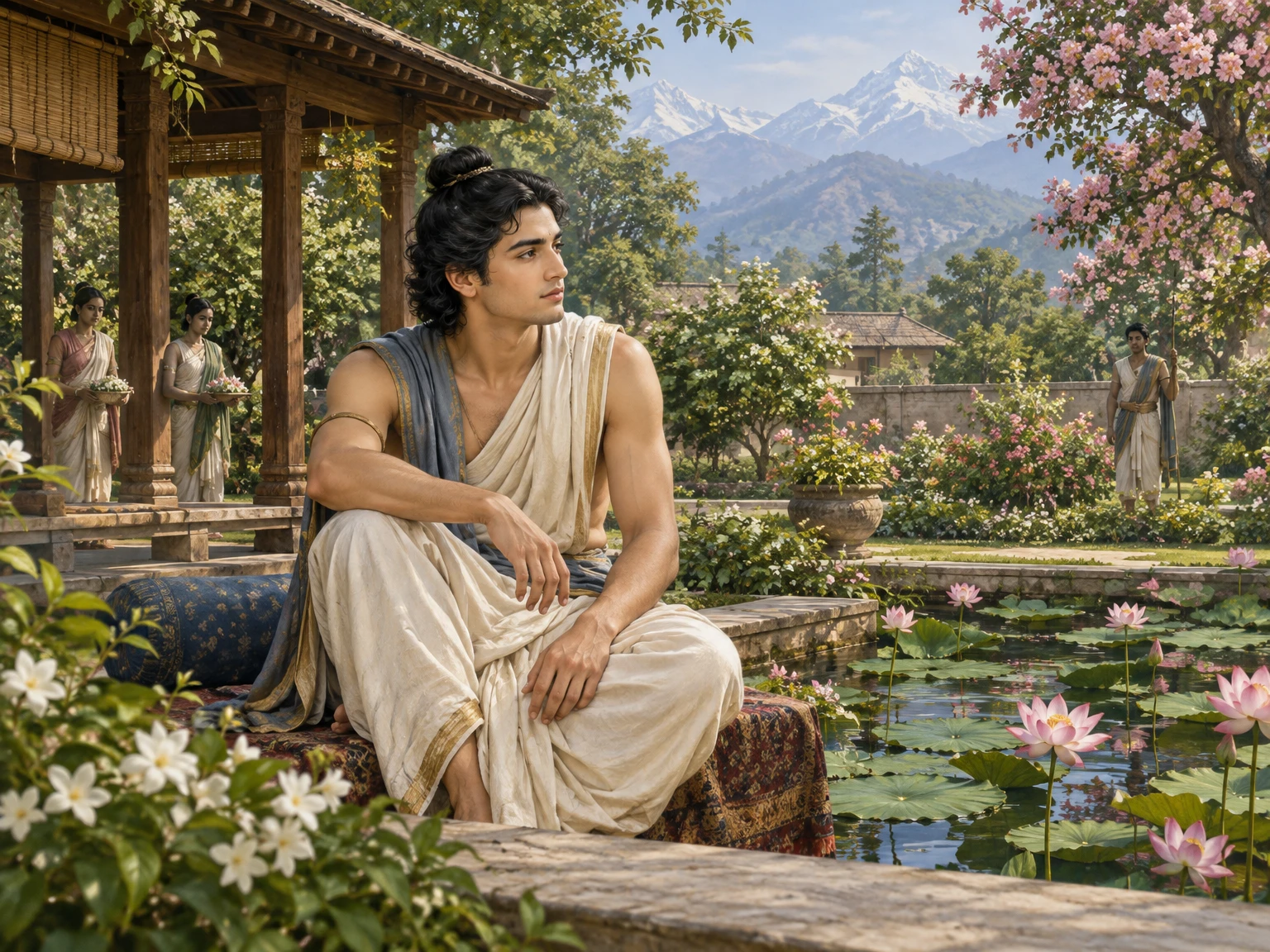
A striking passage appears in the Pali collection known as the Aṅguttara Nikāya, in the discourse called the Sukhumāla Sutta or ‘Refinement.’ In Thanissaro Bhikkhu’s translation, the Buddha says, ‘I lived in refinement, utmost refinement, total refinement.’ He remembers lotus ponds made for him in his father’s home, fine clothing and sandalwood, a white sunshade, and three seasonal residences or palaces. For four rainy-season months, musicians entertained him and he did not go outside the palace compound.
The passage is unusually specific about comfort, but its purpose is not to catalogue a royal estate. It moves from remembered luxury to reflection on aging, illness and death. The contrast makes the teaching vivid: someone who had known bodily ease could still see that youth does not prevent aging, health does not prevent sickness, and life does not escape death. Privilege is presented as a setting for insight, not as proof that the speaker commanded an army, ruled a state or lived in a palace whose ruins can now be identified.
The passage does not name Kapilavastu, Siddhattha, Suddhodana, a tutor, a wife or Rahula. It does not tell the four-sights story. The early textual claim is therefore narrower than many familiar summaries: the Buddha is represented as recalling an exceptionally sheltered upbringing and seasonal palaces in his father’s home. The text itself is an early Buddhist discourse transmitted within a religious community, not an inscription made during his childhood. Its recollection deserves attention while retaining the normal historical caution applied to retrospective testimony and oral transmission.
The numbering of the refinement discourse varies across editions. Thanissaro Bhikkhu’s Access to Insight translation labels it AN 3.38 and notes that some Pali Text Society editions divide the material differently; SuttaCentral numbers the Sukhumāla discourse AN 3.39. The title is a useful stable identifier. A numbering difference is an editorial and collection-history issue, not evidence for two separate childhood testimonies. The translation’s ‘palaces’ also reflects a rendering choice; the key point is seasonal residences and remembered refinement, not a modern architectural classification.
Leaving home in the Noble Search
The Majjhima Nikāya’s Ariyapariyesanā Sutta, or ‘Noble Search,’ gives a second first-person recollection. The Buddha says that while still young, with his parents unwilling and weeping, he shaved his hair and beard, put on the robe and went forth from the household life into homelessness. The passage then follows his search for a satisfactory spiritual path, including study with Āḷāra Kālāma and Uddaka Rāmaputta, and his later striving at Uruvelā.
This is valuable evidence for an early canonical memory of departure and family sorrow. It is not a detailed departure scene. The discourse supplies no exact age, no date, no name for either parent, and no identification of the home as Kapilavastu. It does not describe a secret night ride, a charioteer, a sleeping wife, a final conversation, or a planned sequence of encounters with old age, sickness and death. Those details should not be imported into the passage as if they were in its words.
The discourse also uses household ties in a teaching about the limits of things subject to birth, aging, illness and death. Its references to spouses or children in that argument are not a family register. The text’s focus is the spiritual search and the turning away from a life that cannot secure lasting freedom. Read alongside the Sukhumāla Sutta, it offers a restrained outline—privileged youth, family bonds, departure, teachers and practice—without the elaborate childhood chronology found in later life stories.
How a fuller Buddha biography developed
The Pali Nikāyas preserve teachings and scattered life episodes, not one continuous modern-style biography. The oral transmission of Buddhist texts continued across generations; written collections and later commentaries have their own histories. A narrative assembled centuries after the events can preserve older memories, religious interpretation, literary conventions and local devotion together. Its later date does not make it useless, but it changes the question we should ask: it is evidence for how communities told the Buddha’s life, not automatically direct evidence for every event it narrates.
Among the major Sanskrit biographies is Aśvaghoṣa’s Buddhacarita, commonly placed around the second century CE. Its chapters present palace life, the prince’s encounters with suffering and his departure. The Lalitavistara is a composite Buddhist life narrative whose received form is later than the earliest discourses; its chapter sequence includes schooling, arts, marriage, palace life and excursions beyond the palace. The Mahāvastu is also a layered biography, while the Pali Nidānakathā, which introduces the Jātaka commentary, is generally associated with a much later period, often around the fifth century CE.
These works do not necessarily agree on every name, age, sequence or emphasis. The Lalitavistara, for example, narrates marriage to Gopā; other traditions use names such as Yaśodharā and Yasodharā. Translations, recensions and later retellings also vary. A responsible account identifies which story comes from which literary source, and avoids blending details from several texts into one supposedly uniform eyewitness account. Their richness helps explain why the story is so visually memorable, even as historical claims remain limited.
The dates of the texts are not dates of the events they describe. The Pali discourses were transmitted orally before the canon was committed to writing, and their precise composition histories are difficult to reconstruct. Scholars often treat some material as relatively early within Buddhist literature, but ‘early’ is comparative: it does not mean an eyewitness document written in Siddhartha’s youth. The first-person voice tells us how the tradition presents the Buddha’s recollection; it cannot on its own settle every historical detail of that recollection.
Palaces, schooling and the cultivated prince
The three seasonal residences in the Sukhumāla Sutta are early canonical evidence for the tradition of comfort. Later biographies enlarge that image into an elaborate courtly world of palaces, attendants, gardens and protections against unpleasant sights. Some texts describe the young man being shielded from suffering so that his life appears almost sealed off from ordinary human vulnerability. These additions shape a powerful contrast with renunciation, but the early discourse does not give their architectural plan, names or archaeological coordinates.
Later works also turn education into a set of dramatic episodes. The Lalitavistara depicts Siddhartha mastering scripts, calculation, and worldly and martial arts to an extraordinary degree. Such scenes express the ideal of a complete, exceptional bodhisattva and the culture’s expectations of elite training. They are not an independently verified school record. The early passages considered here say nothing about a childhood tutor, an examination, a contest, a named martial curriculum or a personal feat in combat. No battle, military command or rulership should be invented from the word ‘prince.’
Education in an ancient elite household is historically plausible in general terms, but plausibility is not proof of a particular syllabus. We cannot identify which teachers Siddhartha may have had before his departure, what language instruction he received, or how the family organized his daily life. The early Noble Search names teachers he approached after leaving home. That is a different stage of life from the later stories of palace tutors. Separating these episodes prevents the vivid classroom and contest narratives from being presented as details recorded in the earliest texts.
Marriage and household in the later narratives
Marriage becomes a prominent part of the later biographies, where it helps explain the emotional and social cost of leaving household life. Different texts and traditions name the spouse differently, with Yaśodharā among the most familiar names and Gopā appearing in the Lalitavistara’s account. The narratives may describe a marriage arranged within the elite Shakya world, but the details are not uniform enough to be collapsed into a single securely documented event.
Exact ages, the length of married life and the circumstances of marriage vary across tellings. A fixed claim such as ‘he married at sixteen’ or ‘he was exactly twenty-nine when he left’ should not be stated as established history simply because it appears in a popular retelling. The early discourses do not name a wife or set out a marriage chronology. They remember the departure from home and the parents’ grief, while the extended household story is supplied chiefly by later biographical literature.
This uncertainty need not erase the human stakes of the tradition. The narratives portray a person embedded in family obligations, privilege and expectation, not an abstract seeker with no ties. But historical writing should distinguish that literary portrait from what can be independently established. We can say that later Buddhist biographies describe Siddhartha as married within the Shakya elite and represent departure as a painful break with family life. We cannot claim from the early discourses alone to know his spouse’s identity, their private conversations or the precise sequence of their life together.
The four sights: a later narrative of awakening to suffering
The familiar four sights—an old person, a sick person, a corpse and a renunciant—give a memorable shape to the decision to leave. In later biography, each encounter reveals a truth that palace life had concealed: youth does not last, health is fragile, death comes to all, and a life of spiritual practice may offer another way. The order and wording vary across versions. In the Lalitavistara outline, for example, the excursions are presented as sickness, old age, death and a mendicant; modern summaries often reorder the first encounters.
The key distinction is that the early Noble Search discourse does not tell this episode as Siddhartha’s personal childhood experience. Nor does the Sukhumāla passage say that he first understood aging, illness and death only after seeing particular people outside a palace. It says he reflected on the nature of these conditions. The four-sights story may be a powerful later literary way to dramatize such reflection, but it should not be quoted as a scene directly documented by the earliest accounts.
The difference between ‘the texts say’ and ‘the tradition tells’ matters especially when describing what the Buddha learned. The early discourses present reflection on suffering as central to the search; the later biographies set that reflection within a carefully staged narrative of discovery. Both illuminate Buddhist teaching, but they answer different questions. One shows a canonical account of the problem and the path; the other gives communities an accessible story through which to imagine the moment a sheltered life could no longer seem sufficient.
Rahula and the family story
Rahula is remembered in Buddhist tradition as Siddhartha’s son. The early Pali canon includes the Ambalaṭṭhikarāhulovāda Sutta, a discourse addressed to Rahula that uses the image of a mirror to teach careful reflection and truthful conduct. It is direct evidence that the canonical community knew and taught a relationship between the Buddha and a son called Rahula. It does not, by itself, tell the later palace story of Rahula’s birth, give his date of birth, or establish that Siddhartha left on the same night the child was born.
Later biographies weave Rahula into the renunciation narrative and often make his birth a turning point in the household story. Aśvaghoṣa’s Buddhacarita includes Rahula’s birth in its account of palace life. Other versions add or rearrange circumstances. These accounts can be studied as literature and religious memory, while their chronology remains uncertain. They are not contemporaneous civil records, and a name in a canonical discourse does not verify every later account of age, ceremony or sequence.
The role of family in these stories is not a minor decoration. A departure from household life involves more than an individual choice; it affects parents, spouse, child and community. Later narratives make those costs visible, while early texts compress the moment into the parents’ tears and the search for freedom from what is subject to loss. Reading both levels together can preserve the emotional force of the tradition without claiming that every detail has the same evidentiary status.
What archaeology can—and cannot—tell us
Archaeology can establish that large settlements existed, reveal their layout, date layers of occupation and trace later religious activity. At Tilaurakot, surveys and excavations have mapped fortifications, gates and urban features. At Piprahwa–Ganwaria, excavators have documented a stupa, monastery remains, inscriptions and substantial structures. Such evidence provides a real setting for the history of the Shakya region and its later Buddhist pilgrimage networks.
Archaeological dates refer to layers, structures or objects, not automatically to an individual’s biography. A settlement occupied in the sixth century BCE is not, for that reason alone, proven to be the precise house in which Siddhartha lived. A later seal bearing the word Kapilavastu may support a site’s historical association, but it does not by itself identify a particular room as a royal chamber. A relic inscription linking remains to the Shakyas says something important about community memory and devotion, not necessarily who owned every nearby building.
UNESCO lists Lumbini as the Buddha’s birthplace and dates the Ashoka pillar there to 249 BCE; its inscription identifies the place with the birth of Śākyamuni. This is strong evidence that Lumbini was associated with the Buddha’s birth by Ashoka’s time. It does not prove the exact birth year—UNESCO’s page also gives the traditional date 623 BCE—or resolve the location of Kapilavastu. UNESCO’s Tilaurakot entry is a Tentative List submission, not an inscription on the World Heritage List or a final adjudication of the Tilaurakot–Piprahwa debate.
UNESCO’s current documentary status is another reason to describe the identification cautiously. Tilaurakot appears on Nepal’s Tentative List, which is a preliminary national inventory rather than a final World Heritage inscription. The UNESCO committee deferred a later nomination and requested additional research and more precise dating. This process neither disproves the Nepalese identification nor settles the alternative Indian proposal. It shows that archaeological interpretation and international heritage designation remain active questions, not a completed institutional verdict.
A careful portrait of youth and privilege
A historically careful portrait can still be vivid. The early discourses preserve a memory of uncommon refinement: a father’s household, lotus ponds, fine clothing, seasonal residences and entertainment. They also preserve a young person’s departure despite parental opposition and grief, followed by a search among teachers and disciplines. These are not minor details; they make clear that the early Buddhist account did not imagine awakening as an escape from a life with social privilege and family ties.
What those texts leave open is just as important. They do not identify the precise archaeological location of the home, name the parents in these passages, describe the young man’s lessons, record a marriage, or narrate the four sights. Later biographies supply those scenes in different forms, adding palaces, mastery of arts, spouse, child and encounters with suffering. Their details are part of a long religious and literary tradition, not a transparent window into a fifth-century-BCE household.
The most responsible conclusion is neither that nothing can be known nor that every familiar story is proven. Early Buddhist literature offers a remembered outline; later biographies reveal how that outline grew into a full life story; archaeology offers competing material histories of ancient Shakya centres. Together they illuminate why Kapilavastu became central to the Buddha’s story, while leaving the exact palace, childhood chronology and many intimate details uncertain. The enduring point of the tradition is the movement from comfort toward an unflinching encounter with aging, illness and death—not a claim that we can reconstruct every scene as fact.
Sources
- Aṅguttara Nikāya 3.38, Sukhumāla Sutta, trans. Thanissaro Bhikkhu, Access to Insight
- Aṅguttara Nikāya 3.39, Sukhumāla Sutta, trans. Bhikkhu Sujato, SuttaCentral
- Majjhima Nikāya 26, Ariyapariyesanā Sutta, trans. Bhikkhu Bodhi, SuttaCentral
- Majjhima Nikāya 61, Ambalaṭṭhikarāhulovāda Sutta, trans. Bhikkhu Sujato, SuttaCentral
- Aśvaghoṣa, Buddhacarita, Book II, English translation
- Aśvaghoṣa, Buddhacarita, Book III, English translation
- Lalitavistara overview and chapter structure, Encyclopedia of Buddhism
- UNESCO World Heritage Centre, Lumbini, the Birthplace of the Lord Buddha
- UNESCO Tentative List, Tilaurakot, the Archaeological Remains of Ancient Shakya Kingdom’s Capital
- Durham University, Tilaurakot Archaeological Project
- K. M. Srivastava, “Kapilavastu and Its Precise Location,” Journal of the International Association of Buddhist Studies 3.1 (1980)
- Upinder Singh, “What Were the Ganas and Sanghas of Ancient India Like?”, The Wire
This content is a collection of ancient history,books and various articles and collection of library and news and other post ; all details may not be the same. Readers are requested to verify the information themselves. Readers are not allowed to take any disciplinary action; content is only for educational purposes. If readers do not agree about the contents, they may send a personal comment to my personal email ID: achary.purna@gmail.com
