
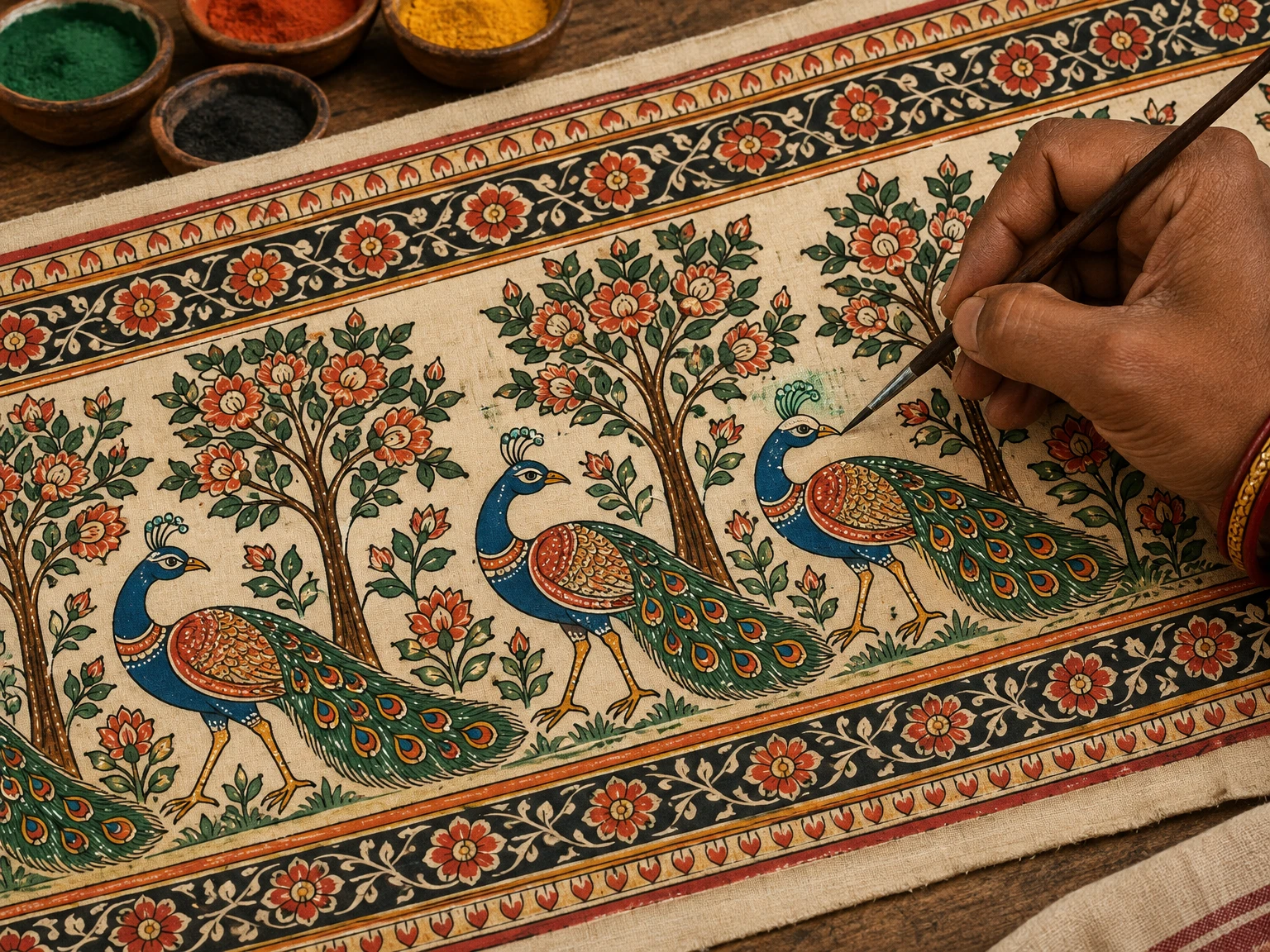
Begin at the edge
Look first at the frame of a traditional Odisha Pattachitra. A border may be built from repeating flowers, leaves, curling stems, animals or geometric marks. It does more than keep the eye from wandering off the cloth. Its repeated units establish a visual beat; its corners turn that beat around the picture; and its colors can echo the scene held inside it. In the November 2018 Odisha Review, museum superintendent Dr. Jayanti Rath describes the ornament of Odisha temple paintings as organic, when it draws on plant or animal life, or inorganic, when it is made from geometric lines and points. Rath notes the prominence of lotus and creeper motifs. These are descriptions of a recognizable visual vocabulary, not a checklist every painter must obey. [3]
The name itself joins two ideas often translated as cloth and image: patta and chitra. The Government of India’s 2014 feature on Raghurajpur uses “canvas” for patta, while the IMPART Encyclopedia of Art explains the form through its cloth support and image-making. The ordinary English phrase “cloth painting” is therefore useful but incomplete. It tells us what the painting is on; it does not yet tell us how the support is made, how the picture is organized, or why a particular image may matter to a temple, a household, a painter or a buyer. [2][4]
Odisha Pattachitra is not one frozen pattern. Government and institutional descriptions identify religious, mythological and folk subjects, but also record artists applying the visual language to objects beyond a cloth panel. A painting may be a devotional image, a narrative composition, a carefully bounded decorative work or a craft object made for another setting. The word names a family of related practices, not a single size, subject or use. What ties the examples together is less a simple recipe than a way of making an image legible through a worked surface, ordered color, emphatic line and decoration. [1][2]
Making a surface that can hold a line
A cloth painting begins before the first figure appears. The Odisha Government’s account says the cloth is coated with soft white chalk powder and glue made from tamarind seeds. The preparation strengthens the cloth and creates a smooth, semi-absorbent ground that can accept paint. IMPART describes a more layered version: two cotton sheets are joined with tamarind gum, then the painting face receives more gum mixed with powdered limestone; the prepared surface is dried and polished. These accounts describe related processes, but their different wording is a reason for care. They do not establish one universal number of cloth layers or one recipe used by every artist in every workshop. [1][2]
That distinction matters because craft descriptions often turn an observed method into an absolute rule. A state tourism page may summarize a traditional technique; an encyclopedia may describe the procedure documented by its contributors; a practitioner may work with materials adapted to the commission, available supplies or the demands of a particular support. The sources support the importance of preparing a ground that is smooth and receptive. They do not justify assuming that every finished painting has identical thickness, absorbency, color or finish. When a writer cannot identify a specific painter or object, “one documented method” is more accurate than “the method.” [1][2]
The surface is both a practical base and the first part of the work’s design. Cloth has a grain, flexes under the hand and can be carried or displayed differently from a rigid board. A prepared ground makes it possible to draw clean marks without treating the raw weave as the final visual texture. But the image does not erase the support. The painter’s brush moves over a material that has been joined, coated, dried and polished; those steps are part of the making, even when the viewer sees only the finished scene. Thinking about preparation helps us read the object as a crafted thing rather than as a picture that simply appeared on blank fabric.
Published accounts also differ in the exact names and mixtures of binding materials. The Government page mentions tamarind-seed glue for the cloth preparation and describes pigment sources; IMPART names kaitha, or wood-apple, gum and coconut water as a color medium. These details should be kept in their proper place: they are accounts of specific traditional recipes, not laboratory specifications for every contemporary work. The useful lesson is that the paint is not just a collection of colors. It must be made to sit on a prepared ground, adhere to it and remain readable after the image has been handled, stored or displayed. [1][2]
Border first, then the picture
The Government of Odisha describes a particular sequence for cloth Pattachitra: the border is completed first; the artist sketches directly with a brush using light red and yellow; broad, flat colors follow; and fine black brush strokes finish the work with an effect compared to pen lines. The page explicitly says the preliminary drawing is not made with pencil or charcoal. This concise description is especially useful because it presents order as part of the technique. The border is not merely an ornament attached after the subject. In this account, it is where the process begins, establishing the field that the later figures and forms will occupy. [1]
IMPART likewise describes the border as a starting point, often made of intricate floral and curving designs. It says the frame can use colors associated with the central scene, so the boundary and the picture are related rather than independent. Read this as a common approach, not a law of composition. A particular panel may simplify its border, vary its motif or arrange the subject in a way that does not match a short description. Still, the idea of the edge as active design helps explain why a close look at the frame can reveal how the painter has organized the image. [2]
After the border, a brush-drawn sketch can guide the main forms. A viewer accustomed to graphite underdrawing might imagine a hidden pencil map beneath the paint; the state description instead records a direct brush sketch in light red and yellow. The exact procedure may vary, but that account points to a tradition in which drawing and painting are closely linked. The hand does not simply trace an already fixed outline and then fill compartments mechanically. The initial mark, the broad color areas and the finishing lines belong to a sequence of decisions, each affecting how clearly the next stage can be made. [1]
Flat color can create a strong, almost architectural clarity. Rather than relying on gradual shading to suggest depth, a painter may distinguish figure, clothing, animal, foliage and ground with crisp areas of color and carefully placed contours. IMPART describes figures commonly shown in profile, with tapering eyes, pointed noses and rounded chins; it also notes that backgrounds may be sparse, while foliage and small details can gather around a figure’s feet. These are useful visual clues when encountered, but they are not a formula that determines whether an image is “authentic.” The article’s language is appropriately general: “typically,” “usually,” and “sometimes” leave room for variation. [2]
Black finishing lines have a different role from the first sketch. The state account says they give the effect of pen work; IMPART describes different brushes used for narrow outlines and thicker marks or color filling. Line can clarify an arm against a garment, separate a bird’s wing from its body, sharpen an eye, or make the curve of a vine hold together. It can also add rhythm: a repeated contour brings several figures into relation without forcing them into realistic perspective. The result is not an absence of structure. The structure is made visible through contour, scale, repetition and the measured relation between empty and painted areas. [1][2]
Color is a set of choices, not a single palette
The Government of Odisha lists lampblack for black, haritala stone for yellow, “shingle stone” for red, and crushed, boiled and filtered shells for white. IMPART gives a related but not identical list: indigo blue, haritala yellow, hingula or geru-clay red, soot black, crushed leaves for green and conch-shell white, with kaitha gum and coconut water as a medium. The differences are important. They show that source descriptions do not give us one final inventory to paste onto every painting. A pigment can be identified by a material name, a local term or a preparation method, and those descriptions may reflect different records or practices. [1][2]
Color in a Pattachitra is not only a matter of matching a real-world object. A blue body, red garment or pale face can carry a recognizable convention, distinguish one character from another, or direct attention through the panel. IMPART notes traditional associations for some deities and describes the use of color to convey moods in certain figures. Such conventions should be explained as reported practice, not universal symbolism. A color’s meaning depends on the subject, the source, the painting and the people who read it. A modern viewer should not assume that one hue has exactly the same meaning in every workshop or that every artist follows the same code. [2]
When a source says “natural colors,” it may be describing a traditional materials system, not promising that every contemporary painting uses only one set of natural pigments. The Government page itself describes artists working across cloth, wood, silk, coconut shell and other supports, and reports products developed in the Pattachitra style. That expanded field makes it especially important to separate a technique description from a claim about all items currently sold. To identify the materials in a particular object, the soundest route is to ask its maker or consult its object-specific documentation, rather than infer a pigment from the color alone. [1]
Odisha’s state account says a finished cloth painting may be held over charcoal fire and coated with lacquer, which it describes as improving water resistance, durability and sheen. This gives the surface a final change: a matte image can acquire a shine, and the coating becomes part of how color is seen. The wording “water resistant” should not be silently inflated into “waterproof.” The page gives a craft description, not a guarantee for every object or a handling manual. It is safer to understand lacquer as one described finishing practice and to avoid assuming that it removes the material’s need for thoughtful display and care. [1]
How a picture carries a story
Many Pattachitra subjects are drawn from religious narratives, mythology and folk themes. The Government page highlights Krishna Leela and Jagannath; IMPART also names stories of Krishna and Rama, along with other subjects; the PIB feature on Raghurajpur describes scenes arranged so that a story can be followed by reading pictures in sequence. These sources point to a visual narrative that can be understood through the relation of figures and episodes, not solely through written captions. A painting can compress a tale into one surface, placing its characters and motifs in an order the viewer learns to follow. [1][2][4]
That does not mean every panel is a strip of sequential scenes. IMPART lists non-narrative or more emblematic subjects too: the layout of Jagannath Temple, Panchamukhi Ganesh, Kandarpa Ratha and Navagunjara among them. A viewer may encounter a deity, a temple arrangement, a composite creature or an episode whose narrative is familiar to some audiences and obscure to others. The picture’s meaning is therefore not always contained in its visual description alone. Context, devotional practice, oral explanation and knowledge of a story can all influence what a viewer recognizes. [2]
Rath’s 2018 discussion of Odisha temple painting describes border and surface decoration through plant, animal and geometric motifs. A lotus, creeper, flower-and-vase form or stylized creature may be ornamental, but “ornamental” does not mean unimportant. Repeated motifs can connect the borders to the central scene, mark a transition, or make an image feel full without turning it into a naturalistic landscape. Some motifs may also have specific associations in a particular setting. When a reliable source explains such an association, it can be shared; when it does not, the writer should describe the visible form rather than invent a symbolic meaning. [3]
IMPART’s account of faces and figures offers one way to look closely: profile presentation, long eyes, pointed noses and rounded chins appear as recurring conventions in its description. The eye, in particular, can attract attention because it may seem to animate a face even when the pose is still. Yet it is easy to turn a visual guide into a rigid rulebook. Artists may alter proportions, vary the treatment of a figure, or make a different choice for a particular narrative. “A frequent feature” is a more honest phrase than “every Pattachitra must.” The value of these clues is that they help a viewer notice craft choices rather than grade a picture against a checklist. [2]
Sequence also involves scale. A central figure may be larger than attendants; a prominent animal may orient the viewer before the smaller details are read; a frame may hold a scene at a distance. Relative size does not have to function as photographic perspective. It can express emphasis or help a story remain legible. Where several episodes share one panel, the viewer’s eye can move from one area to another through repeated colors, gestures, borders or objects. The picture thus has a temporal dimension: not because it moves, but because the viewer spends time discovering relationships across its surface.
A temple setting, and the limits of one story
Pattachitra is closely associated in many accounts with Jagannath worship in Puri. The Government of Odisha describes specially treated cloth paintings of the deities in relation to the temple; the 2018 Odisha Review article focuses on the ritual Anasara period, when the wooden images are kept from public view after the bathing festival. It describes three paintings used in that interval and says preparation of the Anasara canvases begins on Akshaya Tritiya. This is a specific ritual context. It should not be used as a synonym for every Odisha Pattachitra, nor should every painting be described as a temple object. [1][3]
Descriptions of the figures in the Anasara paintings are not identical across the sources retrieved. Rath’s article names the painted forms Sesha Deva Ananta, Narayana and Bhuvaneswari as substitutes for the three wooden images; IMPART describes the paintings in relation to Jagannath, Balabhadra and Subhadra. Those formulations are not simply interchangeable labels. A careful account can say that a set of paintings has a particular role during Anasara, while acknowledging that institutional descriptions identify the represented forms differently. It is not necessary to resolve the iconographic terminology in order to understand the wider point: temple ritual gives certain cloth paintings a defined role and schedule. [2][3]
The same care applies to historical claims. IMPART says the tradition likely dates to the twelfth century, linking that estimate with the period when Jagannath Temple was built. “Likely” is doing real work in that sentence. It marks an informed association rather than a dated surviving painting or an unbroken chain of records. Rath’s 2018 article reports that the Nityachara Paddhati, a Smriti text from the first part of the fourteenth century, mentions a role for patta paintings in temple rituals. That is a more specific documentary claim, but the article is reporting the text rather than reproducing a primary-edition passage for readers to inspect here. [2][3]
Together, these accounts support a long relationship between painted cloth, Jagannath worship and pilgrimage culture. They do not establish an exact invention date, a complete chronology or an unchanged technique from the medieval period to the present. A tradition can be old and still change: materials, markets, formats, audiences and the circumstances of practice can shift. Saying “likely,” “documented by,” or “the source reports” is not an attempt to diminish an art form. It is how a historical feature distinguishes evidence from a story made more certain than the records allow. [2][3]
Raghurajpur: an important place, not the whole map
Raghurajpur is one of the places most visible in descriptions of Odisha craft. A 2014 Press Information Bureau feature locates the village in Puri district and reports more than a hundred resident families at that time, with a majority engaged in some form of handicraft. It describes work on cloth, paper and palm leaves and lists other practices in the village. Those details are a dated journalistic snapshot, not a current census. They help establish the setting of that feature; they cannot tell us how many families practice Pattachitra today or how work is distributed among households. [4]
Odisha Tourism now presents Raghurajpur as a craft village and lists Pattachitra, palm-leaf engraving, stone carving, wooden toys and masks, among other traditions. The official page is useful for understanding how the place is described to visitors, but its destination language is not a complete ethnographic survey. It would be careless to infer from a list that every household practices each craft, or that one village represents every Pattachitra painter in Odisha. The PIB report and Tourism page together show a multi-craft setting and its public presentation; they do not replace the voices or records of individual artists. [4][5]
The Government of Odisha associates traditional painting with Mahapatra or Maharana painters; IMPART refers to Mahapatra and Moharana communities and says the artists historically lived near the Puri temple. These terms are spelled differently in the sources. They are useful as the labels those accounts use, but not as a complete description of every present-day practitioner. IMPART notes that women now paint full time and that the tradition has expanded to include artists from outside Chitrakar families. That detail matters: a hereditary history and an evolving present can both be true. [1][2]
The official descriptions also make clear that Pattachitra operates in a wider craft economy. The 2014 PIB feature says Raghurajpur artists sold products through organizations and participated in fairs and exhibitions. Because the report is from 2014, it should not be presented as a current map of sales channels or a guarantee of livelihood. The current Tourism page invites visitors to meet artists and purchase craft objects, which is a statement about a tourism experience, not an independent measure of income. We can say that craft, visitors and sale have been connected in public accounts; we cannot infer how those arrangements work for every artist now. [4][5]
Do not confuse cloth painting with palm-leaf engraving
Odisha’s painted cloth and its palm-leaf work are related in the broader world of picture-making, but they are not the same process. The Government’s page on palm-leaf painting describes leaves that are cut, partly dried, seasoned, dried in shade and joined or strung. The image is incised with an iron pen; a dark paste rubbed across the surface catches in the grooves and makes the lines visible. The Directorate of Handicrafts also calls the tool a lekhani and describes ink filling grooves on joined panels. That is a subtractive technique: the mark is cut into the leaf before it is darkened. [6][7]
On cloth, the painter lays color and line onto a prepared ground. On palm leaf, the artist uses a pointed tool to incise a surface, and pigment or ink helps reveal those cuts. The difference is not just that one picture is brown and another is bright. It affects the mark, the movement of the hand, the scale of detail, the way separate panels can be joined and the kind of surface that carries the image. The state page says subdued color is used in palm-leaf work, while the Directorate describes black or white ink in the grooves. These short descriptions may emphasize different examples; neither should be expanded into a rule for all palm-leaf work. [6][7]
The Government of Odisha also describes “chitra-pothies,” collections of painted palm leaves stacked together between painted wooden covers and held by string. That phrase reminds us that a medium can move between image and book-like form. A joined leaf panel, a painted manuscript, a cloth pata and an object painted in a Pattachitra style may all belong to related local craft conversations while retaining different construction and use. A label that says “traditional painting” may hide important distinctions; a precise account names the support and technique whenever the evidence permits. [1][6]
Odisha and Bengal: a shared name, different practices
The word “Patachitra” is also used for traditions in Bengal, and the shared name can tempt a writer to treat them as one art. A West Bengal Rural Craft and Cultural Hub document describes Patuas painting stories in frames on long scrolls and gradually unfurling the scroll as they sing Pater Gaan. It lists mythological, historical, contemporary and social subjects, and records several regional styles within West Bengal. This is a distinct format and performance context from the cloth paintings discussed in Odisha sources. The comparison should clarify differences without pretending that one short description covers every artist or every work in either state. [8]
In the Odisha sources used here, a prepared cloth panel is a recurring form; the state also notes related work on objects such as boxes, bowls, silk and wooden toys. The Bengal craft-hub document emphasizes the long scroll and its presentation through song. These are helpful contrasts, not mutually exclusive boxes. The sources retrieved do not prove that no Odisha artist ever paints a scroll, or that every Bengal Patua performs every work in the same way. What they do show is that the term cannot do all the explanatory work by itself. A reader needs place, support, technique and use alongside the shared name. [1][8]
Even within Bengal, the craft-hub document describes multiple styles and districts, including scroll traditions and the history of Kalighat painting. That internal variety is another reason not to flatten the comparison into “Odisha has panels, Bengal has scrolls” as if each state had one format. A better sentence is narrower: some well-documented Bengal Patachitra practices use narrative scrolls performed with song; Odisha cloth Pattachitra is strongly associated in institutional accounts with prepared panels and Puri’s temple-art context. The words “some,” “strongly associated,” and “institutional accounts” keep the statement close to what the sources support. [1][8]
Adaptation, recognition and what a label can tell us
Craft changes when its audiences and settings change. The Odisha Government lists artists painting themes on wooden boxes, bowls, tussar silk, coconut shells and doors, as well as making wooden toys in the Pattachitra style. It also mentions painted playing cards known as Ganjifa. These examples show that a visual language can travel beyond the prepared cloth panel. A small painted object may use familiar motifs in a new scale; a decorative surface may be made for a different purpose from a devotional image. The existence of adaptation does not make every object identical to a temple painting, and the label “Pattachitra style” should not erase differences in support or function. [1]
Formal recognition also has a defined record. The Indian Geographical Indications Registry lists application 386 under the name “Orissa Pattachitra (Logo),” with the Orissa State Co-operative Handicrafts Corporation Limited as applicant. The registry page records filing in 2012, a certificate date of 3 February 2014, and validity through 4 October 2032. The wording includes “(Logo),” and the entry gives a defined registered name and geographical area. It is not a basis for claiming that every painting, seller or label has been individually checked or certified. A registry entry is a specific record, not a shortcut to verify the provenance of a particular object. [9]
Recognition, tourism and sale can bring attention to a craft, but the sources read here do not tell us that every practitioner benefits equally or that public promotion has solved questions of income, training, authorship or fair attribution. We should resist both easy celebration and easy pessimism. What the evidence does show is an art form discussed across government, museum, tourism and craft institutions, practiced on several supports and associated with both temple contexts and contemporary craft production. The remaining questions belong to specific artists, communities, organizations and markets; they should be answered with current, local evidence rather than guessed from a broad cultural label. [1][2][4][5]
How to look without turning a painting into a checklist
When you stand in front of a Pattachitra, notice how the frame meets the subject. Does the border repeat a flower, a leaf or a curling stem? Does the central figure sit against a mostly open ground, or do small plants and objects gather at the feet? Are lines broad in one place and delicate in another? Which colors carry the strongest contrast? These questions do not require specialist knowledge, and they leave room for each painting to differ. The aim is not to test whether the artist followed a recipe. It is to see the decisions that make a dense surface readable.
Then ask what kind of object you are looking at. Is it a cloth panel, a palm-leaf engraving, a manuscript-like group of leaves, a painted box, a silk piece or a work that borrows a Pattachitra visual language for a new format? Is it associated with a ritual use, a story, a craft market or a particular artist? The answer may not be printed next to the work. That absence is a reason to ask for information, not to invent it. A good label can identify the maker, place, date, materials and intended context; where those facts are not known, uncertainty should remain visible.
It is equally useful to separate what the eye shows from what a source says. You can observe that an image has a patterned border or a figure in profile. You can attribute to a source the claim that a pigment came from a particular mineral, that a certain ritual painting was used during Anasara, or that a village is known for a craft. The first is a description of an object; the others are historical or contextual claims that need evidence. Keeping these categories apart makes the writing more respectful as well as more accurate. It avoids making the artist’s work carry a story that the records do not establish.
A living craft, not a single origin story
Odisha Pattachitra is best understood through the connection of many elements: the prepared cloth, the boundary drawn before the center, the painter’s direct line, the relationship of flat color to outline, the narrative or devotional subject, and the particular setting in which the image is made and seen. Temple ritual is one important history; Raghurajpur is one important craft place; palm-leaf engraving is a neighboring medium; Bengal Patachitra is a related but distinct tradition. None of these alone is the whole art form.
The sources support a tradition with deep historical associations and active contemporary practice, but they do not provide a complete chronology or a census of all practitioners. They document techniques in differing detail, and some recipe descriptions vary. That is not a flaw in the craft. It is a reminder that an art form lives through people who make choices in particular places and moments. The most faithful account is one that can describe those choices clearly, name the evidence behind its claims, and leave space for what it has not yet learned.
For a viewer, the simplest invitation is also the most useful: spend time with the border before rushing to the central figure. Follow the black line where it turns, notice how a patch of color balances another, and let a small motif lead you across the panel. The picture may be a single devotional image or a story held in sequence; its surface can be read at more than one pace. In Pattachitra, looking closely is not a substitute for learning the context. It is a way of beginning that learning with attention rather than assumption.
Sources and further reading
- Government of Odisha, “Patta Chitra.” Process, themes, supports and institutional description of practitioners.
- IMPART Encyclopedia of Art, “Odia Pattachitra,” first published 21 April 2022. Material, visual conventions, subjects and contemporary participation.
- Dr. Jayanti Rath, “Patta Paintings and Identity of Odisha,” Odisha Review, November 2018. Temple ritual, Anasara Patis and decorative motifs.
- Press Information Bureau, “The land of artisans: Raghurajpur,” 11 April 2014. A dated feature on craft practice and village context.
- Odisha Tourism, “Raghurajpur Craft Village.” Current destination description and listed craft practices.
- Government of Odisha, “Palm Leaf Painting.” Palm-leaf preparation and engraving process.
- Directorate of Handicrafts, Government of Odisha, “Palm Leaf Engraving.” Description of the lekhani tool and engraved panels.
- Rural Craft and Cultural Hubs of West Bengal, Patachitra feature. Scroll, song and regional-style descriptions; the retrieved document does not state a publication date.
- Indian Geographical Indications Registry, application 386, “Orissa Pattachitra (Logo).” Registered record and dates.
This feature distinguishes source statements from general visual description. Institutional summaries and dated reports are not substitutes for an individual artist’s account of a particular work.
This content is a collection of ancient history,books and various articles and collection of library and news and other post ; all details may not be the same. Readers are requested to verify the information themselves. Readers are not allowed to take any disciplinary action; content is only for educational purposes. If readers do not agree about the contents, they may send a personal comment to my personal email ID: achary.purna@gmail.com
