
District Overview & Geography
Balasore, officially used in many state records as Baleshwar, occupies Odisha’s northern coastal edge: a district where the Bay of Bengal meets a broad alluvial plain before the land rises westward into the Nilgiri hills. It is bordered by West Bengal’s Medinipur region to the north, the Bay of Bengal to the east, Bhadrak district to the south, and Mayurbhanj and Keonjhar to the west. That position makes it both a threshold district and a richly self-contained travel region: Bengali and Odia cultural currents meet here, while riverine farms, fishing settlements, temple towns, woodland and beach coexist within a manageable circuit.
The district administration describes Balasore as a coastal district with hot, humid conditions, May as the hottest period and December as the coolest. Most rain falls from June through December. These facts matter to travellers because Balasore’s personality changes sharply with the season. Winter and the early post-monsoon months are usually the most comfortable for beaches, temple visits and road journeys. In high summer, begin early, carry water and allow for the coast’s humidity. During the monsoon, streams at hill shrines become forceful, roads can be affected by heavy rain, and sea conditions demand particular caution. Water shapes the district in more ways than its long coastline suggests. The Subarnarekha is the northern river most closely associated with the Balasore coast and its borderland settlements. The Budhabalanga also crosses the district’s wider landscape, while smaller channels, estuaries and tidal creeks sustain agriculture, fishing and bird habitat. The eastern plain is largely low and alluvial; towards Nilgiri, land rises into forested hills and streams. This west-to-east transition gives an itinerary real variety: dawn on a tidal shore can be followed by a shrine beneath running water, then by a forest drive where access is governed by conservation rules.
Balasore town is the natural base. It is a significant railhead on the Kolkata–Chennai corridor and a road-connected district headquarters, with Chandipur, Remuna and several nearby sites reached by road. Biju Patnaik International Airport in Bhubaneswar is the principal practical airport for most visitors; onward travel is by rail or road. Kolkata may be convenient for travellers approaching the northern part of the district, especially Jaleswar and the Bengal-border coast. Always check current rail, road and weather conditions rather than assuming a published itinerary’s timings remain valid.
The coast is not one continuous resort strip. Chandipur is an established visitor centre; Balaramgadi is closely tied to fishing activity; Talasari–Udaypur forms a northern beach landscape near the West Bengal boundary; and quieter beaches such as Kashaphal and Chowmukh Dagara should be approached as working coastal environments, not blank recreational spaces. Fishing boats, seasonal tides, nesting or shore ecology, and weather all deserve priority over a visitor’s timetable.
Balasore’s economy and daily life are often summarised through agriculture, fishing, industry and tourism, but the useful traveller’s view is more intimate. Rice fields, coconut and casuarina-lined coastal stretches, markets, roadside tea, temple kitchens, fish landings, Odia speech inflected by a northern borderland setting, and the deep presence of Vaishnava and Shaiva worship give the district its texture. The district is also associated with national defence infrastructure around Chandipur. That facility is not a tourist attraction: obey restrictions, do not photograph protected installations, and accept any access controls without argument.
Mythological & Historical Significance
Balasore’s history requires two lenses. One is documented political and commercial history, recorded by the district administration. The other is religious memory: temple narratives, devotional traditions and local explanations of place. They may overlap, but they are not identical kinds of evidence.
Official district history places the region within ancient Kalinga and later Tosali or Utkal traditions. It records Mughal annexation in 1568, Maratha control in the eighteenth century, and East India Company acquisition through the 1803 Treaty of Deogaon. Balasore became a separate district in October 1828 during the Bengal Presidency. It became part of Odisha when the separate province was formed on 1 April 1936; Nilgiri merged with Odisha in January 1948, and the former Bhadrak subdivision became a separate district in 1993. This sequence is more than administrative detail. It explains why a traveller encounters coastal trade memories, princely-state legacies around Nilgiri, and a cultural borderland that looks north as well as south.
Balasore was a trading settlement of consequence. The district’s historical account dates the first English settlement in the region to 1634 and the first English factory to 1640; Dutch and Danish settlements also followed. European commercial presence was neither the beginning nor the whole of local history, but it left a tangible frame for understanding Balasore as a port-connected town rather than merely a modern gateway to Chandipur. Look for this history in the town’s older geography and in the idea of the coast as a route of exchange, not simply a scenic edge.
The name “Balasore” itself is presented with caution. The official history notes a Persian derivation, Bala-e-Shore, interpreted as “town in the sea,” while also recording a local legend that links the name to Baneshwar, a form of Shiva. Neither needs to be forced into a single definitive origin. The first is an etymological tradition recorded by the administration; the second belongs to devotional local memory. Respecting both is more illuminating than treating legend as an archival fact.
The district’s religious landscape is unusually plural. Official cultural material points to Buddhist images found at Avana, Kupari, Basta and Ayodhya, and Jain images at Jaleswar and Avana. It also links the visibility of Buddhism in the region to the Bhaumakara period, while noting the popularity of Jainism in the tenth and eleventh centuries. These references should encourage slow looking rather than overconfident conclusions: scattered sculpture and archaeological remains are evidence of historical religious worlds, but individual sites may require specialist interpretation and may not be developed as conventional monuments.
Shaiva sites give Balasore much of its devotional map. Panchalingeswar, Chandaneswar, Bhusandeswar, Maninageswar and other shrines belong to active circuits of worship, not museum heritage alone. Shakta worship is also prominent, including Bhudhar Chandi at Sajanagarh and Danda Kali near Khantapara. Vaishnava devotion finds one of its strongest expressions at Remuna’s Khirachora Gopinath temple. The district administration attributes the temple’s construction to the period of the second Narasimhadeva; visitors should read that statement as the local official account of the shrine’s provenance, while recognising that living temple histories are often sustained through layers of patronage, rebuilding and oral tradition.
Remuna is inseparable from the story of Khirachora Gopinath, Krishna as the “stealer of kheer.” In Vaishnava devotional tradition, the deity secretly reserved sweetened milk for the saint Madhavendra Puri. This is a sacred narrative, not a claim to be tested like a dated inscription. It explains why the shrine’s food offering, known as khira or kheer, holds such emotional importance for pilgrims. Visit as a guest: follow dress and queue arrangements, ask before photographing, and do not assume that every inner space is open to all visitors.
Balasore also belongs to Odisha’s literary and political history through Fakir Mohan Senapati, the great Odia writer closely associated with the district. The administration credits him, alongside figures such as Radhanath Ray and Rai Bahadur Radha Charan Das, with strengthening Odia language and public life. It notes that newspapers including Bodhadayinee and Balasore Sambad Bahika helped energise the Odia language movement. This is an important corrective to a beach-only image of the district: Balasore helped articulate a modern regional literary identity.
The freedom struggle has local sites too. The state’s identified-tourist-centre list names Inchudi for the freedom movement and Chasakhanda for the Baghajatin memorial. Jatindranath Mukherjee, remembered as Bagha Jatin, died after the 1915 encounter at Chasakhanda while resisting British forces. Such places are best visited with historical seriousness rather than as quick photo stops. They anchor national history in a specific rural landscape.
Tourist Destinations & Hidden Gems
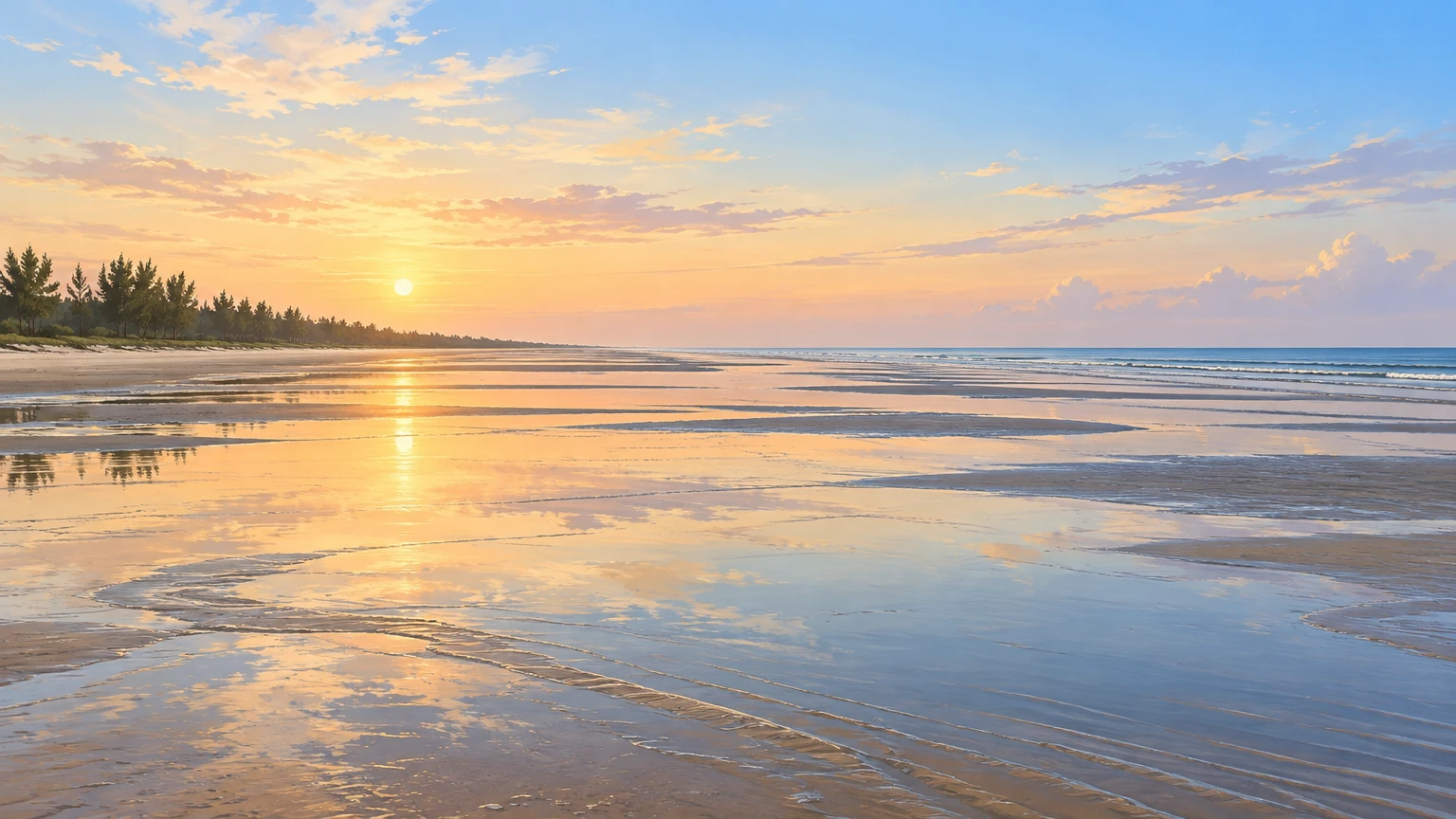
Chandipur is Balasore’s defining natural spectacle, but it rewards patient observation rather than dramatic claims. At low tide, the Bay of Bengal retreats far from the visible shore across a very gently shelving seabed; the district’s tourism page calls it one of India’s distinctive beaches, and Odisha Tourism commonly describes the retreat as extending several kilometres. The effect is extraordinary: wet sand becomes a mirror, small pools and marine traces appear, and the horizon seems to move away.
The best way to experience Chandipur is to consult a current tide table locally and arrive with time to watch the transformation. Do not walk far out simply because the sand looks firm. Returning water, channels, changing weather and darkness can make an exposed shore unsafe. Avoid swimming unless conditions and locally authorised guidance clearly support it. Never disturb crabs, shells or stranded marine life, and carry every piece of plastic back. Chandipur’s beauty lies in a living intertidal zone, not in its conversion into a playground.
The town also carries the nearby presence of the Defence Research and Development Organisation’s Integrated Test Range. It is part of modern Balasore’s identity, but visitors must keep a clear boundary between public beach travel and restricted defence areas. Photography, access and movement restrictions are not optional on test days or near protected infrastructure. Plan the beach for its shore, light and tide; there is no need to seek out the restricted landscape.
A short inland journey brings one to Remuna and Khirachora Gopinath. This is among the district’s most resonant cultural stops because architecture, worship and food tradition meet in one place. The temple is a working Vaishnava shrine rather than an archaeological ruin. Go in unhurried clothes, remove footwear where required, listen to temple staff, and taste prasad only through authorised counters or customs. For travellers interested in Balasore’s cultural history, Remuna pairs naturally with a walk through Balasore town and a reading of Fakir Mohan Senapati’s place in Odia letters.
Panchalingeswar, in the Nilgiri hills, offers a wholly different atmosphere. Odisha Tourism describes it as a Shaiva hill shrine where five lingas are concealed beneath the flow of a natural stream and worshipped by touch. The approach through a wooded, rising landscape is part of the experience. The constant water and stone underfoot make this a place for good grip, restraint and weather awareness. In heavy rain, conditions may change rapidly; local authorities have previously closed the temple during severe weather. Never treat the flowing shrine as a swimming or adventure site. Panchalingeswar’s mythology is deeply cherished, with traditions connecting the five lingas to the Pandavas. Such associations are devotional folklore, not securely documented political history. Their value is cultural: they explain why a modest water-washed rock formation carries the emotional force of a major pilgrimage place. The formal reality is equally compelling—the Nilgiri hill setting, the stream, the forest fringe and the ongoing rhythm of worship.
Kuldiha Wildlife Sanctuary is the district’s major forest destination, located in the hill country around the Balasore–Mayurbhanj–Keonjhar trijunction. EcoTour Odisha describes the sanctuary as an undulating landscape of hills, valleys and streams, declared a sanctuary in 1984, and comprising the Kuldiha, Tenda and Devgiri reserved forests with surrounding revenue forest. It is also part of a broader ecological connection towards Similipal. Crucially, Similipal itself is in neighbouring Mayurbhanj district; do not describe it as a Balasore attraction merely because an itinerary may combine the two.
Kuldiha is known in official eco-tourism material for mixed deciduous forest, elephants, gaur and birdlife. That does not make sightings guaranteed. Forest travel should be built around habitat and silence, not an expectation of seeing large mammals. Use the designated booking, permit and guide systems; confirm seasonal access directly with official EcoTour Odisha or forest authorities; remain in approved vehicles and trails; and never approach, feed or call wildlife. Elephant movement in particular deserves serious distance and respect. Forest closure periods, route rules and accommodation arrangements can change.
The Rissia area is associated with the Kuldiha eco-tourism circuit, but its appeal should be understood as a regulated nature-camp landscape rather than an invitation to roam freely into forest. Ask the managing agency what activities are currently authorised. Birding, quiet landscape observation and guided walks are more responsible ambitions than attempting to recreate unverified social-media routes.
The northern coast offers a different register of shoreline at Talasari–Udaypur. The district tourism page highlights long sandy stretches, red crabs and casuarina. It lies near the Odisha–West Bengal boundary, and that border position is part of its character: it can be approached from either state, yet belongs to Balasore district on the Odisha side. Keep the visit low-impact. Stay clear of fishing gear and dunes, do not chase crabs, and avoid assuming that facilities, lifeguards or water activities available at a larger beach are present here.
Balaramgadi is worth including for its working-coast perspective. The state’s 2025 list identifies it as a sea beach and fish-trading centre. Visit early if you wish to understand the scale and rhythm of fish landing, but remember that this is a workplace. Do not obstruct nets, boats, loading or auctions. If seafood is offered in local eateries, choose freshly prepared food and ask what is available that day rather than demanding a fixed “must-eat” list. Balasore’s coastal food culture is shaped by seasonal catch, rice and local household practice, not a single standard menu.
Chandaneswar, near the northern border, is one of north Odisha’s most important Shiva shrines. The official district tourism page calls it a prominent religious and cultural site and identifies Chadak Mela as an important festival. Festival schedules and crowd-management arrangements must be rechecked close to travel, especially because festival dates can follow local and lunar calendars. The shrine is reached from Balasore, Jaleswar or the Digha side, but a traveller should allow for road congestion during major observances and avoid treating pilgrimage crowds as spectacle.
Bhusandeswar near Bhograi is another powerful Shaiva destination, identified in the state tourist-centre list as a religious centre. It is often described locally in superlative terms for its large linga. Rather than repeating unverified size rankings, encounter it for what is certain: a living shrine of considerable regional importance. This is the better practice across Balasore’s temple country. Worship, local memory and architecture are enough; inflated claims are unnecessary. Other worthwhile names on the official list include Ayodhya, associated with religious and archaeological remains; Raibania, noted for its fort; Sajanagarh, a religious centre; Langaleswar; Laxmannath; Kupari; Bardhanpur; and Tripisagadia. These are not “hidden gems” in the sense of secret or unexplored places. They are local heritage locations, sometimes lightly interpreted and sometimes deeply alive to nearby communities. Visit only when you have sound local directions, adequate daylight and permission where applicable. A responsible traveller values a small place without forcing it to perform as an undiscovered attraction.
Recent News & Tourism Developments
As of this edition date, 20 October 2026, the clearest district-specific tourism development identified is still a proposal, not a completed attraction. On 4 October, The New Indian Express reported that hotel, resort and ecotourism project plans worth around ₹290 crore had been received for Balasore during Odisha Travel Bazaar 2026. The report does not establish that these plans have been approved, begun construction or set opening dates. No verified new Balasore tourism facility completion or official programme of future local festival dates was found in the reviewed sources. Check current official updates before planning around any proposed facility or event. There is, however, useful dated background. On 1 November 2025, local reporting said that Kuldiha Wildlife Sanctuary reopened to visitors after a six-month seasonal closure. That report is not evidence that the sanctuary is open every day in October 2026, nor that the same rules apply now. It does reinforce the key planning lesson: forest access is seasonal and regulatory, so confirm the current status before setting out.
A September 2025 report documented the shutdown of Panchalingeswar Temple amid severe rainfall. Again, this is not current closure information. It is a reminder that Balasore’s hill and coast itineraries must remain weather-responsive, particularly during and immediately after the monsoon. Rain can alter stream crossings, hill paths and road conditions quickly.
EcoTour Odisha’s current Kuldiha destination material presents the sanctuary through guided wildlife viewing, birding, nature trails and the Rissia landscape. This is a welcome emphasis when read correctly: managed, low-impact nature travel is the development model being communicated, not unrestricted access to a sensitive forest. Travellers should use official booking channels and treat changing rules as conservation measures rather than inconveniences.
The state Tourism Department’s February 2025 list of identified tourist centres is another useful baseline. It confirms the breadth of the district’s recognised circuit—beaches, temples, memorials, archaeology and a fort—but it is a listing, not a guarantee of facilities, interpretation, accommodation or year-round access at every location. Build a realistic itinerary around Balasore town, Chandipur, Remuna, Panchalingeswar and, when officially open, Kuldiha; add smaller places only with time and reliable local information.
Traveler Essentials
A first visit works well as a two- or three-day circuit. On day one, arrive in Balasore, visit Remuna’s Khirachora Gopinath and spend a tide-aware late afternoon or dawn at Chandipur. On day two, travel towards Nilgiri for Panchalingeswar and, if permits and season allow, a pre-arranged Kuldiha experience. A third day can be devoted to Talasari–Udaypur and Chandaneswar in the north, or to Balasore’s historical sites and the working coast around Balaramgadi. Do not try to combine distant northern beaches, Kuldiha and a full Chandipur tide cycle in one rushed day.
By air, Bhubaneswar is the usual gateway, followed by rail or road to Balasore. By rail, Balasore station is the district’s principal hub and is practical for Chandipur, Remuna and road connections inland. By road, the national highway corridor links the district with Bhubaneswar and Kolkata, while local roads reach Nilgiri, Jaleswar, Bhograi and the beaches. Hiring a vehicle or using a trusted local taxi can be sensible for multi-stop days, but confirm the return plan before leaving the town. Never invent an itinerary around assumed bus frequency or a last service that has not been checked.
October through February is usually the most comfortable broad window for the coast and outdoor sightseeing, though October can still bring humidity and post-monsoon rain. March to May can be very hot. Monsoon travel has its own green beauty but requires flexibility, especially for Panchalingeswar and Kuldiha. Cyclonic weather, heavy rain and high sea conditions are real coastal hazards. Follow official alerts, postpone beach walks in unsafe weather, and never argue with local closures.
Accommodation is most straightforward in Balasore town and Chandipur. Odisha Tourism lists Panthanivas properties in Balasore and Chandipur, while other stays are available in the wider area. For forest accommodation, rely on the official eco-tourism system rather than informal claims of access. Reservations, identification requirements, entry rules and availability should all be reconfirmed close to the journey.
Food is best approached with curiosity and restraint. In Balasore town and beach areas, rice-based meals, dal, vegetable preparations, fish and other seasonal seafood are common possibilities. At Remuna, the shrine’s kheer tradition is culturally central. Choose clean, busy eateries; eat seafood only when freshly cooked; carry drinking water; and be considerate of fasting practices around temples. Avoid claiming a dish is “the” single authentic Balasore speciality when households, seasons and communities vary.
Dress modestly at shrines, especially during worship and festivals. Ask before photographing people, priests, fishing activity, prayer, markets or any forest staff. Do not fly drones near defence areas, temples, wildlife habitat or crowds unless you have explicit legal permission. Carry back waste, avoid single-use plastic where possible, and do not remove shells, plants, stones or religious objects. On the beach, give wildlife and fishermen room; in the forest, keep noise low and remain with authorised guides.
Balasore is most rewarding when its contrasts are allowed to stand: a tide that redraws the shore, a stream that conceals five lingas, a temple sweet remembered through devotional literature, a forest corridor governed by conservation, and a town whose trade and language history reaches far beyond a weekend getaway. Travel here with time, humility and a willingness to let the district set the pace.
Publishing Metadata & Tagging
- Group: Odisha Tourism
- Section/Category: Society And Culture
- Destination: https://pcachary.in
- District: Balasore
- Edition: 2026-10-20
- Cycle: 1
- Tags: Odisha Tourism; Balasore; Society And Culture
Sources
- Balasore district: about us — Government of Odisha, date not stated. District boundaries, climate, rivers, economy and cultural overview. Evidence checked 20 October 2026.
- Balasore district: history — Government of Odisha, date not stated. Administrative, trade and political history. Evidence checked 20 October 2026.
- Balasore tourist places — Government of Odisha, date not stated. Official descriptions of Chandipur, Panchalingeswar, Remuna, Chandaneswar and Talasari–Udaypur. Evidence checked 20 October 2026.
- Balasore culture and heritage — Government of Odisha, date not stated. Buddhist, Jain, Shaiva, Shakta, Vaishnava and literary context. Evidence checked 20 October 2026.
- Panchalingeswar Temple — Odisha Tourism, date not stated. Shrine setting and practical approach information. Evidence checked 20 October 2026.
- Kuldiha Wildlife Sanctuary — Odisha Tourism, date not stated. Sanctuary location and district travel context. Evidence checked 20 October 2026.
- Kuldiha Wildlife Sanctuary — EcoTour Odisha, page updated 27 January 2026 in sitemap. Sanctuary history, forest landscape and listed wildlife. Evidence checked 20 October 2026.
- Identified tourist centres in Odisha_0.pdf) — Odisha Tourism Department, February 2025. Official district list; it does not establish current facilities or access. Evidence checked 20 October 2026.
- Kuldiha Wildlife Sanctuary welcomes tourists after six-month closure — Pragativadi, 1 November 2025. Dated background on reopening; current access must be confirmed independently. Evidence checked 20 October 2026.
- Cover image: Chandipur beach sunrise — Tripadvisor-hosted user image, publication date and rights status not verified. Used as a private-app preview reference only; no republication permission is implied. Evidence checked 20 October 2026.
Featured image: original AI-generated editorial illustration of Chandipur’s low-tide shoreline, created for this article; an illustration, not a documentary photograph.
- The New Indian Express, “Rs 11.5K crore new proposals in bag for Odisha’s tourism sector” — 4 October 2026. Reports around ₹290 crore in Balasore hotel, resort and ecotourism project plans; proposal status, not completion.
Disclaimer
This content is a collection of ancient history,books and various articles and collection of library and news and other post ; all details may not be the same. Readers are requested to verify the information themselves. Readers are not allowed to take any disciplinary action; content is only for educational purposes. If readers do not agree about the contents, they may send a personal comment to my personal email ID: achary.purna@gmail.com

