
## District Overview & Geography
Cuttack is often introduced through its city, but the district deserves to be read as a much wider river country. Its administrative landscape joins the old urban capital of Odisha with the agricultural plains, river islands, shrine settlements, low hill country and lake-side villages of Athagarh, Banki, Choudwar and the surrounding interior. The official district profile records an area of 3,932 square kilometres, with three subdivisions—Cuttack, Athagarh and Banki—14 blocks and 15 tehsils. Its population was 2,624,470 in the 2011 Census; that figure is historical census data, not a current population estimate. [Cuttack district profile](https://cuttack.odisha.gov.in/en/about-district/district-profile)
The city of Cuttack occupies the celebrated wedge between the Mahanadi to the north and the Kathajodi to the south. That setting explains both its beauty and its political logic. A place protected by substantial channels could serve as a defended seat of power, while the same waterways connected it to markets, craft settlements and the wider delta. The official history compares its situation to Varanasi between the Varuna and Asi rivers, noting the inscriptional name Abhinab-Baranasi-Katak. The comparison should be understood as a historical description of place and prestige, rather than as evidence of identical urban histories. [District history](https://cuttack.odisha.gov.in/en/about-district/history)
Beyond the city, water remains the organising fact. The Mahanadi system divides and re-joins across a broad alluvial terrain; the Kathajodi, Birupa and their connected channels sustain fields and settlements. The district administration identifies rice, pulses, oilseeds, jute, sugarcane, coconut and turmeric among the principal crops, and describes agriculture as dependent on rivers and canals. Such a landscape changes visibly through the year: dry-season riverbanks can appear expansive and sandy, while the monsoon makes water levels, road conditions and access to low-lying places matters for close local attention. [About Cuttack district](https://cuttack.odisha.gov.in/en/about-district/about-us)
Cuttack has a tropical climate. Summers can be intensely hot; the district’s official profile notes that maximum temperatures rise well above 40°C, while winter temperatures can fall near 10°C. Most rain comes with the south-west monsoon. These broad climatic descriptions are useful for planning, but they are not a substitute for a current weather forecast or local flood advisory. October to March is the visiting window suggested by district tourism pages for Cuttack city and several nearby sites, when outdoor walking and road journeys are generally more comfortable. [Cuttack city tourism page](https://cuttack.odisha.gov.in/en/tourism/tourist-places/cuttack-city)
The district is not uniformly urban, nor is it a single continuous forest destination. Its western and south-western reaches introduce more undulating country around Athagarh and Banki, with wooded slopes, riverine vegetation and cultivated clearings. Visitors should resist reducing this mixed terrain to an abstract “green belt.” The most responsible way to encounter it is through established roads, public sites and authorised accommodation, without entering private cultivation, riverbeds, nesting areas or protected land merely for a photograph. The official tourism directory lists natural and religious sites across the district, but its listings do not create a blanket right of access.
Cuttack’s river geography also calls for humility. The Mahanadi is a working river system, not a recreational backdrop alone. Banks may be slippery, currents can change, and seasonal inundation can reshape familiar approaches. At lakes, islands and riverside temples, follow current local instructions. Do not assume that a previous visitor’s boat trip, bathing experience or shortcut is available or safe on another day. A slower itinerary—city heritage first, then a day for Athagarh or Banki—is usually more rewarding than attempting to collect every place in a single rush.
## Mythological & Historical Significance
The name Kataka, rendered as Cuttack in English, has long been explained as a military cantonment, fort or seat of government protected by an army. This is more than an attractive etymology: the official district account ties the city’s growth to its naturally defended riverine setting. Yet precise claims about its foundation need care. Official pages themselves present differing chronologies in their summaries of the early city and Barabati Fort. It is sounder to say that Cuttack developed into a major capital over the medieval period than to repeat one exact founding year as settled fact. [Cuttack district history](https://cuttack.odisha.gov.in/en/about-district/history)
The district history traces Cuttack’s emergence as a capital to the end of the 10th century under the Somavamsis and says its importance increased after Chodaganga’s early-12th-century expansion. It identifies Anangabhimadeva III of the Eastern Ganga line with the construction of Barabati Fort in 1229. This official account is an important guide to the political history of the site, while the surviving ruins ask visitors to distinguish archaeological remains from later retellings. A fort is not a complete medieval city frozen in time; what remains is fragmentary evidence of a much larger courtly, military and administrative landscape.
Under the Eastern Gangas and then the Gajapatis, Cuttack continued as Odisha’s capital. The district history notes later Afghan, Mughal and Maratha phases, before British occupation following the Treaty of Deogaon in 1803. These transitions gave the city a layered character: a Ganga citadel, a Mughal provincial centre, a Maratha commercial emporium and a colonial administrative town. The old city’s religious institutions, markets, educational landmarks and river infrastructure should therefore not be forced into a single dynasty’s story.
Cuttack’s historical importance was also commercial. The official account describes land and water connections with medieval ports and calls the city a flourishing mart of eastern trade before it became politically central. That context helps explain why maritime memory has such force here. It does not prove every popular story told about individual overseas voyages, but it does locate the city within the long networks of the Bay of Bengal. At Bali Jatra, that memory becomes public culture: the fair recalls the seafaring traditions associated with Odia sadhabas and with connections to Southeast Asia. [Bali Jatra, Incredible India](https://www.incredibleindia.gov.in/en/festivals-and-events/odisha/bali-jatra)
The colonial period brought painful as well as institutional change. The district history links improved communications and the later railway connection to official responses after the devastating famine of 1866. It records the start of *Utkal Dipika* in 1866 through the efforts of Gouri Shankar Ray, and describes the development of educational institutions including Ravenshaw. These are not decorative footnotes. They help explain why Cuttack became a centre of Odia public debate, print culture, education and civic life.
The city remained the headquarters of the new Odisha province when it was formed in 1936, before Bhubaneswar became the state capital in 1948. Losing the formal capital did not erase Cuttack’s role. Its courts, hospitals, colleges, markets, workshops and associations have continued to give it a distinct public character. The district’s official history aptly presents the city as a bridge between Odisha’s past and present. [District history](https://cuttack.odisha.gov.in/en/about-district/history)
Sacred geography runs alongside documented political history. Katak Chandi is among the city’s best-known shrines and an important focus of devotion, while Qadam-i-Rasool represents Cuttack’s Islamic heritage. Dhabaleswar, on an island setting in the Mahanadi, is cherished as a Shiva pilgrimage site. At Banki, Charchika is a significant goddess shrine; at Simhanath, the official directory identifies Shambunath as the presiding Shiva deity and also notes Raghunath and Dakshina Kali temples. Devotional accounts, miracle stories and local origin legends should be treated with respect as living belief, not casually restated as independently documented political history. [Cuttack tourist places directory](https://cuttack.odisha.gov.in/en/tourism/tourist-places)
Cuttack’s most portable heritage is tarakasi, the intricate silver filigree for which the city is known as the Silver City. Odisha’s Directorate of Handicrafts describes the craft as fine silver threads fashioned into delicate metalwork. Its appeal lies in patience, line and density: jewellery, decorative forms and ceremonial work can appear almost woven, though they are made in metal. Buy from a maker, cooperative or established seller where possible, ask for a bill and purity information, and avoid assuming that every shop offers the same workmanship. [Odisha silver filigree craft profile](https://crafts.odisha.gov.in/?crafts=silver-filigree)
## Tourist Destinations & Hidden Gems
Barabati Fort is the essential starting point. Its significance is not in a fully intact palace—none survives—but in the encounter with scale, terrain and historical residue. The fort occupies a strategic location near the Mahanadi, and the visible gateway, moat and excavated remains suggest the defensive and residential complexity of the old citadel. Walk it as a historical landscape rather than a background for hurried selfies. The city’s official profile refers to the ruins, moat, gate and earthen mounds associated with the Ganga dynasty’s palace complex. Since accounts differ over exact early dates and builders, visitors should value the monument without repeating contested details as certainty. [Cuttack district profile](https://cuttack.odisha.gov.in/en/about-district/district-profile)
Close by, the Odisha State Maritime Museum gives the best interpretive bridge between Cuttack’s riverfront and Odisha’s sea-facing past. It occupies the former River Boat Construction and Repair Workshop at Jobra, a British-era complex established in 1869. Odisha Tourism explains that the workshop’s functions related to inland waterways and irrigation as well as boat work, and that the restored museum opened in 2013. Galleries and outdoor material introduce navigation, boat-building, inland water transport and maritime exchange. This is a place to learn before making broad claims about “Kalinga’s fleets”: objects, models and river infrastructure make the region’s watery history more tangible than slogans can. [Odisha State Maritime Museum](https://odishatourism.gov.in/content/tourism/en/discover/attractions/museums/odisha-state-maritime-museum.html)
The Netaji Birth Place Museum is another major city stop, connected with Subhas Chandra Bose’s Cuttack childhood and family history. It belongs in an itinerary not simply as a nationalist memorial but as part of the city’s twentieth-century intellectual and political world. Verify visiting arrangements directly before going, particularly on public holidays. Cuttack’s official tourism page includes the museum among the city’s major attractions. [Cuttack city](https://cuttack.odisha.gov.in/en/tourism/tourist-places/cuttack-city)
The old city is best explored on foot in short, considerate stretches. Begin with a heritage site, then make room for neighbourhood texture: lanes, markets, shrines, craft counters and the changing sound of traffic around older quarters. Katak Chandi and Qadam-i-Rasool invite quiet conduct and appropriate dress. At active places of worship, photography rules, queues and entry practices are for the custodians to decide. Do not turn prayer spaces into staged “hidden gem” content. The value of Cuttack lies precisely in this coexistence of living faith, commerce and historical memory.
For a view of Cuttack’s craft identity, look for tarakasi work rather than treating silver merely as a souvenir category. Delicate wirework rewards close looking: repeated coils, floral forms and fine filigree mesh reveal the skill of shaping and joining silver threads. The craft department’s description is deliberately modest and specific; it does not promise that visitors may enter workshops, watch artisans at work or obtain a particular design. Respect private workspaces, ask before photographing, and choose an informed purchase over bargaining that dismisses skilled labour. [Directorate of Handicrafts: silver filigree](https://crafts.odisha.gov.in/?crafts=silver-filigree)
Dhabaleswar offers a contrasting experience: a riverside-island pilgrimage setting rather than an urban museum visit. The Cuttack Municipal Corporation’s tourism information identifies the temple as located on an island in the Mahanadi and refers to bridge and boat access. Conditions on a river can change with season, weather, maintenance and official controls, so travellers should check locally which approach is operating rather than rely on an old blog or map pin. The island location is the attraction; it is also the reason to avoid unsafe bathing, improvised crossings or crowding narrow approaches. [Cuttack Municipal Corporation tourist places](https://cmccuttack.odisha.gov.in/index.php/tourist-places/)
Ansupa Lake, nearer Athagarh, is among the district’s most rewarding natural destinations when approached with restraint. The official district page calls it a small picturesque freshwater lake and notes that migratory birds use it in winter; it also mentions fishing and boating. That is evidence of the lake’s seasonal ecological and livelihood character, not a promise of bird sightings, boat availability or unrestricted access. Visit quietly, keep clear of fishing activity, carry back all litter and use only authorised arrangements. October to March is the period recommended on the official listing. [Ansupa tourism page](https://cuttack.odisha.gov.in/en/tourism/tourist-places/ansupa)
Ansupa is a useful reminder that “hidden” should not mean unregulated. Birdwatchers should bring binoculars, maintain distance and avoid playback, drones and loud conversation. No specific species list is established by the district tourism page, so it is better to observe what is present than to promise named birds. Early-season light, changing lake levels and winter migration make the landscape variable. This uncertainty is part of its appeal.
Banki’s Charchika shrine is a natural continuation of an Athagarh–Banki day rather than an urban add-on. It has deep devotional importance and is frequently linked in local religious narratives to the goddess Charchika. Visitors need not settle theological or legendary questions to appreciate its role: arrive respectfully, allow for crowding around major observances and confirm road conditions and temple practices on the day. Pairing a shrine visit with a lake stop can be meaningful, but it should not become a rushed checklist.
Simhanath, described in the district directory as a small island on the Mahanadi, is another place where faith and river setting meet. Its named temples include Shambunath, Raghunath and Dakshina Kali. The island’s character makes advance enquiries important, especially in monsoon conditions or whenever river levels are unsettled. Travel only through lawful, locally advised access; avoid presenting seasonal approaches as permanent visitor infrastructure. [Simhanath listing](https://cuttack.odisha.gov.in/en/tourism/tourist-places)
Choudwar broadens the itinerary toward industrial and historical Cuttack. The district tourism page calls it an industrial centre of Odisha and records a local historical tradition that it was once the capital of the Somakali Keshari kings, with Shiva pithas associated with the Keshari dynasty. This is best presented as the local tourism account, not as a substitute for a detailed archaeological report. Its attraction is the way historic association, temple geography and a working industrial-town identity overlap. [Choudwar tourism page](https://cuttack.odisha.gov.in/en/tourism/tourist-places/choudwar)
Lalitagiri, in Mahanga within Cuttack district, belongs on a culturally serious itinerary. Odisha Tourism identifies it as one of the state’s oldest and most significant Buddhist heritage sites and as part of the Buddhist Diamond Triangle, with excavated monasteries, stupas, chaityas, sculptures, inscriptions and relic caskets. Its location in Cuttack district matters: visitors should not casually relocate it to a neighbouring district simply because it is discussed with the other Buddhist sites. Treat the excavated landscape as a protected archaeological place, stay on permitted paths and let the site museum provide context. [Lalitagiri Buddhist Complex](https://odishatourism.gov.in/en/places/lalitagiri-buddhist-complex)
Smaller places reward patience too. The district directory lists Baldev Jew and Hanuman Jew at Umar as a protected monument under the Odisha Ancient Monument Preservation Act. It identifies Jagannath, Balabhadra, Subhadra and Hanuman as the worshipped deities. This is a living temple site as well as a protected monument: modest clothing, calm conduct and respect for worshippers matter more than extracting a dramatic photograph. [Baldev Jew and Hanuman Jew at Umar](https://cuttack.odisha.gov.in/en/tourism/tourist-places/baldev-jew-and-hanuman-jew-umar)
Mani Nag Cave at Jaluka Hills is another lesser-known listing, situated west of the Birupa and east of Manduka Hill according to the district page. The page frames its significance primarily through religious and mythological association. That wording is important. Visitors may experience the hill as a place of belief and landscape, but should not translate devotional tradition into unsupported archaeological fact. Use the advised route, do not wander off paths and avoid visiting alone after dark. [Mani Nag Cave – Jaluka Hills](https://cuttack.odisha.gov.in/en/tourism/tourist-places/mani-nag-cave-jaluka-hills)
## Recent News & Tourism Developments
The most consequential confirmed tourism-related development as of 24 October 2026 is planned, not complete. On 13 October 2026, the Odisha Cabinet approved ₹133.72 crore for Mahanadi Waterfront Development at Kataka. The official Chief Minister’s update records the Cabinet decision among 16 approved proposals. This should not be described as an already-open riverfront or as a finished visitor facility. [Odisha Cabinet resolution, 13 October 2026](https://cm.odisha.gov.in/en/latest-news/odisha-cabinet-approves-16-proposals-11-departments-its-48th-meeting-resolution)
A subsequent report by OMMCOM News said the approved bid outcome included proposed promenades, Kataka Haat, a pavilion, theatre and waterbody work, with construction expected between November 2026 and November 2028 and a five-year maintenance period. The reported timetable is not a guarantee: tender, statutory, environmental, engineering and river-condition requirements can affect delivery. For travellers in late 2026, the sensible conclusion is simple—expect planning and construction-related change around the riverfront, and do not promise access to facilities that are still proposed. [OMMCOM News report](https://ommcomnews.com/odisha-news/mahanadi-waterfront-to-get-major-facelift-odisha-govt-clears-rs-133-71-cr-project/)
Bali Jatra is the immediate cultural landmark on Cuttack’s calendar. Incredible India lists 24 November 2026 at Bali Jatra Ground, Cuttack. On 26 August 2026, *Prameya News* reported the Cuttack Collector’s statement that the fair was scheduled from 24 November to 1 December, across upper and lower grounds. These are reported and officially listed dates, but detailed programme schedules, traffic plans, safety rules, river activities and stall arrangements should be checked immediately before travel. [Bali Jatra listing](https://www.incredibleindia.gov.in/en/festivals-and-events/odisha/bali-jatra) and [reported Collector announcement, 26 August 2026](https://www.prameyanews.com/cuttack-baliyatra-to-begin-on-november-24)
The fair’s cultural value is best understood beyond spectacle. Bali Jatra commemorates maritime memory, but it is also a contemporary marketplace where craft, food, commerce and public gathering meet. Heavy crowds are likely. Visitors should use official transport and parking instructions, keep children close, agree on a meeting point and avoid assuming that any water-based activity is safe or available. A large fair beside a major river requires particularly careful attention to on-site directions.
Cuttack’s established attractions—the fort, museums, shrines, lake and craft traditions—remain the dependable core of a visit, while the waterfront project and Bali Jatra preparations belong to a changing late-2026 context.
## Traveler Essentials
Cuttack is most easily approached through Bhubaneswar’s airport, then by road to Cuttack. Cuttack also has its own rail connection and is a significant rail arrival point for the region. From within Odisha, road travel links the city with Bhubaneswar and onward destinations; Athagarh, Banki, Ansupa and Choudwar are best planned as separate road excursions. Do not build an itinerary around assumed bus frequency. Public services, diversions and last-mile vehicles vary, so confirm same-day connections locally.
For an unhurried first visit, allow one full day for Cuttack city: Barabati Fort, the Maritime Museum, the Netaji museum area, a respectful shrine visit and time for food or craft browsing. Give a second day to Dhabaleswar, Ansupa and the Athagarh–Banki side, depending on current routes and weather. Lalitagiri needs its own deliberate heritage excursion. This pacing recognises that Cuttack’s appeal is cumulative. The city is not a single monument but a conversation between rivers, courts, markets, temples, workshops and educational institutions.
October to March is generally the most comfortable period cited by district tourism pages. October can still carry post-monsoon humidity and changing water conditions; winter mornings may be cool; March can begin to feel warm. Summer journeys require heat precautions, especially at exposed archaeological sites and on riverbank roads. During the monsoon, do not improvise around floodwater, submerged paths or unstable banks. Check weather, local advisories and the status of bridges or boat access before leaving the city.
Food is part of Cuttack’s everyday culture. Dahi bara aloo dum is the city’s best-known street-food combination, and Odisha Tourism names it among Cuttack’s signature flavours. Taste it from a busy, clean-looking vendor and choose freshly served food. The wider district’s agricultural base—rice, pulses, vegetables, oilseeds and coconut—also helps explain the simple grain-and-pulse foundation of many meals. [Odisha Tourism: Kataka](https://odishatourism.gov.in/en/destinations/kataka) Visitors with allergies or dietary restrictions should ask directly about ingredients, oil and preparation rather than assuming a dish is vegetarian, mild or allergen-free.
For shopping, tarakasi is the obvious craft to seek, but quality, weight and design vary. Ask whether an item is silver, whether it is handmade, and what the final price includes. Keep the receipt. Horn work, textiles, brass or bell-metal goods may also appear in the district’s craft economy, though availability depends on the seller and season. The district profile names these traditions, but it does not guarantee a specific market stock or workshop visit. [District profile](https://cuttack.odisha.gov.in/en/about-district/district-profile)
At temples, follow signs and the direction of priests or attendants; remove footwear where required and do not photograph people at worship without consent. At Barabati and Lalitagiri, do not climb fragile masonry, scratch names into stone or use drones without explicit permission. At Ansupa and river islands, stay away from nesting birds, fishing gear and slippery edges. Carry water, a reusable bottle and a small bag for your waste. A respectful visitor adds nothing to the litter burden of a riverbank, lake or shrine approach.
Cuttack asks travellers to look beyond the idea of an old capital. It is a district where a fort’s surviving masonry, a silversmith’s thread-like work, a lake’s winter birds and a fair’s memory of sea routes all make sense through water. That is the thread worth following: not a hunt for exaggerated secrets, but attention to the many ways landscape, faith, labour and history continue to meet.
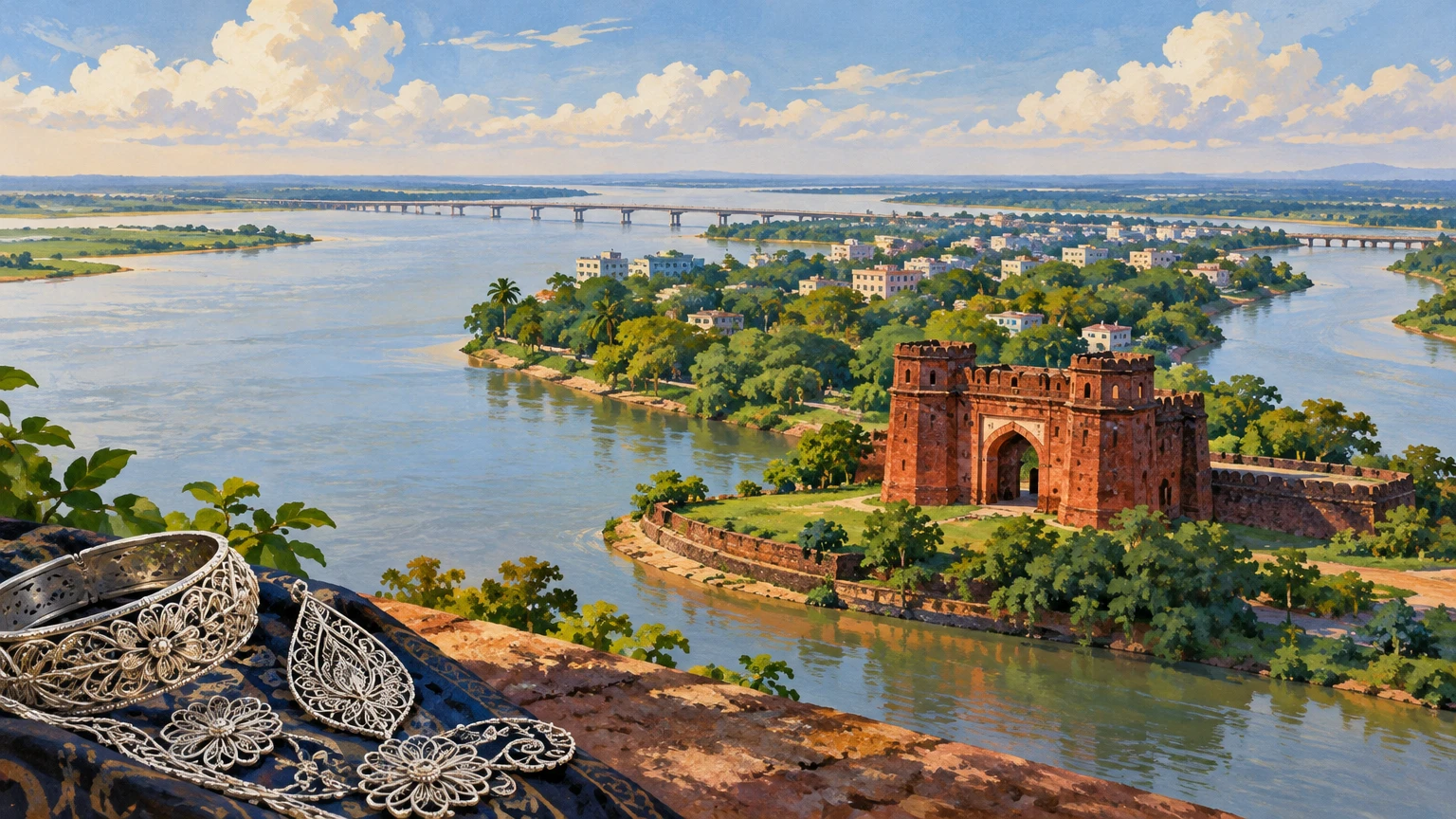
**Featured illustration:** Original AI-generated, text-free editorial artwork created for this article; it evokes Cuttack’s river setting and is not a documentary photograph. **Alt text:** “Illustrated view of Cuttack’s riverine setting, with the Mahanadi and Kathajodi, a fort gateway and silver filigree motif.”
## Publishing Metadata & Tagging
– Group: Odisha Tourism
– Section/Category: Society And Culture
– Destination: https://pcachary.in
– District: Cuttack
– Edition: 2026-10-24
– Cycle: 1
– Tags: Odisha Tourism; Cuttack; Society And Culture
## Sources & checks
– [Cuttack district profile](https://cuttack.odisha.gov.in/en/about-district/district-profile), Government of Odisha, undated. Checked 24 October 2026.
– [Cuttack district history](https://cuttack.odisha.gov.in/en/about-district/history), Government of Odisha, undated. Checked 24 October 2026.
– [Cuttack tourist places directory](https://cuttack.odisha.gov.in/en/tourism/tourist-places), Government of Odisha, undated. Checked 24 October 2026.
– [Ansupa](https://cuttack.odisha.gov.in/en/tourism/tourist-places/ansupa), Government of Odisha, undated. Checked 24 October 2026.
– [Cuttack city](https://cuttack.odisha.gov.in/en/tourism/tourist-places/cuttack-city), Government of Odisha, undated. Checked 24 October 2026.
– [Odisha State Maritime Museum](https://odishatourism.gov.in/content/tourism/en/discover/attractions/museums/odisha-state-maritime-museum.html), Odisha Tourism, undated. Checked 24 October 2026.
– [Lalitagiri Buddhist Complex](https://odishatourism.gov.in/en/places/lalitagiri-buddhist-complex), Odisha Tourism, undated. Checked 24 October 2026.
– [Silver filigree](https://crafts.odisha.gov.in/?crafts=silver-filigree), Directorate of Handicrafts, Odisha, undated. Checked 24 October 2026.
– [Odisha Cabinet resolution](https://cm.odisha.gov.in/en/latest-news/odisha-cabinet-approves-16-proposals-11-departments-its-48th-meeting-resolution), Chief Minister’s Office, Odisha, 13 October 2026. Checked 24 October 2026.
– [Mahanadi waterfront report](https://ommcomnews.com/odisha-news/mahanadi-waterfront-to-get-major-facelift-odisha-govt-clears-rs-133-71-cr-project/), OMMCOM News, 2026. Checked 24 October 2026. The reported construction timeline remains a proposal, not completion evidence.
– [Bali Jatra](https://www.incredibleindia.gov.in/en/festivals-and-events/odisha/bali-jatra), Incredible India, 2026 listing. Checked 24 October 2026.
– [Cuttack Baliyatra to begin on November 24](https://www.prameyanews.com/cuttack-baliyatra-to-begin-on-november-24), Prameya News, 26 August 2026. Checked 24 October 2026.
– Featured illustration: Original AI-generated, text-free editorial artwork created for this article; it evokes Cuttack’s river setting and is not a documentary photograph.
## Disclaimer
> This content is a collection of ancient history,books and various articles and collection of library and news and other post ; all details may not be the same. Readers are requested to verify the information themselves. Readers are not allowed to take any disciplinary action; content is only for educational purposes. If readers do not agree about the contents, they may send a personal comment to my personal email ID: achary.purna@gmail.com
