
District Overview & Geography
Dhenkanal is a district where the visual language of central Odisha changes from broad river plains into wooded rises, low hill systems and inward-looking valleys. Its headquarters town lies on the historic Cuttack–Sambalpur corridor, but the district’s character is not exhausted by a road journey through it. Temple hills, forest edges, the Brahmani river system, old princely-state memory and distinctive religious movements all give Dhenkanal a deeper identity.
The district covers 4,452 square kilometres and is bounded by Kendujhar to the north, Jajpur to the east, Cuttack to the south and Angul to the west, according to the Dhenkanal district administration. These boundaries matter to travellers because places associated with the wider Brahmani valley or adjoining forest landscapes are often casually described as “near Dhenkanal” without actually being within the district. A considered itinerary should keep Kapilash, Joranda, Saptasajya, Dandadhar, Saranga and Kualo in their proper Dhenkanal setting rather than treating the district as an extension of neighbouring Angul or Cuttack.
The terrain is marked by hills, ridges and forested tracts interspersed with cultivated land. The official district profile records 1,654.96 square kilometres as forest area, a historical administrative figure rather than a present ecological survey. Its significance for visitors is plain: Dhenkanal’s landscape is not merely a backdrop to monuments. Forest cover shapes roads, village rhythms, the setting of hill temples and the care required in moving through the district. The same official record lists three subdivisions, eight tahsils and eight blocks, suggesting the spread of its settled and upland geography rather than a tourism district concentrated in one town.
Watercourses connect that geography. The Brahmani is the principal river system shaping the region, and the Ramial is particularly important in the district’s visitor map because the Dandadhar irrigation project forms a reservoir landscape around it. These are working water landscapes, not theme-park scenery. Seasonal rain, irrigation needs, changing water levels and local rules should guide a visitor’s conduct. Reservoir banks and riverbeds are not automatically safe for swimming, boating or informal picnics.
Dhenkanal has a moderate seasonal pattern, although “moderate” should not be mistaken for uniformly gentle weather. The official district overview describes hot, humid conditions in April and May, a monsoon generally beginning in June, and cooler winter months in December and January. Rain makes the hills richly green, replenishes springs and transforms roadside views, but it can also make steep approaches, unsealed paths and forest-side travel difficult. Winter is usually the most comfortable period for first-time visitors who want to combine town heritage, hill shrines and longer drives. The post-monsoon months can be especially beautiful, while summer calls for early starts, drinking water and realistic expectations about heat.
Agriculture remains central to the district’s everyday landscape. Fields, tanks, homesteads and market settlements sit beside the more dramatic hills. A traveller who sees only Kapilash misses this lived countryside: early-morning movement on local roads, shrines within settlements, seasonal produce and craft work connected to family and community life. The 2011 Census population reported on the district’s official pages is inconsistent: the overview gives 1,192,948 while the District at a Glance gives 1,192,811. The latter should be treated as a historical census reference, not as a current population estimate.
Dhenkanal’s forests are often spoken of in broad, celebratory terms. It is better to be precise and restrained. They support wildlife habitat and are integral to a landscape where elephants may move through wider forested areas; visitors should never seek close wildlife encounters, enter restricted habitat, use loud music or treat forest roads as safari tracks. Publicly available district material consulted for this article does not provide a reliable current species list for tourist use, so no unverified flora or fauna checklist is offered here. Observant travellers can still appreciate the changing canopy, deciduous woodland textures, birdsong and the relationship between hill, shrine and settlement without disturbing any habitat.
Mythological & Historical Significance
Dhenkanal is best understood through several overlapping histories: archaeological traces, early dynastic claims, the record of a princely state, anti-colonial memory, devotional landscapes and oral tradition. These layers should not be flattened into a single tale of uninterrupted antiquity.
The name itself illustrates the distinction. The district administration says it is commonly believed that Dhenkanal derives from Dhenka, described in local tradition as a Savara chief who ruled this tract. This is an attributed explanation, not an established linguistic conclusion. The same official history page cautions that written evidence for the district’s prehistoric past is limited, while noting that archaeological evidence and inscriptions offer some clues. That caution is valuable: local reverence and inherited stories deserve respect, but they are not automatically documentary proof.
The official historical narrative associates the region with the Satavahanas in the second century CE, the Guptas in the third and fourth centuries, the Bhauma-Karas in the sixth and seventh centuries, and the Sulkis up to the ninth century. These claims are presented by the district website as a broad political chronology informed by inscriptions and archaeological interpretation. They help place Dhenkanal within eastern India’s changing networks of power, religion and trade, but they should not lead a visitor to imagine that every present shrine or village has an unbroken, datable link to each dynasty.
A more clearly legible political history emerges with the Dhenkanal princely state. The district website lists a succession beginning with Hari Singh Vidyadhar in 1530 and continuing through rulers of the Bhramarbar and Mohindra Bahadur lines until Shankar Pratap Mohindra Bahadur. The princely state merged with the Indian Union in 1947. Its legacy survives in institutional memory, local architecture, ceremonial culture and the way older residents speak of the district’s political past. Yet the most meaningful historical encounter is often not a palace façade; it is the recognition that the district’s towns, roads and public institutions were shaped by the transition from royal administration to democratic India. Dhenkanal also belongs to the story of Odisha’s freedom movement. Baji Rout, remembered as a young martyr in the struggle against princely-state repression, is among the district’s most resonant figures. His story has travelled through literature, memorial culture and public remembrance. Visitors should approach such sites and narratives with seriousness rather than turning sacrifice into a quick photo opportunity. The district profile also identifies figures including poet Brajanath Badajena, political leader Nandini Satpathy and mountaineer Kalpana Das as people associated with Dhenkanal, evidence of a public culture that extends beyond religious tourism.
The district’s most distinctive spiritual contribution is Mahima Dharma. Emerging in nineteenth-century Odisha, the tradition is associated with Mahima Gosain and a devotion to the formless, often articulated through the idea of Sunya, the void or absolute. Its ethical emphasis on equality and critique of social hierarchy have made it important far beyond Dhenkanal. Joranda is its central sacred landscape, a place where theology is encountered through architecture, communal discipline, pilgrimage and the annual Magha gathering. It should not be reduced to an exotic curiosity or folded carelessly into generic Hindu temple tourism.
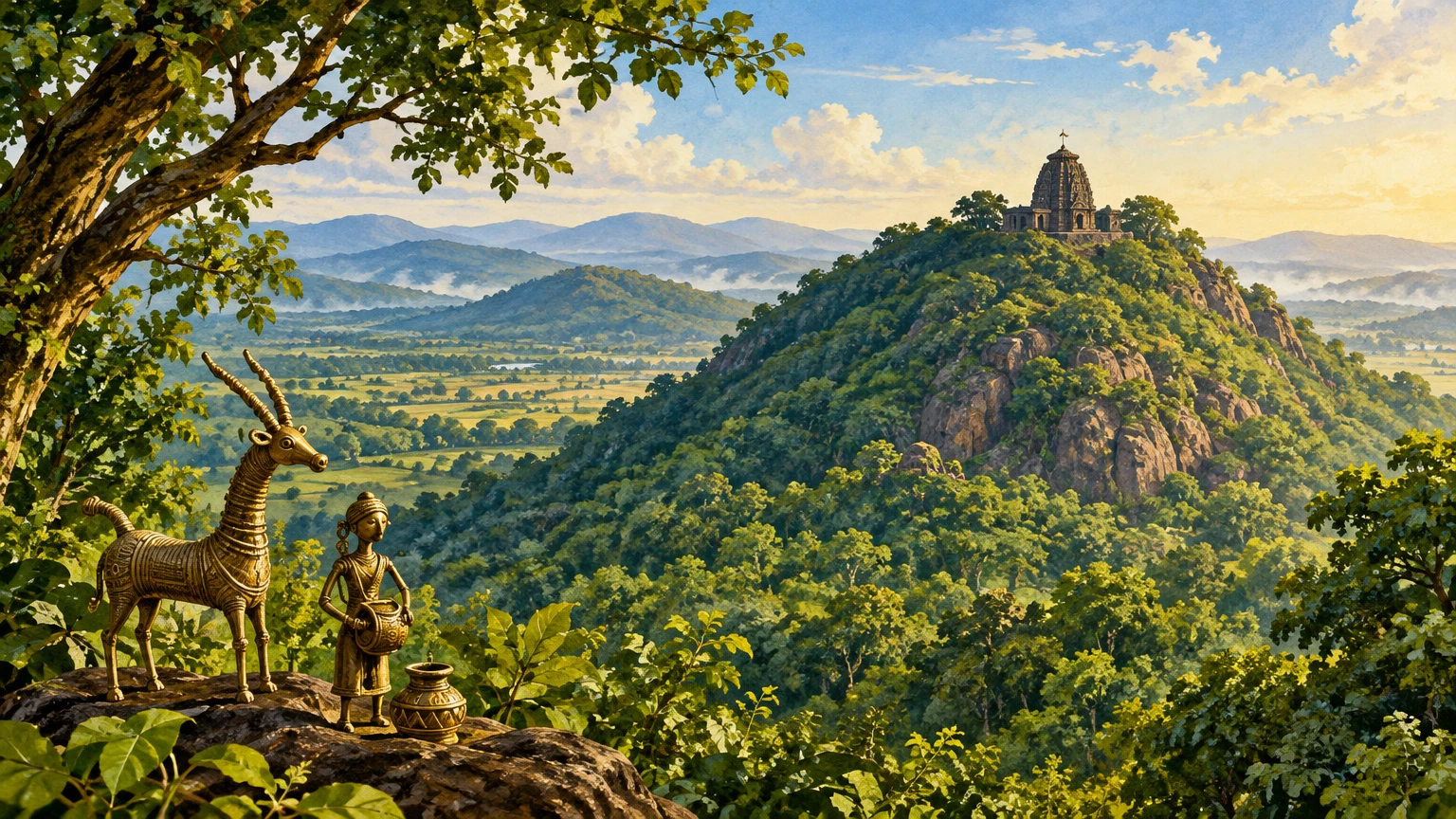
Kapilash, too, is a landscape where historical form and sacred tradition meet. The hill is associated with Lord Chandrasekhar, a form of Shiva, and carries Puranic associations in popular devotion. Such associations are matters of faith and tradition; they are not independently dated historical records. The value of the place lies partly in this coexistence: a living shrine, an ascent through a wooded hill, old ruins and caves mentioned in official tourism material, and an enduring cycle of pilgrimage.
The district’s material culture makes history tactile. The official culture page highlights Dokra casting, bell-metal work, horn work, straw work, wood and stone carving, bamboo work, tribal jewellery and silver filigree. These are not decorative labels for a tourism brochure. Each craft depends on skilled labour, inherited techniques, market conditions and changing access to materials. The same page notes that Magji Ladoo received GI status on 3 January 2024. That recognition is a useful point of local food history, though it should not be treated as a guarantee that the sweet is available in every shop or season.
Tourist Destinations & Hidden Gems
Kapilash is Dhenkanal’s defining destination because it combines pilgrimage, elevation and a strong sense of arrival. The Sri Chandrasekhar shrine stands on Kapilash hill, at about 457 metres according to the district’s Kapilash tourism page. The official description records 1,352 steps as well as a motorable ghat road. For many devotees, the stairway is part of the act of pilgrimage; for other visitors, the road may be the sensible choice. Neither option should be romanticised. The steps demand time, suitable footwear, water and attention to weather, while hill roads require careful driving and respect for local traffic.
The temple’s white form, set against dense green slopes, creates a powerful visual contrast. But Kapilash rewards slow looking beyond the main shrine. The official page refers to caves and fort ruins in the area, reminders that a sacred hill can carry multiple historical layers. Do not climb over fragile structures, follow unofficial shortcuts or enter areas marked as restricted. The presence of forest around the shrine also requires quiet behaviour: do not feed animals, leave food waste or pursue wildlife for photographs. Festival days may be spiritually compelling but can bring substantial crowds; travellers seeking a more contemplative visit should confirm local conditions before setting out.
Joranda offers a very different sacred experience. Rather than a conventional image-centred temple complex, it is the principal centre of Mahima Dharma. The district’s Joranda page identifies the Mahima Gosain samadhi and the Sunya, Dhuni and Gadi mandirs as key places in the complex. Architecture here is inseparable from religious thought: the sacred centre directs attention towards formless divinity and a disciplined devotional tradition.
The Magha fair takes place around Magha Purnima, usually in January or February, and is one of the major moments in the Mahima calendar. It is not wise to announce a future date without current confirmation from local authorities or the institution. During the gathering, visitors should dress modestly, ask before photographing people or rituals, respect spaces reserved for devotees and avoid intrusive questioning. Joranda is not a “hidden gem” in the sense of an undiscovered stop; it is a living religious centre whose depth is too often overlooked by hurried itineraries.
Saptasajya is a hill-and-spring landscape associated with the Raghunath temple. The district tourism page attributes the temple to Rani Ratnaprava Devi and notes a spring in the area. Its association with the Pandavas belongs to local legend and should be described as such, not offered as historical fact. The appeal of Saptasajya is quieter than Kapilash: a wooded setting, shrine architecture, a sense of cooling water and a natural pause from the main highway corridors. In the monsoon and immediately after heavy rain, paths and stone surfaces can be slippery. Use established approaches, carry out all waste and never assume that water from a spring is safe to drink untreated.
Dandadhar broadens the district’s tourism map beyond temple hills. Located around the Ramial river irrigation project, it is a reservoir landscape rather than a conventional monument. The district’s Dandadhar listing is appropriately brief, identifying the project and water body without promising recreation facilities. That is the right frame for a visitor. Come for a daylight landscape view, keep clear of operational infrastructure, follow any directions on site and do not presume that boating, bathing or waterside access is permitted. The reward is the view of water meeting an inland, agricultural and wooded horizon.
Saranga preserves one of Dhenkanal’s most evocative sculptural sites. Here, the official tourism material identifies an Anantasayi Vishnu image on the bed of the Brahmani. The reclining Vishnu image is compelling because it belongs to the river itself: art, sacred geography and seasonal conditions are intertwined. Respect for the site means more than removing footwear or speaking softly. It means avoiding litter, not climbing onto heritage surfaces and not entering the riverbed when water, weather or local advice makes it unsafe. The cultural significance of a riverine sculpture is diminished when it is treated as a prop for risky photographs.
Kualo is another essential stop for travellers interested in temple groups and historical texture rather than polished spectacle. The district Kualo page refers to a group of temples and the ruined Kanakeswar temple. The chronology and identification of the site should be attributed to the official district account rather than embellished with sweeping claims about every structure. Kualo’s interest lies in its layered condition: active reverence, old masonry, rural setting and ruin together. Visitors should avoid touching carvings or entering unstable sections simply to obtain a closer image. Dhenkanal town itself deserves time. The district directory lists the Science Centre and Kapilas Science Park among places of interest. These can suit families and students, though opening hours, programmes and facilities should be confirmed locally rather than assumed from a static web listing. Town visits are also an opportunity to look for responsibly sourced craft. When buying Dokra, bell-metal or other artisanal work, ask sellers about the maker and material, accept that handwork takes time, and avoid bargaining to the point that the craftsperson bears the entire cost of a visitor’s “good deal.”
A useful idea of hiddenness in Dhenkanal is not a secret waterfall or an unmarked forest trail. It is the overlooked connection among known places: a morning in a town market, a respectful visit to Joranda, a hill ascent at Kapilash, a roadside meal and an unhurried drive through cultivated and wooded country. The district’s real richness is accessible without trespassing, chasing viral locations or demanding that communities convert sacred and ecological spaces into entertainment.
Recent News & Tourism Developments
As of the edition date, 26 October 2026, no verified completed new tourism infrastructure project in Dhenkanal was identified in the sources reviewed for this article. It is important not to recast announcements, civic preparations or sporting plans as finished development.
The most immediate public event is Dhenkanal’s Gajalaxmi Puja. A report published by The Hans India on 19 October 2026 said that the celebration was scheduled from 25 October until the immersion ceremony on 4 November. For the intended late-October reading date, the festival is therefore underway according to the published schedule, not independently confirmed here as an on-the-ground status report. The report described administrative preparations involving security, traffic management, fire safety, power supply, road repairs and civic amenities. These were directions and preparations, not proof that every work had been completed.
For visitors, the practical implication is simple: festival time can be culturally memorable, especially for those interested in Dhenkanal’s public devotional arts and evening streets, but it also requires patience. Traffic diversions, crowd controls and changed access may occur. Follow local administration, police and organiser guidance; do not drive into pedestrian-heavy areas merely to save time; and do not rely on last year’s routes. On 23 October 2026, OdishaBytes reported the announcement of the Tata Steel Kapilash Half Marathon for 9 January 2027. The planned fourth edition was described as being held near the Kapilash Wildlife Sanctuary buffer area and Sri Chandrasekhar Jew Temple, with 21-kilometre, 10-kilometre and 5-kilometre categories. The report said organisers expected more than 5,000 runners and presented the event as linking fitness, community participation and conservation awareness.
This is an announced future event, not one that has taken place. Prospective participants should consult official organiser communication for current eligibility, route, registration, medical requirements, closing dates and any changes. Travellers who are not running should also remember that a large sporting event in a sensitive hill-and-forest setting brings pressure on roads and public spaces. Ecological messaging only matters if participants, spectators and vendors minimise litter, avoid disturbing wildlife and follow designated access arrangements.
These two October announcements show a district where cultural gatherings and public events remain central to visitor interest. They do not, however, replace the slower work of heritage protection, forest stewardship, sanitation and community benefit. Dhenkanal’s tourism future should be measured not only by visitor numbers but by whether sacred places remain dignified, craft workers are fairly valued and forest margins are treated with care.
Traveler Essentials
Dhenkanal is approachable by road and rail, but good travel here begins with flexible planning. The official How to Reach page identifies rail and bus connections to Dhenkanal and notes local buses, taxis and auto-rickshaws for onward movement. Because online transport listings and local schedules can change, check current train, bus and vehicle availability before departure. Do not assume a late-night service, a fixed frequency or a guaranteed shared vehicle based on an old travel blog.
By air, Bhubaneswar is the practical gateway for many travellers, followed by an onward road or rail journey to Dhenkanal. By train, Dhenkanal station is on the Cuttack–Sambalpur/Baranga–Sambalpur rail corridor identified by the district administration. By road, the district sits on the Cuttack–Sambalpur route, historically associated with NH 55. From Dhenkanal town, Kapilash, Joranda and other sites need separate local transport planning; grouping several distant places into one hurried day can turn a thoughtful journey into an exhausting drive.
October to February is often the most comfortable broad season for temples, town walks and hill excursions. The Magha gathering at Joranda, usually falling in January or February, offers a major religious experience but also greater crowding. Summer visitors should begin early, avoid strenuous climbs in the hottest part of the day and carry water. Monsoon travellers should enjoy the greenness but accept that rain can alter road conditions and make natural surfaces hazardous. Weather, local advisories and religious calendars matter more than a rigid itinerary.
Dress should be modest at shrines and religious institutions. Carry footwear that can manage steps and uneven ground, but be ready to remove it where custom requires. Ask before photographing worshippers, ascetics, craft workers, children or ritual activity. Drone use should never be presumed acceptable around temples, settlements, forests or public events. Keep voices low in sacred spaces, avoid alcohol around religious sites and never leave plastic, food packaging or discarded flowers in forested areas or water bodies.
Food is part of Dhenkanal’s cultural itinerary, though visitors should seek it with curiosity rather than entitlement. Look for simple Odia meals based on rice, dal, seasonal vegetables and local preparation styles at established eateries, and ask politely what is freshly available. The district’s official culture page notes the GI recognition of Magji Ladoo on 3 January 2024; tasting it from a trusted local seller can be a meaningful food stop. Availability, recipes and freshness vary, so do not treat a GI tag as a universal promise. Drink safe water, choose freshly prepared food where possible and accommodate local meal timings.
Stay options, temple access, parking arrangements, restroom availability and mobile connectivity can vary widely. Confirm these directly with current accommodation providers, local contacts or district information channels. Carry cash as well as digital payment options, retain a charged phone and power bank, and tell someone your day route when travelling to hill or reservoir sites. Solo travellers and families should avoid isolated trails after dark and should not rely on map shortcuts through forest-edge roads.
Finally, travel in Dhenkanal works best when it is reciprocal. Buy local crafts only through transparent, respectful transactions. Do not remove stones, leaves, fragments or offerings from heritage and forest sites. Treat Mahima institutions, Shiva shrines and village temples as living places rather than sets. Leave room in the schedule for conversation, weather and detours. The district reveals itself most clearly not through speed, but through attention.
Featured illustration: Original AI-generated, text-free editorial illustration made for this article; it evokes Kapilash hill and Dhenkanal’s craft traditions and is not a documentary photograph. Alt text: “Forested Kapilash hill with a ridge-top temple above the countryside, and Dokra-style brass figures in the foreground.”
Disclaimer
This content is a collection of ancient history,books and various articles and collection of library and news and other post ; all details may not be the same. Readers are requested to verify the information themselves. Readers are not allowed to take any disciplinary action; content is only for educational purposes. If readers do not agree about the contents, they may send a personal comment to my personal email ID: achary.purna@gmail.com
