
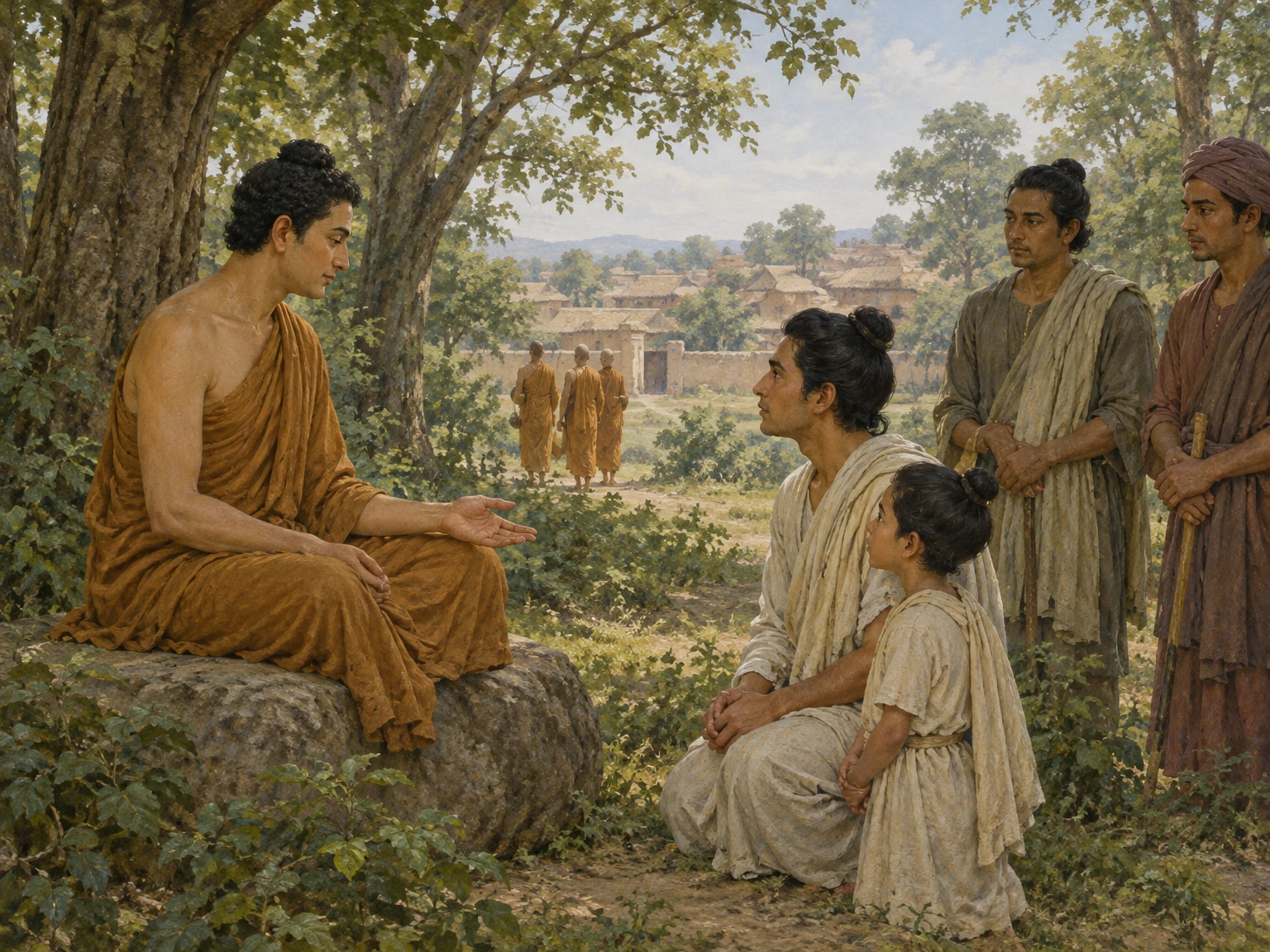
A return to the Shakya homeland
After the previous episode’s account of Sāriputta and Moggallāna joining the Buddha’s community, the Pali Vinaya turns to another story of entry into the Saṅgha. In the Mahāvagga, the Buddha travels from Rājagaha back to Kapilavatthu, the town associated with his Shakya family. There, at a monastery grove called Nigrodhārāma in the narrative, he meets members of the family he had left when he began the life of a renunciant. The emotional centre is not a royal contest or a battle. It is a child’s request, a father’s grief, and a new rule about parental permission before a boy is ordained.
The Mahāvagga places this story in the first chapter of the Vinaya, at I.54. It is the next substantial life-story episode preserved after the earlier account of the chief disciples, but the text’s arrangement needs careful handling. The early section through the ordination of Sāriputta and Moggallāna is often presented in a roughly chronological sequence; later parts organize many topics around monastic procedures. We should call this the next narrative in the Mahāvagga, not claim that every event in the Buddha’s life occurred in a proven, uninterrupted order.
What kind of source is the Mahāvagga?
The Mahāvagga is part of the Pali Vinaya Piṭaka, a collection that preserves monastic rules and stories explaining their formation. Its narratives are not modern biographies assembled from independently dated documents, still less transcripts made at the time of each conversation. They are important evidence for how Buddhist communities remembered the founding generation, explained their discipline, and connected rules with events in the Buddha’s life. That source purpose matters: a story can be valuable for religious history even when a historian cannot verify every speech, number, or sequence independently.
A 2024 study of the Mahāvagga’s structure notes that the first twenty-four chapters appear to move in a biographical order, from awakening toward the ordination of Sāriputta and Moggallāna. The later chapters gather material by subject, and their ordering does not maintain the same strict timeline. This helps situate today’s episode. The return to Kapilavatthu is the next story in the Vinaya’s remembered sequence; it should not be used to assign a precise year to Rāhula’s birth, the Buddha’s departure, or this visit.
Kapilavatthu and the grove
The text names Kapilavatthu as the Buddha’s home region and Nigrodhārāma as the place where he stays. Kapilavatthu is the Pali form often written Kapilavastu in Sanskritized usage. Scholars and archaeologists have discussed more than one site in connection with ancient Kapilavastu, and the exact geography remains a matter of evidence and interpretation. A careful account can preserve the place-name in the source without pretending that every scene can be pinned to a single modern marker.
Nigrodhārāma means a banyan grove or a grove associated with banyan trees. In the narrative it is a monastic residence, not a palace. The setting matters: the former Shakya heir is now a mendicant teacher living with a community, and his return is framed by hospitality and alms rather than royal ceremony. The text offers a remembered setting and a religious narrative. It does not supply a modern architectural plan, survey boundary, or archaeological inscription identifying this exact grove.
A family described with restraint
The Mahāvagga identifies Suddhodana as the Buddha’s father and describes a woman as the princess who was Rāhula’s mother. In this passage her personal name is not given. Later Buddhist traditions commonly identify her as Yasodharā or Yashodhara, but the label belongs to those later traditions, not to the wording of this specific Vinaya passage. Keeping that distinction clear is a small but important act of source care: a familiar name may be meaningful in Buddhist memory without appearing in every early text.
Rāhula is presented as the son of the Buddha and the princess. The story does not offer a complete family history, nor does it establish the child’s age in a way that can be independently checked. Popular retellings sometimes add detailed scenes about palace life, a long separation, or a particular age at the meeting. Unless a cited source supplies those details, they should not be inserted as fact. Here we follow the account’s own shape: a return to Kapilavatthu, an encounter with the child, and an ordination that leads to a new disciplinary rule.
The Buddha’s arrival and the family visit
In the Mahāvagga’s account, the Buddha comes to Kapilavatthu and stays at Nigrodhārāma. The narrative then describes Suddhodana visiting him and the family’s contact with the community. Its telling is brief compared with later popular biographies, and it does not stage the return as a dramatic reclaiming of political authority. The Buddha arrives as a teacher and monk. The people around him respond through the social conventions and relationships that the text chooses to preserve.
That difference from a palace-return story is worth noticing. The Buddha is not described as returning to govern the Shakya people, take possession of a throne, or lead an armed force. The episode concerns a teacher’s relationship with his relatives and the growing monastic community. Its central question is what kind of inheritance can be offered to a child when the father has renounced household life. That is a religious and ethical theme in the text, not evidence of a political succession or a transfer of property.
The request for an inheritance
The familiar inheritance scene begins when Rāhula’s mother directs the boy toward the Buddha and tells him to ask for his inheritance. In the Mahāvagga, the request is framed in the language of inheritance, but the story does not describe a legal claim over land, wealth, or a kingdom. The narrative presents Rāhula approaching his father and asking for what he is told to request. The episode’s meaning comes from the contrast between worldly inheritance and the path the Buddha now embodies.
Some modern retellings give the scene elaborate dialogue, motives, or emotional reactions that are not stated in the source. The Vinaya’s brief narrative does not let us know everything the mother or child privately felt. We can say what the text says: she points Rāhula toward the Buddha and instructs him to ask for his inheritance. We should not turn that short instruction into a verified account of a family argument, a deliberate test, or a detailed plan. The story’s quiet ambiguity is part of what makes careful retelling necessary.
A child follows his father
Rāhula follows the Buddha and repeats his request. The Mahāvagga presents this as the immediate circumstance leading to his going forth. It does not give a detailed psychological portrait of the child or explain whether he understood all the consequences of becoming a novice. The narrative instead focuses on the response of the monastic community and the procedural question that follows: who may admit a young person into the training?
The title “Rāhula’s first going-forth” refers to the Vinaya’s ordination story, not a claim that we can reconstruct every event of his childhood. Pali texts use pabbajjā for the going-forth from household life into homelessness. It is often described as novice ordination, distinct from the higher ordination required to become a fully ordained monk. Translators use different English terms, and institutional details developed over time. In this episode, the main point is that Sāriputta is asked to give Rāhula the going-forth according to the procedure the community follows.
Sāriputta is asked to ordain Rāhula
The Buddha asks Sāriputta to give Rāhula the going-forth. This choice links the story to the previous episode, where Sāriputta became one of the chief disciples after hearing Assaji’s verse and joining the Saṅgha. The Mahāvagga’s narrative thus gives him a role in welcoming a new generation into the community. It does not say that Sāriputta acted as Rāhula’s father or replaced his family; he performs a monastic responsibility at the Buddha’s request.
The account explains the ceremony by referring to the three refuges: taking refuge in the Buddha, Dhamma, and Saṅgha. This is a practical detail in a Vinaya narrative, where rules and procedures are connected with episodes in the community’s life. The story should not be flattened into the claim that a child merely received a new name or joined a club. In Buddhist understanding, taking refuge is a religious commitment; in the Vinaya’s history, the way ordination is performed is also a matter of communal discipline. Both aspects belong in a responsible retelling.
The first rule about parental permission
When Suddhodana learns that Rāhula has gone forth, he speaks to the Buddha about the pain a parent experiences when a son leaves home. The text recalls that he had already suffered when the Buddha went forth, and now faces the departure of Nanda and Rāhula as well. The passage’s emphasis is not simply on a ruler’s command. It gives a father’s grief a place in the formation of a communal rule.
In response, the Buddha establishes that a son should not be given the going-forth without the permission of both parents. The rule is presented as arising from this particular situation. It protects a family interest while giving the Saṅgha a clear procedure to follow. It is important not to extend the rule beyond what the passage states or to assume that every community in every Buddhist tradition has always applied it identically. The text records a disciplinary response in the Pali Vinaya; later monastic practice can vary by tradition and context.
What the rule reveals—and what it does not
The parental-permission rule shows the Vinaya narrative depicting monastic discipline as responsive to human relationships. The Saṅgha is not represented as indifferent to householders or families. A father’s concern leads to a rule that novice ordination should not proceed without both parents’ consent. The story therefore places family responsibility beside renunciation, rather than pretending that leaving home carries no consequences for the people who remain.
At the same time, this passage does not furnish a general modern legal ruling about minors, guardianship, or religious conversion. It does not define how permission should be documented, what happens when a parent cannot be reached, or how the rule applies in every later school of Buddhism. Those are questions for particular traditions and contemporary institutions. Our task here is narrower: to state the Mahāvagga’s rule and its narrative setting accurately, without presenting an ancient monastic procedure as a universal civil law or inventing exceptions the text does not give.
Nanda and the shape of the story
Suddhodana’s speech mentions not only the Buddha but also Nanda and Rāhula. The passage invokes the father’s distress at the departure of three sons or close family members, but it is not a full narrative of each person’s ordination. Other Buddhist texts and traditions tell additional stories about Nanda. Those accounts should be treated as separate sources rather than silently merged into this episode.
This is a useful example of why a series needs careful boundaries. A passage may refer to an event without narrating it fully. The Mahāvagga here uses the mention of Nanda to explain the father’s concern and the resulting rule. It does not give us permission to fill in the gaps with any story from later literature and call it part of the same contemporaneous record. We can acknowledge the reference, then leave Nanda’s fuller story for a source-based episode of its own if the series later turns to it.
Rāhula in later Buddhist teaching
Rāhula appears in other important Pali texts, including the discourses commonly known as the Advice to Rāhula at Ambalaṭṭhikā and the Greater Advice to Rāhula. These teachings are traditionally associated with the Buddha instructing his son in reflection, truthfulness, and the examination of actions. They offer a different kind of evidence from the ordination story: not a Vinaya account about how a novice joined the community, but discourses preserved in the Sutta Piṭaka and associated with ethical training.
It is tempting to place every Rāhula episode into a detailed life timeline. The texts do not always provide the dates needed to do so, and the collections have their own structures and transmission histories. A cautious reader can compare the themes and identify the sources without pretending to know the exact number of years between the boy’s going-forth and each later teaching. The Rāhula of these discourses is a figure through whom Buddhist texts explore practice; those passages should not be treated as independent diary entries simply because they are linked to the same named person.
Different traditions, different biographical details
Buddhist communities across Asia have preserved a rich range of accounts about the Buddha’s family, the naming of Rāhula’s mother, and the child’s later life. These traditions are part of Buddhist history and devotion. Their differences are not a reason to dismiss them, but they do mean a writer should identify which source says what. The Mahāvagga passage we are following calls the woman Rāhula’s mother and does not name her; later accounts supply names and further scenes.
The same care applies to the word “inheritance.” Readers may interpret the story spiritually, as the Buddha offering a path rather than possessions. That is a meaningful reading, but it should be marked as interpretation, not confused with a sentence in which the Vinaya explicitly defines every metaphor. We can explain why the episode invites that reading: the request is followed by ordination, and the child enters the community. Still, the primary text’s procedure and later devotional interpretation are distinct layers. Keeping them visible allows readers to appreciate tradition without mistaking commentary for quotation.
What can be established historically?
The Mahāvagga is direct evidence that the Pali Vinaya tradition preserved a story of the Buddha’s return to Kapilavatthu, Rāhula’s going-forth, and a parental-permission rule. It also shows how the tradition connected a disciplinary provision to a remembered family event. This is a meaningful historical fact about Buddhist textual and institutional memory. It is not the same as independently proving the exact date of the visit, the wording of every conversation, or the details of each participant’s private feelings.
The story is set in the early Buddhist past, but no calendar date for the visit is supplied in the cited passage. The Buddha’s chronology remains debated, and biographical texts were transmitted and organized over time. Archaeology can illuminate settlement and later Buddhist activity in the region, but it cannot ordinarily verify a particular conversation or identify the precise grove in which a child asked for inheritance. A responsible conclusion is neither that the story is a modern transcript nor that it has no value. It is a source with a clear religious and institutional purpose, to be read on its own terms and alongside other evidence.
Reading the episode with care
There are several layers in this episode. The Mahāvagga tells a return journey and a novice ordination; its rule concerns permission from both parents; later traditions add names and biographical details; modern historians assess what can be independently dated or located. These layers can be discussed together, but only if they are not collapsed into one undifferentiated narrative. Quotation marks should be reserved for the translation actually consulted, and paraphrases should be identified as summaries of the Vinaya.
This care does not make the story cold. The text places a child between two worlds: the household where he is told to seek an inheritance and the renunciant community where his father now lives. It also lets a father’s pain alter the rules of a growing institution. Readers may find poignancy in the scene, while recognizing that the narrative does not reveal every family member’s thoughts. Respectful reading can preserve both the human significance of the story and the limits of the evidence.
From a family encounter to a community rule
The episode’s lasting institutional effect is the rule about parental consent. A request made on a visit home becomes a question that affects future ordinations. That is characteristic of the Vinaya’s narrative method: an incident is remembered together with a rule, allowing readers to see the human problem that the discipline is meant to address. The rule does not erase the decision to renounce household life; it shapes how the community receives a son whose parents still have a claim on their care and responsibility.
The story also connects the first circle of disciples with the community’s future. Sāriputta, introduced in the preceding narrative, is now the monk asked to ordain Rāhula. The community is no longer only a group of adults who encountered the Buddha as wanderers or householders. The Vinaya imagines a child entering its training, prompting a formal safeguard. That shift is the episode’s chronological contribution to the series: the Buddha’s teaching community is growing, and its rules develop as new kinds of relationships arise.
The next chapter in the series
Day 8 follows the Mahāvagga’s account of the Buddha’s return to Kapilavatthu and the going-forth of Rāhula. The previous story focused on Assaji’s verse and the joining of Sāriputta and Moggallāna; this one turns to family, renunciation, and the formation of a rule. The connection is literary and thematic, not a claim that the texts provide a fully verified calendar between every event.
In later installments, the series can continue with other narratives from the Buddha’s life while identifying when a text shifts from biography to monastic procedure or teaching. For this episode, the essential point is modest and clear: the Pali Vinaya remembers Rāhula’s entry into the community and explains a parental-permission rule through Suddhodana’s concern. The source does not name his mother in this passage, date the event, or establish every later biographical detail. Leaving those limits visible is part of telling the story well.
Inheritance as a question of belonging
The word “inheritance” carries more than one possible resonance. In ordinary family life it may point to property, status, a livelihood, or the benefits a parent passes to a child. In this narrative, however, the Buddha no longer lives as a householder, and the requested inheritance leads to an invitation into religious life. Many readers therefore understand the scene as a contrast between material succession and a spiritual path. That reading fits the story’s movement, but it remains interpretation: the Vinaya’s immediate narrative function is also to explain how Rāhula’s ordination took place and why a new parental-permission rule followed.
This distinction protects the story from two opposite simplifications. It is too narrow to treat the episode only as a legal transfer, because the text’s sequence leads to the going-forth and a communal rule. It is also too confident to claim that the source itself spells out one fixed allegory for every use of “inheritance.” We can notice the religious meaning invited by the plot while keeping the text’s stated events separate from later explanation. Readers from different Buddhist traditions may emphasize different dimensions, and the passage can be studied as both a family story and a record of how monastic discipline was remembered.
Sources
- Pali Vinaya, Mahāvagga I.54 — Rāhula’s going-forth and parental permission, Rhys Davids & Oldenberg translation
- Mahāvagga I.54 — The Buddha’s return to Kapilavatthu and Rāhula, Wisdomlib translation
- Mahāvagga structure and the limits of its chronology, Journal of Buddhist Studies (2024)
- MN 61, Advice to Rāhula at Ambalaṭṭhikā — SuttaCentral
- MN 62, Greater Advice to Rāhula — SuttaCentral
This content is a collection of ancient history,books and various articles and collection of library and news and other post ; all details may not be the same. Readers are requested to verify the information themselves. Readers are not allowed to take any disciplinary action; content is only for educational purposes. If readers do not agree about the contents, they may send a personal comment to my personal email ID: achary.purna@gmail.com
