
A question of place after Jetavana
The previous installment followed the story of Sudatta’s gift of Jetavana to the Buddhist community. The Cullavagga now turns from that celebrated gift to a practical question: how should members of the Order use the places made available to them? Its account does not offer a dated diary of the Buddha’s life. It is a rule-origin narrative in a monastic legal collection, preserving how a tradition explained its expectations about lodging, deference and shared property.
In Cullavagga VI, section 6, the Pali Vinaya describes a dispute over sleeping places. The episode places two themes beside each other. Monks are expected to show respect and courtesy, including toward senior members; yet common lodging cannot simply be claimed in advance for one’s own group. The story of three animals provides the narrative’s memorable lesson in courtesy, while the rule that follows sets a limit on how priority can be used.
The group that arrived first
The text begins with pupils belonging to the group of six monks. They hurry ahead of the Order and reserve lodging and sleeping places for their preceptors, teachers and themselves. By the time the elder Sāriputta arrives, places have already been taken. He finds no lodging and sits beneath a tree. The account does not present the problem as a shortage caused by a natural disaster or a particular building plan; it focuses on the pupils’ act of reserving places for their own party.
That detail matters. The argument is not simply whether an elder deserves courtesy. The question is whether one group may control common sleeping places by acting first, before others arrive. The narrative shows the practical result through Sāriputta’s situation: a monk identified in the account as an elder is left without a place because the arrangement has already been made around private loyalties.
Sāriputta beneath the tree
The story makes Sāriputta’s tree-side rest the point at which the dispute becomes visible. The Buddha asks the monks who ought to receive the best seat, water and alms-food. The replies appeal to different kinds of standing: family or caste, learning, and spiritual attainments. The exchange brings the community’s ideas of precedence into view before the narrative asks how those ideas should shape daily life.
Horner’s translation records these questions as part of the source’s rule-setting scene. They should not be turned into a complete account of all Buddhist customs, or treated as a verbatim transcript independently verified by another record. Within this passage, the question about seats and offerings opens a discussion of deference. It does not by itself establish that every resource, room or communal object should be allocated according to rank.
Three companions beneath a banyan
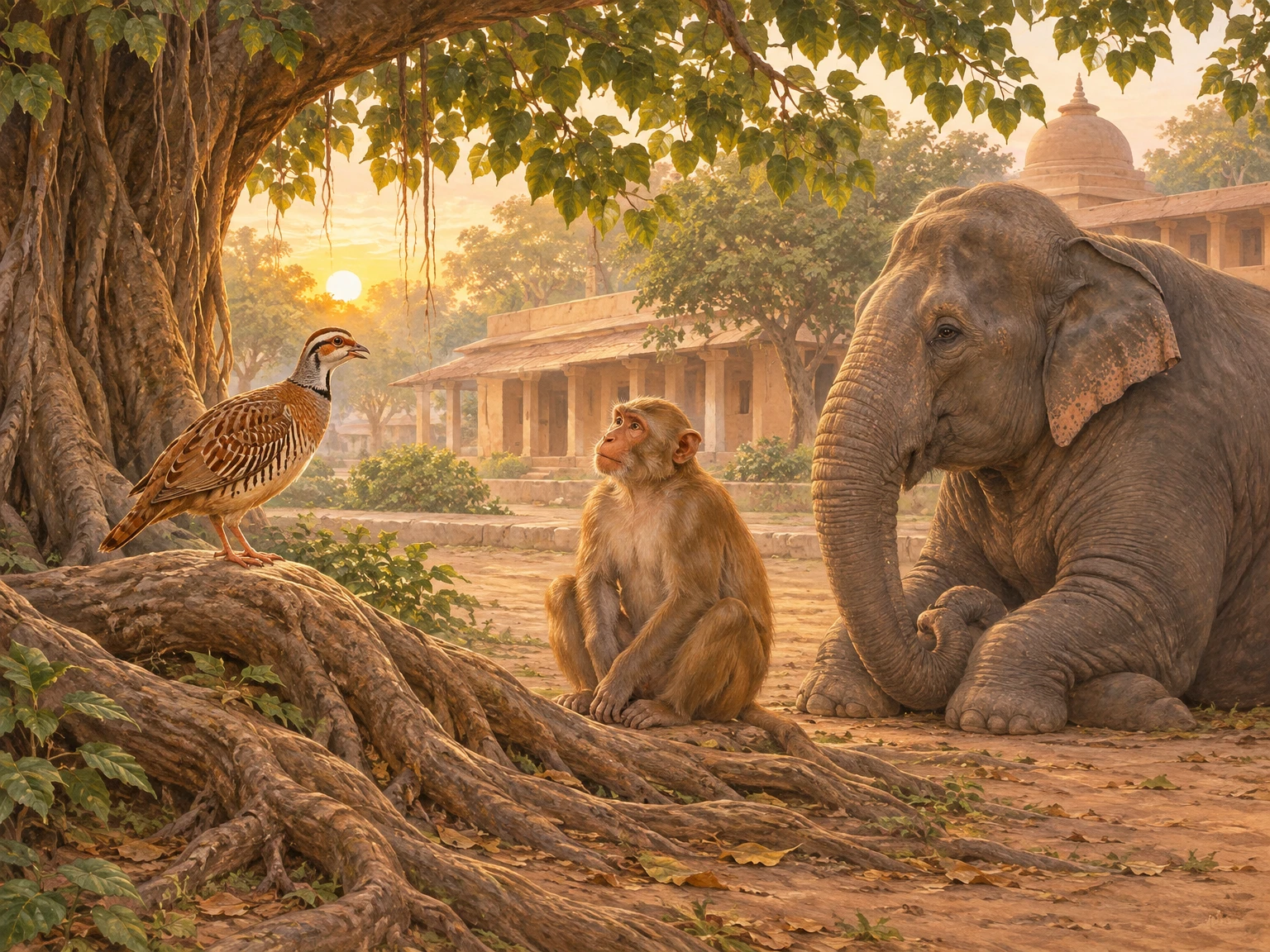
The Buddha then tells the story of a partridge, a monkey and a bull-elephant living near a banyan on a slope of the Himalaya. They ask which of them is oldest. Each answers by describing what the tree looked like when it was young. Their memories do not agree, and the order in which they recount them becomes the key to the question.
The tale is not presented as zoological observation. It is an animal story within a Buddhist textual tradition, used to make a point about conduct. Its setting is simple: three companions share a place, ask a question, listen to one another and decide how to live together. The contrast with the monks’ lodging dispute is deliberate in the narrative: the animals model a form of deference that the monks are being asked to consider.
The elephant remembers the small tree
The bull-elephant recalls that, when he was young, he used to cross the ground where the banyan now stands. The tree’s highest shoots would brush against his belly. In the animal’s account, this memory shows that he knew the tree at an early stage of its growth, though not when it first began.
His testimony is measured against what the monkey and partridge remember. The elephant does not simply announce himself as oldest because he is largest or strongest. He offers a specific recollection and waits for the others’ accounts. That choice gives the story an important rhythm: claims of priority are tested through shared listening, rather than settled by force or appearance.
The monkey remembers the top branches
The monkey says that when he was young he would sit on the ground and eat the banyan’s topmost shoots. This places him at a stage when the tree was still small enough for him to reach its new growth. His memory, like the elephant’s, describes the tree in relation to his own younger life.
The story does not make the monkey’s account a contest of cleverness. The animals’ recollections are pieces of a common history. The monkey listens to the elephant, then offers his own memory. The sequence prepares the answer: if the partridge can remember the tree before it grew at this site, then both other companions are younger than the partridge.
The partridge remembers an earlier banyan
The partridge says that in an earlier place there was a banyan whose fruit it ate. The bird later passed the seed, and the present tree grew from it. The partridge’s recollection reaches further back than the elephant’s or the monkey’s: before this tree became a landmark, its beginning lay in the life of another tree and in the seed carried from it.
On this basis, the companions recognize the partridge as eldest by birth. The story’s answer is not that the bird deserves deference because it is stronger, more imposing or more powerful. The distinction is age, established within the tale by the order of events the animals recount. The partridge’s older memory becomes the reason the other two accept its precedence.
Deference becomes a shared practice
After identifying the eldest, the monkey and elephant honor the partridge and follow its counsel. The partridge teaches them the five precepts; the story says that it practices them too. Their respect is therefore more than a title. It is expressed through listening and conduct within their shared life.
Horner’s English text calls this the “Partridge Brahma-faring” and links the episode to the Tittira Jātaka. That cross-reference helps identify the tale’s place in a wider body of Buddhist narrative, while the Cullavagga uses it here to introduce a monastic rule. The two settings are related by the text, but they should not be conflated: the animals’ story is a moral illustration embedded in a legal discussion, not an independent historical record of three creatures at a monastery.
From animal courtesy to monastic conduct
Returning to the monks, the Buddha in the narrative asks whether animals can be courteous, respectful and polite. If they can, the account reasons, monks should be capable of such conduct as well. The passage then describes forms of homage: greeting, rising, joining the palms and paying proper respect. It also discusses precedence in relation to the best seat, water and alms-food.
These details belong to the text’s account of monastic etiquette. They show that seniority and respectful conduct matter within this community’s rules. But the episode does not end by saying that seniority governs every material decision. Its next distinction is crucial: homage to an elder is different from reserving communal lodging for one’s own preceptor, teacher or group.
Respect is not a license to reserve common rooms
The first ruling says that common lodging and sleeping places are not to be reserved according to seniority. The pupils of the group of six had treated priority as a way to secure places for their own party. The rule rejects that use of precedence. In this account, respect can be shown through customary forms of homage, while the shared places themselves remain subject to the community’s arrangements.
This is the episode’s central distinction. The text is not saying that elders should never receive respect, nor that all monks have identical roles. It is distinguishing a gesture of deference from a claim over common accommodation. When seniority becomes a means to set aside shared places in advance, the narrative presents it as an improper reservation rather than a proper act of homage.
The second lodging dispute
The narrative then describes another attempt by the group of six pupils. They argue, in effect, that the rule against reserving ordinary communal property should not apply to places specially made for the Order. They take such places for their own preceptors, teachers and themselves. The text names examples including prepared sheds, mats and open places. Once again, Sāriputta arrives and finds no place available, so he stays beneath a tree.
This repetition matters because it tests the boundary of the rule. The first dispute might have been explained away as applying only to ordinary or general lodging. The second asks whether a place expressly provided for the community can be privately claimed by one group. The text answers no: special provision for the community does not make a common place an individual or factional possession.
Shared provision and fair use
The Cullavagga’s account is concerned with how common lodging is used, not with a modern housing code. It describes monastic settings in its own terms and addresses the community to which its discipline applies. Its examples—sheds, mats and open places—show that the rule reaches more than a single type of bed or room. The stated concern is reservation for favored persons, whether the place is ordinary or specially provided.
The narrative does not give a building inventory, a floor plan or a universal procedure for every monastery. It does, however, make a practical principle legible: resources made available to a community should not be silently converted into private allocations by those who arrive first or have influence over a particular teacher. The fairness here is an interpretation of the episode’s contrast between shared provision and private reservation, not a quotation of a modern policy.
Why the elder’s example matters
Sāriputta’s repeated arrival after places have been taken keeps the consequences in view. The story does not dwell on a confrontation or describe him forcing his way into a room. Instead, he accepts the immediate situation and rests beneath a tree; the Buddha’s teaching addresses the rule that allowed it to happen. The narrative uses this contrast to make the issue one of communal conduct rather than personal retaliation.
That portrayal should not be expanded into claims about Sāriputta’s private feelings or about how every historical monk would have responded. The source tells us what its story needs us to see: a respected elder lacks lodging because places were reserved for a favored group, and the community is instructed about the boundary between deference and possession. The quiet image of a monk at a tree serves the rule-origin account without proving a specific event took place exactly as narrated.
A rule-origin story, not a dated biography
The Cullavagga belongs to the Pali Vinaya, a collection of monastic discipline transmitted in Buddhist tradition. Its rules are often presented through narratives that describe a problem, a report to the Buddha and a rule or clarification. Such passages are primary evidence for the legal and narrative tradition preserved in the text. They do not automatically establish that every named conversation or event can be independently dated or verified.
Horner’s translation is a modern English rendering of the Pali Text Society edition. The edition’s section numbers help readers locate the passage, but other editions may format or number material differently. For this installment, “Cullavagga VI, section 6” and the printed subdivisions within that section provide the relevant reference. The story should be followed as the text presents it, without turning its sequence into a secure calendar of the Buddha’s life.
The story’s relation to the Tittira Jātaka
Horner’s edition notes the partridge episode’s relation to the Tittira, or Partridge, Jātaka. That connection helps explain why the tale sounds like a moral animal story within a discussion of disciplinary rules. The Vinaya passage draws on the partridge, monkey and elephant narrative to support its teaching about courtesy and respect among monks.
A shared motif across Buddhist texts can illuminate transmission and the ways communities used stories. It is not, by itself, proof that the narrated encounter happened as literal history. Nor does the reference allow us to assume that every version of the Jātaka has the same wording or purpose as the Cullavagga passage. This article follows the function the story has in Horner’s translated Vinaya section: an example used to make an argument about monastic behavior.
What the episode establishes—and what it does not
The passage establishes, as a fact about the text, that the Pali Vinaya’s Cullavagga tells of pupils reserving lodging, Sāriputta finding no place, an animal story about determining age, and a rule distinguishing homage from reservation of common sleeping places. It also preserves how the text frames a second claim about places specially provided for the Order. These are claims about the source’s content.
The source alone does not independently verify the historical conversations, the animal tale, the exact date of the events or the precise practices of every early monastery. It does not establish a rule for contemporary housing, workplaces or religious institutions outside the tradition and context it addresses. Readers can study the passage as evidence of remembered discipline and ethical instruction without claiming that it proves more than its text can show.
A reflection on precedence and belonging
One way to read the episode is as a warning that a good principle can be misused when it is applied without attention to its purpose. The story honors seniority in forms of respect, yet refuses to let seniority become a way to monopolize common lodging. That distinction can be meaningful to readers today, provided we label it as a reflection rather than a direct rule for modern life.
The animal tale adds a second angle: the partridge’s age is recognized through memory and the others respond with respect. In the monastic setting, however, the relevant question is not only who deserves honor, but how the community shares places intended for its members. The story therefore holds courtesy and fairness together without making them identical. Respect for a person need not mean that common goods become privately reserved for that person’s circle.
Following the textual sequence
The series has been moving through episodes and rules preserved in Buddhist literature, while keeping textual order separate from an independently verified biography. The transition from Jetavana’s gift to lodging rules is thematic: once a community has places to live and practice, questions arise about how members use them. The source’s rule-origin narrative supplies its own explanation; it does not say that every episode occurred at the same historical moment.
The next installment should continue from the primary source rather than assume a seamless chronology. The Cullavagga offers practical detail about shared monastic life alongside stories that explain or illustrate its discipline. Reading those layers together—while noting where historical verification ends—lets us see both the rule and the literary work the narrative performs.
Sources and reading note
Primary source: I. B. Horner, translator, The Book of the Discipline (Vinaya-Piṭaka), Volume V: Cullavagga, Pali Text Society, first published 1952, reprinted 2001; Cullavagga VI, section 6, especially its opening subsections and the partridge story. The translated passage includes a cross-reference to the Tittira Jātaka.
This article paraphrases the passage rather than reproducing a long translation. Section labels and pagination may vary in other editions. The story is discussed as part of a religious and monastic textual tradition; the article does not claim independent historical verification for the narrative events.
Sources
This content is a collection of ancient history,books and various articles and collection of library and news and other post ; all details may not be the same. Readers are requested to verify the information themselves. Readers are not allowed to take any disciplinary action; content is only for educational purposes. If readers do not agree about the contents, they may send a personal comment to my personal email ID: achary.purna@gmail.com
