
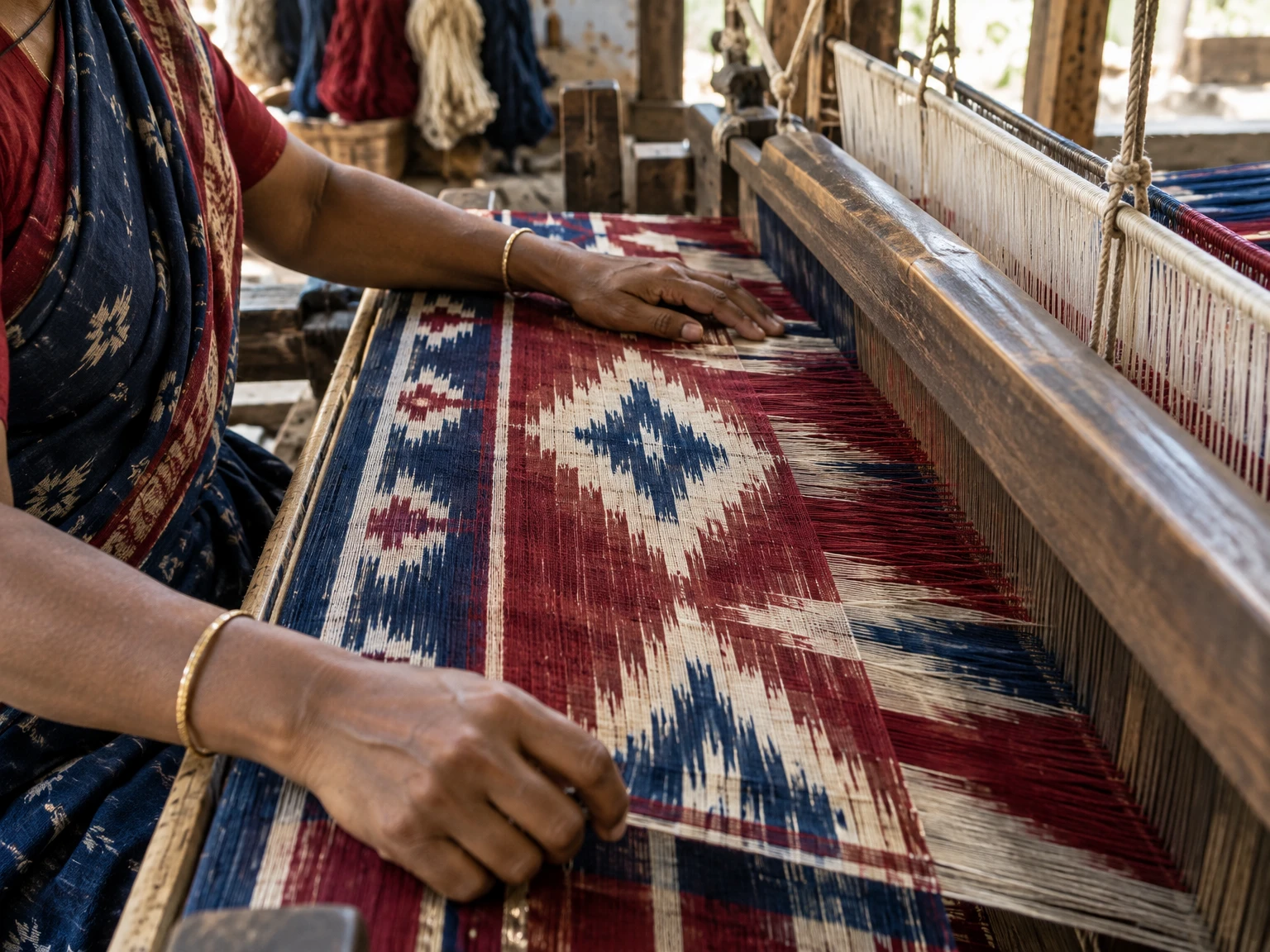
“Sambalpuri” is often used as if it names one pattern, one cloth and one unchanging tradition. A closer look reveals a richer story. Sambalpuri Bandha is a method of planning colour and pattern in yarn before the yarn is woven, a body of skill cultivated in particular communities and production centres, and a name attached to a specific registered geographical-indication product. It belongs within the wider family of Odisha’s ikat textiles, but the words are not interchangeable: Odisha has several textile traditions, and “ikat” covers practices extending well beyond a single district or design. A careful account therefore begins by separating what the technique does, where particular practices are documented, and what a pattern might mean to the people who make or wear it.
The attraction of Bandha is partly visual: motifs seem to emerge from a field of colour, often with softly feathered edges rather than the hard boundary of a printed line. Yet the blur is not carelessness. It is the visible trace of a demanding process in which groups of yarns are measured, protected from dye, coloured in stages and aligned so that their planned marks meet during weaving. The finished surface is only the last stage of a sequence of decisions. To appreciate the cloth is to look both at its image and through it, toward the planning, memory, coordination and repeated adjustment held in every patterned length.
1. A name with a specific reach
Odisha’s official handicrafts description presents Sambalpuri cotton sarees as woven in Sambalpur district and recognises their distinctive borders and pallu, the decorated end of a saree. It notes motifs such as fish, conch shells and flowers, and sometimes animals. This is a useful public description, not a complete map of every textile made in the region or a guarantee that every product sold under a broad label shares the same origin. “Sambalpuri” can refer in everyday speech to a style, a market category or a recognised product, so the context matters. A buyer reading a label should distinguish the maker’s claim, the actual place of production and the legally registered indication.
Geographical-indication registration gives the name a defined legal and administrative setting. The Indian GI Registry record identifies “Sambalpuri Bandha Saree & Fabrics” and lists the Directorate of Textiles & Handloom as applicant. The public record gives the filing date as 13 July 2010 and certificate 175, dated 17 July 2012; its current entry records validity through 12 July 2030. Those dates describe the registry record, not the beginning of weaving. Nor does registration itself describe every workshop, settle the history of a technique or tell us how a particular saree was made. It is one important piece of information within a much larger cultural and economic picture.
2. Odisha’s broader ikat landscape
Bandha is often discussed through the international word “ikat,” used for resist-dyeing yarn before weaving. In Odisha, this broad family includes distinctive regional practices and products. Research on Odisha ikat identifies major centres around Sambalpur–Bargarh and around Cuttack, and describes multiple traditions, including Sambalpuri Bandha and Khandua. Place names matter because they point to histories of work, skills, markets and local institutions. They should not be flattened into a claim that all Odisha ikat comes from one town or that one registered name covers every textile woven in the state.
Even within a named centre, production is not a single uniform recipe. A weaver’s community, the loom and yarn available, intended cloth, buyer, design scale and the roles of designers, dyers and preparatory workers can all shape the result. Some practices are transmitted through family or workshop relationships; others shift as people learn, migrate, collaborate or respond to new orders. A label can make a complex network legible for commerce, but it cannot substitute for asking who did which work, where the cloth was produced and how the makers themselves describe it. Respectful writing keeps these distinctions visible rather than treating “tradition” as a single voice.
3. What the resist process does
In a resist-dye technique, parts of the yarn are tied or otherwise protected so that dye does not reach them. The resist is removed or shifted, and another colour can then be applied to exposed portions. Repeating the process creates a planned sequence of coloured and protected sections. Once the yarn is placed on a loom, those sections become the building blocks of a pattern. The design must be conceived in relation to yarn length, thread order, the dimensions of the intended cloth and the way a loom brings warp and weft together. A motif that looks simple on the finished surface may require careful arithmetic and a detailed understanding of how the pattern will travel through the weave.
IMPART’s account of Odisha ikat describes Odisha Bandha as primarily a weft-ikat practice, with pattern created through dyed weft yarns and characteristic feathered outlines. “Primarily” is important: descriptions of a broad regional practice do not mean that every textile follows one identical construction. The soft outline is produced by the relation between a dyed yarn segment and the neighbouring threads, and by the way the yarns sit together in the woven cloth. It can make a pattern feel as if it is moving or dissolving at its edge. This is a technical effect with aesthetic possibilities, not an error to be corrected into the crispness of a printed graphic.
4. The design must be imagined in yarn
Planning an ikat design differs from drawing a finished picture and placing it on a surface. The maker has to imagine how yarn positions will translate into a woven grid. If a coloured segment is too long, too short or placed at the wrong point, a motif may widen, shift or break when the cloth is woven. If several colours are used, each dye stage must align with the others. The warp and weft behave differently under tension, and the loom’s structure affects how the pattern appears. The design is therefore both an image and an instruction set: it has to be beautiful in the mind and workable through a series of physical operations.
Scale adds another challenge. A tiny motif can be repeated many times, while a large central figure may require long spans of carefully controlled yarn. Borders and pallus have their own visual jobs: a border can frame the field, and the pallu can carry a concentrated arrangement that becomes prominent when the saree is draped. Planning has to account for the length of the cloth, the position at which the wearer may fold it, and the way the design appears when some parts are hidden. The maker is not merely decorating a rectangle; the maker is anticipating a garment in motion and shaping the pattern for that use.
5. Tying, dyeing and keeping alignment
Resist tying is a form of controlled protection. The tied areas must correspond to the intended design, and they must withstand dyeing without unwanted colour entering the protected fibres. The preparatory work is repetitive but not mechanical in the sense of being mindless: a repeated tie can demand close attention to spacing and tension. A small shift in one bundle can affect a row of motifs. When a design requires several colours, each stage adds decisions about which areas remain protected and which are opened to take dye. The sequence must be planned so that later colours complement, rather than erase, the earlier ones.
After dyeing, the yarn must be arranged so that its separate coloured portions align across the loom. This moment makes visible how much of the pattern lives in anticipation. The cloth has not yet emerged, but the maker must judge whether the dyed sequences will meet as intended. With weft ikat, the weft threads are inserted across the warp, and their coloured sections have to be placed in the right order as weaving proceeds. The design can be checked progressively, but correction may be difficult once the work is under way. Knowledge of the yarn, dye, loom and desired image works together; none of these is an isolated step.
6. Why edges look feathered
The characteristic softness of many ikat outlines is frequently called “blur,” but the term can suggest an accidental defect. In fact, a feathered edge is part of the visual language of the technique. Small differences in the placement of dyed sections can make neighbouring colours interlock or appear to shimmer. Instead of a perfectly sharp boundary, the pattern has a threshold: the eye reads one colour as turning into another through tiny steps. This quality helps explain why an ikat motif can seem lively even when it is geometrically organised. The edge records the passage from yarn plan to woven surface.
That visual quality also makes it unwise to judge a handwoven ikat by the standards of a printed copy. Printing can reproduce a motif with a clean, repeated outline, but the result is not the same construction. A printed imitation may look similar from a distance while leaving out the yarn-based resist process, the alignment work and the particular surface created by weaving. Conversely, not every irregularity proves handwork or authenticity; provenance and production information are still needed. Appearance can invite questions, but it cannot alone certify origin, technique or the identity of the people who made a cloth.
7. Motifs: recognition without invented meanings
Fish, conch shells, flowers and animal figures are among the motifs noted in the Odisha government’s description of Sambalpuri cotton sarees. Their appearance gives viewers a starting point for looking carefully at a design. They do not provide a licence to assign one fixed meaning to every motif. A fish may carry associations in one context and function primarily as a pleasing shape in another; a flower can be a recognisable symbol, a repeated unit in a border or one element in a larger composition. The maker, wearer and community may understand a motif through local knowledge that a catalogue description does not capture.
Design also changes through combination and repetition. A motif may be enlarged, compressed, mirrored, spaced more tightly or set against a different ground colour. A border can transform a familiar shape by placing it in a rhythmic sequence. A pallu may gather several elements into one field, while the body of a saree repeats a smaller unit. These choices influence the mood and balance of a textile without requiring a speculative story about what each shape “must” mean. Good interpretation distinguishes documented descriptions from personal response: a viewer can say that a pattern evokes movement or abundance, while being clear that this is an impression rather than a universal cultural explanation.
8. The saree as a designed form
A saree is a length of cloth used in a particular way, so the textile’s design is encountered through draping as well as through inspection. The wearer decides how to fold, pleat and arrange it; the pallu may be displayed over the shoulder, and parts of the border may appear or disappear depending on the drape. A motif placed near an edge can become a visual frame, while a broad field can read differently when gathered into pleats. The same textile can therefore present several compositions during one day. A designer working with this form has to imagine not only how a fabric looks flat, but how it behaves on a moving body.
This practical dimension also connects cloth to occasion and personal preference. Some people choose a vivid contrast, others a restrained palette; some value a familiar motif, others a newer arrangement. These choices should not be reduced to assumptions about age, community or ceremony. A textile can be worn as everyday clothing, kept for special use, given as a gift or passed through a household. Each use gives the cloth a different social life. The pattern is not frozen at the loom: how it is worn, cared for and remembered becomes part of its meaning, even when those meanings are private and cannot be read from a photograph.
9. Labour distributed across a chain
When a finished saree is admired, the production chain may be invisible. Preparing yarn, planning and marking designs, tying, dyeing, washing, arranging threads, setting the loom, weaving, finishing and selling can involve different people and workplaces. Their roles may overlap, and the arrangement varies. A description that names only “the weaver” risks erasing the work that made weaving possible; one that describes a whole community as if every person performs the same task is also too simple. Careful attention asks what kind of labour is documented and whose contribution is named.
Time and skill are not captured by a motif alone. A repeated tie may take many careful movements; a complex colour plan may require memory of how the sequence will be assembled; weaving demands coordination between hands, tools and the growing cloth. Errors can carry a material cost because yarn and dye have already been used. This is one reason that an apparently effortless pattern should not be mistaken for easy production. At the same time, an article cannot infer an individual artisan’s income, working conditions or personal story without evidence. Respect requires both recognition of skilled labour and restraint about claims that have not been established.
10. The GI record and its limits
Geographical indications are intended to connect a named product with a place and recognised characteristics or reputation. The GI Registry’s Sambalpuri Bandha Saree & Fabrics entry gives readers a public record to consult: product name, applicant, filing and registration details, and validity information. This can be useful when comparing a seller’s use of a protected name with the formal record. It also offers a reminder that craft names are not merely decorative words in marketing; they can be connected to collective recognition and specified territorial claims.
But legal registration is not a complete account of the craft. It does not automatically make every item bearing a similar name authentic, reveal who tied or dyed the yarn, guarantee fair payment, or tell the history of every motif. Nor should a reader assume that the law alone settles all questions about cultural ownership or livelihoods. A GI entry is one source among others: it should be read alongside government descriptions, research, producer information and, where available, the accounts of artisans and organisations. Keeping those kinds of evidence separate makes it easier to say what a register confirms and what still needs to be learned.
11. History: evidence before romance
Craft histories are often told through attractive claims of great antiquity. An old motif in a literary work, a reference to a textile, and a surviving example of a cloth are not the same kind of evidence. IMPART’s overview notes references to motifs in a fourteenth-century work but cautions that such references do not prove the survival of extant cloth from that period. It also discusses a document from 1719 recording a Bandha Gita Govinda textile woven at Nuapatna. Those are meaningful historical clues, but they should be described with care: the document indicates a recorded textile and place, not an uninterrupted chain of identical production over every intervening century.
The same source places the oldest extant examples it discusses in the early twentieth century and says the origins of the practice remain unclear. That is not a shortcoming in the craft; it is an honest boundary in the available evidence. Material objects survive unevenly. Cloth is worn, repaired, reused, stored in unsuitable conditions or lost, and written records tend to preserve the concerns of the institutions that produced them. A responsible history can be compelling without filling gaps with confident legend. It can explain what is documented, identify what is inferred, and leave room for new archival or oral-history work to change the picture.
12. Printed imitations and changing markets
Handwoven ikat operates in markets where printed textiles can reproduce an eye-catching pattern quickly and at different price points. IMPART’s account notes competition from printed imitations. The presence of an imitation can affect how a buyer understands value: the visual appearance may be familiar, while the process, labour and production chain are different. For shoppers, the important question is not simply whether a cloth looks “traditional,” but what the seller says about its material, technique, place of production and maker. Clear, specific information helps buyers make a choice without treating low price or machine production as moral failure.
Markets also create opportunities for new forms. Contemporary designers may adapt colours, scale or garment uses; artisans and businesses may develop products for people who want a scarf, furnishing textile or smaller accessory rather than a saree. Change is not automatically a loss of authenticity. The relevant questions are who controls the design, who benefits from the sale, whether production claims are accurate, and whether the people whose knowledge is used are recognised and paid on agreed terms. A label or marketing image cannot answer all of these questions. It can, however, make a more honest conversation possible when it names the process and provenance plainly.
13. Care and the life of cloth
The life of a textile does not end at purchase. How a garment is washed, dried, stored and repaired affects how long it remains usable. Specific care should follow the maker’s or seller’s advice for the actual fabric, dye and finishing, since a generic instruction cannot account for every material combination. Gentle handling and careful storage are sensible habits, but they should not be substituted for label-specific guidance. If a piece has sentimental or historical value, a textile conservator can advise on safe treatment rather than relying on an untested home remedy.
Repair can extend use and retain a textile’s value to its owner. A small tear, loose edge or worn section may be addressed by a skilled repairer, but the method should suit the cloth and the owner’s wishes. Some people prefer a visible repair; others seek a discreet one. An old garment can be repurposed, shared, gifted or kept as a record of an occasion. These choices are individual, not rules that every household follows. Writing about care with this flexibility respects the fact that cloth has practical, emotional and economic value, and that the person who owns it should decide how it continues to be used.
14. Looking closely and asking better questions
A viewer can begin by observing the whole composition: where the border runs, how the pallu differs from the body, whether motifs repeat in a regular rhythm, and how colour fields meet. Then look at an edge. Are there softly stepped transitions characteristic of a resist-dyed yarn pattern, or does the line appear printed on the surface? This close looking is an invitation to inquiry, not a certification test. A textile can include more than one process, and photographs or shop lighting may hide important details. If authenticity matters, ask the seller for the production location, the process used, the material composition and information about the maker or producer.
Useful questions are specific and open-ended: Was the pattern made by resist-dyeing yarn before weaving, or applied after the cloth was made? Which part of production took place in the named region? Is this item covered by a GI-authorised producer or other documented supply chain? What is the fibre content, and what care does the maker recommend? A seller may not know every answer, but a willingness to clarify is more useful than a vague promise that a cloth is “pure traditional.” Buyers can also ask whether a product is handwoven, power-loomed or printed. These descriptions help distinguish technique without implying that one format is inherently better for every purpose.
15. Keeping knowledge alive
Continuity in a craft depends on more than admiration. Skills are sustained when people can learn them, practise them, earn from them and make choices about the work. Documentation can help preserve knowledge, but it should not treat artisans as anonymous illustrations of heritage. Good documentation records names and consent where appropriate, credits design and production contributions, and does not publish restricted knowledge simply because it is interesting. Schools, museums, craft organisations, designers, public bodies, sellers and buyers can all shape how the work is presented; none should assume that a public label gives them unlimited authority over the people who make the textile.
Learning is also a living exchange rather than a museum exercise. A younger maker may value inherited techniques and still experiment with a new palette or product. A customer may prefer a contemporary design and still want to know how it was made. A researcher may compare written records with oral testimony while explaining the limits of each source. Such conversations are stronger when they allow disagreement and change, rather than insisting that a tradition must remain visually frozen in order to count as authentic. A craft can be recognisable and dynamic at once: continuity lies in knowledge and relationships as well as in familiar motifs.
16. A way to read the cloth
Sambalpuri Bandha rewards a layered kind of attention. At first glance, a viewer sees colour, rhythm and motif. A closer look reveals boundaries that soften, repetitions that change scale and a garment designed for movement. Looking further back, the pattern points toward dyed yarn, careful alignment, loom work and the many people who may have contributed to production. Looking outward, it connects to regional histories, markets and the protections associated with a registered product name. Each layer contributes something different; none alone gives the whole story.
That layered view helps avoid two opposite mistakes. One is to treat a textile as a timeless emblem whose history can be confidently embellished. The other is to reduce it to a decorative object with no place-based knowledge or labour behind it. The more useful approach is precise: name the technique when known, distinguish the Sambalpuri registration from Odisha’s wider ikat family, cite what the historical record actually says, and ask makers and sellers for production details. In that approach, the feathered edge is not merely an attractive effect. It is a visible trace of planning and making, inviting us to appreciate the cloth without claiming more than the evidence can support.
Sources and further reading
- Government of Odisha, Handicrafts — public description of Sambalpuri cotton sarees and noted motifs.
- Geographical Indications Registry, Sambalpuri Bandha Saree & Fabrics — application and registration record.
- IMPART, Odisha Ikat — overview of Odisha Bandha practices, centres and historical evidence.
- Odisha Review, Geographical Indications overview — contextual discussion of Odisha’s GI products and textile terminology.
This content is a collection of ancient history,books and various articles and collection of library and news and other post ; all details may not be the same. Readers are requested to verify the information themselves. Readers are not allowed to take any disciplinary action; content is only for educational purposes. If readers do not agree about the contents, they may send a personal comment to my personal email ID: achary.purna@gmail.com
