
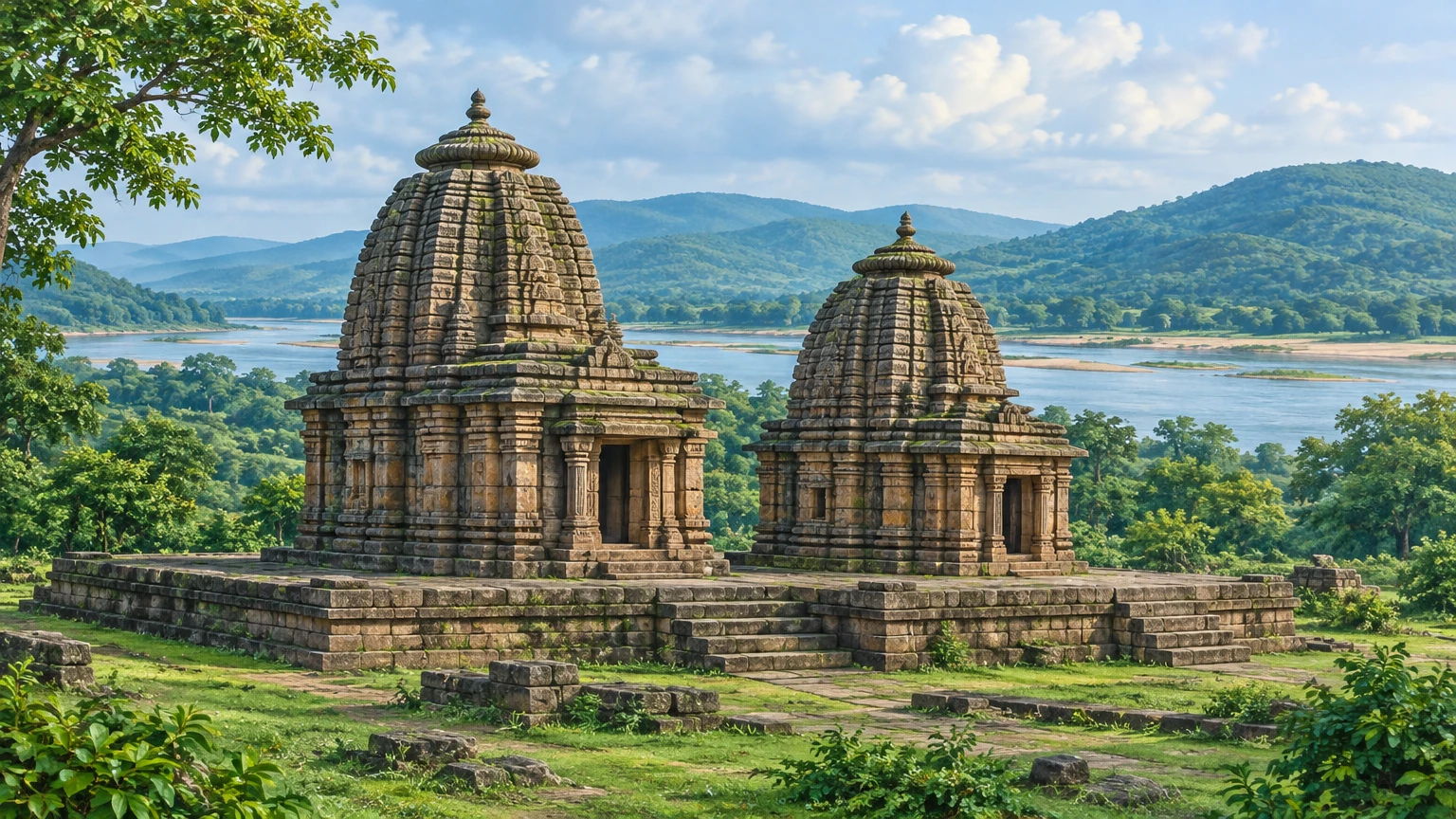
Boudh rewards the traveller who pauses over relationships: between two temples on one platform, between a river and the settlements it sustains, and between an ancient sculpture and the people who care for it today. Its monuments are not isolated relics of a vanished past. They sit within a working district of farms, forest-based livelihoods, neighbourhood shrines and market towns. A useful way to explore is to start in Boudh town, then follow the Mahanadi towards Gandharadi. The journey brings Buddhist and Hindu histories into the same field of view without flattening their differences. Allow room, too, for the less monumental evidence of place: a seasonal meal, a locally woven sari, or the changing shape of the river.
District overview & geography
Boudh lies in central Odisha. The Mahanadi and Angul district form its northern boundary; Kandhamal lies to the south, Nayagarh to the east, and the Tel River and Subarnapur to the west. Between the southern hills and the Mahanadi are cultivated plains, while forested slopes and foothills give the district a different character from the coastal delta. The district’s own survey report provides this geographical frame.
The Mahanadi is more than a picturesque edge to the town. It is the principal river system against which much of the district’s settlement and historical geography can be read. The Tel marks part of the western boundary and belongs to the wider Mahanadi basin. Smaller drainage channels respond to the monsoon, linking hill slopes, fields and larger rivers. Their appearance changes with rainfall: a quiet bank in the dry season should not be assumed to be safe or accessible during high water.
Boudh’s climate is hot and moist sub-humid. The district survey describes summer from March to mid-June, the rainy season from mid-June to September, a post-monsoon period in October and November, and winter from December to February. Winter is generally the more comfortable time for sightseeing. Summer heat can make exposed temple courtyards and road travel tiring, while monsoon rain can affect river levels, smaller roads and outdoor plans.
The district survey names sal, bija, asan and mahua among its trees and describes the collection of kendu leaves, tamarind, mahua flowers and seeds, and sal seeds as economically important. Forests here are not simply a backdrop to an excursion: they support livelihoods as well as wildlife. A traveller who notices this can begin to understand why access, conservation and local use cannot be reduced to a single tourist itinerary.
Satkosia adds another dimension to the landscape. The National Tiger Conservation Authority describes a reserve extending across Boudh, Angul, Cuttack and Nayagarh, with sal, asan, dhaura, bamboo and simal among its vegetation. Its recorded wildlife includes elephants, spotted deer, sambar, sloth bears and gharials. These are reserve-wide records, not promises of sightings in any particular part of Boudh.
The Ramsar site description places the northern side of the gorge sanctuary in Angul and Cuttack and the southern side in Boudh and Nayagarh. That distinction matters: a destination advertised as “Satkosia” is not automatically in Boudh. The gorge has strong currents and sensitive habitats; enjoy its story through permitted, officially confirmed experiences, not an improvised swim or approach to wildlife.
Mythological & historical significance
Boudh’s history is best approached as a series of layers rather than a simple succession of religions. Surviving Buddha images show the importance of Buddhist traditions in the region, while early medieval temples testify to the patronage and continuing worship of Shiva and Vishnu. These remains are evidence of religious life; they do not, by themselves, establish an uninterrupted history for every community or shrine.
An overview by Odiapedia describes a large Buddha image near the old palace, generally placed around the eighth century, and records Buddhist finds at Syamsundarpur and Pargalpur. Such sculptures make Boudh an important place to consider Odisha’s Buddhist past beyond its better-known coastal sites. Their presence does not prove that the district’s name has one settled derivation, or that every nearby monument was originally Buddhist.
In the middle of the eighth century, the region formed part of Khinjali Mandala under early Bhanja rulers, according to the historical overview. Somavamsi power followed, and the Eastern Gangas also figure in the region’s later history. The identification of present-day Jagati with Yayatinagara, associated with the Somavamsi ruler Yayati I, is an interpretation reported in historical writing, not a fact that can be established merely by looking at the village today.
A later Bhanja line ruled the princely state of Boudh. The historical overview traces that line to Ananga Bhanja and describes the state’s relationship with British power after 1803. The princely state merged with Orissa in 1948; Boudh became a separate district in 1994. These administrative changes help explain why a palace, old religious buildings and a modern district headquarters share the same townscape.
Local explanations add meaning but should be heard in their own register. At Gandharadi, Odisha Tourism records the belief that Charisambhu refers to four Shiva lingas: Siddheswar, Jogeswar, Kapileswar and Paschima Somnath. It is a valuable guide to how the place is understood in worship, rather than a substitute for architectural dating. Similarly, stories linking a cave or hill to epic figures belong to local tradition unless supported by independent historical evidence.
At Dambarugada, the district administration recounts associations with Vajrayana Buddhism and discusses possible identities for old images. Those interpretations are intriguing but not conclusive proof that a particular Buddhist teacher lived there. The distinction is not a reason to dismiss local memory; it is an invitation to listen carefully to what a source can and cannot establish.
Tourist Destinations & Hidden Gems
Gandharadi: Two shrines, one platform
The twin temples at Gandharadi, also called Charisambhu, are about 15–16 km from Boudh town. Odisha Tourism dates them broadly to the eighth–ninth centuries and attributes their construction to Bhanja patronage in Khinjali Mandala. Siddheswar is dedicated to Shiva; Nilamadhava to Vishnu.
Their shared platform is the first architectural detail to notice. Rather than treating one shrine as an annex to the other, look at the paired composition: two sanctuaries placed in conversation. Each has a curving rekha deula, or sanctuary tower, and a pidha jagamohana, the hall in front with a tiered roof. The form belongs to the early development of Odisha’s temple architecture.
The Archaeological Survey of India, in a post dated 18 June 2025, points to naga couples around openings, miniature shrine-like pilasters and lattice designs. It dates the pair to the ninth century, within Odisha Tourism’s broader range. Look slowly at these details from the permitted visitor area: they help turn a general impression of “old stone” into an understanding of craft.
The ASI identifies an akasa-linga above Siddheswar and a chakra above Nilamadhava. Odisha Tourism describes the crowning details differently, so the precise identification of the Vishnu shrine’s finial remains a source conflict. The broader point is secure: the paired temples honour distinct deities while sharing an architectural setting.
Gandharadi is a living sacred site as well as a monument. Ask before photographing worshippers or rituals, follow instructions posted by custodians, and do not touch carvings or place offerings on unapproved surfaces. A shared platform is a remarkable architectural statement; it should not be taken as proof that past religious relations were always simple or free of difference.
The Buddha image in Boudh town
The Buddha image near the old palace offers a different encounter with the district’s past. Odiapedia describes the large image as being in the earth-touching posture, a gesture associated in Buddhist art with the Buddha’s enlightenment. Observe the relationship between the figure’s composed form and its present setting: the image is both historical evidence and an object approached with reverence.
The sculpture is a good starting point for thinking about what archaeology can tell us. A surviving image demonstrates skill, patronage and Buddhist presence, but it cannot alone reconstruct the size of a monastery, the identity of every patron or the date of every later ritual. Those questions need inscriptions, comparative study and archaeological context.
Syamsundarpur and Pargalpur extend the Buddhist story beyond the town. Odiapedia reports images and other finds there, but a list of discoveries is not a guarantee that every object is displayed in situ or that every site has visitor facilities. Ask the district tourism office about present access before planning a special journey, and treat any active place of worship with the same courtesy as a temple.
Rameswara: A question written in stone
The Rameswara, or Ramanatha, group in Boudh town offers a useful comparison with Gandharadi. Three early Shiva temples stand within the complex. Their unusual star-shaped plans invite attention to the way intersecting geometries shape the outer walls; moving around the buildings where permitted reveals a plan that cannot be understood fully from a frontal view.
Their dating is less settled than a brief travel caption might suggest. The Odiapedia account, comparing the district administration with a published study, notes differences in both the names assigned to the individual shrines and their dates: the district account places them in the eighth century, while the study cited there places them in the tenth under the Somavamsis. A local newspaper has described the group as ninth-century Somavamsi work. It is more honest to call the temples early medieval than to choose one date without qualification.
Spend time looking at the plan, the surviving sculpture and the relationship between the older structures and the present complex. Do not assume that a loose image now found in a compound necessarily originated in the building beside it. Historic sites accumulate objects and meanings over time, and a local guide or caretaker may be able to explain present worship as well as the history visitors usually come seeking.
Jogindra Villa and the district museum
Jogindra Villa, locally known as Rajbati, was the palace of Boudh’s former rulers. The district’s tourism listing associates its construction with the reign of Raja Jogindra Dev. Even a view from an accessible public area connects the river town to the princely history that followed the earlier temple-building centuries. Do not assume that the palace interior is open; check locally before visiting.
Boudh’s district museum is another way to connect individual monuments with a wider story. The district describes a former royal-era building near the Collector’s office adapted to house material relating to local history, art, culture and literature. Verify current access before making it the centre of a day’s plan. If it is open, allow time to read labels rather than treating the collection as a quick stop between temples. The palace and museum are especially useful together as a question: how does a district choose to preserve and present its past? Stone temples, royal buildings and museum objects survive under different kinds of care. Their preservation is not automatic, and visitor interest is most helpful when it supports conservation rather than putting fragile surfaces under pressure.
Marjakud: A lived-in river island
Opposite Boudh town, Marjakud is an inhabited island in the Mahanadi, not an empty landscape arranged for photography. Odisha Tourism identifies the Maa Pitabali and Swapneswar Mahadev shrines there and notes that the latter is partly submerged during the monsoon. This is a place where the seasonal behaviour of the river is part of local life.
A 26 June 2025 OrissaPOST report said a bridge to the island had been constructed. Odisha Tourism also describes boat access, but neither source establishes the present condition of a route or a current boat service. Ask locally which crossing, if any, is safe and available at the time of travel; do not improvise a river crossing.
If visiting is appropriate, remember that homes, fields and paths serve residents first. Seek permission before photographing people or entering private land, avoid blocking work, and carry rubbish back. A respectful visit can be brief and still rewarding: the important insight is not that island life is “untouched”, but that a river is also a place where people live.
Dambarugada and Purunakatak
The district describes Dambarugada near Sangrampur, roughly 20 km from Boudh on the Balangir side, with a Radha-Krishna shrine on the hill and views towards the Mahanadi. It explains the name through the hill’s resemblance to a dambaru, the small drum associated with Shiva. The name is a local explanation, not a geological classification.
The hill’s religious associations are layered. The district page discusses Buddhist interpretations alongside the present shrine, but the identification of particular old images remains uncertain. Go for the combination of landscape and living worship, not in expectation of a proven monastic site. Check locally whether the approach is open and suitable; do not enter forest land or climb beyond permitted paths.
Purunakatak, on the Boudh–Daspalla road, is associated with the Bhairabi temple and the worship of the goddess. It offers a different perspective from the paired male deities at Gandharadi: Boudh’s sacred geography also includes active Shakti traditions. A visitor can appreciate the shrine without converting an account of devotion into a claim about the exact date of the present structure. Ask about current access and customs before entering.
A responsible forest perspective
Boudh’s proximity to Satkosia is valuable even when a forest visit is not possible. The reserve’s river, slopes and woodland are connected habitats, not a collection of guaranteed wildlife viewpoints. The Ramsar description identifies both gharial and mugger crocodile in the wider wetland; it also describes the gorge’s deep water and strong undercurrents.
If an authorised forest experience is available, obtain current guidance directly from the responsible forest authorities or an official operator. Stay on permitted routes, keep quiet, do not feed animals and leave no plastic or food waste. Never follow an animal for a photograph. Tikarpada is commonly associated with Satkosia, but it is on the Angul side; it should not be presented as a Boudh-town attraction or as a shortcut into the Boudh portion of the reserve.
Recent news & tourism developments
As of this edition, the clearest recent Boudh-specific infrastructure announcement found is not a completed tourism project. On 19 June 2026, the Prime Minister’s Office said the widening and strengthening of the Dhalpur–Harbhanga road in Boudh was among projects for which foundation stones were to be laid. Better roads could matter to residents and travellers, but the announcement is not evidence that this work is complete or that a particular journey is now faster.
In an interview published on 4 October 2026, The New Indian Express quoted Odisha’s chief secretary saying people had come forward to invest in tourism across districts, mentioning Boudh among them. The interview did not identify a specific Boudh property, timetable or completed facility. Its state-wide investment figures should not be read as a Boudh allocation.
Earlier district reporting gives useful context. On 26 June 2025, OrissaPOST reported that proposals for Dedhasura-Bhaibohu, Biramunda and Khandikanpara had been sent to higher authorities and were awaiting approval. It also described uncertainty around a proposed Nandanban ecopark after partial work. That was the reported position in 2025, not a verified operating status in November 2026. These names are therefore not recommendations to enter undeveloped sites.
A district Mission Shakti tender planned a Subhadra Shakti Mela at Boudh’s Kacheri Padia in the first week of March 2026, intended as a platform for women’s self-help groups, rural producers and artisans. The tender documents an intended event, not its completion or a future festival schedule. Together, these sources show interest in both infrastructure and local enterprise, while leaving important questions about delivery unresolved.
Traveler essentials
Getting there and planning time
By air: Biju Patnaik International Airport in Bhubaneswar is the district’s suggested airport. Continue by road after checking the route and transport arrangements. Official pages give differing distance estimates, so use a current map rather than treating one number as a promise.
By rail: Rairakhol, also written Redhakhol or Rairakhole, is the railhead suggested by Boudh district. The district describes an onward road journey of roughly 27 km to Boudh town; other official pages give approximately 29–30 km. Check train availability and arrange the last leg by bus or taxi rather than assuming a connection will be waiting.
By road: The district describes approaches from Bhubaneswar via Nayagarh and Charichhak or via Angul. Its older page uses earlier highway numbers, so navigate by the current route and place names. Boudh also connects by road with the wider Sonepur and Phulbani directions. Confirm road conditions after heavy rain and allow extra time for the final approach to smaller sites.
For a first visit, use Boudh town as a base for the Buddha image, Rameswara, the palace area and, if open, the museum. Gandharadi makes a logical separate outing. Marjakud, Dambarugada or Purunakatak can add another perspective, provided transport and access are confirmed. This is a flexible sequence, not a claim that all sites can always be entered on the same day.
When to go and how to travel safely
Odisha Tourism suggests October to March for Boudh, while the district identifies winter as particularly comfortable. These are seasonal guides, not weather forecasts. In November, post-monsoon conditions can still change; check current district information, official weather warnings and local road advice shortly before travel.
Carry drinking water, sun protection and footwear suitable for uneven surfaces. In hot months, plan exposed visits for cooler parts of the day where access permits. During rain, avoid swollen streams, slippery slopes and river edges. Do not swim at shrines or in the Mahanadi simply because water is visible; currents and changing levels can be dangerous.
Opening arrangements, photography rules, forest permissions and transport services may change. Confirm them with the district tourism office, site caretakers or forest authorities. A heritage listing or a photograph online does not establish a right of entry.
Food, craft and everyday encounters
Odisha Tourism’s Boudhagada guide lists karadi besara, a bamboo-shoot preparation with mustard, alongside pakhala bhata, dalma, santula, greens and seasonal vegetables. It also mentions mustard-based freshwater fish preparations and pithas. These dishes connect Boudh to broader Odia food traditions; they are not exclusive to the district, and availability depends on season and kitchen.
Ask what is freshly prepared rather than expecting a fixed “tourist menu”. Pakhala is water-soaked rice, often served with accompaniments; dalma combines lentils and vegetables. Karadi besara is worth asking about when bamboo shoots are in season. Choose food and drinking water appropriate to your needs, and ask about ingredients if you have dietary restrictions.
District craft is another reason to spend time in a market rather than only at monuments. The state Mission Shakti Boudh page describes women’s self-help groups weaving traditional Sambalpuri handloom saris and preparing products including dal, badi, papad and spices. The page does not establish that a particular producer or product will be available on a given day.
Buy directly from a maker or recognised local seller when possible, ask about materials and workmanship, and pay a fair agreed price. A conversation about a woven cloth or a packet of locally prepared badi can give the journey a contemporary dimension. Boudh’s culture is not confined to royal history or temple stone: it is also sustained by people making, cooking, trading and worshipping in the present.
Publishing Metadata & Tagging
- Group: Odisha Tourism
- Section/Category: Society And Culture
- Destination: https://pcachary.in
- District: Boudh
- Edition: 2026-11-22
- Cycle: 2
- Tags: Odisha Tourism; Boudh; Society And Culture
Sources & checks
Evidence checked: 22 November 2026. Undated official pages may change; access and project status require a fresh local check. – Boudh district survey report, Boudh district administration, undated: geography, climate, forests and routes. – How to reach and Dambarugada, Boudh district administration, undated. – Charisambhu Temple, Boudhagada and Marjakud Island, Odisha Tourism, undated. – Gandharadi twin temples post, Archaeological Survey of India, 18 June 2025, for architectural details; the post’s photograph is not used. – Cover: original text-free artwork generated for this article on 22 November 2026; interpretive, not an exact reconstruction. – Boudh district history and sites, Odiapedia, 6 October 2026. Rameswara shrine names and dates differ between sources cited there; Gandharadi finial descriptions also differ between ASI and Odisha Tourism. – Satkosia Tiger Reserve brief, National Tiger Conservation Authority, undated; Satkosia Gorge information sheet, Ramsar Sites Information Service, undated. – Neglect hinders Boudh’s rise as tourist hub, OrissaPOST, 26 June 2025. – PM to visit Odisha on 20 June, Prime Minister’s Office, 19 June 2026: advance announcement, not completion evidence. – Tourism investment interview, The New Indian Express, 4 October 2026. – Subhadra Shakti Mela tender, Boudh district Mission Shakti, 2026: planned event, not proof of completion. – Boudh district page, Department of Mission Shakti, undated: craft and producer context.
Disclaimer
This content is a collection of ancient history,books and various articles and collection of library and news and other post ; all details may not be the same. Readers are requested to verify the information themselves. Readers are not allowed to take any disciplinary action; content is only for educational purposes. If readers do not agree about the contents, they may send a personal comment to my personal email ID: achary.purna@gmail.com
