
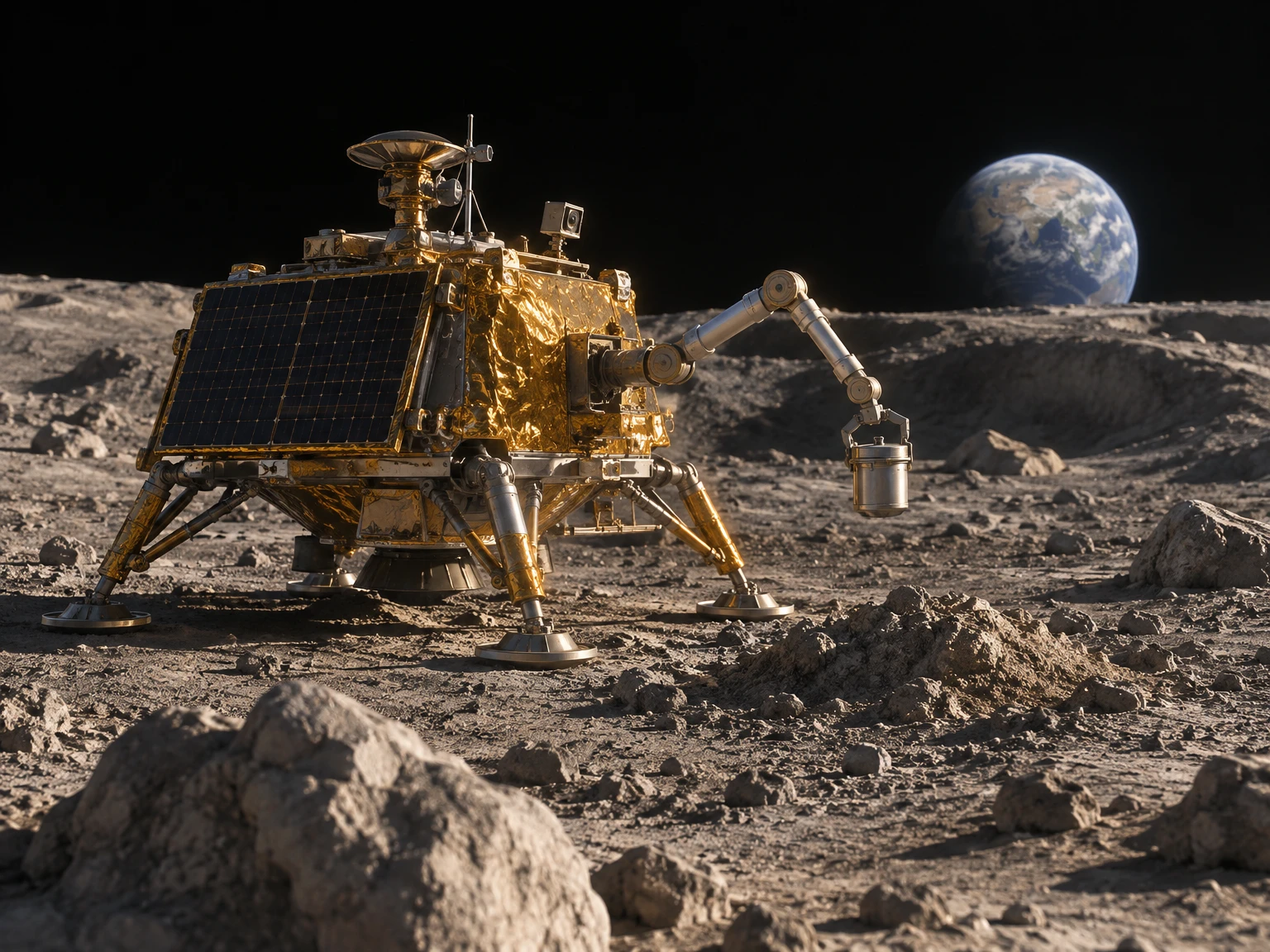
India’s proposed Chandrayaan-4 is designed to do something more demanding than look at the Moon from orbit or examine a few grains where a lander touches down: collect lunar material, carry it through a chain of robotic hand-offs, and return it to Earth for study. That difference matters. A spacecraft can take cameras and compact instruments to the lunar surface, but Earth laboratories can apply many techniques, preserve samples for future instruments and let different research teams examine carefully documented material. The mission is a plan, not a completed expedition; the details below describe the architecture and science ISRO has publicly outlined, not results that have already been obtained.
Why bring lunar material back?
Remote sensing is powerful because it lets scientists map a large area rather than one small patch. Spectrometers can estimate the composition of a surface, cameras reveal landforms, and radar can help probe features that ordinary visible-light images do not show. A lander and rover add close-up context. They can measure properties at a chosen site, take images and perform analyses with instruments that must be small, light and able to survive launch, radiation, heat and cold. These approaches answer different questions, but none is identical to bringing a sample home.
On Earth, a laboratory can devote much more space, power and time to a tiny piece of rock than a spacecraft can. Scientists can examine a grain under optical and electron microscopes, map its minerals and chemistry at very small scales, separate a portion for one test while protecting the rest, and compare results from instruments built by different institutions. Methods can improve after the sample returns. A material collected today may be examined again decades later with instruments that do not yet exist. That is not a promise that every sample will answer every question; it is a way to keep scientific options open.
Samples are most informative when researchers know where they came from and what happened to them. A grain without a reliable location or handling record is harder to interpret. Images, surface observations and the order of collection therefore matter alongside the laboratory analyses. The rock has a physical composition; its context supplies clues about the geological process that placed it there. In a sample-return mission, the scientific chain begins before collection and continues through sealing, transfer, landing, curation and eventual allocation for study.
ISRO’s Cabinet-approved description calls Chandrayaan-4 a lunar sample-return mission and emphasizes both analysis on Earth and the protection of material from contamination. It says that cameras and sensors on the spacecraft will help characterize the regolith around the landing site, providing context for interpreting the returned material. The samples will be classified and catalogued before detailed characterization. Those steps are not administrative extras: they are part of making a small collection useful to more than one experiment or one generation of scientists.
A five-module mission, built in two launches
ISRO’s published design describes five spacecraft modules: Descender Module (DM), Ascender Module (AM), Transfer Module (TM), Re-entry Module (RM) and Propulsion Module (PM). The DM and AM are planned as one launch stack. The TM, RM and PM form a second stack. Two separate LVM3 launches would place those stacks in elliptical Earth orbit, where the mission plan calls for them to dock and form an integrated stack. In other words, the spacecraft is not intended to leave Earth as one fully assembled vehicle; rendezvous and joining in orbit are part of the mission design.
After docking, the PM is described as providing the first set of Earth-bound manoeuvres. ISRO says it will be jettisoned after its propellant is depleted. The remaining integrated stack—DM, AM, TM and RM—would then perform the manoeuvres required to reach the Moon in an orbit whose plane is aligned with the predetermined landing site. In the final lunar orbit, the DM and AM separate from the TM and RM. The landing pair then makes a powered descent. This sequence leaves the return vehicles in lunar orbit while the surface elements work below.
Each module has a distinct job in the published architecture. The DM carries the lander and the surface-sampling equipment. The AM is designed to receive and store the samples, then launch from the Moon. The TM supports transfer and return operations between lunar orbit and Earth. The RM is the protected capsule intended to carry the sealed lunar material through atmospheric re-entry and land on Earth. The PM helps move the combined stack through the early part of the mission. These functional names describe roles in a planned design; hardware details can evolve as engineers test and refine a mission.
Splitting the mission across two launches makes in-orbit assembly a central challenge. The stacks must arrive in compatible orbits, find one another, establish relative position and speed, and connect without damaging the spacecraft. The joined structure must then operate as a single system through Earth departure, lunar arrival and later separation. The architecture creates operational flexibility around launch mass and module arrangement, but it also means success depends on accurately choreographed actions by several vehicles, not just a successful liftoff or landing.
Collection on the lunar surface
ISRO’s plan describes two kinds of collection. A robotic arm mounted on the DM, called the Surface Sampling Robot, is intended to scoop approximately two to three kilograms of material from around the landing site and transfer it to a container on the AM. A separate drilling mechanism is intended to collect subsurface material and move it to another container on the AM. The published account distinguishes surface and subsurface samples; it does not specify in that description the precise depth of drilling, exact sample locations, or the final list of scientific measurements.
That distinction can be scientifically important. The exposed surface is continually affected by impacts, solar radiation and the space environment. Beneath it, material may have experienced a different history of heating, mixing and exposure. Comparing material collected at the surface with a sample from below could help investigators test how local processes vary with depth. The value depends on geological context and careful records; one should not assume in advance that the two containers will contain a particular kind of rock or reveal a particular discovery.
Sampling is not simply a matter of picking up the largest rock. A scoop can gather a mixture of grains and fragments. A drill may bring up material whose layering, cohesion and composition are not known until the tool encounters it. Engineers must manage the mechanics of contact, the arm’s reach and forces, the transfer path, dust and the possibility that equipment interacts with the sample. Cameras are planned to monitor different phases of collection. Images can document operations and surroundings, although photographs alone cannot replace laboratory measurements or guarantee that every grain’s origin is known.
ISRO describes the containers as being sealed to prevent contamination and leakage during the trip to Earth. That requirement reaches back into the design of the sampling system: surfaces that touch lunar material, transfer joints, seals and handling procedures can all affect what the eventual laboratory can infer. The plan also calls for sample-recovery, safety, preservation and curation protocols to be worked out. The public mission description does not provide a complete operational manual, so exact procedures and acceptance criteria should not be invented. What is clear is that keeping the sample’s record and condition intact is treated as a core mission objective.
The robotic hand-offs are the heart of the return
After collection is complete, the AM is intended to lift off from the lunar surface and enter lunar orbit. There it must rendezvous and dock with the parked TM and RM. The sample containers are then transferred from the AM into the RM. The TM and RM separate from the AM after transfer; the TM and RM perform the return manoeuvres toward Earth. At the appropriate entry corridor, the RM separates from the TM, enters Earth’s atmosphere on a ballistic trajectory and lands on land carrying the lunar samples.
This is a series of linked milestones: surface work must finish before ascent; the ascending module must reach the right orbit; the two sides must meet and connect; the sample package must move into the protected return capsule; the return stack must navigate home; and the capsule must survive re-entry and be recovered. A failure or delay in one link could affect the next. There is no crew on the surface to improvise a manual repair. The design therefore has to make the tools, mechanisms, navigation, communications, power and operating software work together across a mission that spans Earth orbit, lunar orbit, the surface and the return to Earth.
Docking is especially notable because it happens twice in different settings: the two launch stacks are planned to join in Earth orbit, and the lunar ascender is planned to meet the return spacecraft in lunar orbit. Successful docking requires more than a sensor recognizing another vehicle. The vehicles must approach at controlled relative speed, know their position and orientation, align their interfaces and complete a connection that can tolerate the forces and electrical or data requirements of the next phase. Mission controllers must also understand what state the spacecraft is in and decide whether conditions are safe to continue.
ISRO has separately demonstrated rendezvous, docking and undocking with its SpaDeX satellites in Earth orbit. ISRO reports the first docking on 16 January 2025, an undocking on 13 March and a second docking on 20 April, followed by power-transfer tests on 21 April. These are relevant technology demonstrations, but they are not Chandrayaan-4 flight tests. The lunar mission has different spacecraft, distances, environment and operational demands. It is reasonable to see the demonstrations as part of a broader national capability-building effort; it would be inaccurate to treat them as proof that every Chandrayaan-4 operation is already qualified.
Why a southern-polar sample could add something new
The Moon is not geologically uniform. Dark plains, highlands, impact basins, volcanic materials and regions shaped by different histories do not all contain the same mixture of rocks. ISRO’s rationale for sample return points to the limits of earlier collections: Apollo and Luna samples came from zones with similar geological character, while the Moon contains more diverse material. The agency notes that China’s Chang’e-5 returned a sample from a geologically young region, contributing to understanding the Moon’s thermal history. A sample from a different geological setting can add evidence that fills a gap left by earlier missions.
Chandrayaan-4 is planned for the Moon’s southern polar region. That broad regional description matters, but it is not the same as a named landing site. The Cabinet-approved account says the landing site is to be predetermined for mission design; the public description we are relying on here does not identify a final site. The article therefore does not claim that the spacecraft will touch down at a particular crater, ridge or permanently shadowed area. Nor does the mission description establish that the returned sample will contain water ice. Those are distinct questions that require current, authoritative mission information and measurements.
Polar environments attract scientific and engineering interest for several reasons. Low Sun angles can create long shadows and sharp contrasts between illuminated slopes and dark terrain. Permanently shadowed regions can be extremely cold, and remote observations have motivated investigation of volatile materials there. But a landing site, a permanently shadowed deposit and a resource prospect are not interchangeable concepts. Chandrayaan-4’s stated sample-return goal is to collect and return lunar material from the southern polar region; separate missions and instruments address other questions, including the distribution of volatiles near shadowed terrain.
For science, a candidate landing site must balance interest with the practical needs of arriving, operating and returning safely. The local geology must be interpreted in the context of maps and orbital observations. The lander needs terrain it can reach and work on. Lighting, communications, temperature, surface texture and navigation affect what can be done. A broader scientifically valuable region does not guarantee that every intriguing feature is accessible to the planned spacecraft. Identifying a final site is a mission-planning decision, and it should be reported only when ISRO announces it.
From Chandrayaan-3 to a different kind of lunar mission
India’s earlier Chandrayaan missions provide context for the next step. Chandrayaan-1 and Chandrayaan-2 studied the Moon from orbit and expanded global observations. Chandrayaan-3 achieved a successful soft landing on 23 August 2023, then operated the Pragyan rover. ISRO reported that the rover’s LIBS instrument confirmed sulfur at the lunar surface on 28 August. That was an in-situ measurement: an instrument examined material at the landing site. It did not return a sample to a terrestrial laboratory.
The distinction is not a ranking in which one mission type is automatically better. Orbital missions can compare large regions; a lander can measure local conditions; a rover can examine nearby terrain; and a sample-return mission can bring material into laboratories with a much wider range of tools. Each type answers different questions and supplies context for the others. Chandrayaan-4’s planned advance is to add lunar launch, orbital rendezvous, sample transfer, Earth return and curation to the chain of capabilities, while retaining cameras and sensors that can help describe the collection site.
ISRO says Chandrayaan-3 demonstrated a soft landing in the southern polar region, rover exploration, a lander hop and return of its propulsion module from lunar to Earth-bound orbit. Chandrayaan-4 is intended to build on some of that experience but introduces new tasks: a two-launch configuration, docking of launch stacks, collection and sealing of material, lunar ascent, a second rendezvous and docking, transfer into a re-entry capsule, and safe return to Earth. Each item has its own qualification and operational questions. Prior success is a starting point for engineering, not a shortcut around testing.
In September 2026, ISRO held a three-day national meeting on scientific exploration of the Moon through Chandrayaan missions. The agency reported about 150 registered participants, including around 75 from academia and research institutes, representing more than 45 institutions; 36 students were pursuing lunar research. The agenda covered lessons from Chandrayaan-1, -2 and -3, plans for Chandrayaan-4 and Chandrayaan-5/LuPEX, and discussion with researchers and students. This shows that the agency is engaging a broader scientific community as it plans missions. It does not mean the meeting finalized a landing site or announced sample results.
What laboratories may learn—and what a sample cannot say by itself
Returned lunar material can be studied using microscopes, electron microprobes, ion-beam instruments, transmission electron microscopes and spectroscopic methods. These techniques can reveal mineral structure, chemical composition, texture and relationships among tiny grains. Different approaches can examine different scales, from the overall character of a piece to the composition of a mineral boundary. A laboratory can also preserve unexamined portions for later work. ISRO’s mission description emphasizes that this continuing access is one of the advantages of returning samples to Earth.
Researchers may use chemistry and mineralogy to test hypotheses about how rocks formed, how material was mixed by impacts, and how the Moon evolved. Isotopic measurements can sometimes help constrain ages or trace processes, but a result depends on the chosen sample, the method, calibration and assumptions. A sample’s composition is not a direct narration of its history. Scientists compare multiple lines of evidence: laboratory measurements, maps, images, surface observations, models and samples from other locations. Interpretation usually advances through careful comparison rather than one dramatic measurement.
The Apollo collection illustrates why returned material can remain scientifically productive. NASA reports that Apollo astronauts landed six times and brought back 2,196 samples totaling 842 pounds, or about 382 kilograms. In 2025, NASA described a new analysis of zircon grains from Apollo samples that investigated a major lunar magmatic event around 4.338 billion years ago. The researchers’ interpretation was that a strong episode of crystallization may fit an impact-related event better than a slowly cooling magma ocean. The finding is an example of later analysis of old samples, not a result from Chandrayaan-4, and the proposed explanation remains a scientific interpretation supported by particular evidence.
That example also shows why a single sample collection cannot represent the whole Moon. The Apollo sites were selected for the missions’ scientific and operational context, and returned material has illuminated many processes. Yet ISRO’s published rationale is that more geological diversity is needed to develop a fuller picture. The point is not that previous missions failed, or that their samples have no continuing value. It is that each well-documented sample from a different region can help researchers check whether an explanation applies widely or only to a particular location.
Pristine does not mean untouched by nature
When mission planners speak of keeping a sample pristine, they mean protecting its scientific usefulness during collection, handling and return, not claiming that it has never been altered. Lunar material has a geological and space-weathering history before a spacecraft reaches it. The spacecraft must preserve evidence of that history rather than add avoidable changes during contact, storage, transport or landing. Contamination can complicate the search for trace components, while a leak or loss of material can change what researchers receive.
Sealed containers are one part of that problem. A full chain of custody also involves documenting what the sampling tools touched, which container holds which material, when the sample was collected, and how it was moved. The scientific team needs records of operations and context, and curation facilities need procedures for receiving, storing, cataloguing and allocating the material. ISRO’s description says sample recovery, contamination and safety protocols, preservation and curation will be worked out. Those future procedures are important, but their detailed form should not be presented as already published unless the agency releases it.
Preservation has a second side: access. A sample locked away forever would be protected but would not deliver its full scientific value. NASA’s discussion of Apollo samples highlights the importance of both maintaining pristine condition and making the collection available for scientific study and education. A fair allocation process can let qualified teams ask different questions while retaining enough material for future techniques. This balance is difficult because samples are limited and sometimes tiny. It requires careful documentation and stewardship, not simply a single instrument reading followed by disposal.
Returned material also needs to be handled in a way that supports reliable public claims. A press release, preliminary observation or sample allocation is not the same as a peer-reviewed result. Early analyses may be promising, but interpretations can change as methods improve or additional measurements become available. A responsible account of Chandrayaan-4 should distinguish the mission’s planned design from completed operations, and separate future scientific possibilities from observations actually made. At present, the science described here is what the mission could enable, not a report of lunar specimens already in laboratories.
Engineering questions that remain open
The architecture leaves a long list of engineering questions for mission teams to resolve through design, tests and operations. The launch stacks must be assembled and checked before flight. After launch, they have to rendezvous and dock. The integrated spacecraft must navigate from Earth orbit toward the Moon, separate the landing elements, and make a controlled descent. The sampling arm and drill then need to function on the surface, transfer their cargo, and seal it. The AM must launch from the Moon, dock in lunar orbit and transfer the package. Finally, the return vehicle must enter Earth’s atmosphere and land where it can be recovered.
These are not minor steps, and the public mission description does not give enough information to calculate exact margins, schedule probabilities or failure likelihoods. It would be wrong to assume that the mission is guaranteed simply because some related technologies have been demonstrated, and also wrong to treat the presence of unsolved engineering work as evidence of failure. Spaceflight programs manage risk through analysis, tests, redundancy where appropriate, simulations, reviews and revised procedures. The details and progress of those processes should be grounded in later official updates.
There is also a science-planning side to the open work. A useful sample requires a site chosen for both scientific value and operational feasibility. The sampling strategy must collect material with well-understood context. The containers and return capsule must protect the samples. The ground team must have the laboratory and curation capacity to receive them. Researchers need to know what analyses are possible, how samples will be documented and how findings will be shared. ISRO’s 2025 science meeting addressed potential science, landing-site questions and plans for curation and analysis facilities; that meeting indicates planning activity, not that every facility or procedure is complete.
ISRO’s 2024 Cabinet account places Chandrayaan-4 among technologies relevant to later human lunar exploration, including docking and return from the Moon. That connection is a strategic aim, not a claim that the robotic sample-return mission is itself a crewed flight. The engineering knowledge from rendezvous, landing, ascent, re-entry and recovery may inform future planning, but crewed missions would require additional systems, safety standards and qualification. A careful description should keep the present robotic mission separate from longer-term ambitions.
How to follow the mission without getting ahead of the evidence
The most useful updates to watch for are concrete and attributable: an official revision to the mission architecture; a formal announcement of a launch window or landing site; progress on spacecraft hardware and integrated testing; a confirmed launch; results from orbital or surface operations; and, eventually, recovery and scientific analysis of the returned material. These are different milestones. A policy approval is not a launch date; a planning timeframe is not a final schedule; a technology test with another spacecraft is not a flight qualification for every Chandrayaan-4 component; and a successful landing does not by itself mean samples have been returned.
ISRO’s public pages provide useful starting points. Its Cabinet-approved mission description explains the five-module architecture and planned sampling sequence. The agency’s national-meeting summaries show how Indian researchers are being brought into the science planning. Chandrayaan-3 mission updates document the prior landing and surface measurements. NASA’s lunar exploration and Apollo sample pages offer historical context for the long scientific value of returned material. Together these sources establish a rationale and a plan, but they do not supply a current definitive launch date or final landing location in the details cited here.
It is also worth keeping labels precise. “South polar region” is a broad location, not an exact point. “Sample return” describes a mission goal, not evidence that a specimen has arrived. “Water ice” is an important question in lunar science, but the planned Chandrayaan-4 sample should not be described as ice unless an official result supports that statement. And “self-reliant” in an agency’s stated mission objective is an aspiration about critical technologies to be developed domestically, not a substitute for verifying the eventual hardware, schedule or science results.
Those distinctions do not make the mission less interesting. They make it possible to follow its progress honestly. Chandrayaan-4 is a complex sequence of launches, orbital assembly, landing, sampling, ascent, docking, transfer and Earth return. If the plan succeeds, it will create a carefully documented collection from a region not represented by the same kinds of samples as earlier missions, and place that material within reach of laboratories and future researchers. The prospect is significant precisely because the hardest parts are still ahead and the results are not yet known.
Sources and further reading
- ISRO: Mission to the Venus, and to the Moon — Configuration and Scientific Objectives (Cabinet approval and Chandrayaan-4 mission design, 18 September 2024).
- ISRO: National Science Meet on Chandrayaan-4 Lunar Sample Return Mission (meeting held 16 April 2025; report dated 24 April 2025).
- ISRO: National Meet on Scientific Exploration of the Moon through Chandrayaan Missions (28–30 September 2026).
- ISRO: Chandrayaan-3 mission updates (landing and surface observations).
- ISRO: SpaDeX undocking successful (13 March 2025).
- ISRO: SpaDeX second docking and power transfer (20–21 April 2025).
- NASA: Apollo samples yield new information about the Moon (22 January 2025).
- NASA: History of Lunar Exploration.
This content is a collection of ancient history,books and various articles and collection of library and news and other post ; all details may not be the same. Readers are requested to verify the information themselves. Readers are not allowed to take any disciplinary action; content is only for educational purposes. If readers do not agree about the contents, they may send a personal comment to my personal email ID: achary.purna@gmail.com
