
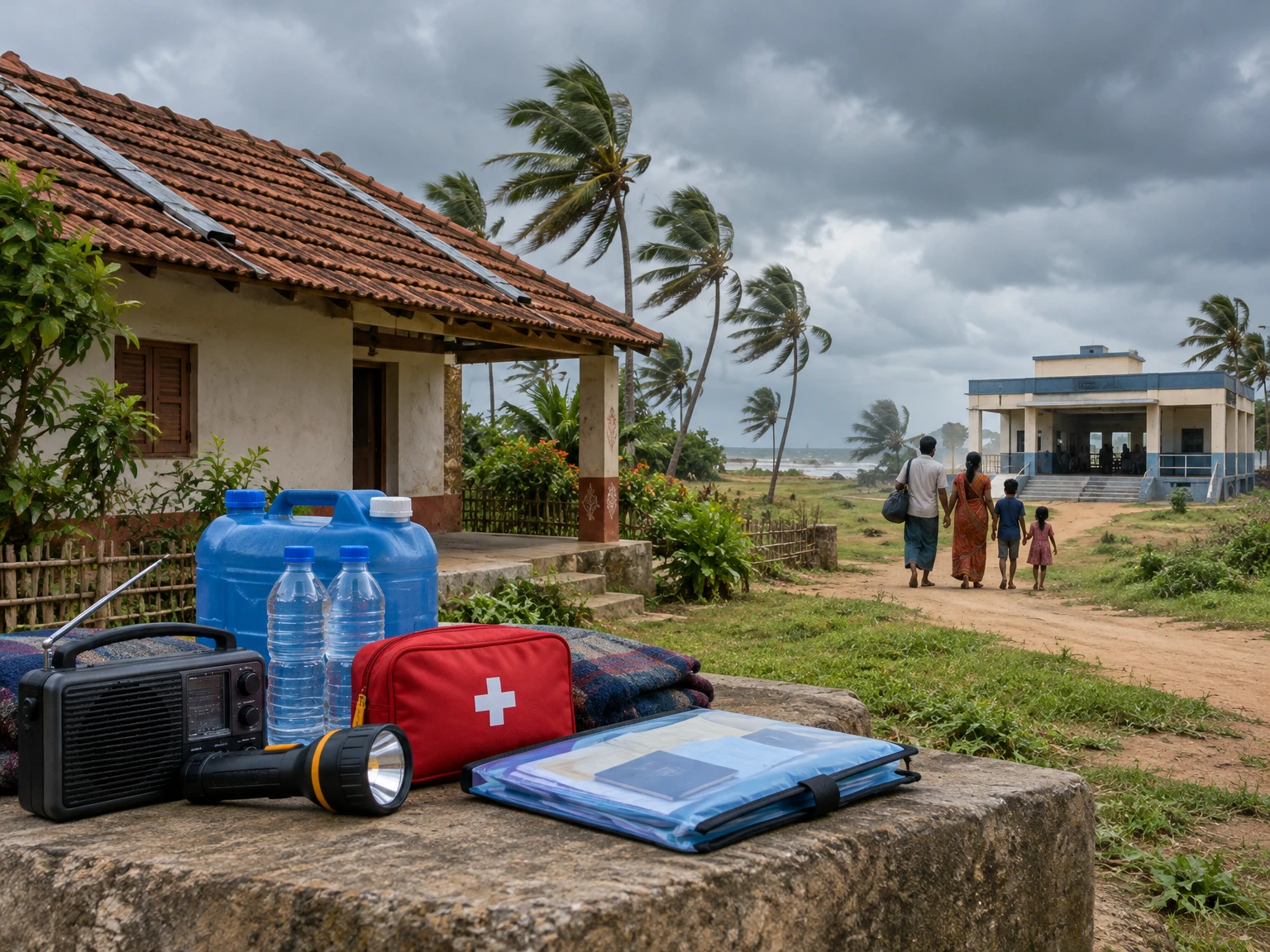
What makes a cyclone plan work after the warning is issued? Odisha’s experience points beyond the dramatic moment of evacuation: a shelter has to be open, reachable and managed; a warning has to become a decision; and relief has to continue when wind gives way to rain, damaged roads and disrupted services. Recent official bulletins about Cyclone Arnab’s remnants and heavy rain in October 2026 make that chain of readiness worth examining again.
Readiness is a chain, not a single act
A cyclone warning is only the beginning of a sequence. Someone must receive it, understand what it means for their own settlement, decide whether to leave, help a relative who cannot travel alone, find a safe route, reach a shelter and discover that the shelter is open and usable. After the immediate danger, the same people may need food, drinking water, medical care, information about family members and a way to return home safely. A weak link anywhere in this chain can turn a well-written plan into a difficult day for the people it is meant to protect.
That is why readiness should not be measured by one impressive number or one successful evacuation alone. It includes institutions, trained local teams, communication systems, transport, accessible buildings, arrangements for animals and livelihoods, and a recovery plan that does not end when the weather improves. Odisha’s record contains examples of large-scale preparation, as well as continuing questions about how those arrangements are maintained and how they work in each locality.
This article treats official figures as claims made by the source that published them, not as a live inspection of every facility. A count of shelters is not a count of shelters currently open, supplied or accessible. A forecast is not an observation, and an evacuation total is not a complete measure of safety. Those distinctions matter because preparedness is practical: people need to know what is available now, not only what was built or promised.
The institutional lesson of 1999
Odisha’s State Disaster Management Authority says it was constituted on 29 December 1999, after the Super Cyclone of that year. The timing itself records a lesson: a severe disaster can expose the need for institutions that plan before the next emergency rather than improvise every responsibility during it. Over time, disaster management has to coordinate weather information, district and local administration, emergency response, public communication, relief and restoration. No single office can carry that whole chain alone.
The scale of the 1999 catastrophe is also part of the context for later planning. A World Bank assessment describes roughly 18 million people affected across 14 districts and about 10,000 deaths. These figures are historical estimates reported in the assessment; they are not a direct comparison with later storms, whose tracks, exposure and available records differ. They do, however, help explain why coastal Odisha’s disaster planning has treated evacuation and cyclone shelters as central public responsibilities.
Institutions are most valuable when residents can see their work in ordinary time: warnings that are understandable, shelters whose caretakers are known, routes that remain passable, and officials who can explain what to do. Emergency preparedness is therefore not just a command structure. It is a set of relationships and routines that must be rehearsed, funded and reviewed between storms.
Warnings have to travel the last mile
Modern forecasting can describe a storm’s position and expected movement with increasing detail, but a forecast does not automatically reach every person who needs to act. The last mile may include a coastal settlement with unreliable power, a family without a smartphone, a worker away from home, or a person who does not understand the language used in a public notice. A warning system needs more than a technical signal: it needs trusted messengers, repeated communication and a clear instruction tied to local action.
Odisha’s warning infrastructure has included the Early Warning Dissemination System, or EWDS. A World Bank account of the National Cyclone Risk Mitigation Project describes sirens being activated 36 to 48 hours before Phailin’s landfall in 2013, alongside mass messaging and local preparation. That account says 18 million text messages were sent to BSNL subscribers before Fani in 2019. Such figures show the reach reported by the project, but do not demonstrate that every message arrived, was understood or reached the person making a household decision.
For that reason, sirens, mobile alerts, radio, local officials, volunteers and face-to-face communication should be treated as complementary channels rather than substitutes. A siren can signal urgency; it cannot explain which route is safe or whether a shelter has space. A text can carry detail; it cannot help someone whose phone is switched off or whose family is separated. Communities need clear instructions that remain useful when one channel fails.
Evacuation works only when arrival is possible
Phailin offers an important example of organized evacuation. The World Bank’s project account reports that more than one million people were evacuated within 36 hours before landfall in 2013. It describes advance mock drills, checked shelters, activated village committees, satellite phones, free-kitchen arrangements and medical teams. These are concrete elements of preparation, not proof that every household had the same experience. The scale of the movement nevertheless shows why planning ahead of landfall matters: people need time, transport and credible information to leave before roads and weather become dangerous.
Moving people safely requires decisions at more than one level. Local authorities need to identify places exposed to surge, flooding, falling trees or isolation; arrange transport for people who cannot travel independently; and make sure that the receiving shelter can accommodate the people directed there. At household level, leaving may mean securing a home, carrying medicines and documents, arranging care for children or older relatives, and deciding what to do with livestock or fishing gear. Instructions that ignore these real costs can be harder to follow.
Preparedness should make the safer choice practical, not blame residents for weighing difficult trade-offs. If transport is not available, if a shelter is far away, or if a family fears losing its livelihood, a general order may not resolve the problem. Local planning can reduce those barriers by mapping needs in advance, communicating the reason for evacuation, identifying assistance and explaining when it is safe to return.
A shelter is infrastructure and a local institution
Odisha’s State Disaster Management Authority describes village-level Cyclone Shelter Management and Maintenance Committees, or CSMMCs, as responsible for managing multipurpose cyclone shelters. Its FAQ says these committees are trained in shelter management. It also describes Disaster Management Teams at each shelter, with 25 volunteers in each of several categories, trained in areas including first aid, search and rescue, and provided with basic equipment. These arrangements recognize that a building needs people, skills and procedures before it can function as a refuge.
That local role matters during the hours before a storm, when residents need to know whether the doors are open, where people should gather and who can help with mobility or first aid. It matters during the emergency, when orderly admission, sanitation, drinking water, lighting and information can affect the experience of everyone inside. It continues afterward, when people may need assistance returning, checking damage or finding family members. A shelter committee is not merely a name on a government list; its practical readiness depends on training, equipment, communication and regular maintenance.
The details of shelter construction also need careful interpretation. OSDMA’s Integrated Coastal Zone Management Project page reports 14 shelters built through that specific project: four in Kendrapara, eight in Puri and two in Ganjam. It also reports training in 2018–19 for shelters constructed under the National Cyclone Risk Mitigation Project. Those are project-specific descriptions and dates, not a current statewide inventory. A planning document should identify which facilities it counts, who maintains them and when their operational status was last checked.
Accessibility and dignity belong in the plan
A building may be structurally sound and still be difficult for a person to use. Older people, people with disabilities, pregnant women, small children and anyone with an acute illness may need assistance that is not captured by a shelter count. A ramp is useful only if it is navigable and kept clear; accessible toilets, resting space, lighting, privacy and help carrying essential medicines may matter just as much. Planning should account for the actual path from a home to the shelter as well as the rooms inside it.
Households also need to know that they can bring the people and essential items they are responsible for. Families may hesitate if they are unsure about separate sleeping arrangements, safety, sanitation or the treatment of livestock. A cyclone plan that anticipates these concerns can provide practical answers: who accompanies a person needing assistance, what facilities are available, how animals will be managed where feasible, and where to ask for help. Such details are not extras to be added after the warning; they shape whether people can leave in time.
Local authorities and shelter committees can make readiness more inclusive by maintaining a confidential, consent-based list of assistance needs, verifying it before cyclone season, and arranging trained volunteers or transport. That work must respect privacy and avoid assuming that one household has the same needs as another. The useful question is not simply “How many people can the building hold?” but “Can the people most exposed reach it, enter it and stay there safely?”
Communications need a backup plan
Emergency communications can fail at exactly the moment they are most needed. Power cuts can disable charging; mobile towers can lose power or backhaul; heavy rain can interrupt roads; and families may be separated. The World Bank project report on Fani notes that telecommunications failed in some affected areas and describes satellite-based terminals supplied to support emergency broadband. It also records a large volume of pre-landfall alerts. The contrast is instructive: broad distribution before landfall and resilient communication afterward are different tasks.
A robust plan uses several routes for information and has a fallback when one stops working. Local sirens can prompt action; public address systems and community volunteers can carry instructions; radio and mobile networks can provide updates; and satellite or other emergency links can help officials coordinate when ordinary systems are disrupted. Information should state what is known, what is forecast and when it will be updated. Uncertainty is not a reason to say nothing, but it should not be disguised as certainty.
Families can also agree on a simple contact and meeting plan before a storm: whom to call, where to reunite if separated, and how to send a short message when networks are crowded. This is a supplement to public preparedness, not a replacement for it. Authorities still have a responsibility to communicate accessible, location-specific information and to maintain systems that do not depend on every resident owning a working smartphone.
Relief and restoration continue after the wind
The emergency phase does not end when the cyclone moves away. Flooding, damaged bridges, fallen trees and interrupted power or telecommunications can prolong the danger. People may need safe drinking water, food, medicine, sanitation and information before they can return home. Roads may be unsafe, and the location of fallen lines or unstable structures may not be obvious. A careful return plan should use local assessments and clear guidance rather than an assumption that the weather has improved everywhere at once.
The World Bank’s account of Phailin describes 4,197 free kitchen centres and medical teams as part of the response. These reported arrangements illustrate why relief logistics must be planned before landfall: food distribution and medical care require supplies, staff, safe access and coordination. Later restoration work may involve clearing routes, repairing infrastructure, restoring services and assessing damage. Each task depends on information from affected communities and on coordination among district agencies and service providers.
Recovery also raises questions about livelihoods and unequal loss. A household that depends on fishing, daily wages, small trade or agriculture may face consequences that are not visible in a structural damage report. Relief should be timely and based on needs, while restoration should avoid leaving isolated communities behind because they are difficult to reach. Public updates can distinguish what has been restored from what remains disrupted, helping people make decisions without promising a date that has not been established.
Rain after a cyclone can create a second emergency
Recent official bulletins about Arnab’s remnants underline why cyclone readiness cannot end with a coastal landfall. The India Meteorological Department’s 28 October 2026 bulletin described the remnants of a very severe cyclonic storm over coastal Andhra Pradesh and Yanam and adjoining parts of the west-central Bay, with a deep depression then over north coastal Andhra Pradesh and adjoining South Odisha. It forecast isolated heavy rain in interior Odisha on 29 October. The bulletin did not describe an Odisha landfall by the original cyclone; that distinction should be preserved.
In its 29 October bulletin, IMD described a depression remnant over central Chhattisgarh and adjoining Odisha, with warnings of heavy to very heavy rain over interior Odisha and locally extremely heavy rain. The department’s 30 October press release reported 12 to 20 centimetres of rainfall over Odisha in the 24 hours ending at 0830 IST, including 19 centimetres at Bhogorai. These are separate observations and forecasts, each with its own date and scope. They should not be blended into a claim that every district experienced the same conditions.
For residents and responders, the practical point is that a storm’s weakening classification does not mean every hazard has ended. Rain can swell rivers, flood low-lying settlements, isolate roads or complicate relief after the strongest winds have passed. Warning messages should continue to explain rainfall, river and access risks as they evolve. Cyclone planning and flood planning overlap, but they are not identical; a community that is outside the coastal surge zone may still face serious rain-related disruption.
Arnab as a test of continuity, not a single score
OSDMA reported on 6 November 2026 that the Chief Secretary reviewed Cyclone Arnab and subsequent flood damage, relief and restoration efforts with a central inter-ministerial team. The existence of that review is evidence of an official assessment and coordination process. The notice does not, by itself, quantify damage or establish that all restoration work was completed. A responsible account keeps those facts separate: a review happened; the full condition of each locality requires more specific evidence.
That distinction can guide how agencies report progress. A useful public update identifies the affected places, the service or route under discussion, the step completed, and the remaining need. If a road is open to emergency vehicles but not ordinary traffic, say so. If a shelter has supplies but no confirmed transport, say that too. Precise statements help residents act and help authorities notice where the plan is not yet working.
For the public, the lesson is to follow current instructions from local authorities and official weather bulletins, especially when rainfall continues after a storm. Avoid entering floodwater or damaged buildings, and do not rely on old posts that describe conditions from a previous day. This is general preparedness information, not a location-specific warning; conditions vary by district and can change quickly.
Preparedness is also a question of trust
People are more likely to act on warnings when they trust the source and understand the reason for the instruction. Trust is built through consistent communication in ordinary time, clear explanations during an emergency, and honest accounts afterward. If a warning changes, officials should explain what changed. If an estimate is uncertain, it should be labelled as an estimate. If a facility is not available, that should be communicated plainly so people can be directed elsewhere.
Trust also depends on what happens after residents comply. Families who leave homes, work and belongings need timely information about safe return, assistance and repairs. If they encounter a closed shelter or an unclear process, the experience can shape their response next time. Listening to residents after an event can reveal whether routes, notices, shelter arrangements or relief distribution worked as intended. Such feedback should inform the next plan rather than be treated as an afterthought.
Public agencies can strengthen accountability by publishing dated inventories and readiness checks, making responsibilities visible, and reporting both completed work and gaps. The date on a report matters: an older training count cannot establish current staffing, just as a current website total cannot prove that a particular shelter is stocked today. Readers and journalists can help by asking what a number measures and when it was last verified.
What communities can prepare before the next warning
Households can take practical steps without trying to replace public services. Keep essential medicines, important papers and contact details together in a waterproof pouch; identify an agreed meeting point; and discuss how to assist anyone who cannot travel alone. Learn the nearest designated shelter and more than one route where possible. Ask local authorities or community volunteers how warnings will be issued and what transport support is available. Check information close to the event rather than relying on a remembered route or a forwarded message from a previous storm.
Before cyclone season, residents can ask whether the local shelter is open for inspection, who manages it, and where to report a maintenance problem. Local groups can identify people who may need help leaving, with their consent, and plan who will check on them. Fishers, farmers and small businesses can ask about official safety advisories and relief procedures. These actions do not guarantee safety, and they cannot substitute for functioning public infrastructure; they can make responsibilities and missing information visible early enough to address.
During an alert, follow current instructions from local administration and IMD. Do not wait for a dramatic change in the sky if an evacuation has been ordered. Avoid the coast, riverbanks, flooded roads and damaged electrical infrastructure when authorities advise against travel. If a route is blocked or a shelter is full, contact local officials or the designated emergency channel for guidance rather than improvising into an unsafe area. Conditions and official directions take precedence over general advice in this article.
What a more useful readiness scorecard would show
Counting shelters or volunteers can be useful, but a better scorecard would also show whether facilities have been inspected recently, whether water and sanitation are available, whether accessible routes work, and whether committee members have current contact details. It could show which warnings were sent through which channels, how quickly local teams received them, and what backup was used when networks failed. During recovery, it could record which roads and services have reopened, where relief distribution continues and what remains uncertain.
These measures should be reported with dates, definitions and geography. A statewide total can conceal local gaps; a project-specific figure can be mistaken for a state total; and a past exercise can be misread as proof of current readiness. The reporting should protect personal data and avoid turning residents into statistics without context. What matters most is whether people can make a safe decision using the information and support available in their own place.
No single score can capture preparedness completely. But a transparent set of measures can help communities and officials find weak links before a crisis. It can also make it possible to learn from success without exaggerating it: an evacuation can be counted, while questions about shelter conditions, follow-up care and communication remain open for further review.
Beyond evacuation
Odisha’s cyclone experience shows why evacuation remains indispensable and why it is not enough by itself. Forecasting, warning dissemination, transport, shelters, trained community teams, communications backups and sustained relief all depend on one another. A shelter may be a building, but it is also a local service that must be maintained. A warning may be a technical forecast, but it becomes protection only when people can act on it. Recovery may begin after the wind, but rain, flooding and disrupted services can keep the emergency alive.
The strongest measure of readiness is therefore not how many plans exist, but whether the chain works for the people who need it: from a credible warning to a reachable safe place, and from immediate shelter to an informed return and recovery. The next storm will not follow the exact pattern of the last one. The habits that help are steadier: check facilities, rehearse communication, include people with different needs, keep public information current and report gaps honestly.
Sources
- OSDMA: When and why OSDMA was constituted
- World Bank: Odisha Disaster Recovery Project and lessons from the 1999 Super Cyclone and Phailin
- World Bank: First National Cyclone Risk Mitigation Project, India
- OSDMA: Maintenance and management of multipurpose cyclone shelters
- OSDMA: Integrated Coastal Zone Management Project
- IMD National Bulletin No. 30, 28 October 2026, 2330 IST
- IMD National Bulletin No. 33, 29 October 2026, 1130 IST
- IMD press release, 30 October 2026
- OSDMA: Review of Cyclone Arnab and subsequent flood damage, relief and restoration
This content is a collection of ancient history,books and various articles and collection of library and news and other post ; all details may not be the same. Readers are requested to verify the information themselves. Readers are not allowed to take any disciplinary action; content is only for educational purposes. If readers do not agree about the contents, they may send a personal comment to my personal email ID: achary.purna@gmail.com
