
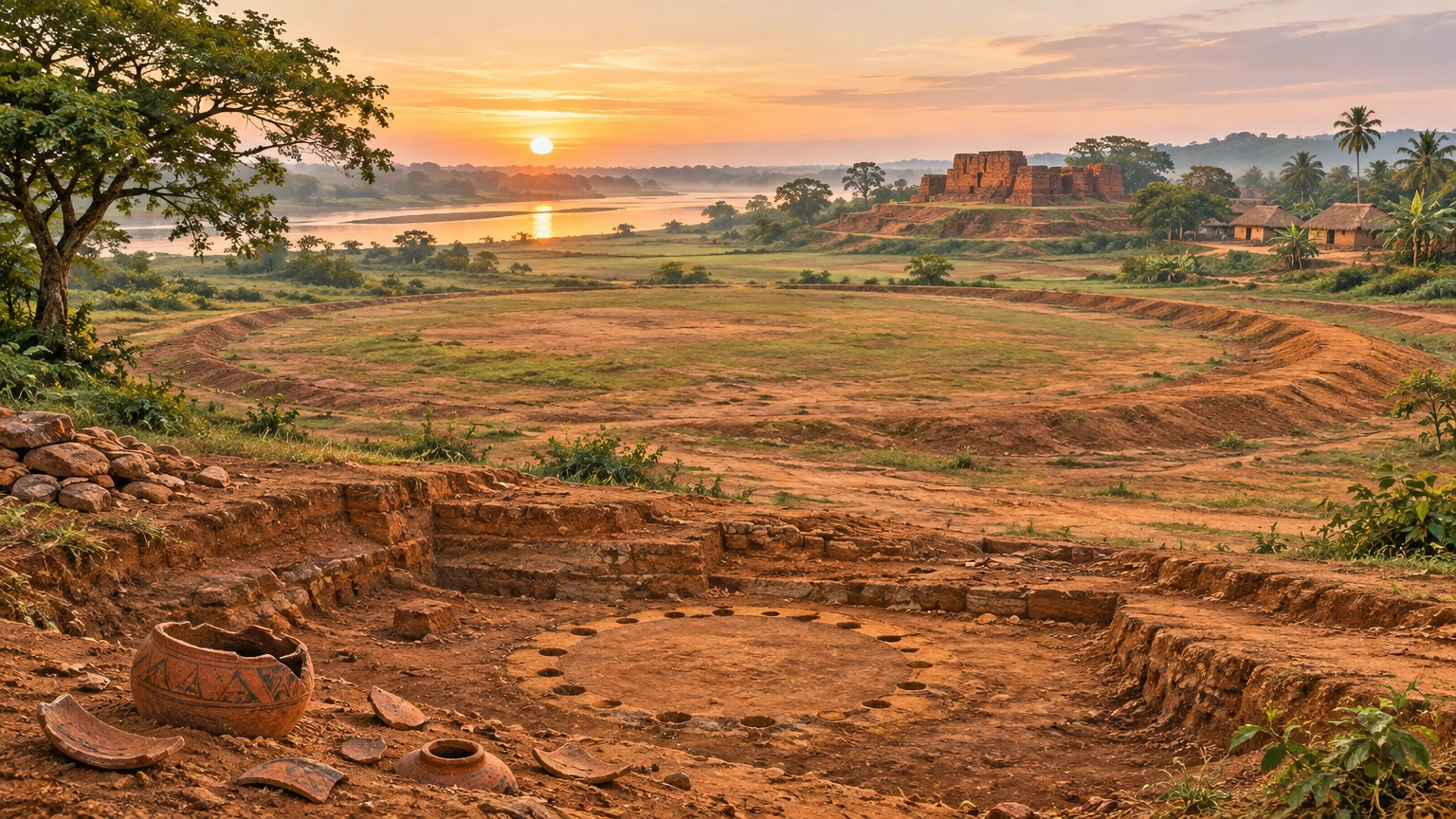
Balasore’s oldest stories do not begin with a carved gateway or a royal inscription. They begin under the soil: a hut floor, a fragment of painted pottery, a piece of iron and the line of an earthen enclosure. Together, such modest finds suggest how people lived here long before the district acquired its present name and boundaries.
This edition follows those traces inland, from the excavated settlement of Durgadevi to the medieval fort landscape at Raibania and the dispersed sculptures of Ayodhya, Kupari and Avana. It is a journey through evidence rather than a promise of polished attractions. Some places require prior permission or local guidance; others are best understood through the research that has recorded them.
## District Overview & Geography
Balasore, also written Baleshwar, occupies Odisha’s northern coastal edge. West Bengal lies to the north, the Bay of Bengal to the east, Bhadrak to the south, and Mayurbhanj and Kendujhar toward the west. Its landscape moves from coastal country through cultivated alluvial plains to the lower hills and forested slopes around Nilagiri and Oupada.
The Budhabalanga and Subarnarekha are major rivers of the district; the Sona, Jalaka and Kansabansa are also part of its wider drainage landscape. Rivers matter to this story not simply as lines on a map. They bring water and sediment into agricultural country, while seasonal flooding can reshape fields and affect travel. At Durgadevi, the Sona and Budhabalanga frame an archaeological landscape whose setting helps explain why researchers ask questions about settlement and water management.
The district’s climate is generally hot and humid. Summer can make exposed archaeological ground uncomfortable, while the monsoon brings heavy rain and the possibility of flooding. The cooler months, broadly October to March, are usually more comfortable for an inland trip, although weather and road conditions should still be checked. [Odisha Tourism’s Baleshwar guide](https://odishatourism.gov.in/en/destinations/baleshwar) recommends that season and identifies the town as a gateway to both coast and forest.
Forest belongs to this geography too. Kuldiha’s mixed deciduous landscape supports elephants, gaur and birdlife, according to EcoTour Odisha; sal and bamboo are among the plants associated with the district’s forest economy. These are living habitats, not an extension of an archaeological site. Encounters with wildlife are never guaranteed, and visitors should use only routes and activities permitted by forest authorities. See [EcoTour Odisha’s Kuldiha description](https://www.ecotourodisha.com/destination/kuldiha-wildlife-sanctuary) for background, and check the Forest Department’s current access rules before planning a visit.
Between forest and sea, paddy fields and settlements give the plain its everyday character. An archaeological mound may be close to homes or agricultural land. The traveler’s privilege is to learn from that landscape without assuming that every visible path or patch of ground is public.
## Mythological & Historical Significance
Balasore’s deep past is not a single unbroken royal chronicle. Archaeology works with material left in different layers; inscriptions, sculptures and later accounts offer other kinds of evidence. They can illuminate one another, but they do not automatically tell the same story.
At Durgadevi in Remuna tehsil, excavators identified Chalcolithic, Iron Age and Early Historic phases. “Chalcolithic” describes a period in which copper and stone were used; it is not the name of a dynasty or a community whose identity is known. The site provides evidence for settlement, farming and technologies over a long span, not a complete account of every generation that lived there.
In 2021, researchers described broad phases beginning as early as 2000 BCE. A later excavation paper reports laboratory dates of about 1350 BCE for the Chalcolithic phase and 800 BCE for the Iron Age or Early Historic phase. Those dates relate to the samples and contexts studied; they should not be recast as a precise founding date for the whole settlement. The later paper also discusses two field seasons rather than just the first. Compare [India Today’s report of 3 July 2021](https://www.indiatoday.in/india/story/archaeologists-unearth-remains-of-4-000-years-old-settlement-in-odisha-s-balasore-1823455-2021-07-03) with the [excavation paper by Sunil Kumar Patnaik and colleagues](https://www.pbjournals.com/image/catalog/Journal%20Papers/JHAA/2024/No%201%20(2024)/2_Sunil%20Kumar%20Patnaik.pdf).
Many centuries later, religious images and temples offer a different historical record. The Balasore district’s [Culture & Heritage page](https://balasore.odisha.gov.in/tourism/culture-Heritage) associates Buddhist images from Avana, Kupari, Basta and Ayodhya with a regional Buddhist presence, and refers to the Bhaumakara period. A study of Jain remains records evidence across Balasore and neighboring Bhadrak. These objects demonstrate the presence and circulation of religious traditions; an image alone cannot establish the complete history of a village or prove that all traditions flourished there at exactly the same time. The [sculptural study](https://www.academia.edu/40820966/Exploring_Jaina_Sculptural_Remains_from_the_Districts_of_Balasore_and_Bhadrak_Odisha) is particularly useful for its attention to objects and their contexts.
Raibania belongs to a much later fortified landscape. Odisha’s state-protected monuments list places Raibania Fort at Jaleswar and gives it a broad twelfth- to fifteenth-century date range. Some accounts associate the fort with the Eastern Ganga ruler Narasingha Deva I; that attribution is not the same as a documented construction date for every surviving feature. The [state list](https://rtiodisha.gov.in/Pages/printManual/section_id:2/office_id:268/lang:) is an administrative guide to heritage, not a final answer to every question of chronology.
Local tradition also connects Raibania with King Virata and the Mahabharata. A [2019 New Indian Express report](https://www.newindianexpress.com/states/odisha/2019/Jul/15/1000-year-old-odishas-raibania-fort-to-get-new-lease-of-life-2004057.html) records that belief as legend. It is worth hearing as part of the place’s cultural life, but it does not establish that the surviving fort was built in an epic age. Respecting a story and distinguishing it from archaeological evidence are compatible acts.
## Tourist Destinations & Hidden Gems
### Durgadevi: Reading a settlement through its remains
Durgadevi lies in Remuna tehsil, approximately 20 kilometres from Balasore town, near the Mayurbhanj border. The 2021 excavation account described an approximately circular earthen fortification, around 4.9 kilometres in circumference, between the Sona to the south and the Budhabalanga to the northeast. The figure describes a reported enclosure, not a marked walking route.
After an Archaeological Survey of India licence was obtained in February 2021, the Odishan Institute of Maritime and South East Asian Studies began its first excavation season in March, continuing to 5 May. The institute’s [official disclosure](https://rtiodisha.gov.in/Pages/getDisclouser/page:2/office_id:1014/section_id:2) lists Durgadevi as a fortified Early Historic site excavated in 2020–21. The subsequent research paper describes work over two seasons.
The finds make the site compelling even without a reconstructed monument. Excavators reported the base of a circular hut, painted pottery, black- and red-slipped wares and copper objects in the Chalcolithic phase. Iron objects, including nails and an arrowhead, appeared among later material; crucible and slag were also reported. Terracotta beads, bangles, ear ornaments, gaming pieces and wheels offer glimpses of adornment and play as well as work.
These objects invite questions rather than ready-made portraits. A hut base is evidence of a structure, but it does not name its occupants. An arrowhead points to a technology, not automatically to a battle. Pottery helps archaeologists compare deposits, but one fragment cannot map a trade route. The evidence belongs to several phases, not a single frozen moment. The 2021 first-season report offered broad working ranges; the 2024 study describes two excavation seasons, 2020–21 and 2021–22, and reports laboratory dates of about 1350 BCE and 800 BCE for samples assigned to the Chalcolithic and Iron Age/Early Historic periods. Those findings should be compared, not blended: the later dates apply to tested samples, not to every wall, object or occupation layer. The study also discusses domesticated rice, irrigation evidence and stone and brick structures, opening questions about cultivation, water management and building practices. It does not by itself establish when the whole rampart was built, whether every watercourse was deliberately engineered, or how long any one settlement lasted. The distinction between a dated sample and a date for an entire site is essential here.
The 2024 account distinguishes a habitation mound of roughly 300 by 200 metres from the broader fortified enclosure, and notes modern buildings, including a school, close to the excavated landscape. That matters for anyone approaching the place: this is not a fenced archaeological park separated from everyday life. Excavation samples small areas and depends on preserving each object’s location and layer; a pottery shard removed from its context loses much of its evidentiary value. Do not enter trenches, school grounds or cultivated land, and do not assume there is a marked visitor entrance. Ask the district administration or archaeology authorities whether a visit is appropriate, then follow local directions. The most rewarding reading is in layers: early broad interpretations, later laboratory results and further excavation can refine one another without turning uncertainty into a gap to fill with invented stories.
The enclosure raises a separate question: when was it made, and how did its use change? In a report dated 14 March 2025, archaeologist D. K. Chakrabarti, who had visited the site the previous month, argued that the beginning of the Early Historic period at Durgadevi might reach back to around 800–600 BCE. That is a scholarly interpretation of the evidence, not a universally settled date for every part of the rampart. See [The New Indian Express](https://www.newindianexpress.com/cities/bhubaneswar/2025/Mar/14/early-historic-fortifications-in-gangetic-valley-may-have-begun-from-odisha-prof-chakrabarti).
For a traveler, the most rewarding preparation is to read before setting out. There is no verified current public opening, visitor facility, fee or guaranteed access to excavated areas. Ask the district administration or Odisha State Archaeology whether a visit is appropriate, and respect landowners and any active or restricted excavation. Do not enter trenches, collect fragments or disturb the surface. If access is unavailable, the research itself remains a valuable way to encounter the place.
### Raibania: A frontier fort as a landscape
Near Jaleswar, Raibania should be understood as a fortified landscape rather than a single building. Earthworks, former approaches, water bodies and religious structures are part of the story told in historical accounts. A visitor expecting an intact palace or a continuous circuit of monumental walls may miss the significance of dispersed remains.
The fort’s position near Odisha’s northern frontier helps explain its association with defense and movement between regions. Reports attribute a major role to the Eastern Ganga period, while the official protected list uses the wider twelfth- to fifteenth-century range. State Archaeology also includes Raibania among places it has excavated. Neither fact means that all visible structures are of one date or that every reconstruction is medieval. [Odisha State Archaeology](https://odisha.gov.in/index.php/en/explore-odisha/state-archaeology) describes excavation and conservation among its responsibilities.
Historical accounts describe the fort complex beyond its walls, including structures and water features. Those reports help interpret the site, but they are not a verified inventory of what visitors can see today; later changes and works make a fresh local check essential.
Raibania also shows why heritage is more than an attractive backdrop. Roads, community needs, worship and conservation meet at the same place, sometimes uneasily. A 2019 account in The New Indian Express recorded an older description of the fort as a five-sided enclosure spread over about six square miles, and named three gateways: Singhadwar to the east, Hatidwara to the west and Sunamukhidwar to the south. The report also listed temple remains, observation towers and more than 50 ponds. These are historical descriptions, not a current site map or a guarantee that each feature survives or can be visited.
A [Times of India report of 2 September 2026](https://timesofindia.indiatimes.com/city/bhubaneswar/raibania-fort-the-forgotten-sentinel-of-odishas-frontier/articleshow/133715178.cms) adds a present-day community perspective. It quotes a local committee member saying that Jay Chandi temple inside the fort still attracts worshippers and describes a local tradition of 161 guardian goddesses. The number is a belief reported by the newspaper, not an archaeological inventory; the temple’s continuing worship is a reminder that a heritage visit may enter a living sacred landscape. Ask before photographing people or ceremonies, and follow custodians’ wishes.
The site also has a history of repair plans and competing needs. The state’s South Gate funding was reported in 2019; a 2024 report says a ₹16.87 crore restoration and development project had been announced in December 2023, then records committee members’ allegations that road works damaged old gates and walls. Officials were asked to inquire, but that report does not establish the inquiry’s outcome. The 2026 newspaper revisits the restoration history; it does not prove that the wider work is complete. Read allocations, local testimony and surviving fabric as different kinds of evidence. Before making a detour, check which areas are accessible now, stay away from unstable masonry and construction, do not climb walls, and leave stones and artifacts in place.
### Ayodhya: A sculpture shed and a wider religious landscape
Ayodhya in Balasore district is not the better-known city in Uttar Pradesh. Here the name opens a discussion of regional sculpture and the ways antiquities are preserved away from their original settings. Odisha State Archaeology lists a sculpture shed at Ayodhya, while the protected-monuments register associates its entry with the ninth to tenth centuries. That date is an administrative classification; the modern shelter should not be mistaken for a building erected in that period.
The scholarly survey of Jain remains records sculptures at Ayodhya and discusses the wider presence of Jain, Buddhist and Hindu material in the region. Figures such as Tirthankaras are not interchangeable decorative forms: posture, attendant figures and other iconographic details can help specialists identify them. Equally, a work preserved in a shed may have been moved from the location where it was first worshipped or found.
This distinction changes how one looks. A stone figure is an artwork, a religious object and archaeological evidence, but those meanings do not eliminate one another. The district’s heritage account also records Buddhist images at Ayodhya. It is more careful to speak of a landscape containing evidence of several traditions than to claim a seamless history of religious harmony or conflict from sculpture alone.
Current display arrangements and public opening at the shed have not been independently verified. Contact State Archaeology or local authorities before making a detour. If access is granted, follow instructions about photography and do not touch or handle objects; some may remain sacred to local communities.
### Kupari and Avana: Evidence beyond a single shrine
Kupari in Balasore’s Khaira area appears in research on the region’s Buddhist and Jain material. A survey records structural remains and Jain sculptures there, while older studies have discussed Buddhist associations. At Avana, the same research describes Buddhist votive tablets and several types of sculpture alongside Jain material. The evidence is dispersed, and identification of individual pieces can be a specialist matter.
Avana also has the Brahmani Temple, listed by Odisha State Archaeology as a protected monument of the tenth to eleventh centuries. At Seragarh, the state list dates the protected Khajuresvara group to the ninth to tenth centuries. These listings are useful starting points for understanding provenance and approximate period, not guarantees of current access or proof that every feature visible today is original.
These places reward patient inquiry rather than checklist travel. A village shrine can have a living religious purpose, an old image can be protected in a different location, and a published survey may describe conditions from an earlier visit. Ask locally where a temple or object may be approached, follow the wishes of worshippers and custodians, and be prepared to leave an unverified stop for another day.
Balasore’s Ayodhya, Kupari, Avana and Seragarh should also not be casually merged with similarly named places or with sites now in Bhadrak. Older writing may use former administrative boundaries. Check the present district and the specific site before planning a route; the [state monument register](https://rtiodisha.gov.in/Pages/printManual/section_id:2/office_id:268/lang:) is useful for this purpose.
### Balasore town: A base for another layer of history
The district headquarters is a practical base, but it also has its own archaeological and maritime past. Odisha Tourism describes Baleshwar as a trading center on the Budhabalanga with British, Dutch and French commercial presence from the seventeenth century. The institute’s excavation disclosure separately records work at Olandaz Shahi in Balasore town in 1990–91.
This does not turn every old building into a verified trading post. It does offer a useful contrast with Durgadevi: a river-connected town entered written commercial records many centuries after the prehistoric settlement. Look for reliable interpretation and locally confirmed access rather than assuming that a named excavation is a maintained visitor attraction.
## Recent News & Tourism Developments
On **11 November 2026**, the [Odisha Chief Minister’s Office](https://x.com/CMO_Odisha/status/2120419551368344005) announced 70 development projects worth ₹340 crore in Balasore district. It said 28 projects were inaugurated and foundation stones were laid for 42. A foundation stone is an announcement of intended work, not evidence that a project is complete.
The post did not provide a project list or identify a tourism scheme. It therefore cannot establish that Durgadevi, Raibania or any road to these sites benefited. It is district development news, not a verified heritage-tourism update.
Earlier in the year, [Pragativadi reported on 9 March 2026](https://pragativadi.com/chief-secretary-anu-garg-champions-womens-role-in-science-at-drdo-event-oversees-balasores-development-initiatives/) that a district review discussed tourism projects and proposals including an arts, science and literature museum. The museum was described as a proposal; the report did not establish a completed museum, location, opening date or connection with the archaeological sites in this article.
At Raibania, the most consequential verified conservation background remains the [12 March 2024 report](https://www.newindianexpress.com/states/odisha/2024/Mar/12/damage-to-raibania-fort-sparks-protest-in-odishas-jaleswar). It said ₹16.87 crore had been allocated and a foundation stone laid in December 2023. Local committee members alleged that road-related work had demolished historic gates and walls instead of restoring them; the minister directed officials to inquire. The allegation and inquiry order should not be presented as a concluded finding.
The 2025 Durgadevi interpretation discussed above is an academic development, not an announcement of new visitor infrastructure. For this edition, no later verified report was found establishing completion of Raibania’s work or the outcome of the 2024 inquiry. Travelers should seek a current local assessment rather than infer the site’s condition from either the allocation or the protest.
## Traveler Essentials
**Getting there.** Odisha Tourism identifies Biju Patnaik International Airport at Bhubaneswar, approximately 200 kilometres from Baleshwar, as an air gateway. Continue by road or rail according to current connections. Baleshwar railway station is the district’s principal rail base, and National Highway 16 provides a road approach. Check current train, bus and flight availability rather than assuming a particular frequency. From Balasore town, arrange local transport toward Remuna or Jaleswar after confirming the precise destination and access.
**Planning an inland visit.** Treat Durgadevi, Raibania and the sculpture locations as separate inquiries, not as stops on a guaranteed public circuit. Durgadevi is reported to be about 20 kilometres from town; the distance does not establish a journey time. Before departure, ask the district administration, State Archaeology or a responsible local custodian about access, conditions, photography and whether a knowledgeable guide is available.
Leave room for changes. A protected monument can be closed for conservation, a path can cross private land, and a sculpture noted in an older survey may have been moved. No current hours, fees or on-site services have been verified for these heritage stops. Carry water and sun protection, but do not leave litter or food where it might attract animals.
**Weather and safety.** October to March is generally the more comfortable sightseeing season. During the monsoon, rain and river flooding can affect roads and fields; in hotter months, exposed ground can be demanding. Check weather and local warnings before travel. Do not enter trenches, climb walls, cross damaged structures or assume that a pond, river or reservoir is safe for swimming or boating.
**Forest responsibility.** If adding Kuldiha to an itinerary, check current forest-department access rules and use authorized arrangements. Stay on permitted routes, keep a respectful distance from wildlife, and never feed or approach elephants or other animals. Do not treat a habitat or an archaeological mound as a place to collect plants, stones or artifacts.
**Food and everyday culture.** In Balasore town, look for an Odia meal of rice, dalma and seasonal vegetables, or pakhala bhata when available. Odisha Tourism also identifies bara and ghuguni among local snack options and amruta keli as the khir prasad associated with Remuna’s Khirachora Gopinath temple. These are foods to ask for, not promises that a particular stall or temple offering will be available. Confirm ingredients and hygiene according to your needs.
Above all, allow the evidence to set the pace. A weathered enclosure, an excavated hut base and a sculpture in safekeeping do not need invented stories to make them meaningful. They ask for attention to the people who made them, the communities who live alongside them and the researchers still working to understand them.
## Publishing Metadata & Tagging
– Group: Odisha Tourism
– Section/Category: Society And Culture
– Destination: https://pcachary.in
– District: Balasore
– Edition: 2026-11-19
– Cycle: 2
– Tags: Odisha Tourism; Balasore; Society And Culture
## Sources & checks
Evidence checked for the 19 November 2026 edition. Dates below are publication or update dates where known; undated pages may change.
– [Odisha State Archaeology: Functions and excavations](https://odisha.gov.in/index.php/en/explore-odisha/state-archaeology), Government of Odisha, undated.
– [State-protected monuments list](https://rtiodisha.gov.in/Pages/printManual/section_id:2/office_id:268/lang:), Odisha State Archaeology, undated. Periods are administrative classifications.
– [OIMSEAS disclosure and excavation list](https://rtiodisha.gov.in/Pages/getDisclouser/page:2/office_id:1014/section_id:2), Government of Odisha, updated 13 September 2025.
– [Durgadevi excavation report](https://www.indiatoday.in/india/story/archaeologists-unearth-remains-of-4-000-years-old-settlement-in-odisha-s-balasore-1823455-2021-07-03), India Today, 3 July 2021.
– [Archaeology of Durgadevi: A Proto-Historic Settlement, Odisha](https://www.pbjournals.com/image/catalog/Journal%20Papers/JHAA/2024/No%201%20(2024)/2_Sunil%20Kumar%20Patnaik.pdf), S. K. Patnaik, G. C. Pradhan, B. Tripathy and S. Nayak, Journal of History, Archaeology and Architecture 3(1), pp. 11–23, published 30 June 2024.
– [Durgadevi fortification interpretation](https://www.newindianexpress.com/cities/bhubaneswar/2025/Mar/14/early-historic-fortifications-in-gangetic-valley-may-have-begun-from-odisha-prof-chakrabarti), The New Indian Express, 14 March 2025.
– [Jain sculptural remains in Balasore and Bhadrak](https://www.academia.edu/40820966/Exploring_Jaina_Sculptural_Remains_from_the_Districts_of_Balasore_and_Bhadrak_Odisha), Dipsikha Acharya, Puravritta 2, 2019.
– [Raibania fort background](https://www.newindianexpress.com/states/odisha/2019/Jul/15/1000-year-old-odishas-raibania-fort-to-get-new-lease-of-life-2004057.html), The New Indian Express, 15 July 2019.
– [Raibania damage protest](https://www.newindianexpress.com/states/odisha/2024/Mar/12/damage-to-raibania-fort-sparks-protest-in-odishas-jaleswar), The New Indian Express, 12 March 2024. Reports local allegations and an inquiry order; the inquiry outcome and later completion are not established here.
– [Raibania Fort: The forgotten sentinel of Odisha’s frontier](https://timesofindia.indiatimes.com/city/bhubaneswar/raibania-fort-the-forgotten-sentinel-of-odishas-frontier/articleshow/133715178.cms), The Times of India, 2 September 2026. Local traditions and testimony are attributed to the report.
– [Baleshwar destination guide](https://odishatourism.gov.in/en/destinations/baleshwar), Odisha Tourism, undated.
– [Kuldiha Wildlife Sanctuary](https://www.ecotourodisha.com/destination/kuldiha-wildlife-sanctuary), EcoTour Odisha, undated. Search excerpts were available, but a full page read failed.
– [Balasore district review](https://pragativadi.com/chief-secretary-anu-garg-champions-womens-role-in-science-at-drdo-event-oversees-balasores-development-initiatives/), Pragativadi, 9 March 2026.
– [Balasore project announcement](https://x.com/CMO_Odisha/status/2120419551368344005), Chief Minister’s Office, Odisha, 11 November 2026. The post does not identify tourism projects.
## Disclaimer
> This content is a collection of ancient history,books and various articles and collection of library and news and other post ; all details may not be the same. Readers are requested to verify the information themselves. Readers are not allowed to take any disciplinary action; content is only for educational purposes. If readers do not agree about the contents, they may send a personal comment to my personal email ID: achary.purna@gmail.com
