
District Overview & Geography
A useful way to understand Balangir is to begin not with a monument but with materials: cotton and coloured thread, clay, bamboo, metal and paddy. The district administration’s craft list associates these with places across Balangir, from Loisingha and Chandanbhati to Saintala and Titilagarh. They suggest a landscape of many occupations, not a single craft village waiting to be discovered.
Balangir lies in western Odisha, with Bargarh to the north, Nuapada to the west, Kalahandi to the south and Subarnapur to the east. Gandhamardan rises along its northwestern side; elsewhere the land moves between hill streams, agricultural fields, settlements and forested ground. The district headquarters, also called Balangir, is a useful base, but it is not a substitute for the different places and histories contained within the district. The district profile identifies black, red, mixed red and alluvial soils.
Water connects this country to the wider Mahanadi basin. The Tel runs along much of the district’s southeastern side, while the district gazetteer names the Lanth, Sukhtel and Sungadh among rivers in its landscape. Their courses matter to farming and settlement, but they also carry seasonal uncertainty: a river seen from a road in the dry months can behave very differently after heavy rain. The Tel ultimately joins the Mahanadi at Sonepur, in neighbouring Subarnapur district, not in Balangir. The district gazetteer describes both irrigation and flood concerns around the Tel. The district profile describes an agrarian economy in which paddy is the principal crop, alongside pulses, oilseeds and other crops. It says more than 70% of the population depends on agriculture and that paddy accounts for 61% of gross cropped area, but gives no clear reference date for either figure; neither should be read as a fresh 2026 measurement. Fields and craft work may share a regional economy, though the directory cannot tell us how an individual household divides its work.
Seasons shape a visit. Summer can be intensely hot; monsoon brings greener fields, but also rain-related delays and slippery ground. Odisha Tourism recommends October to March for Balangir. Even in the cooler season, carry water and plan exposed walking for the gentler parts of the day. Weather is not a fixed timetable, so check conditions shortly before travel. Odisha Tourism’s Balangir guide provides the seasonal recommendation.
The gazetteer describes sal and mixed deciduous forests, including mahua, kendu and bamboo. Its discussion of wildlife and the district history’s references to tiger, bison and sambar describe a broader or earlier forest landscape, not a promise of present-day sightings. Forests are habitats and working landscapes, not open-air collections for visitors to enter at will.
Mythological & Historical Significance
Balangir’s political backdrop includes the former Patna State and Chauhan rule, but its detailed dynastic chronology belongs to the first guide in this series. This return focuses instead on the material record at Saintala and craft associations named in district sources. Balangir district history is the official starting point.
Administrative dates need care. The district history describes the 1948 merger of princely states and 1949 reorganisation, while district profile and culture pages give different formulations for district formation. Rather than turn them into a single anniversary, this guide notes a sequence of changes; Subarnapur later became a separate district. Saintala offers a meeting point between faith and work. Balangir’s official tourism listing identifies the Chandi temple, while the district handicraft directory separately associates Saintala with Dhokra casting and paddy craft in the Adibasi pada. These listings establish place-name links, not the current presence of a workshop, its opening to visitors, or a particular product for sale.
At Saintala, the district identifies Chandi in Mahishamardini form, a goddess image associated in Hindu tradition with the defeat of the buffalo demon. That is a statement about religious iconography and belief, not a dated historical event at this site. The earlier guide treats Ranipur Jharial’s Yogini shrine; its separate monument history is not repeated here.
Gandhamardan, too, carries a Ramayana association in regional tradition. For believers, the story gives the hills a sacred geography; for a historian, the association is evidence of continuing cultural memory rather than proof of an episode from the epic. The distinction need not diminish either the landscape or the faith invested in it.
Tourist Destinations & Hidden Gems
The phrase “hidden gem” can make an inhabited place sound as though it is waiting to be found. In Balangir, a better approach is to look closely at places already named by residents and local institutions, and to distinguish a documented craft association from a place equipped to receive visitors. The district’s handicraft list is particularly valuable as a map of associations. It does not establish that a workshop is currently operating, that a showroom exists, or that a demonstration is open to the public. Check locally before making any craft-place detour.
Saintala: a shrine and a local craft lead. The district tourist listing places Chandi Temple about 38 km south of Balangir town and describes it as a religious destination. Official tourism text identifies the goddess in Mahishamardini form but gives no reliable date for the present structure or a verified inventory of every sculpture. Follow worship arrangements and pair any craft enquiry with a pre-confirmed local contact. District tourist list.
Saintala is a living place of worship as well as a locality named in the district craft directory. Follow the directions of temple managers, ask before photographing people or sacred images, and leave stonework untouched. The public listings provide no opening hours, display map or guarantee of access to individual sculptures; confirm locally before setting out if those details matter. The craft list likewise does not establish a workshop at the shrine or a demonstration. Allow enough time to visit without rushing worship or arranging an unconfirmed maker meeting immediately afterward.
Saintala also appears on the district craft list for Dhokra casting, and the Adibasi pada of Saintala is associated with paddy craft. These are separate entries from the temple listing. They provide a reason to ask knowledgeable local people about contemporary makers, not a guarantee that a visitor can walk from the shrine into a workshop. If an introduction is possible, agree on the nature and cost of a visit before arriving.
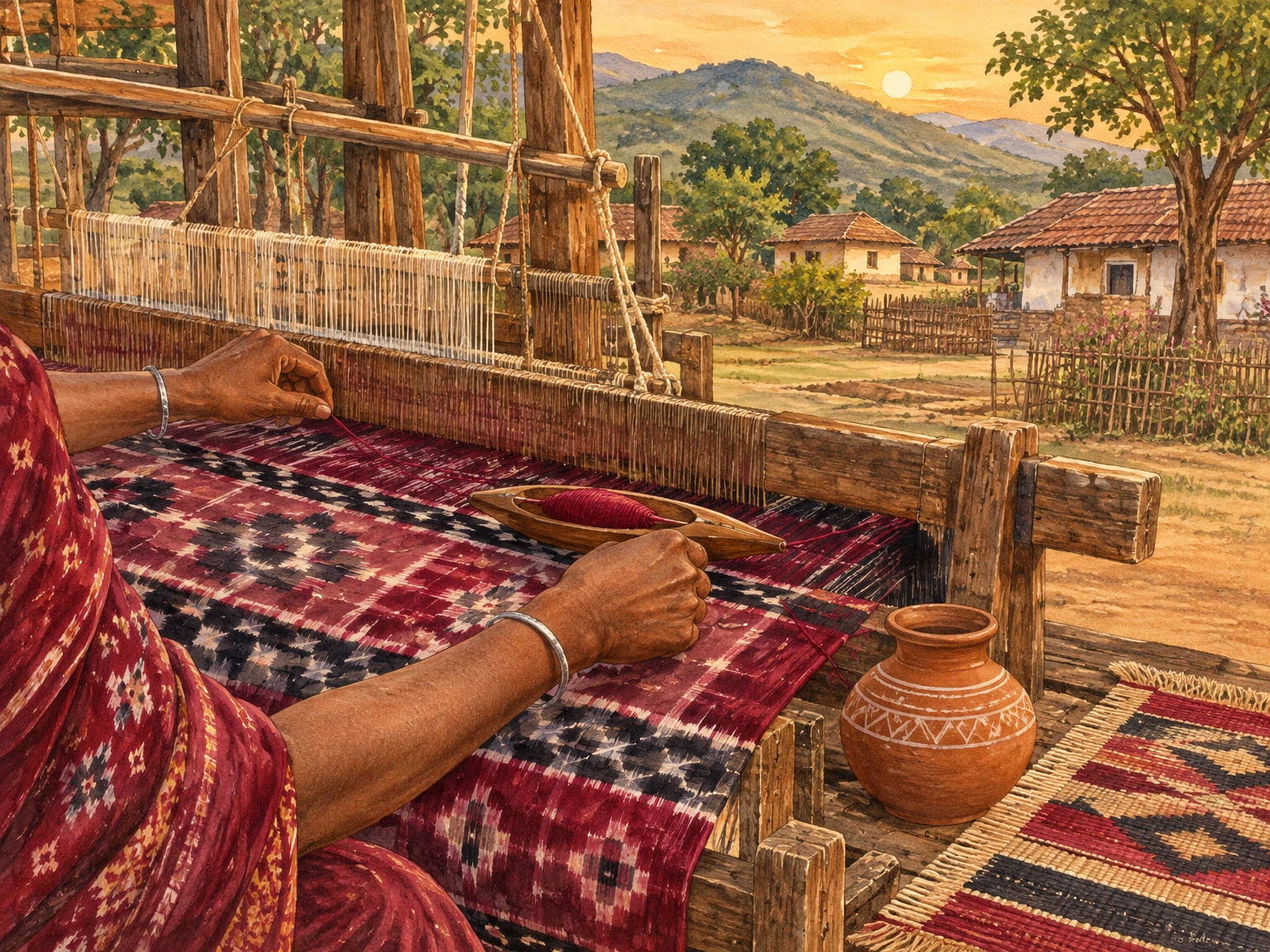
Chandanbhati and the language of cloth. The district associates cotton and wool durries with Chudapali, Chandanbhati, Dhubalpada and Sautnpur; Chandanbhati is also listed for tie-and-dye and art textiles. A durry is a woven floor covering, so ask about fibre, intended use and care as well as who made it. Art textiles are separately associated with Sarmuhan, Belpada, Chandanbhati, Kermeli and Gohirapadar, while applique appears at Tusura and Loisingha. These overlapping entries make the directory more than a one-product-per-village list, but they do not confirm an open workshop or current stock; request a present-day seller or contact before planning a detour.
Western Odisha is widely associated with patterned handloom cloth, but the listing does not specify the exact technique or product made by every Chandanbhati artisan. Tie-and-dye is a broad category; a buyer should not label an individual piece as a particular local technique without asking its maker or a knowledgeable seller. The same caution applies to the district’s tie-and-dye associations with Sarmuhan, Salebhata, Belpada, Loisingha and Agalpur. A place on the list is a lead for research, not proof of a current retail address.
Cloth also asks visitors to think about time. A finished textile conceals decisions about fibre, colour, preparation, weaving and finishing. If invited to meet a maker, ask what part of that process they do themselves and whether others contribute. A respectful purchase can be direct, but not every artisan sells directly, and a cooperative or retailer may have an important role. Do not assume that a low price is a bargain for the person who made the piece.
Clay at Titilagarh and other listed places. The district associates terracotta with Titilagarh, Lakhapali, Malamunda, Baghapali, Bahalbuka, Manahira, Bubel, Naren and Kumbhari. Terracotta begins with earth transformed by shaping and firing; the resulting object can be practical, decorative or connected to worship. The district list does not identify the present range of objects at each place, so visitors should ask what is actually available rather than arrive expecting a particular design.
Clay is fragile, and the details of a purchase matter. Ask how an object should be packed, whether it is suitable for its intended use and who made it. If no maker or shop can be confirmed, Titilagarh remains a district town rather than a failed craft attraction. There is no obligation for a household to open its working space to strangers.
Metal, bamboo and paddy craft. The district’s list associates brass and bell-metal work with Bairasar, Dhubalpada and Balangir; Dhokra casting with Saintala; paddy craft with Saraibahal, Chulifunka and Saintala’s Adibasi pada; and artistic bamboo with Balangir, Gudvela, Siker, Badbandh, Bhutiarahal and Jamut. It also records soft toys, wood carving, art leather, cloth flowers and patta chitra. This is a broad administrative map of different materials and object types, not evidence that every listed practice is active or sold at a public shop today. The place associations help frame a question to local cultural groups or sellers, but a current contact is still needed before making a detour.
The distinction between a material and a product is useful. Brass and bell metal are not interchangeable names for every metal object; bamboo work can take many forms; and a paddy-craft listing does not tell us which parts of the plant a particular maker uses. Ask before describing an object, and let the maker’s explanation lead. A photograph of hands at work can be intrusive when those hands belong to someone earning a living. Permission, fair payment where requested, and time to decline are more valuable than a hurried image.
There is a real opportunity here for travel to support livelihoods, but it is not automatic. A craft-place name does not establish reliable supply, visitor facilities or the price reaching a maker. Buyers can ask whether an item is handmade, where it was made, how it is priced and whether the seller can identify its maker. They can also accept that some questions may not have simple answers. A cancelled or unavailable visit is not a failure of hospitality.
Balangir town: listening for living arts. The district’s culture and heritage page names Dalkhai, Rasarkeli, Ghumura and Dhap among its folk dance and music traditions. These names are a starting point for listening, not interchangeable labels for one generic “tribal dance.” Forms travel across communities and occasions, and a performance is shaped by the people performing it.
The district page also refers to cultural organisations and festivals, but a listing is not a current performance calendar. Ask locally about a public event during your stay; do not expect a troupe to perform on demand. If you encounter a programme, learn the name of the group and the form, pay any stated charge, and ask before recording. An evening performance, when genuinely available, can reveal another side of the district’s skilled work: rehearsal, memory, instruments and the labour of organising an event.
Ranipur Jharial: stone in a wider landscape. For visitors who have time for a longer excursion, the district places Ranipur Jharial roughly 104 km southwest of Balangir town. The Chausathi Yogini shrine stands on a rocky hill, alongside other temple remains in a landscape that rewards attention to both architecture and setting. The circle of yogini figures belongs to a religious history distinct from the later political history of Patna State. The district history describes the site’s association with several religious currents.
This is an exposed place, so carry water, wear secure footwear and check current access before leaving. Do not climb or handle sculpture. Ranipur Jharial is a substantial outing, not a convenient add-on to every village-craft inquiry. For a shorter visit, Saintala and a confirmed conversation with a craft seller may offer a more manageable day.
A boundary matters on the Gandhamardan circuit. Harishankar is associated with the Balangir side of the hills; Nrusinghanath is in neighbouring Bargarh. Odisha Tourism presents them together as a regional pilgrimage landscape, but a journey between them crosses district geography. Check access and road conditions rather than assuming that a forest path is an authorised shortcut.
Recent News & Tourism Developments
Research checked on 17 November 2026 found the most consequential Balangir updates in rural infrastructure and education, rather than a newly opened craft attraction. They may shape future travel and livelihoods, but do not establish that a visitor facility has opened.
On 14 November 2026, the Odisha Chief Minister’s Office announced 248 Balangir projects valued at ₹911 crore, combining inaugurations with foundation stones for new works. The aggregate is a mixed status, not ₹911 crore of completed infrastructure. The announcement does not establish an improvement on a particular craft route or a visitor facility ready to use.
At the same Balangir event, the Press Information Bureau reported on 14 November that a foundation stone had been laid for a new agriculture college. The minister said it would receive support from ICAR and the government. On 16 November, ET Realty’s ANI-syndicated report quoted the deputy chief minister saying a temporary campus had been finalised, permanent-campus land allotted and teacher recruitment advertised. Those are attributed claims about arrangements; the foundation stone is not proof of an operating college or classes already under way. The reporting also uses “college” and “university” differently.
Water planning has a longer timeline. On 13 November 2026, Pragativadi reported that tendering was under way for the Upper Lanth medium irrigation project after a foundation stone in November 2024. It described a planned spillway near Chikili and an intended annual irrigation potential of 6,105 hectares across the kharif and rabi seasons, serving 4,700 hectares of cultivable land. Those figures describe planned outcomes, not achieved irrigation; the seasonal total and land area are different measures. The report also describes a proposed drinking-water allocation, not a verified current supply.
Craft support offers another useful, carefully bounded figure. On 25 March 2026, OMMCOM News reported an Odisha minister’s Assembly reply: three Balangir primary weavers’ cooperative societies received ₹2.72 lakh under a 10% rebate scheme in 2025–26, compared with none receiving that assistance in 2024–25. The report’s 65,353 registered weavers and 153 societies are a combined count for Bargarh, Balangir and Subarnapur, not Balangir alone. Neither figure tells a visitor how many individual Balangir weavers benefited or what they currently earn.
Traveler Essentials
Getting there. Odisha Tourism identifies Balangir railway station as the rail gateway and describes road connections by national and state highways. For air travel, it lists Raipur and Bhubaneswar airports as approaches, although different parts of its page describe the nearest airport differently. Choose according to available flights and onward rail or road connections rather than relying on an unverified “nearest” claim. Check current train availability and arrange the final road journey before departure. Odisha Tourism’s guide is a useful starting point.
From Balangir town, Saintala lies to the south; the district’s approximate distance is 38 km. Patnagarh is west of the headquarters, while Ranipur Jharial is a longer southwestern excursion. For a craft-focused outing, first confirm an actual contact or public point of sale, then plan transport around that appointment. A name on a map may have variant spellings, and a craft entry may refer to a settlement rather than a shop. Ask the person you are meeting for the appropriate destination and allow time for the return journey.
A sensible two-day plan. Use Balangir town as a base. On the first day, visit Saintala Chandi Temple and, only if an invitation or sale point has been confirmed, enquire about a nearby craft association. Leave room for the shrine on its own: access to a maker is not a condition of a worthwhile visit. On the second day, choose either a longer trip to Ranipur Jharial or a confirmed textile-focused visit, rather than rushing both. Ask locally whether a public cultural programme is scheduled; no performance is implied by the district’s general list.
When to go. October to March is the state tourism guide’s preferred window. Summer heat calls for particular caution, while monsoon can alter road and site conditions. In any season, ask about the weather before setting out and avoid driving through flooded sections. Carry drinking water, sun protection, essential medicines and suitable footwear. For a remote excursion, confirm transport both ways and tell someone your plan.
Eating locally. Odisha Tourism’s Balangir page lists mandia, or finger-millet preparations; pakhala, fermented rice; dalma, a lentil-and-vegetable preparation; chaula bara, rice-and-lentil fritters; and pithas among the area’s food traditions. These are shared across wider Odisha and western Odisha, not dishes exclusive to one village. Ask what is freshly prepared and available, and explain dietary requirements rather than assuming a standard recipe. Safe drinking water and food hygiene matter more than completing a checklist.
At shrines and heritage sites. Dress with consideration, remove footwear where requested and follow local directions about photography. A ritual may be private even when a shrine is publicly known. Keep a respectful distance from worshippers, do not move offerings, and leave old sculpture untouched. At Ranipur Jharial, exposed stone and uneven ground deserve care; do not treat carvings as seats or climbing surfaces.
In villages and forests. Arrange introductions rather than entering homes or workspaces unannounced. Ask before photographing adults, and obtain a parent or guardian’s permission before photographing children. Pay agreed prices and any agreed demonstration fee; do not promise publicity instead of payment. Carry litter back, avoid collecting plants or disturbing wildlife, and use only routes and areas confirmed as open by the relevant authorities. Do not swim or boat in rivers, reservoirs or streams on the assumption that a scenic view implies safe access.
Finally, leave space for uncertainty. A listed craft may have changed hands or moved; a temple’s arrangements may change; a road project may still be a plan. Balangir is most rewarding when the traveller treats those facts not as obstacles to a perfect itinerary, but as part of encountering a living district on its own terms.
This content is a collection of ancient history,books and various articles and collection of library and news and other post ; all details may not be the same. Readers are requested to verify the information themselves. Readers are not allowed to take any disciplinary action; content is only for educational purposes. If readers do not agree about the contents, they may send a personal comment to my personal email ID: achary.purna@gmail.com
