
After Kapilavatthu, the story moves west
The preceding chapter in this series followed the Vinaya’s account of the Buddha’s return to Kapilavatthu and the going-forth of his son Rāhula. The next episode in the Mahāvagga moves away from the Śākya homeland. It says that, after staying at Kapilavatthu as long as he wished, the Buddha set out on a journey to Sāvatthī. There the narrative turns from a royal family’s connection with the monastic community to a practical question about how young entrants should be trained and cared for.
This is the sequence preserved in the Theravāda Vinaya’s Mahāvagga, especially its first Khandhaka, sections 55–56. It is an account arranged by a monastic legal and narrative text, not a dated travel diary. We can describe what the source places next without asserting a calendar year, a measured route, or a chronology independently demonstrated by contemporary records. The story’s interest lies in the institutional questions the text uses this journey to introduce.
Sāvatthī and Jetavana in the narrative
The Mahāvagga says the Buddha reached Sāvatthī after travelling in stages and stayed at Jetavana, the park associated with Anāthapiṇḍika. The name is familiar across Buddhist literature: Jetavana appears as a setting for teaching, community life, and rules concerning monks and lay supporters. The Mahāvagga’s short geographical transition serves as more than a change of scenery. It places the growing community in another important town and creates the setting for a decision about admitting and guiding novices.
Later Buddhist memory strongly associates Jetavana with Anāthapiṇḍika’s generosity, and other canonical texts use the monastery as a recurring location. Those textual references show how important the place became in Buddhist tradition. They do not by themselves settle every archaeological question about the earliest structures, the boundaries of the ancient park, or the exact date when a particular teaching occurred there. In this episode, Sāvatthī is first of all the setting named by the Vinaya narrative.
A small question with institutional consequences
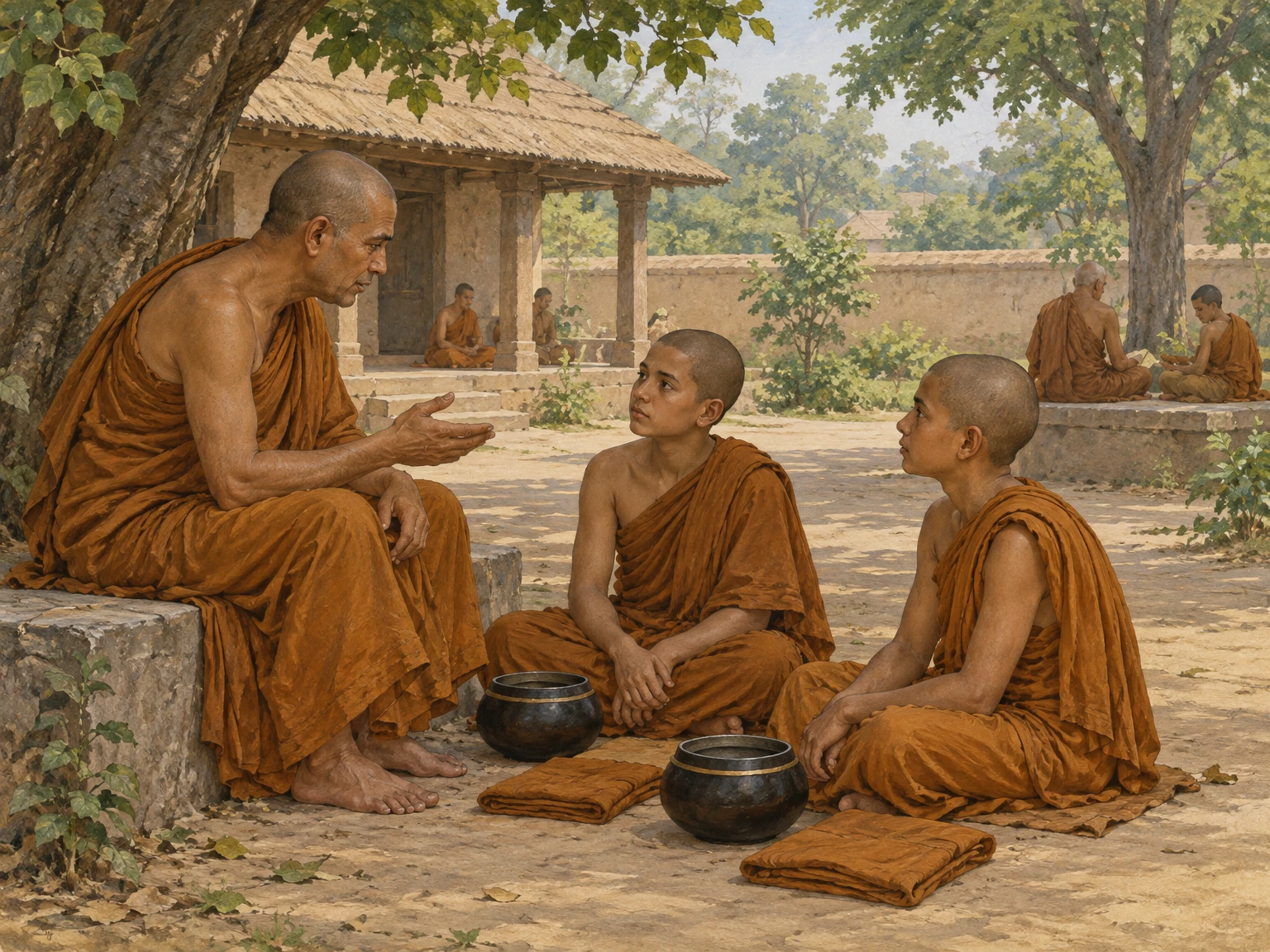
The section does not begin with a grand sermon. It introduces a matter of daily community life: how many novices a single monk may take responsibility for. The text recounts that a family connected with Sāriputta sent a boy to be ordained. Sāriputta already had Rāhula as a novice in his care, and the earlier rule about one monk attending to one novice raised an immediate practical question. Could he accept another young trainee, and under what conditions?
The narrative’s answer is carefully qualified. The Buddha allows a monk who is experienced and competent to take two novices—or as many as he is able to instruct and exhort properly. This is not an unlimited permission to collect followers. The text makes capacity and responsibility central. The story presents rule-making as a response to an actual community problem, balancing access to training with the need for attentive supervision.
Sāriputta as a careful teacher
Sāriputta’s role links this episode to the preceding stories. In the traditional narrative he is one of the Buddha’s chief disciples, known for discernment and teaching. Here he appears not as a figure delivering a philosophical discourse but as a monk who notices that the existing arrangement needs clarification. Because Rāhula is already in his care, the newly sent boy forces him to consider what the rule means in practice.
The Mahāvagga gives Sāriputta’s question a procedural character: he reports the situation and seeks guidance rather than making an exception for himself. The resulting rule makes an important condition explicit—competence to instruct and encourage the novices. That detail matters more than imagining a dramatic private conversation the source does not supply. What the text preserves is a model of consultation: when circumstances reveal a difficulty, a monk brings it to the community’s teacher, and the rule is clarified for future cases.
What “going-forth” means here
In Buddhist monastic vocabulary, going-forth is the step by which a person leaves ordinary household life to enter the training, often first as a novice. It is not identical in every context to full ordination as a bhikkhu. In the Mahāvagga’s account, the boy’s admission raises the question of novice care, and the next section turns directly to the rules novices should undertake. The story therefore offers a glimpse of a structured path rather than a single all-at-once change of status.
The distinction helps prevent a common simplification. A novice is not merely a child living near monks, nor does this episode describe every later ceremony or qualification for full ordination. It concerns a particular stage and the responsibilities attached to it in the Vinaya’s legal framework. Buddhist communities in different places and periods have developed their own procedures and interpretations. The historical article can explain this source’s terms without treating one passage as a complete description of all Buddhist monastic practice.
Why supervision matters
The rule’s central test is not the novice’s age alone but the mentor’s ability to teach and exhort. The Mahāvagga uses terms for experience and competence, then limits the number of novices to what that monk can properly manage. This makes the episode about care as much as administration. A person entering the training needs more than permission to stay; the community must make sure someone can guide, correct, and encourage them.
The passage does not give a modern staffing ratio, a detailed timetable, or a full curriculum for every stage of novice life. It gives a principle in response to a concrete case. The mentor’s capacity matters; numbers are not an end in themselves. Read this way, the rule is a safeguard against neglect and a recognition that training depends on relationships. That reading is grounded in the text’s own emphasis on instruction and exhortation, while broader applications should be identified as interpretation rather than quoted as additional canonical wording.
From a single novice to more than one
The story’s development is easy to miss if the two rules are read separately. The prior restriction prevented a monk from taking two novices under his care. The new permission does not simply erase the concern; it makes the exception conditional on demonstrated ability. A competent monk may take more than one, but only as many as he can teach and encourage. The adjustment reflects a practical problem of scaling a community while preserving the purpose of mentorship.
This pattern is characteristic of the Vinaya’s presentation of discipline: rules are narrated in relation to situations, and later clarifications shape how they are applied. That does not mean every rule in the entire Vinaya originated exactly as each story recounts. Scholars study these texts as layered collections that developed and were transmitted over time. Within the Mahāvagga’s own account, however, the change is clear: a limit is reconsidered, and the permission is tied to the teacher’s real capacity rather than to rank or enthusiasm alone.
The novices ask what to practise
Mahāvagga I.56 follows naturally. After the permission to have more than one novice under a capable monk’s care, the novices ask how many training rules there are and in what they should train. The Buddha is said to prescribe ten training rules. The movement from supervision to practice gives the pair of sections its structure: first, who may guide novices; next, what commitments mark their training.
The list is often called the ten precepts for novices in English. In the source, these are training rules within a monastic discipline, not simply a short summary of all Buddhist ethics or a promise that every Buddhist tradition uses one identical formulation. The Mahāvagga is a Pali Vinaya source. Other Buddhist lineages also have novice disciplines, sometimes with related content but distinct textual histories and local procedures. Careful description keeps the scope of this passage visible while explaining why it has remained influential.
The first rules: non-harming and honesty
The first items in the list concern refraining from taking life and from taking what is not given. They place non-harming and respect for others’ property at the beginning of the novice’s discipline. The next rules concern sexual conduct and false speech. Together these commitments address actions that affect other people directly and the trust necessary for a shared community. They are presented as rules to train in, not as a claim that a novice instantly becomes flawless.
The wording translated into English can vary. Translators may render the first rule as abstaining from killing living beings, and the rule against false speech as abstaining from lying. These are translations of Pali terms, and a reader should consult the cited edition when an exact linguistic nuance matters. The narrative’s practical point is clear enough: novice training begins with restraint in conduct and speech. The rule list is not a biography of the unnamed novice or evidence that he personally broke any rule; it establishes the standards the text says apply to novices.
The rule about intoxicants
Another training rule concerns intoxicating drinks and substances that lead to heedlessness. The Pali Vinaya translation rendered by Rhys Davids and Oldenberg refers to intoxicating liquors; modern translations often use wording such as alcohol and fermented drink that cause heedlessness. The phrase connects the restriction to loss of care or attentiveness, a concern that fits the larger discipline of communal life.
It is important not to silently expand a historical translation into a modern medical or legal claim. The canonical wording belongs to a religious training code, and contemporary communities interpret its scope through their own traditions. The Mahāvagga passage supplies the rule as part of a ten-item list; it does not discuss contemporary drugs, clinical definitions, or public-health policy. A source-aware account can explain the traditional sense while leaving modern applications to the communities and teachers who interpret the discipline today.
Eating at the proper time
The list also includes abstaining from eating at forbidden times, commonly explained in Theravāda monastic practice as not eating after midday. The old English translation uses the phrase “forbidden times,” while later summaries make the noon boundary more explicit. For the novice, food is not treated only as private preference; time and manner of eating become part of a disciplined routine shaped by the monastic community.
This short rule does not tell us the full daily schedule of the novices in Sāvatthī, what foods they received, or how every community handles edge cases. Those details require additional texts and current guidance from a living tradition. The episode gives the principle as one of the ten trainings. Its place in the list shows that discipline reaches ordinary habits, not only dramatic moral decisions. It also reminds a modern reader to distinguish what the source explicitly says from familiar practices explained by later commentaries and present-day institutions.
Entertainment, adornment, and restraint
Two further rules address entertainment and personal adornment. The translations list abstaining from dancing, singing, music, and spectacles, and from garlands, scents, unguents, ornaments, or finery. These practices are grouped as forms of entertainment and display that do not fit the novice’s training in simplicity. The text’s wording reflects a monastic discipline concerned with how attention and identity are shaped by ordinary choices.
The list is not a blanket historical claim that ancient Indian society had no music or ornament, nor does it describe every practice of lay Buddhists. Its subject is novice discipline. Different translations divide or phrase the items in slightly different ways, so short quotations should be tied to a named translation rather than presented as identical wording across all editions. In context, the rules ask novices to practise restraint, reducing distractions and status display while they learn a communal way of life.
Beds, money, and the shape of daily life
The final two rules prohibit high or broad beds and the acceptance of gold or silver. Together with the earlier items, they suggest a discipline that reaches into rest, comfort, and economic dealings. The aim is not merely to make life uncomfortable. The rules mark a boundary between the novice’s training and ordinary pursuits of luxury or money-handling, as those were framed in the monastic code.
The text does not offer a full economic history of the Saṅgha or explain every later arrangement for donations, property, and stewardship. Nor should the prohibition be casually mapped onto modern banking practices without reference to the tradition interpreting it. For this episode, it is enough to say that the Vinaya places simplicity and limits on accepting money among the novice’s commitments. Later monastic communities have had to work out practical arrangements while maintaining their interpretations of the rule; those developments belong to their own histories.
A training list, not a claim of instant perfection
The word “training” is important. These are precepts undertaken as a discipline, not a declaration that young novices have already mastered every quality they are meant to cultivate. The Mahāvagga’s formulation gives a framework for practice: avoid harmful actions, speak truthfully, exercise restraint, and live within the routines of a community. The story does not portray the list as a magical formula or as an alternative to learning from a teacher.
The ten rules also do not exhaust the life of a novice. The following sections of the Vinaya and later literature discuss dependence on a mentor, conduct, learning, and the responsibilities of both teacher and student. When those sources are brought in, they should be identified separately. Here the focus stays on I.55–56: the capacity-based permission for a monk to train more than one novice, and the ten rules named in response to the novices’ question.
Reading the episode as monastic history
For historians, the Mahāvagga is valuable evidence for how the Theravāda Vinaya tradition organizes memories about the early community and explains the origin and rationale of discipline. It preserves names, places, institutional concerns, and rules. But a text’s literary sequence is not identical to a modern chronology established from contemporary documents. The account was transmitted and edited within a religious tradition, and the precise dates of the Buddha’s life and many episodes remain debated.
That distinction does not require dismissing the narrative. It lets readers ask productive questions: what problem does the text say arose, what rule does it attach to that problem, and how does the episode imagine responsible teaching? The text itself is evidence for the tradition’s legal and narrative memory. Independent evidence may illuminate the broader setting, but it cannot automatically verify the precise conversation or the biographical details of every person named. This article therefore attributes its claims to the Mahāvagga rather than presenting its scene as a contemporary report.
What the passage does not establish
The two sections do not provide a year for the journey, a measured itinerary from Kapilavatthu to Sāvatthī, or independent proof that the novice named in the story can be identified outside the Vinaya. They do not give a complete biography of Sāriputta, a census of the Saṅgha, or a universal rulebook covering every Buddhist community across time. Those claims would exceed the source.
The passage also does not say that the Buddha founded every later school, that all traditions interpreted the ten rules in exactly the same way, or that a particular modern site preserves the exact room where the discussion occurred. It names Jetavana as the setting in the narrative. Archaeology and later pilgrimage histories are separate bodies of evidence. Keeping these limits clear is not a way of diminishing the episode; it is how a careful retelling protects both the religious significance of the source and the integrity of historical description.
A community that grows through care
The episode’s lasting theme is the relationship between growth and responsibility. The community can receive more novices, but the permission depends on a monk’s ability to teach and exhort them. The novices in turn ask what they must practise. In the text’s portrait, expansion is not measured only by numbers; it requires a structure of guidance and a shared discipline. That emphasis distinguishes the episode from stories centered on a single dramatic conversion.
The sequence also connects the previous Kapilavatthu story to a broader institutional setting. Rāhula’s going-forth raised a question about who could guide novices; in Sāvatthī, the Mahāvagga develops that question into a rule and then states the novice training list. The story’s geography moves on, but its concern remains how a growing Saṅgha sustains practice. It is a modest episode, yet it shows how religious communities remember the everyday decisions that make teaching and training possible.
The next chapter in the series
After the rules for novices, the Mahāvagga continues through additional questions of training and communal discipline. This article stops at the close of the I.55–56 episode rather than blending later regulations into the same scene. A new installment can follow the text’s next distinct narrative or rule episode, checking the source sequence before choosing its subject and keeping later material in its own context.
The story of Sāvatthī’s novices offers a quiet counterpoint to the earlier tales of awakening, conversion, and royal generosity. Its central image is not a throne or a miracle but a teacher’s responsibility and a student’s question. The Vinaya remembers the community as something formed through both ideals and workable rules. Readers may approach that memory devotionally, historically, or as literature; whichever approach they take, the source’s scope and the limits of what can be independently established remain worth stating plainly.
Translation, transmission, and the scope of the rules
The section numbers used here follow the Mahāvagga’s first Khandhaka as presented in standard English translations. Editions can divide the material differently or use alternate spellings: Sāvatthī may appear as Savatthi, Jetavana may be written Jeta Grove, and Pali terms for ordination or training may be rendered in more than one way. Rhys Davids and Oldenberg’s translation belongs to the late nineteenth century, while later translators make different choices in idiom. Comparing translations helps readers see which details are stable across the accounts and which are shaped by English wording.
The older rendering of the capacity rule speaks of a monk being “experienced and competent”; modern summaries often emphasize being capable of instructing and exhorting the novices. These phrases point to the same practical condition in the passage, but they are not exact quotations from one another. This article paraphrases the shared sense and gives the section references so readers can consult the particular translation they prefer. When wording is quoted directly, the edition should be named, because translations are not interchangeable transcripts of Pali.
The ten rules also have a recognizable relationship to broader Buddhist ethical commitments, but this episode frames them specifically as novice training. A lay follower may undertake different precepts, and fully ordained monastics follow much larger bodies of discipline. Even within a tradition, instruction can explain how a rule is applied in daily circumstances. The Mahāvagga list therefore serves as a beginning framework in this narrative, not as a complete account of every duty or every later interpretation.
There is no contemporary inscription or administrative record cited here that independently confirms Sāriputta’s meeting with the family, the boy’s admission, or the exact words attributed to the Buddha. The secure claim is textual: the Pali Vinaya preserves this story and associates it with the relevant rule and novice precepts. Historians can study the composition and transmission of the Vinaya and compare it with other textual or material evidence, while still distinguishing that work from direct proof of each narrated event.
Sources
- Mahāvagga I.55 — Journey to Sāvatthī and permission for a competent monk to train multiple novices, Rhys Davids & Oldenberg translation
- Mahāvagga I.56 — Ten training rules for novices, Rhys Davids & Oldenberg translation
- Vinaya Piṭaka, Mahāvagga, first Khandhaka, translated by T. W. Rhys Davids and Hermann Oldenberg, Sacred Books of the East 13
- Mahāvagga section index, Access to Insight; section numbering follows I. B. Horner’s PTS translation
- Thanissaro Bhikkhu, The Buddhist Monastic Code, chapter 24: Novices, citing Mahāvagga I.55 and I.56
- Khandhaka structure and textual tradition, Journal of Buddhist Studies (2024)
This content is a collection of ancient history,books and various articles and collection of library and news and other post ; all details may not be the same. Readers are requested to verify the information themselves. Readers are not allowed to take any disciplinary action; content is only for educational purposes. If readers do not agree about the contents, they may send a personal comment to my personal email ID: achary.purna@gmail.com
