
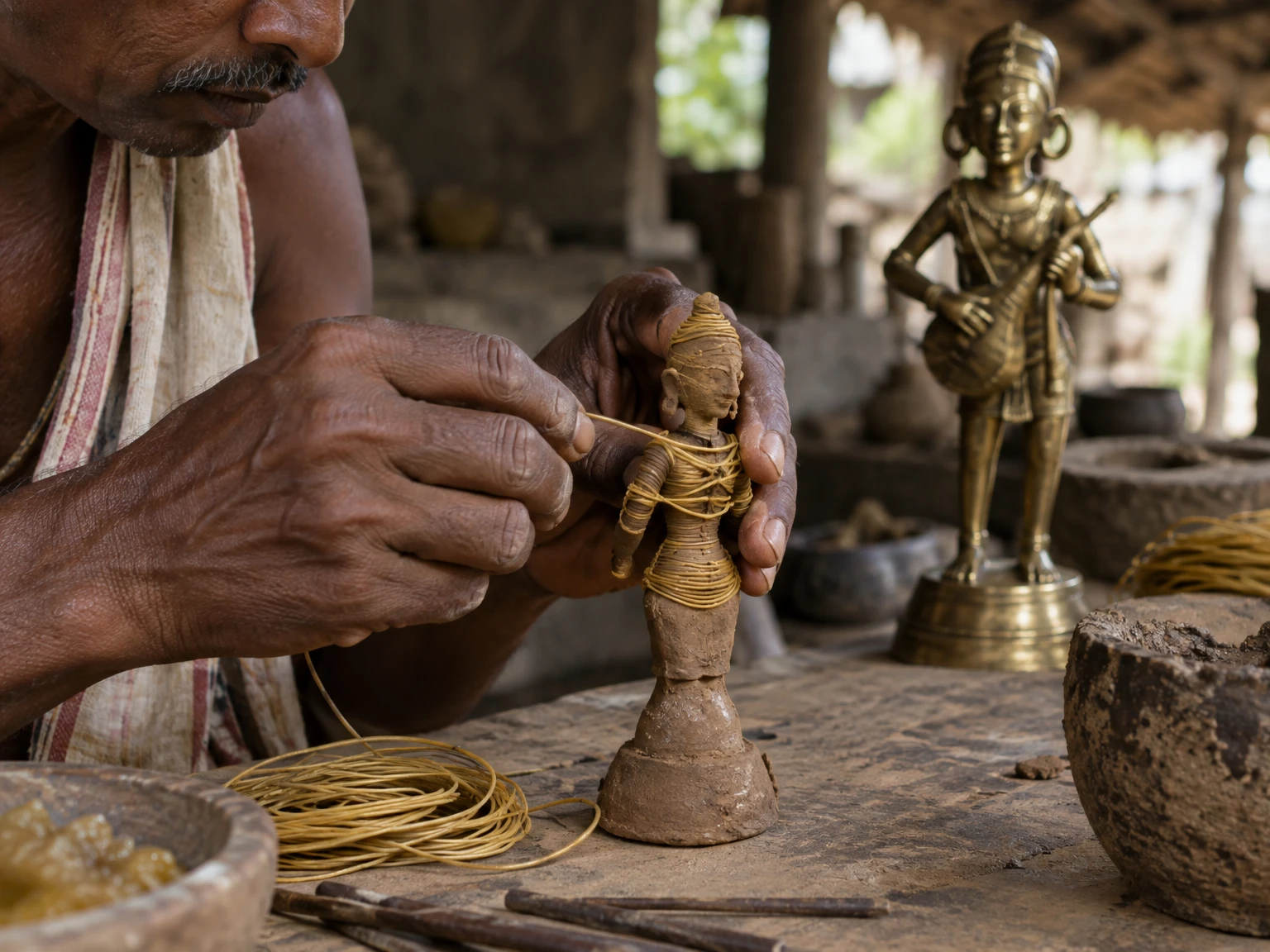
Dhenkanal’s Dhokra work is easy to recognize: a small figure or vessel can carry a web of raised lines, loops and tiny openings, as if a drawing has been made solid. Yet the craft is more than a decorative surface. It is a way of shaping metal through a model that is deliberately lost, and it depends on a sequence of decisions about form, heat, clay, wax and timing. In Odisha, Sadeibarani village in Dhenkanal is identified by the state tourism department as a prominent centre for this bell-metal craft. That local anchor makes the district a useful place to understand the craft, but it should not be mistaken for a complete map of Odisha’s metalwork. Names, materials and workshop histories vary, and one village cannot stand for every artisan or community. The word “Dhokra” is often used alongside “Dokra” for objects made through lost-wax casting, yet the labels do not erase differences among regions, makers and designs. This article focuses on what can be said about Dhenkanal, how the process works in broad terms, and why the craft is both a material skill and a living practice.
A district, a village and a wider tradition
Sadeibarani, in Dhenkanal district, appears in Odisha Tourism’s official listing as a Dhokra handicraft village and a prominent centre for bell-metal work. That is a useful, specific starting point. The same tourism department describes Dokra as part of a wider Odisha craft landscape, with work in more than one district. India’s One District One Product listing also associates Dhenkanal with Dhokra casting and brass or bell-metal work. These sources support a local connection, not a claim that all Dhokra in India comes from Dhenkanal, or that every object labellled Dhokra was made there.
The spelling itself can vary in English-language writing. “Dhokra” and “Dokra” are both used, and spellings may reflect transliteration, local usage or editorial convention. A spelling difference alone does not identify an object’s maker, workshop, community or exact method. When buying or describing a specific piece, the maker’s name, place of production and account of how it was made are more useful than relying on a label alone.Dhenkanal’s craft story also belongs to the people who make the objects: their learned gestures, tools, choices of wax and clay, access to metal, relationships with customers, and ability to earn from their work. A tourism page can tell a visitor where a cluster is listed; it cannot tell us everything about every household, workshop or artisan. A product photograph may show a finished figure, but not the time spent preparing its core, building the wax design, heating the mould or repairing a flaw. Respectful writing keeps these limits visible. It treats the village as a living place, not merely as a backdrop for an old craft narrative. When a maker is named, that name and the maker’s own account should be preserved accurately. When those details are not available, it is better to say so than to attribute a design or history to an unnamed community.
How a casting generally unfolds: The following description is a broad explanation of lost-wax work, not a claim that every Dhenkanal artisan follows an identical sequence. A maker first needs a form in mind, whether it is a human figure, animal, vessel, lamp, ornament or another object. Some designs may be guided by established visual conventions; others adapt to a customer, a workshop’s skills or a maker’s own decisions. In many lost-wax methods, a core gives the object its basic mass and shape. Wax is then worked over or around it to create the surface and fine details. The model may be built from separate wax parts, joined together, and given channels through which wax can escape and metal can later flow. The work is not simply a tracing of a picture: the maker has to anticipate how a model will behave when wrapped in clay, heated, filled and cooled.
Once the model is complete, a mould material is built around it in a way that can hold its shape during heating. In a general lost-wax sequence, heating removes the wax and leaves a negative space. The mould must be dry and sound enough for the next stage; trapped moisture or cracks can spoil a casting, while small details and channels demand thoughtful placement. The metal, heated until it can flow, is introduced through the prepared opening. When it cools, the outer mould is broken away. That destructive opening is part of the method: the mould is usually not a reusable container that can be lifted off intact. A maker must then free the object, remove gates or excess metal, and examine what has emerged. Finishing may include filing, smoothing, joining or polishing, according to the object and workshop practice. A cast can require further attention if a thin section is incomplete, a join is weak or a surface defect appears. The exact order, ingredients, temperatures and tools should be described only when documented for the specific maker or workshop. Broad process descriptions help explain why a small object takes skill, but they should not be mistaken for a workshop’s own recipe.
The object, not the label, is the best place to begin looking closely. A viewer can notice how a figure balances, where its weight sits, whether a limb or ornament is separately formed, and how the surface changes from broad planes to fine lines. Repeated curves may suggest movement; small openings can let a design remain visually light even when the material is metal. These are observations, not proof of a particular symbol or ritual use. A familiar-looking animal, musician or deity should not be assigned a single meaning without the maker’s explanation or a reliable record. In craft writing, it is tempting to turn every shape into a fixed code. That can flatten the range of choices artists make and imply certainty where the evidence is only visual. A more careful description distinguishes what can be seen from what is interpreted: “a seated figure with a raised arm” is observable, while “a guardian spirit” needs a source. If a specific artisan describes the form, their words give the reader a stronger and fairer account than an outsider’s guess. A close look can still be rich without pretending to decode everything.
A useful way to read a small cast object is to consider its construction and its viewing distance together. A piece meant to sit on a shelf may invite a close inspection of openwork, texture and balance, while a hanging ornament or a vessel is encountered through different angles and uses. The same material can support varied scales, from compact figures to larger decorative forms, but scale changes the practical demands: stability, weight, joining and the amount of finishing all matter. These are general design considerations rather than a catalogue of Sadeibarani products. A visitor should look at the objects actually made and displayed by a workshop at the time of a visit, and ask which pieces are intended for handling, hanging, lighting or display. If a work is fragile, has sharp projections or a delicate base, it should be treated accordingly. Descriptions of “traditional form” are most helpful when they identify the particular feature and explain the source of the claim. A broad label can conceal experimentation, new commissions and individual authorship. The viewer can appreciate a design’s rhythm and workmanship without assuming that every object has been unchanged for generations.
A craft survives through transmission, but transmission is not a single event. Skills can be learned through repeated observation and practice, and a maker may adjust an inherited approach to suit new tools, materials or customers. A workshop’s routine is shaped by its available space, the time people can devote, the cost and supply of metal, the need to finish orders and the care required for each piece. These everyday conditions deserve as much attention as a story about antiquity. Calling a craft “ancient” can make it sound safely preserved, as though age alone guarantees its future. In reality, present-day production depends on people choosing to continue, apprentices having a chance to learn, and the work being valued enough to support that choice. Continuity may coexist with change: a form can be familiar while dimensions, surface details, commission patterns or ways of selling evolve. That does not make a new object less meaningful. It means the tradition is active rather than sealed in the past. Any account of Dhenkanal’s Dhokra should therefore ask what makers are doing now, not only repeat origin stories. A living craft is made in the present by skilled people whose decisions deserve recognition.
The economic side of craft is inseparable from its form. A maker’s time is used not only on the visible surface but also on preparing a core, shaping wax, making a mould, heating and casting, cleaning the result and sorting work that needs another pass. Some steps require shared equipment or assistance; the exact division of labour varies by workshop and should not be guessed from a finished object. The amount a customer pays also does not by itself reveal what the maker receives, how long the piece took or whether the price covers materials and overhead. These are questions for a specific seller or artisan, not facts that can be inferred from a photograph. Stable markets can help people plan work, but demand can also reward only a narrow range of familiar motifs or low prices. New designs and commissions may open opportunities while creating pressure to deliver quickly. Good accounts of craft therefore keep makers visible as skilled decision-makers and businesspeople, not anonymous hands supplying a decorative souvenir. Where a cooperative, training programme or buyer initiative is documented, explain who ran it and what it actually did; do not imply that one project represents every household in a village or that a reported benefit reaches every artisan equally.
One documented example of support for rural craft in Dhenkanal comes from Tata Power’s account of its Samriddhi programme and the Anokha Dhaaga brand. The company describes work in Nuagaon involving training, design development, access to raw materials, buyer events and a solar-powered workspace. This is useful evidence that a named corporate initiative has been presented as part of the district’s craft economy. It is not an independent evaluation of the programme, a complete account of its outcomes, or proof that every artisan in Sadeibarani participated. The distinction matters: a company case study can explain what the company says it set out to do and what activities it reports, while a claim about long-term household income, market reach or individual benefit would need additional evidence. These projects are most informative when their particular people, village, dates and methods are stated. They should not be collapsed into a single undifferentiated “Dhokra community.” Readers interested in a current initiative can look for more recent reporting or speak with participating makers and organisers. A project may change after a case study is published; its existence at one point does not guarantee that a facility, training programme or buyer link is still active today.
Raw materials and finishing deserve precise language. “Bell metal” is a broad material description, not a guarantee that every piece has an identical alloy, proportion or sound. A finished object can contain evidence of how it was shaped, but not enough to identify a workshop’s sourcing or recipe without direct information. Ask the maker what metal was used, whether the work is cast in one piece or assembled, and what care the surface needs. Some metals can tarnish or change colour with handling and air; coatings, polishing and household cleaning products may affect a finish. Avoid giving universal care instructions when the alloy and treatment are unknown. A seller who knows the object can explain whether dry dusting is suitable, whether moisture should be avoided and how to store it safely. For a vessel intended to hold liquid or food, ask explicitly whether it is designed and finished for that purpose; a decorative metal form should not automatically be treated as food-safe or heat-safe. These practical questions respect both the maker’s knowledge and the object’s intended use. They also help buyers distinguish a crafted item from a mass-produced lookalike without assuming that appearance alone proves provenance.
For visitors, Odisha Tourism’s listing offers a practical starting point for Sadeibarani, describing it as a Dhokra handicraft village and giving travel information. Its current page lists the village as open from 9 a.m. to 6 p.m. and recommends a visit duration of one to two hours; such details can change, so confirm them before setting out. A listing is not a promise that every workshop will be open, that a demonstration will take place on demand or that products will be available for purchase. If visiting, ask locally about permission to enter a working space, photography, demonstrations and whether an artisan is available to speak. A workshop is a place of work, not a staged exhibit; do not interrupt a deadline or assume that a person owes visitors time. If someone agrees to be photographed or interviewed, clarify how the material will be used and whether their name can be published. The same courtesy applies when taking close photographs of hands, tools or unfinished work. Plans change with orders, family responsibilities and local events. The official tourism information is useful for route planning, but direct confirmation is the sensible final step.Buying a Dhokra object is also an opportunity to ask what “handmade” means in this particular case. A seller may be the maker, a cooperative, a shop or an intermediary; the relationship should not be guessed from the display. Ask where the work was made, who made it, whether the seller can identify the workshop and how the price is set. A clear answer is useful, but a buyer should not demand private family details or turn a conversation into an interrogation. If a piece is described as old, antique or made by a named artisan, ask what evidence supports that description. A new object inspired by an older form can still be a thoughtful purchase; the important thing is that it is represented honestly. Keep a receipt or a written note of the maker’s name and village when offered, especially for a significant purchase. This documentation helps retain the object’s story without treating a broad regional label as proof of a specific origin. Fair trade is not established by a craft name alone: transparent information about the maker, material and price gives buyers a better basis for deciding.The age of the Dhokra tradition deserves care in retelling. Museums and popular accounts often connect lost-wax casting to very ancient metalworking, and the process has a long history in many parts of the world. That general history does not by itself date a particular Dhenkanal workshop, design or object. Nor does it prove an uninterrupted chain from one ancient artifact to a present-day artisan. “Four thousand years old” is a sweeping claim that should be tied to a named archaeological object or a properly sourced account, not repeated as if it were a verified date for every community. The safer description is that Dhokra belongs to a longstanding family of metal-casting practices, with locally specific knowledge and contemporary makers. The difference is more than academic: careful wording respects both historical evidence and living artisans, who are not simply illustrations of an ancient past. When a date is important, consult a museum catalogue, archaeological publication or specialist study that identifies the object and explains the basis for its dating.A responsible account of the craft also asks who gets named. Public descriptions often group objects under a state, district or village label, while a finished work may reflect the decisions of a particular craftsperson, household or workshop. Those levels are not interchangeable. If an artisan’s name is available and they want it used, crediting them can make the account more specific. If a cooperative or collective speaks for a group, identify it accurately rather than assigning a single person’s account to everyone. Photographing a finished object is different from recording a maker at work; the latter may reveal a person’s face, routine, tools or workspace. Permission should be explicit and should cover the intended use, especially if an image will appear in a commercial or widely shared publication. A maker’s explanation can be quoted as their own perspective, not converted into a universal rule about what all Dhokra artists believe. This distinction makes reporting more trustworthy and leaves room for individual voices, disagreement and change.Craft preservation is sometimes described as keeping a tradition unchanged, but a practice that lives only when frozen in one approved form is a fragile one. Makers can retain familiar techniques while changing scale, subject, finish, motifs or the way an object reaches buyers. Such choices may answer a commission, suit a household’s available time or use new channels of sale. Change alone does not show that a craft has been lost; nor does every product marketed as traditional automatically demonstrate continuity. The relevant questions are concrete: who made it, what process was used, what knowledge was involved, and how does the maker understand the work? A new design may deserve attention on its own terms instead of being judged against an imagined timeless standard. Public programmes, training, exhibitions and online markets can open opportunities, but their value depends on how makers experience them and whether they are sustainable. Company descriptions are one kind of evidence; makers’ own accounts and independent follow-up are needed to understand longer-term effects.The most useful way to encounter Dhokra is therefore both attentive and modest. Notice how an object balances mass and open space, how repeated lines become a surface, and how the casting process can preserve the trace of a maker’s hand. Ask about the particular piece rather than assuming that one story explains every work. The official sources identify Sadeibarani as a Dhokra handicraft village and Dhenkanal as a place associated with the craft; they offer a starting point, not a substitute for the people who make and sell it. If you travel, check current access information and meet artisans on their own terms. If you buy, seek clear provenance and care advice. If you write about the craft, distinguish sourced history from folklore, reported programmes from independent findings, and one artisan’s voice from a whole community. These habits make room for the beauty of the work without disguising its present-day realities: skills, livelihoods, individual choices and an evolving relationship between makers and the people who value what they create.
Reading a Dhokra object is also a way to notice the difference between a finished commodity and the chain of work that made it. A buyer can ask whether the object is cast, assembled, or finished by the person selling it; whether the workshop or maker is named; and whether the description refers to this particular piece or to Dhokra in general. Answers may vary, and a seller may not know every stage, but clear limits are more useful than a confident story with no basis. If a piece is described as old, ask what evidence supports its age and whether the claim concerns the object itself, a design, or a broader tradition. Those are different claims. A contemporary object can be a thoughtful purchase without being presented as an archaeological survival.
The same care applies to images and written accounts. A photograph of a maker at work is not automatically permission to use it in advertising, a news story, or a permanent online archive. Consent should identify the intended audience and use, and credit should follow the maker’s preferred name. If the workshop is a shared family or community space, one person’s permission may not speak for everyone shown. A writer can make an account more reliable by separating what a public source documents, what a business reports about its programme, and what a named craftsperson says about their own practice. These distinctions give readers a fairer sense of what is known and whose knowledge is being represented.
Sources and further reading:
Odisha Tourism, “Sadeibarani Dhokra Craft & Artisan Village”: https://odishatourism.gov.in/en/places/sadeibarani-dhokra-handicraft-village
Directorate of Handicrafts, Government of Odisha, “Dhokra Casting”: https://crafts.odisha.gov.in/?crafts=dhokra-casting
Odisha Tourism, “Traditional Arts, Crafts & Handlooms”: https://odishatourism.gov.in/en/arts-crafts-handloom
Incredible India, “Three Exquisite Handicrafts from Odisha”: https://www.incredibleindia.gov.in/en/odisha/bhubaneswar/three-exquisite-handicrafts-from-odisha-that-will-inspire-you
Impart, “Dhokra: Techniques & Processes, Craft & Design”: https://imp-art.org/articles/dhokra/
Disclaimer
This content is a collection of ancient history,books and various articles and collection of library and news and other post ; all details may not be the same. Readers are requested to verify the information themselves. Readers are not allowed to take any disciplinary action; content is only for educational purposes. If readers do not agree about the contents, they may send a personal comment to my personal email ID: achary.purna@gmail.com
