
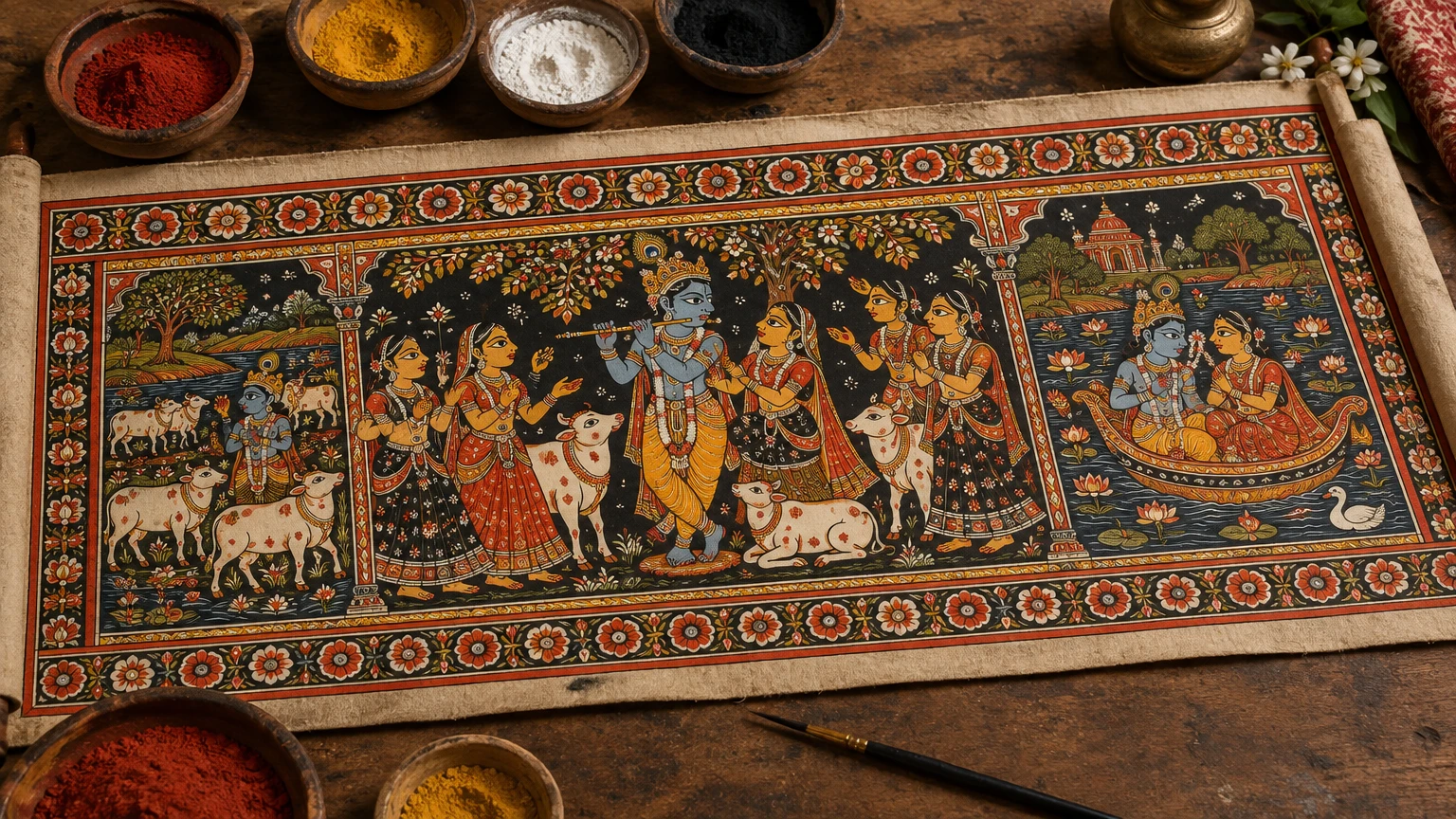
Across Odisha, a painted surface can be more than decoration. In Pattachitra, a carefully prepared cloth becomes a place where line, color, devotion, memory, and skilled labor meet. The word is commonly explained through patta, a cloth or canvas, and chitra, an image or painting. The form is associated especially with the Jagannath tradition and with artist families in and around Puri, yet it is not one frozen design. It is a living body of practice whose makers adapt formats and subjects while carrying forward recognizable techniques.
To understand Pattachitra is to look closely at how an image is made: how a support is prepared, how a border disciplines the composition, how a fine contour gives figures their character, and how color is built into a narrative. It is also to ask who makes the work, how it is used, and what changes when a ritual or household object becomes a souvenir, a commission, or a contemporary artwork. This guide brings those strands together without treating every painting, workshop, or artist as identical.
What the name tells us—and what it does not
Odisha’s official tourism description calls Pattachitra a traditional painting on cloth, with the support prepared using chalk or stone powder and tamarind-seed glue. That description gives a useful starting point: the painting is not simply color laid on any convenient fabric. The support is deliberately made to receive a controlled, durable image. The term Pattachitra is also used in public discussion for a wider family of painted and illustrated practices, and sellers may apply it loosely to objects that look “folk-inspired.” A label alone cannot establish the maker, workshop, materials, age, or ritual history of a particular object.
The name is therefore a doorway, not a certificate. Individual practitioners may use different materials, tools, sequences, and formats; these can change with the scale of the work, the buyer, the intended use, and what is locally available. An educational account should distinguish the best-documented conventions from the choices of one artist. When a maker explains a personal method, that testimony is valuable, but it should not be converted into a universal rule for the whole tradition.
Preparing the cloth: an image begins before the drawing
The official Odisha account describes a cloth canvas prepared with chalk or stone powder mixed with tamarind-seed glue. This surface preparation matters because it gives the painter a more even ground than untreated fabric. Traditionally described processes include coating the cloth and working its surface until it is suitable for painting. The aim is not mechanical smoothness for its own sake. It is a stable field on which a line can remain legible and a sequence of colors can be applied with care.
Everyday explanations sometimes reduce the preparation to a recipe: cloth, powder, glue, finished. In practice, a maker’s judgement determines how the mixture behaves, how much coating the support needs, and when it is ready for the next stage. Humidity, cloth, scale, and intended finish can all affect the work. The available official description supports the central role of a prepared cloth ground; it does not prescribe one single measurement or workshop formula for every artist.
Preparation also shapes the time and value of a painting. A small image may demand careful work well beyond its visible brushstrokes, while a large commission may require a team or several stages. The finished surface can look effortless because its preparation has been hidden. Looking at a painting with that hidden labor in mind changes the question from “How quickly was this painted?” to “What sequence of decisions made this surface possible?”
Border, composition, and the discipline of the line
Odisha’s official tourism description notes that the border is painted first, before a direct brush sketch begins. A border does more than frame the subject. It establishes an edge, sets a rhythm, and gives the image a contained space. Repeated decorative units can guide the eye around the field; a central figure or event then becomes part of a larger, ordered composition. The border is not a disposable margin. It is one of the ways the painting announces its visual language.
The drawing is generally described as direct brushwork rather than a mechanically transferred outline. A firm contour can keep a figure readable even when the composition is busy. Faces, eyes, hands, ornaments, clothing, plants, and architectural details can each be clarified through line. Viewers sometimes describe the result as “flat” because it does not imitate European linear perspective. That observation misses the point if it assumes flatness means lack of skill. A painter can use overlap, scale, pattern, contour, and placement to organize depth and attention without copying optical perspective.
Consider the contour as a kind of visual syntax. A dark line separates one form from another, marks the curve of a garment, or helps a hand remain expressive in a crowded scene. The line has to serve both the individual figure and the whole arrangement. If every detail shouted equally, the image would lose its hierarchy; if the contour were careless, the story could become difficult to follow. This balancing act is one reason close looking rewards patience.
Color: materials, choices, and the limits of a single palette
The official tourism account names materials associated with traditional colors, including lampblack, haritala, stone, and shells. These names point to a material history rather than a fixed chart of colors. Pigments can be prepared from different sources, and specific recipes vary. A modern artist may use commercially available colors, or combine contemporary and traditional materials. Such choices do not automatically make a painting inauthentic; they do, however, matter when a seller makes a precise claim about how an object was produced.
Color works structurally as well as decoratively. A saturated field can distinguish figures, garments, landscape, and ornament. Contrasts can draw attention to a face or gesture; repeated colors can connect separated parts of a scene. Black is not merely an outline, and white is not merely empty space. Each contributes to clarity and pace. The painter chooses how color behaves in relation to the line and the story, not just which colors look attractive in isolation.
Some accounts make broad claims that every traditional painting uses only natural pigments or that a particular palette has remained unchanged for centuries. Those statements need evidence tied to a specific artist, object, and period. The public sources cited here establish that certain traditional materials are associated with the practice; they do not prove that every contemporary work uses them. Buyers who care about materials should ask the maker plainly, and makers should be able to describe their own process without being forced into an invented “pure tradition” narrative.
Stories and devotional worlds
Religious, mythological, and folk themes are among the subjects identified by the Odisha tourism account. Images connected with Krishna and Jagannath are especially prominent in public descriptions of the tradition. A painting may present a deity, a scene, or a sequence of related episodes. The narrative is often carried not by a single central figure alone but by the relationships among figures, gestures, ornaments, animals, architecture, and border motifs.
Stories travel through many media: oral narration, performance, ritual, books, household images, and works made for worship or exchange. A painting can invite a viewer who already knows a story to recognize a moment, while offering a new viewer a visual entry point. The same motif may be handled differently by different artists. Variation is not a flaw to be corrected; it is part of how a living tradition remains responsive to individual hands and audiences.
Jagannath imagery deserves particular care in description. The forms associated with Jagannath, Balabhadra, and Subhadra have deep religious significance and are not simply graphic motifs detached from worship. At the same time, a commercial painting of a deity is not automatically a consecrated ritual object. Its function depends on how it was made, commissioned, used, and understood. A respectful account should avoid declaring an object sacred, ritual, or historically important without evidence from its maker or context.
How Pattachitra differs from palm-leaf illustration
Odisha also has a distinct palm-leaf illustrated practice, often discussed alongside Pattachitra because the two share narrative interests and can be associated with related artistic communities. The official state description of palm-leaf painting explains a different physical process: prepared palm strips are incised with an iron stylus, and dark pigment is rubbed into the etched lines; some works are colored. In other words, the image is built through incision and pigment in a leaf support, rather than painted with a brush on prepared cloth.
These forms can be related without being collapsed into one technique. A palm-leaf chitra-pothi may unfold as a sequence of joined or arranged leaves, depending on the object, while a cloth painting has its own support and compositional conventions. Similar stories or motifs do not make their methods interchangeable. When discussing a work, name the material and process only when they are visible or documented. If the object is not in hand, use a cautious description rather than guessing from a photograph.
The comparison is useful because it shows how artistic traditions are shaped by materials. A stylus cuts; a brush lays down a line. A leaf has grain, edges, and limits different from cloth. Each support encourages particular ways of sequencing, storing, handling, and viewing an image. A broad label such as “traditional Odisha painting” may help a visitor begin, but a more precise account respects the distinctions that artists and objects make visible.
Raghurajpur and the public story of a craft village
Tourism pages describe Raghurajpur, near Puri, as a village associated with Pattachitra and other artistic practices. Government and tourism sources present the village as a place where visitors may encounter craft and artists. Such pages are useful for orientation, but a destination description is not a complete ethnography and should not stand in for the voices of the people who live and work there. No one village represents every Pattachitra maker, and no single household can speak for all Odisha’s painting traditions.
Travel writing often turns a village into a picturesque backdrop: houses become a gallery, artists become attractions, and craft becomes a timeless spectacle. That framing can hide ordinary realities—education, work schedules, family responsibilities, changing costs, market access, and the effort involved in meeting a commission. A more careful visitor sees both the beauty of a work and the people who make decisions about its price, display, and sale. Ask before photographing a person or a work in progress, and follow a household’s wishes about where visitors may go.
Visitor information can change. Opening arrangements, access, local events, transport, and individual workshop availability are not guaranteed by a general article. Before travelling, check current official tourism guidance and confirm locally if a particular artist or demonstration matters to the trip. Do not assume that a visitor can enter every home, watch every stage, or buy directly at any time. Respectful planning is more useful than treating a craft village as a permanently open museum.
Artists, households, and changing markets
Contemporary reporting on artists in and around Raghurajpur has discussed the work behind a celebrated craft tradition, including the conditions under which some makers work. Such reporting can help readers see that cultural heritage is also labor. But a story about particular individuals at a particular time is not a census of all artists. It should not be generalized into a claim that every maker faces the same circumstances or receives the same income. Where the article makes a specific claim about a named artist, its own evidence and date matter.
Market change is not a simple opposition between “old” and “new.” Artists may work on different scales, use varied supports, respond to commissions, teach, travel, exhibit, sell through intermediaries, or collaborate with family members. Some may make small items for visitors alongside larger paintings. These choices can be economic, aesthetic, practical, or personal. A painting that adapts a familiar motif to a new format does not automatically abandon tradition; a work that looks old-fashioned is not automatically old.
The question of price is therefore more complex than comparing a small object with a large one. Time, detail, preparation, materials, scale, the artist’s reputation, and the conditions of sale can all matter. A bargain can be attractive to a buyer yet leave the maker with little return. Buyers cannot fix every structural problem through one purchase, but they can ask who made the work, whether the seller represents the artist, what the materials are, and whether the price reflects the object being offered.
What makes an object authentic?
“Authentic” is often used as if it were a simple stamp. In reality it can refer to many different things: the maker’s identity, a technique, the place of production, the materials, an object’s age, a ritual role, or a documented chain of ownership. These are separate claims. A locally made contemporary work can be authentic as the artist’s work even if it uses modern materials. A painting that copies a traditional style may not be made by a practitioner from the place a seller names. The word should be accompanied by an explanation.
One national portal listing identifies Odisha Pattachitra within its One District One Product material for the region. That is evidence of a public cultural and product association, not a complete registry of every artist or every object. A listing is not an individual certificate of origin. Similarly, recognition or a geographical label does not answer all questions about a particular painting’s age, maker, workshop, materials, or purpose. Buyers should be wary of confident provenance claims that come with no details.
Useful questions can be simple and respectful: Who painted this? Where was it made? What is the support? Which materials were used? Is the work a contemporary piece, a reproduction, or an older object? Is there a receipt, artist’s note, or other provenance information? A good seller should welcome reasonable questions. If the answer is unknown, “I don’t know” is more honest than an invented story about a royal commission or an ancient lineage.
Looking closely: a practical reading of a painting
Begin at the edges. Notice the border’s repeated forms, thickness, and relationship to the central scene. Does the frame feel symmetrical or lively? Does it lead the eye inward, or is it itself a major part of the image? Then follow the main contours. See how line separates the subject from the background, describes clothing, and marks changes in posture. Rather than asking whether a figure is realistic by modern photographic standards, ask how the line makes the figure readable and expressive.
Next, identify the main action. Which figure draws attention first, and why? Look at gaze, hand position, body direction, placement, and scale. Are there smaller scenes or figures around a central event? What information is carried by color, ornament, or repeated motifs? If you recognize a story, compare what the painting emphasizes with what you expected. If you do not recognize it, do not assume you are missing a hidden code; ask the artist or consult a reliable explanation of that specific subject.
Finally, look at the material surface. Is the support cloth, paper, palm leaf, wood, or something else? Is the finish glossy, matte, or textured? Are there signs of brushwork, incision, or printing? A photograph may conceal these distinctions, so in-person viewing can help. Still, visual inspection alone cannot establish age or authorship. Close looking gives you better questions; it does not replace provenance.
Care, display, and conservation
Care depends on the materials and the condition of the specific work. A cloth painting should not be folded casually or left in direct sunlight, dampness, or a place where it may rub against abrasive surfaces. A palm-leaf work has different vulnerabilities from cloth, and a painted object on wood or another support needs advice suited to that material. No generic online instruction can diagnose an object’s condition or prescribe a conservation treatment.
For a valuable, fragile, or inherited work, consult a qualified conservator or a museum professional familiar with the medium. Avoid household cleaning products, adhesive tape, untested varnish, and attempts to “restore” missing color. A high-gloss coating may change the look of a work and can complicate later treatment. Keep records of what is known about the object—who made it, when it was acquired, how it has been stored—and clearly label uncertain family stories as uncertain.
Display is also interpretation. A work placed in a bright public room may be seen differently from one kept in a prayer space or a private collection. If a painting depicts a deity, the owner’s understanding and intended use matter. A museum label or shop description should not prescribe worship; it should describe the object and its context accurately, while allowing religious practice to remain with the people for whom it is meaningful.
Teaching and learning without reducing the tradition to a motif
For teachers, Pattachitra offers a rich way to discuss visual storytelling, materials, pattern, and cultural context. A classroom activity should not ask students to copy sacred imagery as if it were generic decoration. Instead, begin with observation: how does a border organize a page; how can line distinguish figures; how might a story be told in a sequence of scenes? Students can invent a non-sacred story of their own, test how a limited palette affects mood, and reflect on how materials shape the result.
Students should encounter the names of artists and communities wherever reliable information is available, rather than treating the work as an anonymous “folk style.” If using images from museums or public websites, follow the source’s reproduction terms and credit the source as required. An image available online is not automatically free to copy. A short lesson can include the difference between an artist’s original work, a reproduction, an inspired exercise, and a commercial product—distinctions that help young learners respect creative labor.
Learning is strongest when it allows for questions and uncertainty. A teacher can say that an official source describes a particular preparation method, then explain that practices vary and that one page cannot represent every workshop. Students can compare cloth painting with palm-leaf etching and notice how each support shapes the image. That approach teaches both the art and a broader habit: cultural knowledge is sourced, situated, and open to careful revision.
Responsible buying and visiting
When buying, seek clear information rather than dramatic claims. Ask whether the work is hand-painted, printed, or otherwise reproduced; what support and colors were used; and who made it. If buying through a shop, ask whether the seller can identify the artist or workshop. Do not treat a low price as proof of fraud, or a high price as proof of authenticity. If an object is represented as antique, request documentation and consider an independent expert before making a consequential purchase.
When visiting artists, remember that hospitality is not the same as an obligation to perform. Ask whether a demonstration is available and whether photography is welcome. If an artist shares a process, listen without demanding a rapid performance or asking them to reveal every method. A person may decline to discuss family knowledge or may prefer not to be photographed. Respecting those boundaries is part of cultural engagement, not an inconvenience to it.
Online descriptions can help prepare for a visit, but they may be out of date. Check official current visitor information before setting out, and do not rely on old pages for opening times, access, transport, or event details. This article describes the art and points to public sources; it does not confirm that a particular artist, workshop, or village service is available today.
A living practice, not a frozen picture of the past
It is tempting to speak of a tradition as though it were complete in the past and merely repeated in the present. That language can make contemporary artists disappear. Pattachitra persists because people continue to learn, choose, adapt, make, teach, sell, worship, and interpret. Some decisions preserve a familiar form; others shift scale, subject, material, or market. Those changes are not evidence of decline by themselves. They are part of the conditions under which art is made now.
At the same time, celebrating change should not erase history or the particular knowledge held by practitioners. The careful approach is to ask what is documented, who is speaking, and what a claim actually covers. A state tourism page can explain a recognized process; an artist can describe their own work; a news feature can report on particular people; a national portal can list a product association. Each source contributes something different, and none answers every question alone.
That layered view lets us appreciate Pattachitra without turning it into either a museum relic or a marketing slogan. We can admire the patience of a contour, the order of a border, and the life of a story, while also noticing the people and choices behind the image. The painting asks us to look; a responsible account asks us to look carefully.
Sources and further reading
- Government of Odisha, “Patta Chitra” — overview of cloth preparation, border, brush sketch, colors, themes, and related applications.
- Government of Odisha, “Palm Leaf Painting” — description of the distinct palm-leaf support and etching process.
- Odisha Tourism, “Arts, Crafts & Handloom” — public overview of Odisha’s craft traditions.
- Odisha Tourism, “Raghurajpur Craft Village” — visitor-facing description of the village and its craft associations; check current information before travel.
- Incredible India, “Raghurajpur” — national tourism overview of the craft-village context.
- The Federal, reporting on Pattachitra artists in Raghurajpur — dated feature about particular artists and working conditions; its observations should not be generalized to every maker.
- National Portal of India, ODOP: Orissa Pattachitra — public product listing and regional association, not an individual certificate of provenance.
This content is a collection of ancient history,books and various articles and collection of library and news and other post ; all details may not be the same. Readers are requested to verify the information themselves. Readers are not allowed to take any disciplinary action; content is only for educational purposes. If readers do not agree about the contents, they may send a personal comment to my personal email ID: achary.purna@gmail.com
