
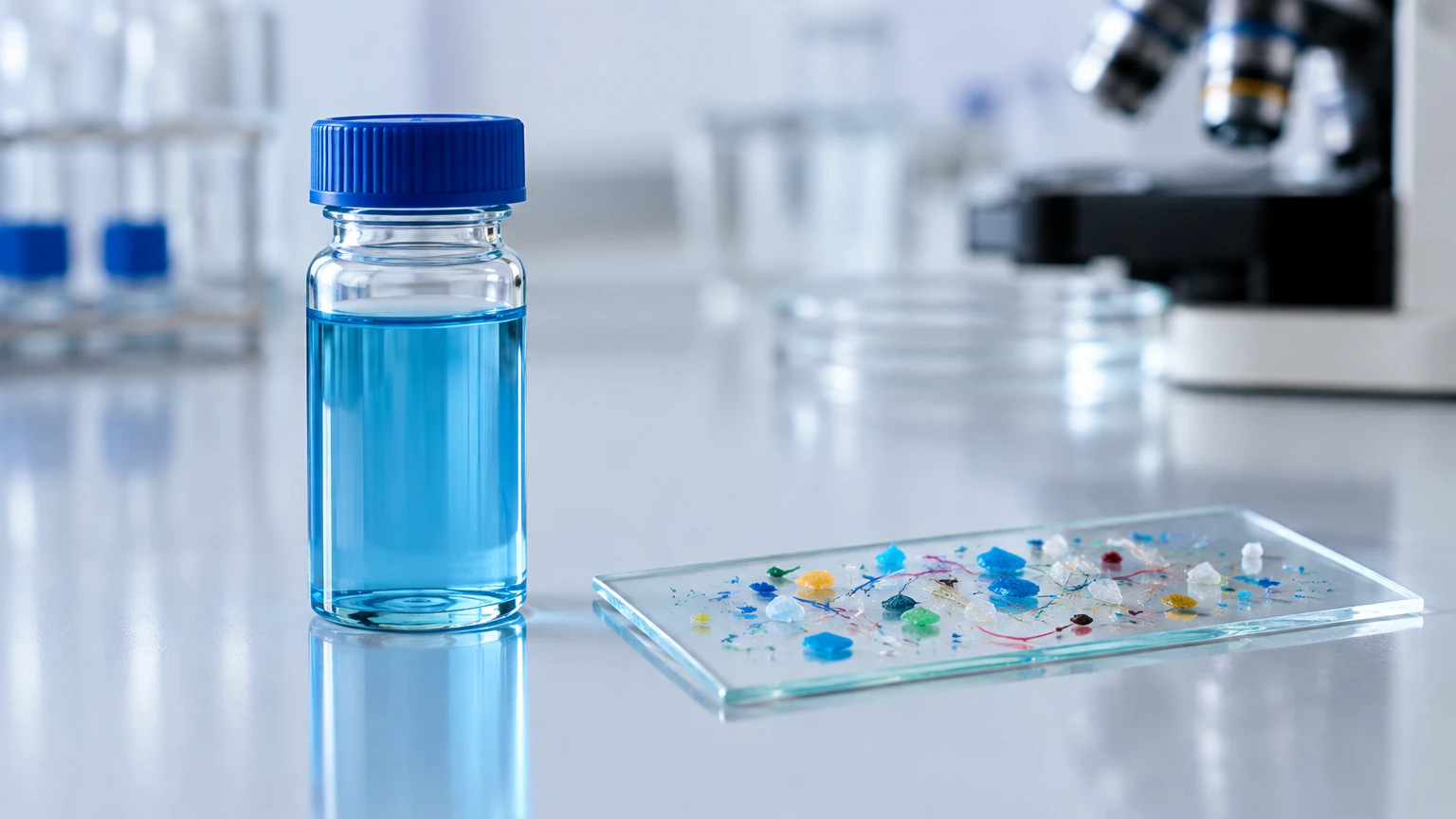
Plastic is not a single substance, and “microplastics in the body” is not one settled measurement. Researchers have reported plastic particles in some human blood, lung, placental, vascular and post-mortem organ samples. Those findings make exposure a serious research question. They do not, on their own, tell us how much of the particles a typical person carries, whether every laboratory result is reliable, or whether a detected particle caused illness. This article separates what has been detected from what remains uncertain, and explains why measurement methods matter as much as headline numbers.
Microplastics are commonly defined as plastic particles smaller than 5 millimetres; nanoplastics are smaller still, often defined in research as below 1 micrometre, although definitions vary. A particle’s size, shape, polymer, additives, weathering and surface all influence how it behaves. A fibre, a rounded bead and a nanometre-scale shard are not biologically interchangeable. Nor is the mass of a sample the same thing as a count of particles. Keeping these distinctions in view prevents a striking laboratory result from being mistaken for a complete picture of human health.
What scientists mean by microplastics
Plastic items weather, abrade and fragment. They can release small particles directly, or larger fragments can break down over time under sunlight, heat, mechanical wear and other environmental processes. “Microplastic” usually refers to particles under 5 mm, while nanoplastic terminology is less uniform across fields. Some researchers use a boundary of 1 micrometre; others use different cut-offs. The chosen boundary matters because instruments that can identify a 100-micrometre fibre may not reliably detect a particle hundreds of times smaller.
Particles also differ chemically. Common polymers include polyethylene (PE), polypropylene (PP), polyethylene terephthalate (PET), polystyrene (PS) and polyvinyl chloride (PVC). Plastic products may contain pigments, stabilizers, plasticizers and other additives; particles in the environment may also acquire coatings or attached chemicals. A measurement that identifies a polymer does not automatically identify every additive, establish where the particle came from, or show that an attached contaminant entered the body with it. Those are separate analytical questions.
It is equally important to distinguish plastic particles from chemicals associated with plastics. A study measuring polymer mass in tissue is not measuring every plastic additive, and a study of an additive is not proof that intact microplastics were present. Researchers may report a particle count, particle-size distribution, polymer mass per gram of tissue, or chemical marker. These numbers answer different questions. Comparing them without checking the method can create an illusion that one study found more exposure than another when, in fact, they measured different things.
How people may encounter particles
Potential exposure routes include inhaling airborne fibres and fragments, swallowing particles in food or water, and incidental contact with dust. Microplastics have been reported in outdoor and indoor air, soil, freshwater and oceans, and in some foods. The U.S. Food and Drug Administration notes that environmentally derived particles have been reported in foods including seafood, salt, sugar, beer, bottled water, honey, milk and tea. Finding a particle in a food sample establishes presence in that sample, not the amount absorbed by a person or a health effect.
Sources can be close to home or far away. Synthetic textiles can shed fibres during use and laundering; tyre and road wear, paint, packaging and degraded waste can contribute particles to the environment. Food may acquire particles during growth, processing, storage or preparation, and laboratory handling can add contamination if researchers do not control airborne fibres and plastic equipment. A particle found in a packaged product cannot be attributed to packaging without a suitable study that separates migration from environmental contamination and other stages of handling.
People are exposed to complex mixtures, not a standard laboratory bead. Particle size, shape, dose, duration, polymer and surface condition vary. A single dietary estimate cannot represent everyone’s diet, indoor air, workplace or local environment. Some estimates in the literature are based on limited foods and methods with uncertain recovery of small particles. Therefore, a numerical “daily intake” should be read with its assumptions and measurement range, not treated as a precise personal dose or a prediction of illness.
Skin contact is often mentioned as a possible route, but the extent to which intact particles cross healthy skin is not established in the same way as inhalation or ingestion. Exposure from personal-care products depends on the product and particle type; regulations in some jurisdictions have restricted certain intentionally added microbeads, but that does not remove all environmental exposure. A route being physically conceivable is not the same as its contribution to total human dose being quantified.
Why measuring them is difficult
There is no single instrument that counts every particle, identifies every polymer and measures all sizes in every sample. Researchers may use microscopy to see particles, spectroscopy to identify chemical signatures, or thermal methods such as pyrolysis–gas chromatography–mass spectrometry (Py-GC/MS) to estimate polymer mass. Each method has strengths and limits. Fourier-transform infrared spectroscopy and Raman microscopy can provide polymer identification for particles within their effective size ranges; smaller particles may be missed or need different methods.
Py-GC/MS heats a prepared sample and identifies characteristic breakdown products associated with selected polymers. It can quantify polymer mass, but it does not provide a simple count of each particle or necessarily distinguish microplastics from nanoplastics. Microscopy can show morphology and location but, unless paired with chemical analysis, visual appearance alone cannot prove a speck is plastic. Electron microscopy with elemental analysis can add structural and compositional clues, but the sample preparation and interpretation still matter.
Contamination control is central. Airborne fibres, plastic labware, clothing and sample containers can introduce particles during collection and processing. Strong studies use procedural blanks, background subtraction where justified, clean handling, suitable controls and transparent reporting. Researchers need to state what size range their method can detect, which polymers were tested, how many particles or how much mass was recovered, and how they dealt with blanks. If those details are missing, the result is harder to compare and may be less reliable.
Sample preparation can also change what is observable. Digestion may remove biological material while leaving particles, but chemicals or heat can affect some polymers. Filtration can exclude small particles, while a method tuned to a few polymers can miss others. A reported concentration may be a measured minimum within a specific analytical window, not a complete count of every plastic particle present. Good interpretation starts by asking: what did this method detect, what could it not detect, and how well was contamination ruled out?
What has been detected in human samples
Several small studies have reported particles or polymer signatures in human tissues. In 2021, Ragusa and colleagues examined six placentas using Raman microspectroscopy and reported 12 fragments, 5–10 micrometres in size, in four samples. The team described particles on fetal and maternal sides and in the membranes. This was an early proof-of-detection study, not a representative survey of pregnancies or evidence that particles caused a pregnancy outcome. Its small sample size and analytical scope limit what can be generalized.
In 2022, Jenner and colleagues used micro-Fourier transform infrared spectroscopy to analyse lung tissue from 13 people. They identified 39 particles in 11 samples, reporting an average of 1.42 particles per gram before background adjustment and 0.69 per gram after the reported adjustment. The method’s lower size limit was about 3 micrometres. Their finding supports inhalation and deposition as plausible exposure routes, but it does not estimate prevalence in the general population or prove that the detected particles caused respiratory disease.
Leslie and colleagues reported polymeric particles in blood from 17 of 22 healthy volunteers in a 2022 study. They used methods intended to identify and quantify several common polymers, with contamination precautions. The authors reported a mean total plastic concentration of 1.6 micrograms per millilitre among the analysed blood samples. The result raised important questions about circulation and transport, but the sample was small, the detected mass represented selected polymers and methods, and independent replication with harmonized protocols is needed before treating this as a settled population estimate.
These studies are sometimes presented together as proof that plastic is everywhere in every organ. That overstates their scope. They involve different tissues, different populations, different analytical thresholds and different units. A positive finding in one group of surgical or donated samples does not establish how common it is in people who were not sampled. Conversely, inconsistent results do not necessarily mean one team was careless: laboratories may measure different particle sizes, polymers or sample fractions.
Brain, liver and kidney findings
A 2025 Nature Medicine paper analysed post-mortem brain, liver and kidney samples using complementary methods, including Py-GC/MS, spectroscopy and electron microscopy. The investigators reported micro- and nanoplastic material in the tissues, with polyethylene prominent and brain samples showing higher concentrations than liver or kidney samples. In their decedent samples, concentrations in brain tissue were estimated to be 7–30 times those in liver or kidney, and the particles imaged in brain were largely nanoscale, shard-like fragments.
The study also compared tissue samples collected in 2016 and 2024. It reported that total plastic mass in brain and liver samples increased over that period, with the brain concentration increasing by roughly 50% in the eight-year comparison. That observation is consistent with rising environmental plastic exposure, but it is not a repeated measurement of the same people over time. Differences in sample collection, storage, population or laboratory conditions can complicate historical comparisons even when authors use careful controls.
The paper found no relationship between brain particle mass and decedent age in its dataset; it also reported higher particle presence in samples from people with dementia. Those observations do not show that microplastics caused dementia. Post-mortem tissue studies cannot establish whether exposure came before disease, whether disease altered tissue or particle handling, or whether other factors explain the association. The study is valuable because it combines detection methods and identifies a research target; it is not a diagnostic test or a population risk estimate.
When readers see a concentration reported in micrograms per gram, they should not translate it into a count of visible fragments or a percentage of the brain. Mass can be dominated by a small number of relatively large particles, while a large number of tiny particles can contribute little mass. The study’s tissue processing and instrument choices define what is counted. Further work needs independent laboratories, larger and better-characterized samples, consistent contamination controls, and methods that can distinguish particle size and polymer composition.
A cardiovascular study—and what it can and cannot say
One influential 2024 study in the New England Journal of Medicine examined carotid plaque removed from patients undergoing surgery for asymptomatic carotid artery disease. The authors enrolled 304 patients; 257 completed an average follow-up of about 34 months. Py-GC/MS detected polyethylene in plaque from 150 patients (58.4%), with a mean measured level of 21.7 micrograms per milligram of plaque among those samples. Polyvinyl chloride was detected in 31 patients (12.1%). The work also used electron microscopy and other analyses to corroborate the findings.
During follow-up, the group with detected micro- or nanoplastics in plaque had a higher rate of the study’s composite outcome—heart attack, stroke or death—than the group without detected particles. The reported hazard ratio was 4.53, with a 95% confidence interval from 2.00 to 10.27. That is an association in a selected group already undergoing carotid surgery. It is not proof that plastic particles caused the events. The participants differed in some health and risk characteristics, and observational studies cannot eliminate all confounding or determine the direction of cause and effect.
The study deserves attention because it links tissue detection with clinical follow-up and uses more than one analytical approach. But it should not be turned into a claim that microplastics make a healthy person 4.5 times more likely to have a heart attack. The hazard ratio applies to the study population and its composite endpoint, not to everyone, and the confidence interval is wide. It also does not identify which exposures or particle properties might matter biologically.
Cell and animal research offers possible mechanisms—oxidative stress, inflammation, altered cell signaling and tissue injury—but a plausible mechanism is not the same as demonstrated human causation. The NEJM authors themselves noted that the clinical relevance of experimental findings remained unknown. Larger prospective studies, better exposure measures and independent confirmation are needed to establish whether the plaque finding predicts risk beyond established cardiovascular factors.
What health effects are established?
For people, the evidence base remains developing. Laboratory experiments and animal studies report biological effects under particular doses, particle types and exposure conditions. A 2024 systematic evidence review concluded that microplastic exposure is “suspected” to harm human reproductive, digestive and respiratory health, while classifying some outcomes, including birth outcomes and gestational age, as not classifiable because the human evidence was low or very low quality. The review’s hazard categories summarize the evidence it assessed; they are not a clinical diagnosis or a personalized risk estimate.
Human studies often measure particles in tissues, compare exposure proxies, or observe health outcomes among small or selected groups. These designs can identify questions and associations, but they face challenges: exposure is difficult to quantify over time; people encounter mixtures; particle measurements vary; and factors such as smoking, occupation, diet, age, air pollution and underlying disease can influence outcomes. A detected particle may be a marker of exposure, a contributor, or neither; the study design must distinguish these possibilities.
It is useful to separate three questions. First, are particles present in a sample? Second, can they reach or affect biological systems under defined conditions? Third, does realistic human exposure cause a measurable disease outcome? A positive answer to the first question does not settle the second or third. Evidence from animal or cell experiments can help test mechanisms, but doses and particle characteristics may not match typical environmental exposure. Human association studies add relevance but still need careful causal interpretation.
Public-health agencies have therefore been cautious. WHO’s 2022 review assessed environmental exposure through food, water and air using literature available up to December 2021 and highlighted major uncertainties and research needs. The FDA says that current evidence does not demonstrate that levels detected in foods pose a human health risk, while emphasizing weaknesses in methods and data. EFSA states that it has not completed a full dietary risk assessment and cannot yet conclude on potential health effects; a new scientific opinion is scheduled for the end of 2027.
Food, water and packaging: careful distinctions
Microplastics have been measured in a range of foods and drinking water, but reported concentrations vary greatly. Differences in sampling, preparation, size cut-offs, blank correction and instrument sensitivity can produce results that are difficult to compare. FDA notes a continued lack of standardized definitions, reference materials, sample collection and preparation procedures, and appropriate quality controls. For nanoplastics, measurement is especially challenging because the particles are smaller than the reliable range of many routine methods.
The FDA distinguishes particles that reach food from the environment from migration from food-contact materials. It says there is not sufficient scientific evidence to show that micro- and nanoplastics from plastic food packaging migrate into foods and beverages, while also explaining that authorized food-contact substances are assessed for intended conditions of use and toxicological data. A report of particles in a food package’s contents alone does not identify the source. EFSA’s 2025 review of particles released from food-contact materials said migration can occur at levels much lower than some earlier estimates, while highlighting data gaps.
Presence, exposure and risk are different concepts. A contaminant’s presence establishes an analytical observation; exposure depends on how much reaches a person and by what route; risk depends on the likelihood and severity of harm at that exposure. This distinction applies to tap water, bottled water and food alike. It avoids both extremes: assuming every detection is dangerous, or assuming uncertainty proves that no problem exists.
WHO’s 2019 drinking-water review considered occurrence in tap and bottled water, possible health effects and removal during treatment. It called for better evidence and identified knowledge gaps. Later studies have expanded the literature, but differences in particle size and measurement mean that a simple bottle-versus-tap ranking is not a reliable personal health conclusion. Current research should compare like with like and report what each method can actually see.
What is sensible for an individual?
At present, public agencies do not provide a validated personal test for total microplastic burden or a proven clinical treatment to remove particles. A result from a commercial test should be interpreted cautiously unless the laboratory explains its analytical method, size range, contamination controls, target polymers and quality assurance. A measurement of one sample cannot necessarily represent a person’s lifetime exposure or determine whether they will become ill.
General steps that reduce plastic pollution—using durable products when practical, avoiding unnecessary single-use items, handling and disposing of waste responsibly, and supporting effective pollution controls—can have environmental benefits. They should not be framed as a proven way to prevent a specific disease. Practical choices depend on cost, access and context. No one should be encouraged to discard safe food or drinking water, buy an unvalidated “detox,” or make medical decisions based on a headline about particles found in tissue.
For workplace exposures, the situation can differ from ordinary environmental exposure. Certain industries handle plastic powders, fibres or fumes at higher levels. Occupational hygiene measures and applicable workplace standards are appropriate in those settings, guided by qualified safety professionals and local rules. Evidence from industrial exposure cannot automatically be applied to everyday exposure; dose and particle characteristics matter.
What better research needs to do
Progress depends on harmonized methods. Researchers need shared definitions, reference materials, size ranges and reporting standards so that one laboratory’s result can be compared with another’s. Studies should state whether they report counts, mass or both, specify the polymers and sizes measured, document sample handling and blank results, and make analytical validation available. Independent replication is especially important for claims about blood and organs, where contamination could change interpretation.
Exposure studies should measure realistic routes over time rather than rely on a single food sample or one blood draw. Cohorts need enough participants to evaluate age, occupation, diet and geography without mistaking chance patterns for biological effects. Tissue studies should include appropriate comparison groups and clinical data while protecting participants. Where possible, researchers should link measurements to outcomes in designs that establish sequence: exposure first, outcome later, with confounders measured and accounted for.
Mechanistic studies should use particles with well-characterized polymer, size, shape, surface and additive composition, at concentrations relevant to measured human exposures. A result from a high-dose experiment with a single pristine bead may not describe a weathered mixture of fibres and fragments in the environment. Conversely, realistic laboratory models can help determine whether particles cross barriers, persist, trigger inflammation or affect cells under conditions relevant to humans.
Risk assessment also needs to distinguish particle effects from chemical additives or other pollutants carried on particle surfaces. These may interact, but they are not interchangeable exposures. Better methods could allow researchers to quantify particle mass and count, identify polymer chemistry, determine size distributions and investigate biological responses in the same well-controlled study. Shared data and transparent uncertainty estimates will help agencies assess evidence without overstating what is known.
The clearest current summary
Researchers have detected plastic particles or polymer signatures in some human samples, including blood, lung, placenta, vascular plaque and post-mortem organs. These findings show that exposure and biological transport deserve serious study. They do not yet provide a complete map of how particles move through the body, a representative estimate for all people, or proof that the particles caused a particular disease. The strongest human studies are still limited by sample selection, measurement differences and the difficulty of separating association from causation.
The fairest conclusion is neither “microplastics are harmless” nor “microplastics are making everyone sick.” Human exposure is plausible and some tissue detections are supported by multiple methods; important gaps remain in exposure levels, measurement standardization and health effects. The practical scientific response is to improve testing, replicate findings, reduce plastic pollution where feasible and keep medical claims proportionate to the evidence. As agencies complete new reviews and better studies appear, conclusions should be updated rather than frozen around a single dramatic result.
Sources and further reading
- World Health Organization, Dietary and inhalation exposure to nano- and microplastic particles and potential implications for human health (2022).
- U.S. Food and Drug Administration, Microplastics and Nanoplastics in Foods.
- European Food Safety Authority, Microplastics and nanoplastics in food (reviewed 21 October 2026).
- Leslie et al., “Discovery and quantification of plastic particle pollution in human blood,” Environment International (2022), PubMed record.
- Jenner et al., “Detection of microplastics in human lung tissue using μFTIR spectroscopy,” Science of the Total Environment (2022), PubMed record.
- Ragusa et al., “Plasticenta: First evidence of microplastics in human placenta,” Environment International (2021), PubMed record.
- Marfella et al., “Microplastics and Nanoplastics in Atheromas and Cardiovascular Events,” New England Journal of Medicine (2024), article.
- Nihart et al., “Bioaccumulation of microplastics in decedent human brains,” Nature Medicine (2025), article.
- Systematic evidence review on microplastic exposure and human health (2024), full text at PubMed Central.
- World Health Organization, Microplastics in drinking-water (2019).
This content is a collection of ancient history,books and various articles and collection of library and news and other post ; all details may not be the same. Readers are requested to verify the information themselves. Readers are not allowed to take any disciplinary action; content is only for educational purposes. If readers do not agree about the contents, they may send a personal comment to my personal email ID: achary.purna@gmail.com
