
A year told in more than one language
A year can be divided by the weather station, the farming calendar, a festival cycle, a school timetable or a family’s own memories. These divisions overlap, but they are not identical. The Shad Ritu, or six-season framework, offers one traditional vocabulary for observing the year: Grishma, Varsha, Sharad, Hemanta, Shishir and Vasant. A commonly used Odia calendar table pairs these names with lunar months, while noting that more than one calendar variant is followed. Odisha’s official climate profile, by contrast, describes four meteorological seasons. Both ways of naming time are useful, provided we do not pretend they answer the same question.
The sixfold calendar invites a poem about change. Meteorological classifications help describe broad patterns in rainfall and temperature. Neither is a daily forecast. The State Disaster Management Authority notes that Odisha’s rainfall is concentrated in the southwest monsoon and distributed unevenly. The state also contains coastal plains, river basins, plateaus and uplands. A single scene cannot represent every district, and a calendar label cannot guarantee that the same weather arrives on the same date each year.
The supplied essay imagines each season as a garment worn by the land and asks the reader to travel through heat, rain, autumn light, harvest, winter quiet and spring renewal. We can keep the movement and the invitation to reflect while correcting its overconfident claims. We will not present unsupported textbook history, invented rural customs, exact weather dates, universal crop practices or unattributed poetic quotations as fact. Instead, this article treats the seasons as a literary map, grounded in public sources where possible and explicit about what remains an image.
A loom is a useful metaphor for this approach. The threads are not all the same: calendar, climate, labor, literature and local observance each have a different texture. The pattern appears when they are placed together, but no one thread can stand in for the whole cloth. To read the six seasons well is to notice the connections and keep the differences visible.
The map and its limits
A common Indian seasonal scheme names six ritu, or seasons, in a recurring sequence: Grishma, Varsha, Sharad, Hemanta, Shishir and Vasant. One Odia calendar reference pairs the months as follows: Grishma with Baisakha and Jyeshtha; Varsha with Asadha and Srabana; Sharad with Bhadraba and Aswina; Hemanta with Kartika and Margasira; Shishir with Pausa and Magha; and Basanta with Phalguna and Chaitra. This is a useful calendar convention, not a universal statement about the exact weather or agricultural stage during each pair of months. Calendar reckoning can vary, and lunar months do not line up exactly with Gregorian months.
The official state climate profile uses four practical categories: winter, hot pre-monsoon, southwest monsoon and post-monsoon. Its descriptions are designed to discuss weather and climate, not to replace the cultural vocabulary of six seasons. The two maps can be set side by side. One can ask what the calendar calls a month and separately ask what current weather records show. A difference between the systems is not an error; it reflects different purposes.
Odisha itself is not meteorologically uniform. The coast, central river plains, western districts and Eastern Ghats experience different combinations of elevation, wind, rain and local conditions. Even within a district, a field near a river may differ from a dry upland plot. An article about seasons should therefore avoid giving a single statewide temperature, flowering date or harvest time unless a suitable current source supports it.
For practical decisions—travel, farming, health or safety—readers need current local information, not just an evocative season name. A calendar can suggest when a transition is commonly expected; it cannot confirm whether a road is open, whether a crop is mature, or whether a weather warning is in force. This distinction is especially important when climate changes from year to year or unusual rainfall disrupts an expected pattern.
The six-season framework can still be deeply meaningful. It allows people to narrate a year through recurring relationships: heat followed by rain, water followed by clearer intervals, harvest and rest, then renewal. The framework makes sense as a cultural lens even when the sky declines to follow a neat schedule. Its value lies not in perfect prediction but in helping a reader notice change and ask better questions about place.
Grishma: heat, shade and preparation
The source essay opens with Grishma as a season of heat and endurance. That is a powerful literary starting point, but exact dates and regional weather should not be assumed. Official climate classifications place the hot pre-monsoon period broadly in the months before the southwest monsoon; local heat varies by region and year. A hot afternoon in a town cannot be used to describe every village, and no essay should turn an evocative image into advice about water, health or safety without current evidence.
Instead of claiming that the sun purifies the soil or destroys pests, we can describe what heat does to a narrator’s attention. Shade becomes visible as a resource. A road holds warmth after midday; a courtyard wall casts a narrow line of darkness; the pace of a walk changes when the sun is high. These are observations, not a claim that the season has one fixed intensity. The body notices heat differently according to work, age, health, housing and access to cooling. A nature poem should not romanticize discomfort as a universal spiritual lesson.
The supplied text describes farmers using a dry period to prepare fields, desilt wells and ready land. Those practices may occur in some places, but the essay provides no evidence that they are statewide or universal. The article therefore does not assign the same work calendar to every household. Agricultural practice depends on soil, water, crop, resources and local advisories. A farmer’s decisions are not simply a folk ritual fixed by the season’s name.
A careful scene can still honor preparation. Before the rains arrive, someone may check a water channel, repair a tool, arrange seed or wait for a forecast. To say “may” is not to weaken the sentence; it marks that the activity is possible and locally variable. If a particular district’s agricultural schedule is important, a current district-specific agriculture bulletin should be consulted.
Grishma offers a metaphor of concentration: attention narrows toward the next necessary task. But the metaphor belongs to the narrator. It does not prove that heat teaches the same lesson to all people. A reader who has worked outdoors may experience it differently from one who meets the season through a classroom, a commute or a shaded garden. The poem can hold those differences rather than flatten them.
Varsha: water and uncertainty
In the six-season sequence, Varsha names the rains. Odisha’s official climate account identifies the southwest monsoon as the period of most rainfall and notes that rainfall distribution is uneven. This is a more reliable frame than saying every district receives the same downpour or that a particular week marks the universal beginning of planting. Monsoon timing and rainfall matter greatly, but local conditions and annual variation must remain part of the story.
The submitted essay portrays farmers transplanting rice in water, women working together in the fields and ponds swelling after rain. Those scenes may be familiar in particular places, but they are not established as universal. A source-grounded article should not assert that all fields use one method, that all households grow the same crops, or that a single labor pattern defines Odisha. We can instead say that monsoon conditions shape agricultural decisions and that the details differ among farms and districts.
Rain changes more than the color of a landscape. It affects roads, drainage, rivers, wetlands, water supply and work schedules. The same rainfall can be welcome in one setting and disruptive in another. In urban areas, drainage and traffic may become concerns; in a rural area, rainfall may be evaluated in relation to fields or water sources. Those claims need current local evidence when they describe a specific event. The poem can reflect on the double character of rain without declaring that it is always salvation or always a hazard.
The essay links the monsoon to Ratha Yatra. The festival’s timing follows a religious calendar and may fall during the broader rainy period, but a reader should check the specific year’s date before tying a particular procession to a weather event. Public sources can establish the festival, place and calendar context; they cannot establish that the deities’ chariot was carried through rain on a particular day unless reporting for that year confirms it.
A rain-filled scene can be lyrical without inventing details: a darkening horizon, water tapping a window, the first drops leaving marks on dust. The narrator may call the scent of wet earth a memory, while avoiding claims that every person experiences the same smell or feeling. Rain is not only a metaphor for emotional release; it is also a material force that deserves accurate, local description.
Sharad: a clearing that is not a promise
Sharad is often imagined as a time of clearer skies after the monsoon. In the calendar reference, it is paired with Bhadraba and Aswina. Official climate descriptions place the post-monsoon period in October and November, while acknowledging broad regional conditions. These frameworks do not prove that the entire state becomes cool, clear or dry at one moment. A careful essay says that a break in clouds or a bright afternoon can be noticed, not that every day of Sharad follows a single pattern.
The supplied text describes white clouds, dew, flowering grasses, ponds and rice fields. A specific plant identification or bloom period should be supported by a botanical source, and a crop stage depends on local conditions. Without that evidence, the article can retain a landscape image while avoiding exact species names. A riverbank can be described as a place of light and water, not as proof that the same flower lines every river in Odisha.
Sharad is also associated in public sources with festivals such as Durga Puja, which the Government of Odisha lists in September–October and describes through particular local celebrations, including Cuttack. Kumar Purnima is another observance discussed in Odisha Review sources. These examples should be presented as named cultural events, not as customs shared identically by every household. A source’s description of one city or district is not evidence about every community.
The aesthetic of a clear sky can support a reflection on attention. When rain clouds part, a person may see more of the horizon; that experience can become a metaphor for a moment of clarity. It should not be framed as a claim about the psychological effect of autumn weather or as a doctrine taught to all Odia children. The meaning is offered, not imposed.
The strongest picture is often particular: a wet lane in one neighborhood, a view of a river from one embankment, or a festival pandal in a named town. Specificity invites the reader into a real place. If the writer cannot identify the location or verify the claim, a general phrase such as “the narrator imagines” keeps the scene honest.
Hemanta: ripening, work and restraint
Hemanta is often paired with Kartika and Margasira in the common calendar table. It is frequently translated as late autumn or pre-winter, but neither term guarantees a particular temperature or harvest date across Odisha. The state climate profile’s four-season scheme gives a separate framework for weather; local conditions still matter. This is why the six-season poem can speak of the feeling of ripening without claiming that every field is ready at the same time.
The supplied essay depicts harvest sheaves, threshing floors and granaries. These images evoke agricultural work, but the article should not present them as universal customs or as evidence about an entire decade. Farm methods differ; crop calendars vary; some details require local documentation. Here, harvest is approached as a sequence of work and decisions rather than a picturesque tableau. The visible crop may be only one part of a wider process that includes labor, weather, storage, transport and market conditions.
The original text links Hemanta to Nuakhai, Lakshmi Puja and Prathamastami as if all fit neatly into one statewide period. That requires more precision. Nuakhai is an important regional observance, especially in western Odisha, and its timing is tied to a particular calendar date. Other observances likewise have distinct schedules and local forms. A broad season label should not be used to assign a festival to every community or to imply one universal ritual. For exact claims, consult the relevant official or community sources for the event and year.
Harvest can become a metaphor for effort, gratitude or humility. Those interpretations are meaningful, but no metaphor should turn into a promise that patience always yields reward. Farmers face uncertainty and unequal conditions. A respectful article acknowledges the work without using the field merely as a moral example.
The season’s meaning may be less “abundance” than “accounting.” What has grown? What remains at risk? What work has been done? What must be stored, sold, shared or planted next? These are questions a writer can pose without claiming to know the answer for every household. The calendar marks a transition; people decide how to meet it in their own circumstances.
Shishir: cold, shelter and the wetland
Shishir is often translated as winter and paired in one common Odia calendar table with Pausa and Magha. The official climate profile identifies winter as December through February, but conditions differ from the coast to upland areas. The phrase “winter in Odisha” does not describe a single temperature or a guaranteed frost. Any claim about snowfall, frost, cold injury or local minimum temperature needs reliable meteorological evidence for a named place and time.
The submitted text presents winter as quiet rest, fireside gatherings and village theatre. These may be meaningful memories in some families, but they are not supported as universal customs. The article does not say every farmer rests after harvest, every household gathers around a fire, or Jatra is held in every rural district during winter. A specific performance event should be tied to a verified date and location. The image of quiet is a literary choice, not an ethnographic report.
Winter does offer a well-supported ecological point of attention at Chilika. Odisha Tourism’s official material describes the wetland as a winter birding destination and identifies sites including Mangalajodi. That evidence supports a discussion of seasonal birding at that location, not a claim that cranes or any other named species appear in every pond or over every village. Wildlife details should be checked against current conservation or ornithological sources and should be written with appropriate scope.
A reader visiting a wetland should respect local rules, keep a suitable distance from wildlife and follow the guidance of site authorities. These are sensible principles, but detailed access advice must be current. A general seasonal article does not establish that a route, boat service or viewing area is open on a future date.
Winter can be a useful metaphor for rest, but people’s bodies and circumstances differ. It would be inappropriate to claim that winter automatically improves mental alertness or that everyone has the safety and time to withdraw. The more modest reflection is that periods of low activity can be part of a larger cycle, and that noticing them may help a person understand their own pace. The season does not prescribe that pace for anyone else.
Vasant: spring and the return of color
Vasant, or Basanta, is commonly paired with Phalguna and Chaitra in an Odia calendar reference. The Government of Odisha describes Saraswati Puja as usually held in January–February and also calls it Vasanta Panchami, associating the observance with the end of winter and the advent of spring. The same government page describes Dola Purnima or Holi as usually celebrated in March and notes distinctive local forms in Odisha. These dates are broad descriptions; lunar-calendar dates vary by year, and the specific event should be checked before publication.
The original essay describes mango blossom, Palash, silk-cotton flowers, koel calls and a “king of seasons.” Some of those images belong to broader seasonal literature, but the article lacks a verified local botanical calendar or source for every named species and behavior. We therefore avoid treating them as universal signs of Basanta. A reader may encounter blossoms or bird calls in a particular place and year; such observations should be named as local and dated if presented as factual reporting.
Spring can be described through change without a species checklist. After cooler months, an observer may notice a longer-feeling afternoon, renewed garden work or festival preparations. Those are possible observations, not a guarantee that every district becomes warm on the same date. A flower’s appearance depends on species, habitat and weather; a season name is not a botanical source.
The festival evidence is more specific. The state page says Saraswati Puja is associated with learning and spring; Dola celebrations in rural areas can include decorated images and village gatherings, according to the same public account. Odisha Tourism describes Pancha Dola Melana in the Parikud and Malud islands near Chilika as a five-day event beginning after Dola Purnima, with deities from surrounding villages carried in decorated bimanas. This is a place-specific example, not a description of every Dola observance.
Spring is often used as a metaphor for renewal. That metaphor can be beautiful when it is offered as a personal reflection. It should not be used to imply that people must feel hopeful, that grief disappears, or that a particular ritual dissolves social barriers. The page supports a description of an event; it does not establish universal emotional or social outcomes.
A festival calendar is not a single story
The six seasons can help organize a broad cultural essay, but the state’s festival life cannot be reduced to six headings. A festival may follow a lunar date, a temple calendar, a local community’s practice or a regional event schedule. Dates can shift from year to year in the Gregorian calendar. Government pages and tourism calendars provide helpful descriptions, but each page has a scope and may use a particular date, place or promotional framing.
For Durga Puja, the Government of Odisha lists September–October and describes prominent celebrations in Cuttack. A cultural article can report those details while avoiding claims that the event is the same in every town or village. For Saraswati Puja, the government page says January–February and identifies it with Vasanta Panchami. For Dola Purnima, it describes a five-day observance, especially in rural areas, and discusses a form of Krishna worship and village processions. These statements should be attributed to that source and not transformed into a comprehensive account of all local traditions.
The official tourism calendar’s Pancha Dola Melana entry is even more geographically specific: it identifies the Parikud and Malud islands, the post-Holi timing and the procession involving surrounding villages. That is a vivid example of local cultural life. It is not evidence that all communities across Odisha have the same five-day event or route.
A good cultural essay resists words like “always,” “everyone” and “unchanged” unless the source genuinely supports them. Practices evolve, communities differ, and people within a community may interpret an observance in different ways. Festival descriptions should name the source and location, verify current dates, and be careful not to speak for participants without their account.
The submitted text sometimes describes festivals as universally dissolving social boundaries or as expressing one common philosophical lesson. Such claims may sound celebratory but are broad social conclusions that require evidence. A more grounded account can describe public rituals, processions, music, food or gatherings as a source documents them, then state that individuals may experience them differently. That nuance does not take away from joy; it respects the diversity of the people who create it.
Landscapes and the labor beneath them
The six-season story often turns to agriculture because crops make time visible. A field changes from soil to seedlings, from green growth to grain, then to stubble or preparation for another crop. Yet this is not one uniform cycle. The crop, variety, water source, land and timing differ. A seasonal essay should not claim that all farmers sow, transplant or harvest in the same month. Current local agricultural advisories are the right source for decisions about a particular crop and district.
The same caution applies to named crops such as paddy, pulses, mustard or summer fruits. Their presence may be common in some zones, but an article needs a source that establishes the relevant crop and season in the place being discussed. The submitted essay’s crop schedule and agricultural practices are not independently verified here, so they are not repeated as statewide facts.
A field is not just a backdrop for philosophical language. It is a workplace where weather risk, labor, land access, irrigation, costs and markets matter. A person can admire the color of a crop while remembering that its result is uncertain. This does not mean every literary essay must become an agricultural report; it means that a metaphor should not erase the material reality behind it.
There is also a risk of using “traditional” as a synonym for fixed or ancient. A tool, song, cooking method or farming practice may be used in some places and not others; it may have changed over time. A claim about historical continuity requires evidence. An image of bullocks, a sickle or a mud floor should not be used to imply that it represents rural Odisha in every era.
The sixfold cycle can instead invite questions. What changes in a specific village when rain begins? Which crops are cultivated in this district? How do local people describe a festival? What work happens before a harvest? Who benefits from a market? These questions open the way to real reporting. When answers are not available, the article can say what it does know and leave the rest open.
Odia literature and the need for accurate attribution
The Government of Odisha’s literary overview describes the breadth of Odia poetry, from early traditions through medieval forms and later developments. A separate Odisha Review article discusses seasonal imagery in Jayadeva’s Sanskrit Gita Govinda. These sources establish that seasons and landscape have a place in literary discussion. They do not verify every poet attribution or quotation in the submitted essay.
The original text names Upendra Bhanja and Gangadhar Meher in connection with particular seasonal themes. Without a primary poem, an authoritative edition or a reliable scholarly source confirming each attribution, this article does not claim that they wrote specific lines about the seasons described here. It also does not repeat invented quotations placed in quotation marks. A seasonal essay has no need to borrow a famous name to justify a new reflection.
A new voice can make its own images. Consider a passage written for this article: A year is not a row of doors that shut behind us. It is a path where the same creek holds different light in different months. The person walking beside it changes too; the creek does not owe them the same reflection twice. This is original prose, not a translation or folk verse. It is offered as interpretation, not as a recovered line from a textbook.
Literary traditions are diverse. A poem can use a monsoon cloud as longing, a harvest as fulfillment, or a spring breeze as desire, but those are decisions made by particular writers in particular works. It is inaccurate to say all Odia poets represented a season in one way. If a future article quotes a specific poem, it should identify the edition, translator, publication details and rights basis. An educational purpose or disclaimer does not automatically eliminate copyright restrictions.
The role of a source is not to limit imagination but to show where imagination begins. One can write a new poem inspired by rain, moonlight or a field. One can also analyze a named poet’s work. The first should be labeled original; the second should quote and attribute accurately and respect the applicable rights. These are different kinds of writing, and readers deserve to know which one they are reading.
Six seasons, six ways of paying attention
The sixfold sequence suggests a practice of attention rather than a fixed set of moral lessons. Grishma can make shade and thirst visible; Varsha can make water’s power visible; Sharad can make a clear interval visible; Hemanta can focus the eye on ripening and work; Shishir can draw attention to shelter and quiet; Vasant can invite notice of return and growth. These are literary interpretations, not universal beliefs or psychological effects established by science.
The sequence also cautions against a simplistic story of progress. One season does not simply defeat another. Heat has its own conditions; rain is both necessary and disruptive; winter is not merely an absence; spring is not an automatic cure. The land’s rhythm includes risk, unpredictability and adaptation. A story that names only beauty may miss the experiences of people facing flood, drought, heat or crop loss. Such claims require current evidence and should be treated with seriousness rather than turned into an aesthetic flourish.
The human response is not uniform either. One person may celebrate a long rain; another may be worried about a flooded route. A cool morning may offer comfort to one worker and create difficulty for someone else. The same festival may be a devotional event, a family gathering, a business opportunity, a public performance or a day of rest. The writer can observe the shared calendar while leaving room for individual experience.
A seasonal reflection can be a small exercise in humility. We see a portion of a landscape, not its entire history. We read a calendar, not the future. We may know a festival’s official description but not what each participant feels. We can make a metaphor, but it is not a fact about everyone. When writing keeps these boundaries visible, its lyric voice becomes more trustworthy.
The loom’s pattern is made from differences. A coast and a plateau are not the same; a lunar calendar and a weather classification are not the same; a government page and a family memory are not the same. But each can add a thread. A careful writer does not force them into uniformity; the writer shows how they cross and where they remain distinct.
A walk around the wheel
Imagine a reader moving through one year with a notebook. In the hottest months, they record the hour the shade reaches a wall. When the rains arrive, they note which path has become difficult and which channel is carrying water. Later, they write down the date a particular local event is announced and the source that confirms it. They do not call one field representative of the state; they name the district and the year.
As the calendar moves toward the post-monsoon months, the reader notices light on a wet road. They do not identify a plant from a distance. They ask a local source about a festival rather than assuming a custom. Near harvest, they watch from a respectful distance and avoid narrating the farmer’s thoughts. During winter, they consult a current site notice before planning a wetland visit. In spring, they describe an event in the place where it happens rather than declaring one statewide celebration.
This notebook would not be a complete climate record or ethnography. It would be a record of attention that identifies its own limits. It would note that a season label came from one calendar, that a weather statement came from a state source, that a festival description came from an official tourism page, and that a personal image was made by the writer. That modesty gives later readers the chance to check, compare and add their own observations.
The year is also a personal archive. People remember a particular flood, a relative’s cooking, a journey home, a field they crossed as a child or a festival they attended once. Those memories can be deeply true as memories without serving as evidence for a statewide claim. A writer can preserve them by naming them as personal recollection and, where appropriate, identifying who shared them and when.
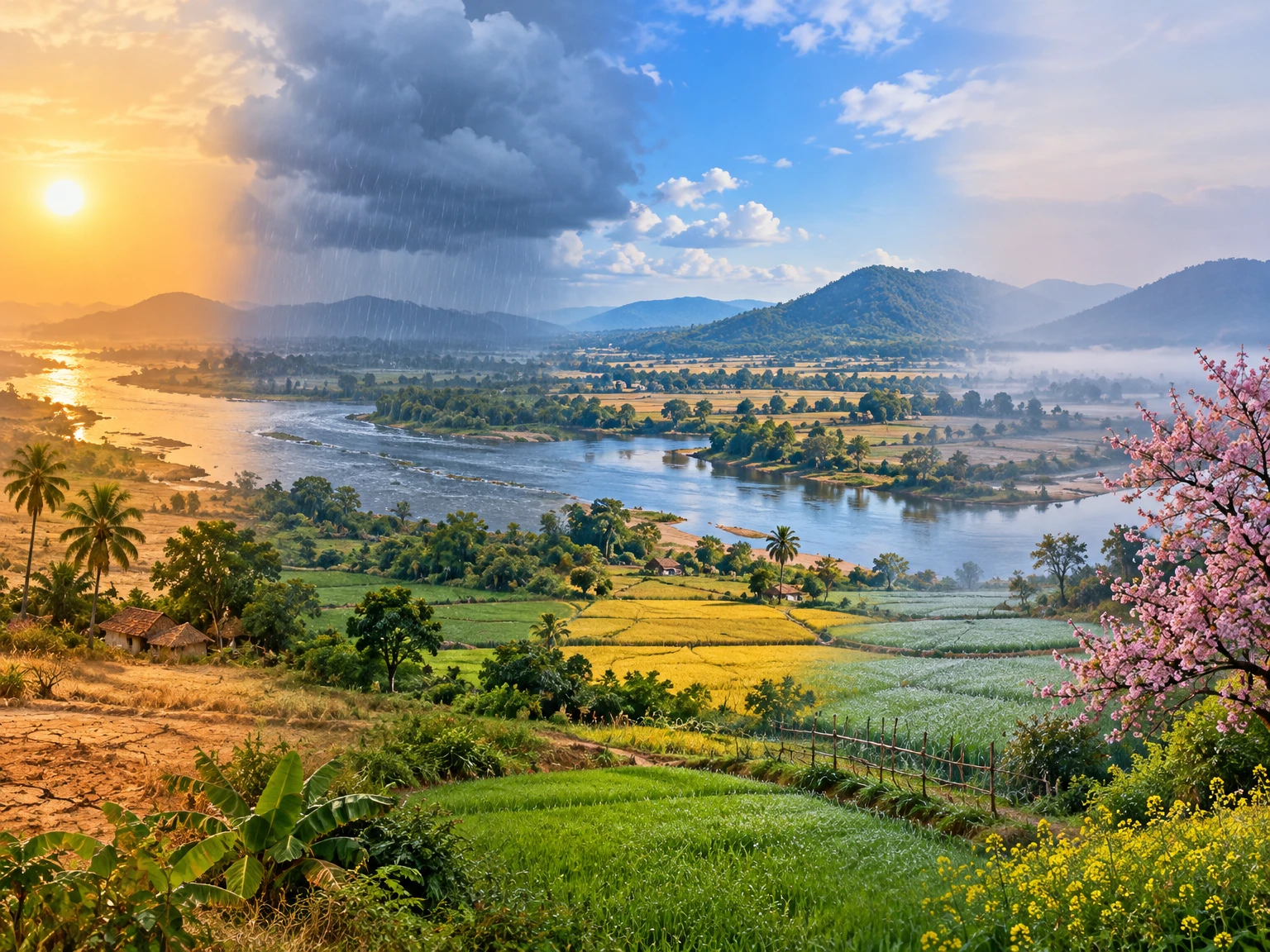
The same ethical care extends to photographs and art. A featured image can evoke a season, but it should not be presented as documentary proof of a real village or event if it is generated artwork. This article’s illustration is original and text-free; its alt text describes the composition rather than claiming a specific location or historical scene. Artwork can invite imagination without pretending to be a photograph.
The year does not owe us a perfect circle
The six seasons form a recurring sequence, but the lived year rarely feels like a perfectly measured circle. Rain can arrive late. A heat wave can extend into an expected transition. A crop can mature early or late. A festival’s Gregorian date shifts. A personal loss can make a season feel unlike any previous year. The word “cycle” is useful, but it should not imply that events repeat identically or that every change is gentle.
The State Disaster Management Authority’s emphasis on uneven rainfall is a reminder that seasonality includes variability. Weather patterns are not a promise that conditions will match an ideal calendar. It is also why people making decisions should turn to current official advisories. This article is not a weather forecast, agricultural guide, medical guide or travel-access notice.
The philosophical tone of the supplied text treats the seasons as lessons in endurance, grace, clarity, maturity, rest and renewal. We can retain these as possible readings. Heat might invite one reader to think about limits; rain might remind another of interdependence; a harvest might evoke gratitude; a winter morning might suggest quiet; spring might feel like a beginning. These are meanings people may make, not a single doctrine shared by all residents of Odisha.
A reader does not need to feel inspired by every season. Sometimes a season is inconvenient, frightening or difficult. A poem should not demand that a person turn hardship into a lesson. Nature’s beauty and nature’s force can coexist, and a person’s response can be complex. That honesty makes the seasonal wheel more human.
The year is a loom, but no one can see every thread at once. We can study a calendar, listen to weather reports, read literature, ask local people, and look carefully at a particular place. We can also admit what we do not know. The pattern becomes more reliable when each thread is named for what it is.
Closing: the song made by transitions
The six-season framework offers a generous way to think about time. It gives language to heat, rain, post-monsoon light, late-year work, winter quiet and spring return. In Odisha, these names meet a varied landscape, an official climate account that uses four meteorological seasons, calendars that can differ, and local lives too diverse for one essay to summarize.
The song of the sixfold loom is not a claim that every field, festival or family follows one unchanging rhythm. It is a way to listen for transitions. A cloud gathers; rain changes a path; light returns; a crop reaches a new stage; a wetland holds visiting birds; a public event brings people to a particular place. Each statement has its own evidence and its own scope. Each reflection has its own voice.
We can honor the supplied text’s love of nature and its wish to connect the outward world with inner thought, while refusing to repeat details that are unsupported. No claim is made that 1980s schoolbooks taught these exact lessons, that every rural household used the same tools, that named poets wrote particular seasonal lines, or that a single crop schedule governs Odisha. Those are questions for specific sources, not for plausible-sounding prose.
The final image is simple: a reader standing where a footpath meets a field, watching the sky change. The calendar offers one name for the month. The weather has its own conditions. The field belongs to people who work it. The reader’s reflection belongs to the reader. These truths can stand together without collapsing into one another.
That is how a seasonal story can be both lyrical and responsible. It can invite wonder without inventing history, celebrate culture without speaking for everyone, and use a metaphor without disguising it as fact. The seasons will turn again, but not in exactly the same way. Our task is to keep looking, keep asking, and keep the record honest.
Sources and further reading
- Odisha State Disaster Management Authority, “State Profile” (meteorological seasons, rainfall and regional variation): https://www.osdma.org/state-profile/
- Shreekhetra, “Odia Calendar” (one six-season/month convention; notes calendar variants): https://www.shreekhetra.com/oriyacalendar.html
- Government of Odisha, “Fairs & Festivals” (state festival descriptions and broad calendar placement): https://odisha.gov.in/en/explore-odisha/fairs-festivals
- Odisha Tourism, “Events & Festivals Calendar” (including place-specific Pancha Dola Melana description): https://odishatourism.gov.in/en/events
- Government of Odisha, “Literature” (overview of Odia literary traditions): https://odisha.gov.in/en/about-odisha/literature
- Odisha Review, “Rutusambhara in Sri Geetagovinda,” May 2013 (a modern discussion of seasonal imagery in a literary work): https://magazines.odisha.gov.in/Orissareview/2013/may/engpdf/23-24.pdf
- Odisha Tourism, “National Chilika Bird Festival” (winter birding and wetland context): https://odishatourism.gov.in/en/national-chilika-bird-festival
This content is a collection of ancient history,books and various articles and collection of library and news and other post ; all details may not be the same. Readers are requested to verify the information themselves. Readers are not allowed to take any disciplinary action; content is only for educational purposes. If readers do not agree about the contents, they may send a personal comment to my personal email ID: achary.purna@gmail.com
