
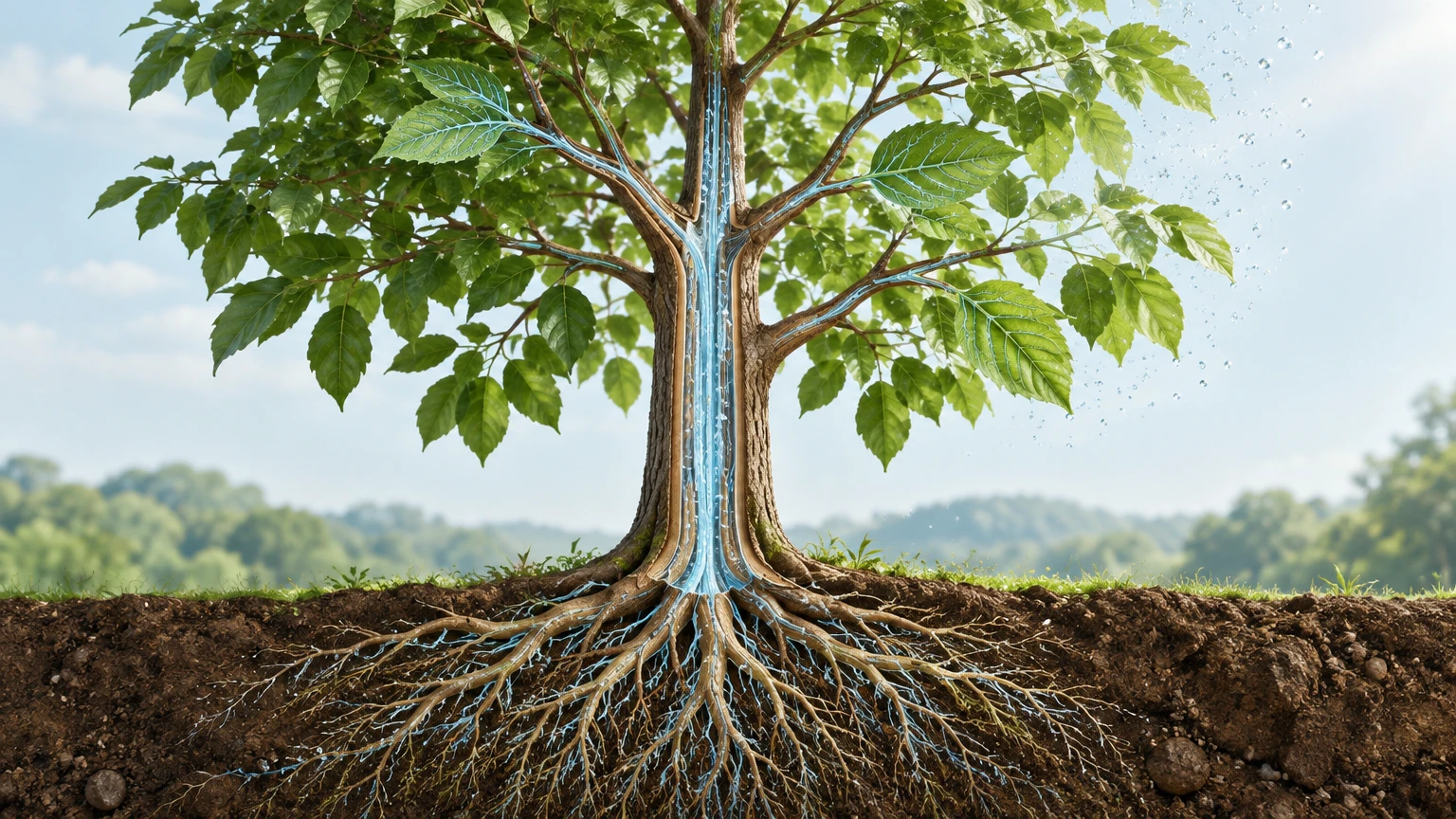
A tree can lift water from damp soil to leaves many metres above the ground, then release much of it into the air. There is no hidden pump in its trunk. Instead, water moves through a connected pathway because of differences in water potential, the pull created as water evaporates from leaves, and the unusual way water molecules cling to one another and to the walls of tiny conduits. The pathway is living at its edges, but the central pipes are mostly made of hollow, non-living cells.
This is a story of physics working through plant anatomy. It begins with water entering roots, travels through xylem in stems, and ends at microscopic pores in leaves. The details vary among species and environments, but the central mechanism helps explain how forests stay green, why plants close their pores during drought, and why a cut flower wilts. It also corrects a common image: water is not simply pushed upward from below like liquid in a household pipe. In most tall plants, the main long-distance force is generated near the top.
1. The idea that connects the whole pathway: water potential
Water potential is a way to describe how freely water can move from one place to another. It combines several influences, including dissolved substances, pressure, gravity, and the physical surfaces water touches. Water tends to move from a place where its potential is higher toward a place where its potential is lower, provided a continuous pathway exists. This is not a plant-only rule; it is a useful framework for understanding water in soils, cells, and the atmosphere.
In a well-watered plant under ordinary conditions, the pathway often runs from soil to root, through stem, into leaf, and finally toward the surrounding air. The air is usually very dry relative to the moist leaf interior, so water molecules escape from wet cell surfaces into air spaces and diffuse out through stomata. That loss lowers water potential in the leaf. The resulting gradient links leaf water to water in the xylem below it. Water molecules move into the leaf to replace what evaporated, and the tension created in the water column can draw more water upward.
The gradient is not a rigid conveyor belt with a fixed speed. Soil texture, salts, temperature, humidity, wind, sunlight, species, and the plant’s own regulation all affect it. A plant in saline soil may have difficulty taking up water even when the soil looks wet, because dissolved salts lower the soil solution’s water potential. A saturated, poorly aerated soil may also impair roots for a different reason: oxygen shortage can restrict the metabolism needed to maintain healthy root tissues. Water potential helps separate these different causes from the simple question of how much water is present.
2. The root: crossing from soil into a plant
Water first meets the plant at the fine surfaces of roots, especially young regions bearing root hairs. These microscopic extensions increase contact with soil; they do not act like tiny straws reaching deep into the ground. Water enters root cells across membranes when the conditions favour movement. The surrounding soil’s water availability and chemistry matter, as do the condition and structure of the root.
After entering, water can travel across the root by more than one route. It can pass through cell walls and spaces outside the plasma membranes, a route often called the apoplast. It can move through the interiors of cells connected by cytoplasmic channels, the symplast. It can also cross membranes repeatedly as it moves from cell to cell. These routes are not interchangeable in every respect. Cell membranes are selective barriers, and living root tissues can regulate the movement of ions and other solutes that influence water balance.
Near the centre of many roots, the endodermis forms a selective boundary around the vascular cylinder. A band of water-resistant material in its walls, known as the Casparian strip, interrupts the continuous cell-wall route. Water and dissolved substances must cross a membrane before entering the stele, where xylem and phloem are located. This helps the plant control what reaches the transport system; it is not a perfect filter that blocks every unwanted substance, and its operation differs with development and species.
Water channels called aquaporins can alter how readily some membranes conduct water. Their abundance and activity can respond to conditions, allowing roots to adjust hydraulic conductance. Such regulation adds a living, responsive layer to the pathway. Still, water entering a root does not by itself explain how water reaches the top of a tall tree. The major upward movement through most of the stem depends on the xylem and on conditions created by evaporation from leaves.
3. Xylem: a pathway built from cells that have finished living
Xylem is the plant tissue that conducts water and dissolved mineral nutrients from roots toward stems and leaves. Its conducting elements include vessel elements in many flowering plants and tracheids across a wider range of vascular plants. These cells mature into elongated conduits with thickened, lignified walls. They lose their living contents, leaving hollow spaces through which water can flow. Their reinforced walls help prevent conduits from collapsing when the water inside is under tension.
Vessel elements are joined end to end, often with openings between them, forming vessels that can conduct water efficiently. Tracheids are narrower cells with tapered ends; water passes between adjacent cells through small pits in their walls. The arrangements vary across plant groups. This diversity matters because wider or more connected pathways can carry water efficiently, while narrow pathways and certain pit structures can contribute to safety under stress. No single design is best in every environment.
Xylem is not one straight pipe from root tip to leaf. It is a network of conduits, pit membranes, branches, and connections. Water must move around dead ends, cross between cells, and navigate changing diameters. The living plant builds and maintains the tissue, but the mature conducting cells are largely passive conduits. That distinction is important: plants do not spend energy actively pumping each parcel of water through every metre of xylem, although living cells use energy for many related processes, including ion regulation, growth, repair in some contexts, and the maintenance of tissues.
The number and arrangement of xylem conduits change as a stem grows. A plant can add new conducting tissue, while older conduits may become less functional or be damaged. In trees, annual growth patterns often leave records in wood, though ring formation varies with climate and species. A trunk’s visible size is not a simple measure of the amount of water moving at that moment; conductance depends on active pathways, their dimensions, connectivity, and the current pressure and environmental conditions.
4. Leaves make the pull
Inside a leaf, water arriving through veins spreads to cells whose moist walls face microscopic air spaces. These internal surfaces provide a large area from which water can evaporate. The water vapour then moves through stomata, adjustable pores formed by pairs of guard cells, into the surrounding atmosphere. Stomata are often more abundant on the lower leaf surface in many plants, but their placement and structure vary widely.
Evaporation from those wet surfaces is the immediate event that draws water toward the leaf. As water molecules leave, the remaining liquid surface becomes curved within tiny cell-wall spaces. Surface tension at these menisci creates negative pressure, or tension, in the adjacent liquid. This tension is transmitted into the xylem water column. Because water molecules cohere to each other, a pull at the top can be transmitted down a continuous column, drawing water from the stem and roots.
Water also adheres to the hydrophilic walls of conduits and cell walls. Adhesion helps stabilize the water column and supports movement through narrow spaces, while cohesion lets molecular attraction transmit tension. These are not separate magic forces that lift water without limit: they operate in a real network where friction, pathway resistance, gravity, and the strength of conduits all matter. A plant must maintain a workable balance between moving enough water and avoiding damaging levels of tension.
Transpiration is the name for water loss from a plant, especially through stomata. It can contribute to cooling leaves as water evaporates, and it is linked to the uptake and movement of mineral nutrients. But water loss is not free. When the atmosphere is dry or the soil is depleted, continued transpiration can threaten hydration. Guard cells therefore regulate stomatal opening in response to light, carbon dioxide, internal water status, chemical signals, and other factors. Stomata balance carbon dioxide entry for photosynthesis against water loss; they do not simply open whenever a plant wants more growth.
5. Why the water column can stay continuous
The cohesion–tension explanation describes the main mechanism of water ascent in most tall plants. Cohesion refers to attraction among water molecules. Hydrogen bonding gives liquid water a degree of tensile strength: under suitable conditions, the molecules can remain connected even while the column is under pressure below atmospheric pressure. When evaporation from a leaf creates tension, that tension can be transmitted down the xylem as long as a continuous water pathway remains.
It is useful to picture a chain rather than a bucket brigade. A bucket brigade would require each cell to actively push a discrete amount upward. In the cohesion–tension model, evaporation at leaf surfaces pulls on a connected column. Water entering the roots replaces the water lost at the top, and the column flows through conduits under a gradient. The analogy has limits: real water columns occupy branching conduits, experience friction, and can break locally; plants also regulate their roots, leaves, and xylem rather than serving as passive tubes.
Capillary action is sometimes offered as a complete explanation for water climbing tall trees. Capillarity can support movement in narrow spaces, and adhesion to walls is relevant, but capillary rise alone cannot account for the heights reached by large trees. Root pressure can push water upward under some conditions, but it is generally too small or too intermittent to explain long-distance ascent in tall plants. The strong pull generated by transpiration is the central account for most daytime water movement in many vascular plants.
There are still active questions in plant hydraulics. Researchers investigate how water moves through complex xylem networks, how conduits behave under changing tension, how roots and leaves share regulation, and how plants recover after stress. Scientific confidence in the broad cohesion–tension framework does not mean that every detail is settled or that every species behaves identically. Good explanations keep both levels in view: the main mechanism is well supported, while the precise contribution of components can differ by plant and condition.
6. Gravity is a cost, not a contradiction
Water moving upward must overcome gravity. That requires a pressure difference: water potential at the destination must be sufficiently lower than at the source to support flow upward, and the pull from leaves contributes to that difference. The taller the pathway, the larger the gravitational component becomes. This is one reason tall trees face substantial hydraulic challenges and why water availability and atmospheric dryness can constrain their growth.
There is no need for the plant to cancel gravity with a single giant pump. The xylem water column is under tension, and the energy associated with evaporating water at the leaf surface helps drive movement. Solar energy warms leaves and air, while the atmosphere’s capacity to accept water vapour helps sustain evaporation. The plant harnesses environmental gradients; it does not convert sunlight directly into a mechanical pump stroke for every litre of water.
At small scales, the pathway’s details matter. Friction slows flow through narrow conduits. A branching vein network distributes water across a leaf, and the distance between veins can shape how well tissues remain supplied. The leaf’s internal surfaces, stomatal density, and air-space arrangement all affect the route from xylem to atmosphere. Even the boundary layer of relatively still air near a leaf can influence the rate at which water vapour escapes; wind can thin that layer and increase exchange, though the result also depends on humidity and stomatal response.
Because gravitational and frictional costs accumulate, a tall tree must maintain sufficient hydraulic conductance from soil to crown. Root distribution, stem anatomy, leaf area, and stomatal behaviour all contribute. Some plants shed leaves or reduce leaf area seasonally; others restrict water loss or grow where water is reliably available. The existence of tall trees does not show that gravity is irrelevant. It shows that a connected physical pathway can sustain flow when the water-potential gradient and xylem structure remain adequate.
7. Stomata: a trade-off managed in real time
Guard cells respond to environmental and internal signals that affect their shape and the opening of the pore between them. In light, many plants open stomata to take in carbon dioxide needed for photosynthesis. As carbon dioxide enters, water vapour moves outward because the air spaces inside leaves are usually more humid than the outside air. A plant must therefore make a trade-off between carbon gain and water loss. That trade-off is dynamic, not a fixed choice made once for the whole season.
When leaf water status falls, stomata may close partly or substantially. Chemical signals, including abscisic acid produced in response to water stress, can help coordinate this response. Closing pores reduces transpiration and can lower the risk that xylem tension becomes dangerous. It also limits carbon dioxide uptake, potentially reducing photosynthesis. The response may protect a plant in the short term while slowing growth, and its effectiveness depends on how rapidly conditions change and how much water remains available.
Stomata also respond to humidity, temperature, light intensity, carbon dioxide concentration, and the plant’s hydraulic status. A hot, dry afternoon can increase the evaporative demand of the atmosphere, but plants differ in how they respond. Some close stomata early; others tolerate greater water loss for longer. Even within a plant, leaves at different heights or exposures can experience different light, wind, temperature, and water supply. One leaf may therefore regulate differently from another.
Stomatal regulation is not a guarantee against drought injury. A plant that closes its stomata may still lose some water through imperfect closure or cuticular surfaces. If soil water becomes too scarce, roots may no longer supply leaves quickly enough to balance losses. Closing stomata also cannot instantly restore a disrupted xylem pathway. The regulation buys time and shifts the plant’s water budget; it is not a reset button that erases stress.
8. When conditions change: soil, air, and weather
Water movement responds to both ends of the pathway. Drying soil can lower the water potential around roots and reduce the ease with which water enters them. Compacted or damaged soil may alter root growth and aeration. Salinity can make water harder to acquire even when visible moisture is present. Conversely, heavy rain may saturate soil and reduce oxygen around roots, temporarily impairing root function. A plant’s water supply is therefore not simply the rainfall total; the condition of soil and roots affects what is accessible.
On the atmospheric side, relative humidity influences the difference between water vapour inside the leaf and in the air. Low humidity usually increases evaporative demand. Temperature affects evaporation and the capacity of air to hold water vapour. Wind changes the still-air boundary layer at a leaf and can speed exchange. These factors interact: a sunny breezy day with low humidity can draw water rapidly, but a plant may respond by closing stomata, so actual water loss does not rise in a simple straight line with wind speed.
Light influences stomatal opening and photosynthesis, while shade changes the leaf’s energy balance and often reduces the rate of evaporation. At night, stomata are frequently less open in many species, but not universally: some plants, including many succulents with crassulacean acid metabolism, take in carbon dioxide mainly at night. Some plants also show nighttime water loss through partially open stomata or other pathways. The familiar daytime pattern is common, not a rule without exceptions.
Plants integrate these signals over time. A brief midday dip in leaf water potential may be reversible, while repeated or prolonged stress can alter growth, leaf area, root allocation, and new xylem formation. Past conditions can influence current responses through development and acclimation. The same species may behave differently in a seedling, a mature tree, a shaded site, or a dry exposed slope. Observing one plant on one day cannot establish a universal water-use strategy.
9. Root pressure and guttation: a useful supporting role
Roots can sometimes generate positive pressure in xylem when ions accumulate in the vascular tissue and water follows osmotically. This is root pressure. It is most apparent under some conditions when transpiration is low and soil moisture is available. In certain plants it can push liquid water to leaf edges, where drops emerge through specialized structures called hydathodes. This process is guttation, which is different from dew condensing from the air onto a leaf surface.
Root pressure can also help explain sap exudation from cut stems in some species and circumstances. It demonstrates that roots are not merely passive entry points. Yet positive root pressure is usually not enough to account for the water ascent in tall trees, particularly when leaves are transpiring actively. Its size and occurrence vary; many plants show little conspicuous root pressure. It should be treated as one mechanism that operates in certain settings, not as the universal engine of xylem flow.
Guttation drops may contain dissolved substances, unlike relatively pure water vapour condensed as dew, but their composition depends on the plant and conditions. Seeing droplets at a leaf margin in the morning does not prove a plant has been overwatered, nor does it reveal the full state of its roots. The drops reflect a particular balance between root pressure, transpiration, and the plant’s water status at that time.
Keeping root pressure in its proper place makes the overall account stronger. Plant water transport can involve several forces and processes, but their relative importance changes across time and species. Transpiration-driven tension generally dominates long-distance movement in most tall plants, while root pressure and local osmotic effects can contribute in specific circumstances. A single simplified slogan misses this conditional picture.
10. Cavitation and embolism: what happens when a pathway breaks
Xylem water can be under substantial tension, especially during drought or high evaporative demand. If air enters a conduit or dissolved gas comes out of solution, a gas-filled space can form. The process that creates such a bubble is called cavitation; a conduit blocked by gas is described as embolized. An embolism reduces or stops water transport through that conduit, although neighbouring conduits may continue to function if the network remains connected.
Pit membranes between xylem conduits help limit the spread of air from an embolized conduit into others. Their microscopic pores and structure are important to the balance between efficient flow and resistance to embolism. Wider conduits can conduct more water under some conditions, but their design may come with vulnerabilities. Narrower conduits may be safer in some settings yet carry water less efficiently. The relationship is not a simple rule that every wide conduit fails first; anatomy and environment complicate the trade-off.
Researchers estimate vulnerability to embolism using different methods, each with assumptions and limitations. Measurements can be technically demanding, and debates continue about methods, species differences, and how laboratory observations translate to whole plants in the field. This uncertainty does not erase the phenomenon: xylem embolism is a recognized hydraulic risk. It does caution against presenting a single threshold or universal failure point as though all plants share the same response.
Plants can respond to hydraulic stress by reducing leaf area, closing stomata, producing new xylem, or changing future growth. Some studies report refilling or recovery of embolized conduits in certain conditions and species; the prevalence, mechanisms, and energetic costs are not universal or fully settled. New growth can restore conducting capacity without requiring the same old conduit to function again. The recovery story is therefore species-specific and should not be reduced to the claim that trees simply pump air bubbles out of their pipes.
11. Efficiency and safety shape plant design
Plants face a hydraulic design problem. Leaves need carbon dioxide for photosynthesis, which typically means opening stomata and accepting water loss. Roots and stems must move enough water to supply those leaves, but xylem under tension can become vulnerable to embolism. A plant that transports water efficiently may support fast growth under favourable conditions; a plant that prioritizes safety may conserve water or maintain function through harsher periods. These are tendencies, not fixed categories that neatly divide every species.
Leaf size, vein density, stomatal behaviour, root depth, and xylem anatomy interact. A plant in a dry habitat may have small or thick leaves, a reduced exposed surface, or stomata that regulate tightly. Another may rely on deep roots or seasonal growth. A plant growing beside a stream can maintain a different balance from one on a rocky slope. These traits reflect both inherited biology and local conditions, and they can vary within populations.
Evolution does not design a plant for perfect performance under every condition. It shapes traits that work well enough across the conditions a lineage encounters, while trade-offs remain. A plant can be vulnerable to an exceptional drought even if it is well suited to its usual climate. A species may grow rapidly in wet years and suffer in prolonged dry periods. Climate change can alter the frequency or intensity of conditions that were once unusual, exposing limits in hydraulic strategies.
Comparing species therefore requires context. A measurement of water transport in seedlings in a laboratory may not describe a mature tree in a forest. A drought response seen in a controlled chamber may differ when roots explore a deep soil profile or when neighbouring plants compete. Scientists combine anatomy, measurements, experiments, and field observation to build an account. Public explanations should convey the core principles without pretending that one leaf or tree represents all plants.
12. Water transport and the minerals plants need
Water moving through xylem carries dissolved mineral nutrients taken up from soil, including ions that plants need in small or larger amounts. This is one reason the water pathway matters to growth beyond hydration. Roots acquire mineral elements through selective uptake processes; xylem then transports many of them toward shoots. The exact form, mobility, and redistribution of each nutrient vary. Some nutrients can also be moved through phloem, the tissue that transports sugars and other substances, so not every nutrient’s journey is exclusively upward in xylem.
The flow of water can influence how quickly nutrients reach growing tissues, but more water is not automatically better. Excessive leaching can wash soluble nutrients out of soil, while waterlogging can impair root function. A deficiency may arise from low nutrient supply, unsuitable soil chemistry, damaged roots, or other constraints. Leaf colour alone is not a reliable diagnosis because different problems can produce similar symptoms. Gardening advice should be based on the plant, site, and evidence rather than assuming that wilting means a simple need for more water.
Water movement also relates to photosynthesis indirectly. Leaves need water to maintain cell turgor and provide the medium for biochemical processes, while stomatal opening allows carbon dioxide entry. Under drought, stomatal closure can limit carbon assimilation; severe dehydration can affect cell function and damage tissues. A plant’s productivity is consequently linked to hydraulic supply, but growth depends on many factors, including light, temperature, nutrients, and developmental stage.
Understanding the xylem–phloem distinction helps prevent another misconception. Xylem mostly carries water and mineral nutrients from roots toward shoots, driven largely by transpiration-related tension. Phloem distributes products of photosynthesis and other transported compounds from sources to sinks; its movement is governed by different mechanisms and can occur in directions that vary among pathways. Both systems are connected to the plant’s living tissues, but they do not perform the same job.
13. Seasonal strategies and the cut-flower lesson
Plants adjust water transport over daily and seasonal cycles. Some deciduous trees drop leaves when temperatures or water availability make maintaining them costly. Evergreen species retain leaves but may still reduce growth or alter stomatal conductance during stress. Annual plants complete much of their life cycle within a season; perennials invest in structures that persist. These different life histories shape how plants encounter water, but none means that the plant stops responding to short-term weather.
A wilting houseplant or cut flower offers a visible demonstration of the link between water supply and leaf condition. When cells lose water, they lose turgor pressure, and leaves or stems may droop. A cut stem can still take up water through its xylem, but air entry, microbial growth, or blockage can reduce flow. Recutting a stem under clean conditions and keeping the vase water fresh can help some cut flowers, though species and handling differ. This practical example is not a perfect miniature of a living rooted plant: the cut flower has lost its root system and much of its regulatory capacity.
Watering should respond to the plant and its growing conditions rather than a universal calendar. A pot may dry quickly in sun and wind, while another stays moist longer. Drainage, pot size, root health, species, and season all affect how often water is needed. Constantly saturated soil can deprive roots of oxygen; allowing some plants to dry between watering can be appropriate, while others need consistently moist conditions. A basic observation of soil moisture and the plant’s requirements is more useful than treating every wilt as proof of thirst.
Plants may close stomata before visible wilting begins. Conversely, leaves can wilt for reasons other than dry soil, including root damage, disease, heat, or a disrupted water pathway. It is wise to check the growing medium and conditions before adding water. More water cannot repair a dead root system, and a wet pot does not guarantee that functional xylem is delivering water to every leaf.
14. How scientists study an invisible flow
Plant hydraulics is difficult to observe because the movement occurs inside tissues, often under tension, and changes with the weather. Researchers measure water potential, sap flow, stomatal conductance, leaf gas exchange, and xylem vulnerability using specialized instruments. Each measurement captures a part of the process. A sensor on a tree trunk may estimate flow through a portion of the stem, while a leaf measurement reflects conditions at one location and moment. Interpretation depends on calibration and experimental design.
Scientists also examine anatomy, including conduit size, pit structure, vein networks, and the arrangement of tissues. Imaging techniques can reveal water pathways or embolism under certain conditions, but methods differ in resolution and potential artifacts. Field studies add realism but make it harder to isolate causes. Laboratory experiments control conditions but may simplify the root environment or plant age. Combining methods helps researchers avoid treating a single proxy as a complete picture of water transport.
Models can connect measurements across scales, from a leaf’s water loss to a tree’s hydraulic status or a forest’s response to drought. Models are useful tools, not direct observations. Their results depend on assumptions about soil, roots, weather, species traits, and physiological response. When models forecast risks, the limits and uncertainty should be stated. A precise number from a model does not become a certainty simply because it is expressed with decimal places.
Public science can preserve this distinction without becoming evasive. We can confidently say that transpiration-driven tension is central to long-distance water transport in most tall plants. We can also say that plants differ, that drought responses involve trade-offs, and that details such as embolism recovery are still actively studied. A clear account should neither exaggerate uncertainty about well-established principles nor hide uncertainty where evidence is still developing.
15. A few useful thought experiments
Imagine a leafy branch in a clear container of water. If the leaves lose water to the air, the branch may continue to draw water upward through its cut stem. Covering the leaves with a transparent bag can reduce the immediate vapour loss by trapping humid air around them. This changes the atmospheric side of the pathway and may reduce the pull. The demonstration is not a full model of a rooted tree, but it helps show how leaf water loss can influence water movement below.
Now compare a plant in humid air with one in dry air, holding other factors as similar as possible. The dry air generally creates greater evaporative demand. A plant may respond with increased water loss if stomata remain open, or it may close them and reduce both transpiration and carbon dioxide intake. The result depends on plant responses rather than the air alone. This is why plant water use cannot be predicted from humidity without considering the species and its current condition.
Finally, consider a wet soil after heavy rain. The presence of water does not guarantee that roots can take it up effectively if the soil lacks air, if roots are damaged, or if salts lower water potential. A plant can wilt in soil that appears moist because the relevant question is not only whether water exists, but whether it is available to the root and can move through a functioning pathway. Water potential makes that distinction easier to understand.
These thought experiments encourage a systems view. The soil, root, xylem, leaf, and atmosphere form one connected pathway, but each segment can limit flow. The plant manages the pathway through anatomy and physiology, while weather and soil set boundary conditions. A change at one point can affect the rest: stomatal closure alters leaf water loss, drought alters soil supply, and embolism changes the conductance of xylem.
16. Common myths, carefully corrected
“Roots pump water all the way to the crown” is an incomplete account. Roots can contribute positive root pressure, but transpiration-driven tension is generally the principal explanation for long-distance water ascent in most tall plants. “Capillary action lifts water to any height” is also incomplete: capillarity matters at small scales, but by itself it cannot explain the height and flow rates of large trees. “The trunk is a living pump” misrepresents mature xylem conduits, which are largely hollow, non-living cells; living tissues regulate and build the system, but do not actively pump every water molecule upward.
“A plant that closes its stomata stops losing water” is too absolute. Closure can greatly reduce water loss, but some loss may continue, and the plant may incur costs through reduced carbon dioxide uptake. “All embolisms are repaired by the same process” is unsupported. Some species and contexts show recovery or refilling, while other plants rely on new xylem or tolerate loss of individual conduits; the mechanisms and their importance remain active research areas.
“More water always helps a wilting plant” can be harmful. If the soil is already saturated or roots are compromised, additional water may worsen conditions. “Every plant uses water in the same way” ignores the extraordinary diversity of vascular plants and the environments they occupy. A useful explanation names the dominant general pattern and then identifies where conditions, species, and evidence change the story.
These corrections are not merely technical. They influence how people care for plants, interpret drought, and understand forest resilience. A plant’s water relations are shaped by its surroundings and its internal design. Observing a symptom matters, but diagnosing its cause requires context and sometimes expert assessment.
17. Why the subject matters beyond a single plant
At ecosystem scales, plant water use affects exchanges of water and energy between land and atmosphere. Forests, grasslands, crops, and wetlands differ in how much water they intercept, store, transpire, and return to the air. These exchanges can influence local climate and the water cycle, but they are not controlled by vegetation alone; soils, topography, weather, and human land use also matter. A claim about one tree’s water use should not be casually generalized to a whole watershed.
Drought can challenge forests through several connected pathways. Soil water declines, atmospheric demand may rise, and xylem tension can intensify. Stomata may close, slowing photosynthesis; prolonged stress can reduce growth, cause tissue damage, or contribute to mortality, especially when combined with pests, disease, heat, or fire. Different species and individuals respond differently, and some plants recover after stress while others do not. Forest response is a matter of both physiology and ecology.
Understanding hydraulic traits helps researchers compare species and assess how changing climates could alter vegetation. It does not produce a simple ranking of which species will survive future conditions. Predictions need to account for temperature, precipitation patterns, soil, competition, fire, disturbance, and the possibility of acclimation or migration. Current research can inform conservation planning, but site-specific decisions require local evidence and professional expertise.
Water transport also matters in agriculture and horticulture. Crop varieties may be selected for water-use traits, irrigation schedules depend on soil and weather, and plant health can influence yield. Efficient irrigation is not only about applying less water; it is about matching water delivery to crop needs, soil capacity, and local conditions. An understanding of stomata and xylem provides useful foundations, but it does not replace agricultural advice tailored to a particular crop and region.
18. The journey in one connected picture
Begin with soil water entering a root. It crosses living tissues and selective barriers, then enters xylem conduits. Within stems and leaf veins, water moves through a branching network. At leaf surfaces, evaporation creates tension; cohesion helps transmit that pull through the water column. Water replaces what was lost, while stomata regulate the rate of loss in response to the plant’s needs and its environment. Gravity, friction, anatomy, and soil conditions all shape how much water can move.
The plant’s task is not to eliminate water loss, but to manage it. It needs water to maintain tissues and transport nutrients; it also needs open stomata to acquire carbon dioxide for photosynthesis. Under stress, conserving water can protect the hydraulic pathway but limit carbon gain. If tensions become too great, cavitation and embolism may reduce transport through some conduits. Plants vary in their capacity to avoid, tolerate, or recover from such damage.
This is why a tree’s quiet water movement is both a physical process and a biological strategy. The atmosphere supplies the demand, the leaf creates the pull, the xylem provides a pathway, and roots connect that pathway to soil. The system is robust because it is distributed and adaptable, yet it has limits. When we say a tree “drinks,” we are compressing a more interesting story: water rises through a living organism largely because evaporation at the leaves draws on a continuous column through wood.
For readers who want to explore further, reliable starting points include OpenStax Biology’s overview of water and solute transport in plants; the US Congressional Research Service’s educational report on plant transport and related physiology; reviews of aquaporins and root water movement in physiological journals; and research on xylem embolism and recovery. These sources present the general mechanism alongside the continuing scientific questions about how different plants manage hydraulic stress.
Further reading
- OpenStax Biology: Transport of Water and Solutes in Plants
- Plant aquaporins and water transport: review in Physiological Reviews
- Review of xylem embolism and hydraulic safety in plants
- Research review on xylem embolism and recovery in plants
This content is a collection of ancient history,books and various articles and collection of library and news and other post ; all details may not be the same. Readers are requested to verify the information themselves. Readers are not allowed to take any disciplinary action; content is only for educational purposes. If readers do not agree about the contents, they may send a personal comment to my personal email ID: achary.purna@gmail.com
