
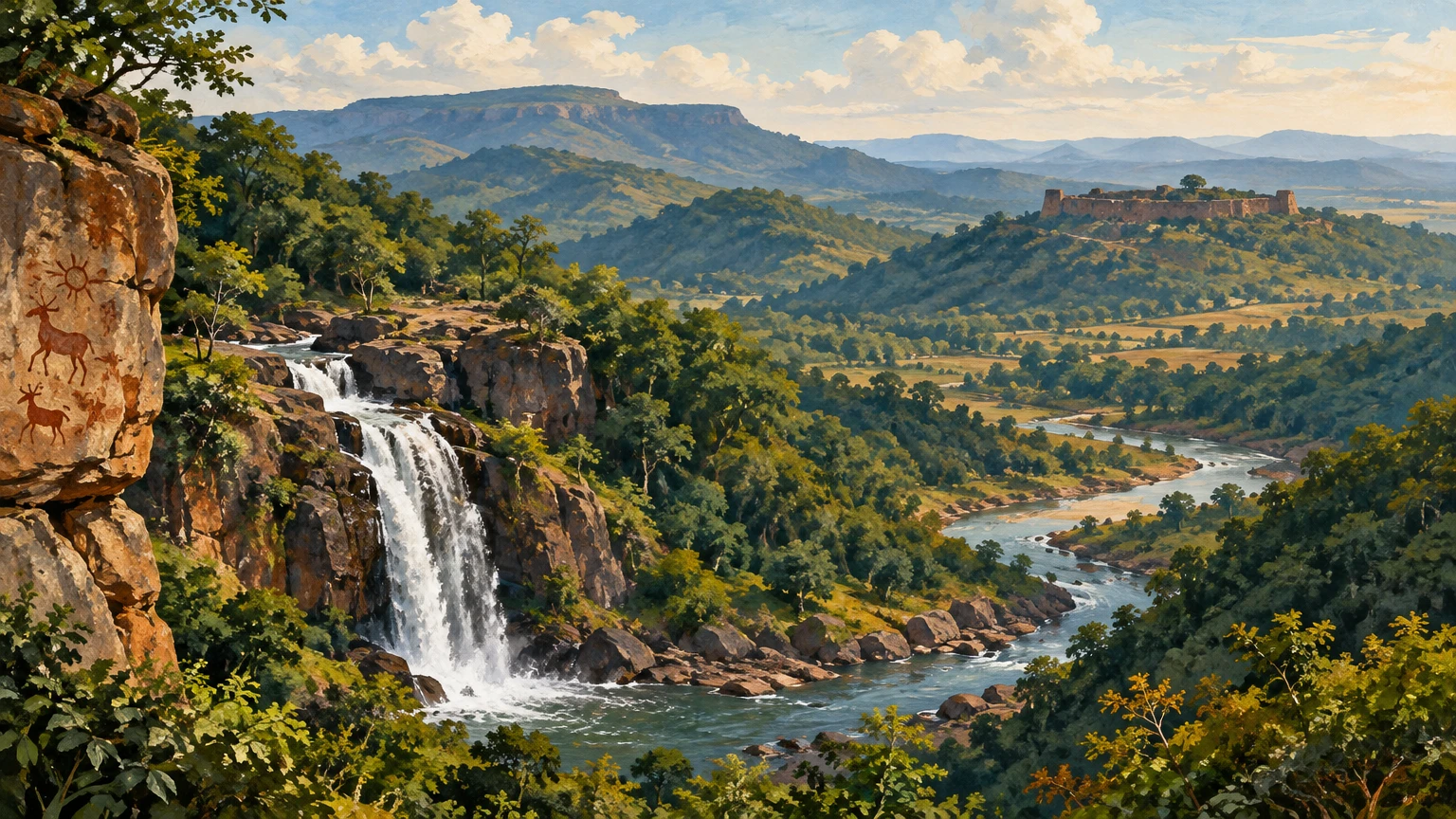
Kalahandi rewards a slower kind of travel. Its landscapes shift from cultivated valleys and river confluences to Eastern Ghats uplands, forested ravines and rock shelters carrying marks of deep antiquity. Bhawanipatna, the district headquarters, is the practical base, but the district’s character lies beyond town: in the sound of Ghumura drums, the ritual gravity of Maa Manikeswari, the archaeological questions of Asurgarh, and the wet-season force of streams descending through stone.
This is not a place to reduce to one old stereotype. Kalahandi’s modern life is shaped by farming, forest-based livelihoods, markets, public institutions, migration, roads and the Upper Indravati irrigation-and-power landscape. For a visitor, that complexity matters. Travel here with time, local curiosity and a willingness to verify conditions rather than expecting every heritage site or waterfall to function like a packaged attraction.
District Overview & Geography
Kalahandi lies in southwestern Odisha and covers 7,920 square kilometres, according to the district administration’s profile. Bhawanipatna is its headquarters. Administratively, the district has 13 blocks and 13 tehsils; the official 2011 Census figure records a population of 1,576,869. That is a historical census count, not a present-day estimate.
The land is part of a transition zone between the western Odisha plains and the hill systems associated with the Eastern Ghats. Broad agricultural stretches, undulating plateaus, isolated hill ranges, seasonal streams and wooded slopes produce distinctly different travel experiences within a single district. The northern and central areas connect more readily to the Tel and Mahanadi drainage systems, while the southern and eastern uplands form part of the wider Indravati landscape. Rivers and tributary streams are not merely scenery: they shape settlement, cultivation, old routeways and the locations of shrines and archaeological mounds.
The Tel River is especially important to Kalahandi’s cultural geography. At Belkhandi, it meets the Uttei, creating a riverine setting for a temple-and-archaeology stop. Elsewhere, the Sandul is closely associated with the fortified archaeological landscape of Asurgarh. In the district’s southern sphere, the Upper Indravati system has transformed irrigation and energy infrastructure. These are working river basins, subject to monsoon variation and changing water levels; visitors should never assume that a riverbank, ford, cascade or pool is safe simply because photographs show calm water.
The climate follows the familiar rhythm of inland Odisha but is shaped by elevation and local relief. Summers can be intensely hot and dry, while the monsoon changes the colour and movement of the countryside, replenishing streams and sharpening the presence of waterfalls. Winter is usually the most comfortable period for longer road journeys, heritage visits and village walks. The post-monsoon months are often visually rewarding, though rain-damaged roads, slippery rock and sudden water releases remain possible. Check current weather and local advisories before setting out.
Forest is central to the district’s ecological identity. The official wildlife listing identifies the Karlapat Wildlife Sanctuary as a notified area of 193.998 square kilometres under a notification dated 1 May 2023. It records species including leopard, gaur, sambar, nilgai and barking deer. These are habitat records, not promises of sightings. Forest travel should mean observation from permitted areas, quiet behaviour and respect for staff instructions, not pursuit of wildlife or off-road exploration.
Agriculture remains visible everywhere in the settled landscape. The district profile notes rice and cotton among important crops, while forest produce and industry also contribute to livelihoods. Markets, roadside eateries and village courtyards show how ecology and food are tied together: seasonal greens, grains, lentils, forest foods and bamboo-shoot preparations belong to everyday kitchens, not to a tourist performance.
Mythological & Historical Significance
Kalahandi’s sacred history is lived as much through practice as through monuments. In Bhawanipatna, Maa Manikeswari is the presiding goddess around whom devotion, civic identity and annual ritual converge. The district tourism page identifies the temple as the city’s principal attraction. Visitors should enter as guests in an active place of worship: dress modestly, follow the temple’s current rules, avoid obstructing devotees and ask before photographing people or rituals.
The annual Chhatar Yatra is among the most prominent expressions of this devotion. On 19 October 2026, OMMCOM News reported that the procession in Bhawanipatna concluded with substantial public participation and traffic management arrangements. This was a report on a completed 2026 event, not a confirmation of the future date of any next edition. Festival schedules, access arrangements and temple customs should always be checked locally before travel.
The district’s historical narrative is layered and should be read with care. The official history page says that the present district was reconstituted in 1949 after the separation of Patna and Sonepur, with Bhawanipatna as headquarters. Kashipur separated in 1962 and Nuapada in 1993. The same official material draws on the 1980 district Gazetteer for evidence of early human activity and stone tools. Such evidence supports the long human presence of this region; it does not turn every local tale or unexcavated ruin into a fixed historical fact.
Asurgarh, near Narla, is the most important place to understand this distinction. It is a centrally protected site, protected since 1981, with a fortified settlement landscape near the Sandul River. Archaeologist Dibishada Brajasundar Garnayak’s report on the Archaeological Survey of India’s 2018–19 excavation records structural remains, beads, coins and evidence linked to Iron Age and early-historic occupation. The published excavation study offers a serious basis for appreciating the site’s antiquity and material culture. Its chronological interpretation remains part of ongoing archaeological discussion; it is not proof of a final claim that Asurgarh was Odisha’s earliest city.
Gudahandi offers another, very different encounter with antiquity. The hills and caves near Khaligarh contain pictographic paintings in red and black. The Odisha government’s overview of painting traditions includes Gudahandi and Yogimatha among the state’s rock-art locations and explains the broad use of mineral pigments and animal, human and geometric motifs in such traditions. The images are precious precisely because they are not fully reducible to an easy story. Claims that they are a decipherable script or direct evidence of the Indus civilisation are speculative and should not be presented as established scholarship.
Belkhandi adds a medieval religious and sculptural layer. At the Tel–Uttei confluence, the official district directory notes standing temples and excavated remains associated with twelfth-century monuments, including images of the Saptamatrikas and Uma-Maheswara. The setting encourages an attentive visit: look at the relationship between shrine, sculpture, river and settlement rather than treating the site as a quick photographic stop.
Junagarh, the old capital of the former Kalahandi state, retains the memory of fortification, temples and inscriptions. It is not interchangeable with Bhawanipatna. The historic capital’s built fabric and Maa Lankeswari’s religious importance make it a useful companion to a Bhawanipatna-based itinerary. Read inscriptions and sculptural fragments with humility: many are damaged, relocated or interpreted through local memory as well as scholarship.
Kalahandi’s cultural inheritance is also performed. The district’s culture and heritage page identifies Ghumura dance as a major living tradition, performed in contexts including Nuakhai and Dussehra. The deep drum, movement and group formation are not simply “entertainment”; they carry local identity, social memory and community skill. If a performance is encountered, watch without stepping into the space of performers, and seek permission before recording.
Tourist Destinations & Hidden Gems
Begin in Bhawanipatna, where the Maa Manikeswari temple provides a clear introduction to Kalahandi’s devotional heart. The town also has markets, transport connections and accommodation options that make it the logical base for several day journeys. Give the temple enough time to experience it as a living shrine rather than a landmark. On major ritual days, expect crowds, altered traffic and restrictions shaped by local administration and temple practice.
Phurlijharan is one of Kalahandi’s best-known waterfall stops. The district tourism directory places it near Bhawanipatna and associates it with the Karlapat landscape. A small fall can be most appealing not for scale but for its cool, shaded setting and the contrast it offers to the dry-season roads outside. The surrounding sanctuary context calls for restraint: do not play loud music, leave litter, feed animals or enter water without local confirmation that conditions are safe. During and immediately after heavy rain, wet rock and strong currents can make an apparently simple visit hazardous.
Karlapat is more than a waterfall backdrop. The Wildlife Odisha unit listing records leopard, gaur, sambar, nilgai and barking deer within the sanctuary’s documented fauna. Odisha Tourism also identifies elephant, mouse deer, sloth bear, green avadavat, Malabar trogon and great-eared nightjar in its broader Karlapat description. Wildlife distributions change, sightings are uncertain and visitor access can be regulated. Use official entry procedures, remain on allowed routes and treat a visit as habitat observation, not a checklist exercise.
Rabandhara, close to Bhawanipatna, is a gentler nature option when conditions permit. Odisha Tourism’s Rabandhara page describes a landscape of forest, streams, waterfall views and the Pengsur reservoir. The same source places the eco-tourism destination roughly ten kilometres from Bhawanipatna. This is a useful place to slow down and observe the dry-deciduous setting, but no promotional description substitutes for same-day information on road condition, permitted trails or weather. Avoid swimming in unfamiliar pools and do not approach reservoir edges without local guidance.
Dokarichanchara, at the Kalahandi–Nabarangpur boundary, combines waterfalls, rocky terrain and the wider Gudahandi cultural landscape. The boundary matters: it is a Kalahandi destination in official tourism material, but it is not an isolated private wilderness. The district’s places-of-interest directory names Dokaridhara and Bhanyaraghumara falls and notes Gudahandi’s proximity. Because access roads and forest conditions can change, this is best attempted with a realistic daylight plan and locally verified directions.
Gudahandi itself is the district’s essential hidden gem, not because it is unknown, but because it asks visitors to look rather than consume. The rock shelters are fragile cultural surfaces. Never touch paintings, add marks, use flash near them, scrape pigment or climb over vulnerable rock. Take a local guide where available, and accept if a route is closed or access is restricted. Rock art has survived because it has not been treated as a casual backdrop.
Ampani is valued for its upland scenery and proximity to Gudahandi. The district directory describes the hills and the Haladigundi valley, while older tourism text makes wildlife claims that should be treated cautiously. Travel there for the changing contours of hill country, cultivated clearings and long views, not for assured animal encounters. In the rains, this terrain is especially beautiful but demands extra care on bends, culverts and unpaved stretches.
Thuamul Rampur lies in the highland zone and is often described as a gateway to Kalahandi’s more elevated terrain. Odisha Tourism places it around 700 metres above sea level and notes its ancient Maa Manikeswari shrine and a viewpoint called Hello Point. Elevation does not guarantee cold weather, and descriptions of past snowfall should not be turned into a travel promise. The value of the route is its gradual change from town to plateau, with local settlements, farms and forest edges revealing a distinct side of the district.
Belkhandi should be visited for its layered setting rather than rushed as a temple tick-box. Here the confluence of the Tel and Uttei makes landscape part of the experience. Examine sculptural details respectfully, keep away from river currents and avoid entering the water. For those interested in art history, the site is a useful reminder that Kalahandi’s heritage includes both excavated fragments and continuing worship.
Asurgarh needs a different pace. The mound, moat-like terrain and archaeological traces do not always look dramatic to an unprepared visitor, yet the place is one of the district’s strongest invitations to historical imagination. Go with a map, daylight and respect for protected-site rules. Do not dig, remove pottery fragments or climb on exposed masonry. The most meaningful souvenir is an informed understanding of how excavation changes what can be known about an ancient settlement.
Other official-directory places, including Mohangiri and older fort remains near Amathguda, can enrich a longer journey, but they require particularly careful verification. Historic references in a tourism directory do not guarantee a maintained approach road, interpretation board, accommodation or unrestricted entry. Ask local residents and relevant authorities before setting out, and do not pressure communities to facilitate access to sacred, private or ecologically sensitive places.
Kalahandi’s crafts deserve attention alongside its landscapes. The district handicraft page records woodwork, terracotta, stone carving and bamboo craft. Buy directly from makers or reputable local outlets when possible, ask about the work and avoid bargaining in ways that diminish skilled labour. Crafts are not generic “tribal souvenirs”; they are material knowledge shaped by available resources, belief, use and markets.
Recent News & Tourism Developments
The most significant recent public cultural event was the 2026 Maa Manikeswari Chhatar Yatra. OMMCOM News reported on 19 October 2026 that the procession concluded in Bhawanipatna after arrangements for crowds and traffic. For travellers, the meaningful conclusion is practical as well as cultural: major religious occasions can offer a powerful view of public devotion, but they also bring congestion, altered movement and restrictions. Plan only with confirmed local information, and never treat a ritual as a spectacle to be pushed through for photographs.
On 23 September 2026, the Odisha government stated that the High Level Clearance Authority had approved Leaomax Textile Pvt Ltd’s proposed composite textile mill in Kalahandi, with proposed investment of ₹1,200 crore and potential employment of 2,700 people. The Chief Minister’s official release is clear about the status: this was an approved proposal. It should not be described as a completed mill, operating factory or realised employment figure.
Energy infrastructure is another important current development. On 27 July 2026, OHPC announced that it had issued an engineering, procurement and construction Letter of Intent for a proposed 600 MW Upper Indravati Pumped Storage Project at Ranibahal in Kalahandi. The OHPC announcement describes four 150 MW units. This planned pumped-storage project is distinct from the existing operational 600 MW Upper Indravati hydroelectric scheme. A Letter of Intent marks a development stage; it is not evidence that the new project is built, commissioned or producing power.
These developments matter to tourism because they alter the context in which landscapes are viewed. A district is not a museum. Its rivers, forests, roads and towns are also spaces of livelihood, infrastructure and public debate. Responsible travel means avoiding claims that all change is either automatically destructive or automatically beneficial, and listening to local information about access, traffic and environmental conditions.
No separately verified district-specific tourism infrastructure opening after the October 2026 Chhatar Yatra was identified in the sources reviewed for this edition. Dated background material should not be promoted as fresh news. Visitors should use official tourism and district channels for current notices rather than relying on older directory pages.
Traveler Essentials
Bhawanipatna is the most practical arrival and overnight base. The official district travel page names Bhawanipatna, Kesinga and Junagarh Road as railheads, and identifies road links through NH-26. It also lists Bhubaneswar, Raipur and Visakhapatnam among airport approaches. Because official directory information can age and transport schedules change, confirm current train, bus and flight connections through operators before booking. Do not assume a particular service frequency from an old tourism page.
By road, Bhawanipatna can be approached from the Odisha interior, Raipur side or southern Odisha routes, but journey times vary with weather, works and the exact destination. A private vehicle or locally arranged transport can make sense for dispersed sites such as Belkhandi, Karlapat, Ampani or Gudahandi, yet travellers should avoid night driving on unfamiliar hill or forest roads. Carry water, a charged phone, offline maps and sufficient time to return before dark. The district’s how-to-reach guide is a geographic starting point, not a live timetable. Independently confirm trains, buses and flights for the date of travel, and ask locally about road works, vehicle access and the safest stopping places. Older tourism pages can remain online after conditions change, so a listed route does not guarantee a current service or an open site.
Treat an excursion as a round trip with time for the return, not a race between map pins. Hill and forest roads may take longer than their distance suggests, especially in rain or where surfaces are uneven. Share your broad plan with someone local when heading to less-visited places, keep enough daylight for the drive back and avoid setting out for a remote waterfall late in the day. Do not assume that a mobile signal, fuel stop or repair service will be available at every point; plan conservatively without treating any online listing as a guarantee.
At protected or ecologically sensitive places, check permission and local guidance before entering. Karlapat is a wildlife sanctuary, not an open-air zoo; use only allowed routes and keep distance from animals. At Gudahandi’s rock shelters, fragile paintings merit special care: do not touch, trace, wet or illuminate them with a flash. At Asurgarh, protected archaeological remains should be left exactly where they are. If a route is closed, a site is under ritual use, or local staff advise against entry, change the plan rather than trying to bypass the restriction.
A small day bag is more useful than elaborate equipment: water, sun protection, a light rain layer in uncertain weather, sturdy footwear and a charged phone with offline directions. Pack out every wrapper and bottle. Ask before photographing people, craftwork or worship, and buy crafts respectfully from makers or known local outlets. These choices make a modest visit more welcome and help keep fragile sites and everyday community spaces from becoming disposable backdrops.
October to March is generally the most comfortable broad window for cultural touring and longer drives. The monsoon offers lush scenery and stronger waterfalls but brings real risks: slippery surfaces, flash flows, landslides or local road disruption. Summer can be punishingly hot. Whatever the season, dress for sun, dust and sudden rain, use sturdy footwear, and never stand beneath unstable rock faces or enter a waterfall pool merely because others are doing so.
Food is best approached with curiosity and humility. In Bhawanipatna and roadside settlements, seek simple local meals: rice, dal, seasonal vegetable preparations and regional snacks. Odisha Tourism’s Bhawanipatna guide highlights bamboo-shoot dishes such as kardi bhaja and hanua tarkari, as well as sun-dried lentil dumpling curries. Availability is seasonal and varies by household or eatery. Ask what is freshly prepared, state dietary needs plainly and avoid demanding ingredients that are not locally available.
Festival travel requires additional care. Ask whether photography is appropriate before raising a phone or camera. Keep clear of processions and temple queues. Do not photograph offerings, sacred interiors, children or artisans at work without consent. Discussions around ritual can be sensitive; report what is publicly documented and avoid intrusive questions.
Ecological responsibility is equally basic. Carry reusable water bottles, take all rubbish back to town, avoid single-use plastics, keep noise low and do not collect plants, stones, feathers, artefacts or rock fragments. Wildlife should be watched from a distance. Do not use drones near sanctuaries, temples or gatherings unless all required permissions have been obtained. Swimming, boating and cliff-edge viewpoints should be treated as conditional activities requiring local safety confirmation, not default tourist rights.
Finally, build the itinerary around fewer places and better attention. One unhurried day in Bhawanipatna and one or two carefully planned excursions can reveal more than a rushed circuit of waterfalls and shrines. Kalahandi’s appeal lies in the conversation between river and plateau, archive and memory, ritual and daily work. The best visitor is one who leaves with clearer questions, lighter footprints and a deeper respect for the communities who make this landscape home.
Featured illustration: Original AI-generated illustrative art created for this article; it evokes Kalahandi’s forested hills, waterfall and river valley and is not a documentary photograph. Alt text: “Forested hills, a waterfall and river valley with an ancient fort silhouette in Kalahandi.”
Publishing Metadata & Tagging
- Group: Odisha Tourism
- Section/Category: Society And Culture
- Destination: https://pcachary.in
- District: Kalahandi
- Edition: 2026-11-01
- Cycle: 1
- Tags: Odisha Tourism; Kalahandi; Society And Culture
Disclaimer
This content is a collection of ancient history,books and various articles and collection of library and news and other post ; all details may not be the same. Readers are requested to verify the information themselves. Readers are not allowed to take any disciplinary action; content is only for educational purposes. If readers do not agree about the contents, they may send a personal comment to my personal email ID: achary.purna@gmail.com
