
District Overview & Geography
Jajpur is a district where Odisha’s historical layers remain unusually close together: a living Shakta shrine in the district town, the ritual banks of the Baitarani, brick Buddhist monasteries on low hills, cultivated plains, and the industrial landscape of Kalinganagar and Sukinda. It is not a museum district, nor merely an industrial one. Its appeal lies in the way worship, agriculture, archaeology, crafts and contemporary work continue alongside one another.
The modern administrative district was formed on 1 April 1993. The district administration’s profile records an area of 2,887.69 square kilometres and a 2011 Census population of 1,826,275; the latter is a historical census figure, not a present population estimate. The district has one administrative subdivision centred on Jajpur; the town is the natural starting point for Biraja Kshetra and the Baitarani’s ceremonial ghats. The Buddhist sites lie farther from town among low hills and village landscapes, where road distances and conditions matter more than a straight-line map.
Geography helps explain the district’s varied character. The Baitarani is the river most deeply embedded in Jajpur’s sacred vocabulary. Elsewhere, the district’s streams and distributaries shape an alluvial farming country, while Sukinda’s more undulating terrain is associated with mineral activity in the district’s own profile. These are not merely scenic contrasts: waterways, cultivated land and extraction areas are working landscapes whose boundaries and access deserve respect. Rainfall arrives chiefly with the southwest monsoon; the months before it can be hot and humid, and the wet season can make country roads, riverbanks and waterfall approaches slippery or temporarily difficult. Winter and the early cool season are generally more comfortable for unhurried archaeological walks.
The terrain is not an invitation to treat every riverbank or wooded rise as a recreation ground. Seasonal water levels, erosion, mining-related traffic and local land use all demand caution. In the Sukinda belt, chromite and other mineral activity are part of the district’s economic geography; visitors should stay on public routes, respect security controls and never assume access to industrial or extraction areas. In the plains, rice fields, homesteads, ponds and roadside groves form the more intimate scenery. Farming remains central to local life, even where major industrial development is visible on the horizon.
Jajpur’s forests and hill vegetation are best approached with restraint rather than a checklist of wildlife promises. Official tourism material identifies Ashokjhar as a scenic waterfall in Sukinda Block, but does not establish a visitor wildlife inventory or guarantee year-round conditions. Trees, scrub, agricultural edges and seasonal watercourses support ordinary rural biodiversity, yet travellers should not enter protected, leased or restricted land in search of animals or photographs. Carry drinking water, avoid disposable plastic, and give village paths, grazing animals and working fields the same respect one would offer at a monument.
Odisha Tourism recommends October to March as a broad visiting window for Jajpur. That is sound guidance for heat-sensitive travellers, but it is not a substitute for weather checks. The monsoon has its own beauty in the green countryside, though it is less suited to squeezing several sites into one day. A measured itinerary gives time for the contrast that defines Jajpur: morning temple bells and river ritual, afternoon stone gateways and quiet monastic courtyards, and roads that pass between agricultural settlements and the infrastructure of a changing economy.
Mythological & Historical Significance
Jajpur’s sacred identity is older in local memory than in securely dated political history. The town is widely known as Viraja or Biraja Kshetra and as Navigaya, a place associated with ancestral rites on the Baitarani. The district’s heritage page notes that pilgrims come to offer shraddha by the river. For families undertaking these rites, this is an active ritual landscape, not a picturesque backdrop. Visitors who are not participating should remain discreet, avoid intrusive photography and ask before recording people or ceremonies.
Religious tradition links Biraja with the Shakta imagination of the subcontinent. The association of the shrine with a Shakti Peetha, including the belief that a part of Sati’s body fell here, is a matter of faith. It should not be converted into an archaeological date or a verifiable event. The same distinction matters for narratives around the Mahabharata, Puranic references and the celebrated Daswasamedha Ghat. They reveal how generations have understood this landscape; they are not interchangeable with epigraphic proof.
The Biraja Temple page describes the present temple as a 13th-century construction and draws attention to its exceptional image of the goddess: a two-armed Viraja/Durga subduing the buffalo form of Mahishasura with a spear while holding its tail. That iconography gives the shrine a visual identity distinct from many familiar multi-armed Durga images. Odisha Tourism likewise presents the temple as a major living Shakta centre and records the local tradition of the goddess’s chariot festival during Dussehra. Festival observances and dates should always be checked locally for the intended year; ritual timetables can change.
The historical story becomes more documentable in the early medieval period, when eastern Odisha was shaped by changing dynasties and religious institutions. Jajpur is associated in official narratives with the Bhaumakara and Somavamsi periods, while the popular account that King Jajati Keshari established an ancient capital belongs to a mixture of local tradition and historical interpretation. It must not be confused with the entirely separate, documented establishment of the present district in 1993. A careful visitor can hold both ideas at once: the town’s ancient prestige is real, while the chronology of its remembered founders is more complex than a single origin story.
Buddhism is indispensable to that complexity. Ratnagiri and Udayagiri show that Jajpur was not only a Hindu sacred centre. These monastic landscapes preserve evidence of Buddhist learning, artistic production and devotional practice over many centuries. Odisha Tourism dates Ratnagiri broadly from the 5th to the 13th centuries CE and describes it as a centre of Mahayana and Vajrayana Buddhism. At Udayagiri, the stated span is broadly the 7th to 12th centuries CE. Such ranges are more useful than forcing every structure into a single date: monastic complexes were occupied, repaired and reshaped over time.
The idea of Pushpagiri adds a productive uncertainty. Langudi hills in Jajpur are associated with Buddhist remains, and some writers have proposed a connection with the Pushpagiri referred to in Chinese accounts. That identification remains debated, not settled fact. The Odisha Review discussion is best read as an interpretive contribution rather than a final verdict. Travellers should also avoid assuming that archaeological interest means open visitor access at every hill or excavation area.
Recent epigraphic work demonstrates why cautious language matters. In a report on its activities for November 2025, the Archaeological Survey of India’s Directorate of Epigraphy said that its staff copied 32 stone inscriptions at Ratnagiri. One highlighted Sanskrit inscription, in Nagari script and dated to the 9th century CE, records Karanda’s repair of a relic stupa and the construction of a monastery, stepped well and pavilion. The ASI report documents epigraphic copying, not a new 2026 excavation and not a complete history of the complex. Even so, it offers a striking glimpse of maintenance, patronage and monastic infrastructure in the site’s own historical world.
Jajpur’s cultural history also survives in domestic art rather than stone alone. The district heritage account describes traditions of Jhoti, Chita and Muruja: rice-paste and coloured-powder designs made for ritual and seasonal observance, especially in contexts linked with Lakshmi worship. These are living practices with local variation, not a decorative performance owed to visitors. When seen in a household or village setting, they should be appreciated as expressions of welcome, devotion and skill, not handled, stepped on or demanded for a photograph.
Tourist Destinations & Hidden Gems
Biraja Temple is the essential first encounter with Jajpur’s religious life. The complex is not simply an “ancient site”; it is a working temple whose rhythms are set by worshippers, priests and ritual obligations. Look closely at the distinctive goddess image described by the official district tourism page, then widen attention to the architecture, subsidiary spaces and the flow of devotees. Dress modestly, follow any temple rules on mobile phones and cameras, and do not presume that every area is open to every visitor. Rather than treating the shrine as a stop between monuments, allow time to understand why Biraja remains the district’s spiritual anchor.
Daswasamedha Ghat and the Baitarani extend that sacred geography beyond the temple walls. The district heritage page associates Jajpur with Navigaya and ancestral offerings on the riverbank. These ceremonies carry personal and family significance. Watch quietly from an appropriate distance if a ritual is under way, and never enter the water on the assumption that a ghat is a safe bathing place. River conditions alter with weather and current; ritual importance is not a safety certification.
Ratnagiri is Jajpur’s great archaeological encounter. Its name, often interpreted as “hill of jewels,” suits the experience of moving through a site where brick, stone carving and devotional objects disclose the scale of an old monastic community. Odisha Tourism describes monasteries, elaborate sculptural entrances, panels and a notable concentration of votive stupas. The site is associated with Mahayana and Vajrayana Buddhism, but it rewards more than a quick search for labels. Notice the relationship between residential quadrangles, shrines, gateways and elevations in the ground. These are traces of organised life: study, worship, patronage, repair and movement through carefully made spaces.
The ASI site museum on Ratnagiri’s northern crest is identified by the Jajpur tourist directory. If it is open during a visit, it can help turn fragmentary architecture into a more legible artistic world. Confirm current access, photography rules, entry procedures and opening arrangements before travelling. Do not climb on masonry, touch sculptures or remove even a small fragment; the restraint required at a protected site is part of what keeps it meaningful for future readers of its history.
Udayagiri complements Ratnagiri without duplicating it. Odisha Tourism identifies two principal monastic establishments here: Simhaprastha Mahavihara and Madhavapura Mahavihara. The Udayagiri page describes stupas, shrines and terraced structures, and notes systematic excavation from 1985. Its spread across a hill setting makes it especially useful for understanding monastic planning in relation to landscape. Walk slowly, read signage where available, and keep to authorised routes. Heritage photography is most responsible when it does not require crossing barriers, standing on old brickwork or turning a religious image into a prop.
Together, Ratnagiri and Udayagiri form two Jajpur components of the Buddhist circuit often called Odisha’s Diamond Triangle. A third major site, Lalitagiri, is commonly included in the same travel circuit, but travellers should be precise about the boundary: Odisha Tourism places Lalitagiri in Mahanga, Kataka, which is Cuttack district. It may be a sensible onward visit, yet it should not be described as a Jajpur monument. This small geographical accuracy improves any understanding of the region.
Langudi hills deserve a similarly careful approach. Odisha Tourism’s Jajpur destination page mentions Buddhist remains at Langudi, but neither archaeological interest nor a contested Pushpagiri theory establishes unrestricted access, marked trails or visitor amenities. Ask locally and consult current official information before planning a stop. It is better to leave a place unseen than to trespass across agricultural, private, protected or excavation land.
Chandikhole offers another strand of Jajpur’s religious terrain. The district directory lists the Chandi shrine at Chandikhole, named for the goddess worshipped there in local tradition. It can be paired with other temples only if travel time allows; do not reduce it to a roadside pause. As at Biraja, etiquette comes before sightseeing. A respectful visitor may find the most memorable details in the sound of bells, flower sellers, offerings and the ordinary movement of worshippers rather than in a hurried attempt to document every surface.
Ashokjhar Waterfall, in Sukinda Block, is a scenic counterpoint to the temple-and-monastery circuit. The district directory places it about eight kilometres from the Sukinda block headquarters, a static planning note rather than a real-time navigation guarantee. Seasonal flow, road condition, local permissions and safety can vary. Do not swim beneath falls, climb wet rock or visit after heavy rain without reliable local guidance. Ashokjhar should be approached as a seasonal landscape where caution matters more than dramatic photographs.
Jajpur town itself rewards an observant walk between major stops. The heritage page lists Baraha, Jagannath and Trilochaneswar among its religious monuments. Their value lies in the continuity of local worship and the layered sculptural language of the region, not in an invented claim that each is untouched or uniquely ancient. Ask residents or temple caretakers about respectful visiting practice, keep footwear rules in mind and avoid making claims about provenance beyond what official or archaeological sources establish.
There are no “secret” sites to chase in Jajpur. The district’s quieter pleasures are public, ethical ones: early light along an authorised river approach, conversations at a tea stall, the geometry of a Jhoti in a threshold space when invited to see it, the change from riverine plain to low hill, and the patience required to study a carved Buddhist doorway. Those moments are more durable than a checklist.
Recent News & Tourism Developments
Among the recent developments confirmed in sources checked on 24 October is an industrial one rather than a new tourism project. On 14 October 2026, the Chief Minister of Odisha announced the inauguration of new plants of Jindal Stainless Limited and Indian Metals & Ferro Alloys Limited at Kalinganagar, Jajpur. The Chief Minister’s official report identifies this as an inauguration; it should not be inflated into a claim that every proposed Kalinganagar investment is complete, or that specific employment outcomes are established.
For visitors, the news is a reminder that Jajpur is a working district, not an isolated heritage zone. Industrial roads may carry heavy vehicles, access can be controlled and photography restrictions may apply near facilities. Tourism writing should not turn active workplaces into attractions without permission. It is more useful to understand Kalinganagar as part of the present-day economic setting through which a traveller passes en route to older sacred and archaeological landscapes.
In heritage research, the November 2025 ASI epigraphy report remains the most specific dated update identified for Ratnagiri. Its documentation of 32 copied inscriptions, including the Karanda record, adds evidence to the scholarly record but does not announce a newly opened monument, new visitor facility or completed tourism project. This distinction is important: research activity is not automatically tourism development.
The sources checked for this article confirm named heritage sites and the 14 October Kalinganagar plant inauguration, but do not establish a current visitor facility or completed tourism-infrastructure project. That is a limit of the material reviewed, not proof that no such work exists. Treat older directory distances and online hours as planning leads only, then check current details with the relevant temple authority, ASI office, tourism office or local administration shortly before departure.
The ASI’s 2025 epigraphy report shows why different kinds of evidence should be read side by side. Its ninth-century inscription records Karanda’s repair of a relic stupa and construction of a monastery, stepped well and pavilion. This documents one patron’s work at a particular moment; it does not mean Ratnagiri remained unchanged through its several-century history. At Biraja, the district tourism account dates the present temple to the 13th century, while beliefs about the goddess’s origin belong to a different register. Keeping inscriptions, building history, local memory and living worship distinct gives Jajpur’s story more texture, not less. It also helps travellers see connections among places without collapsing every shrine, dynasty and monastic site into one continuous account.
Traveler Essentials
Jajpur is best explored at an unhurried pace over at least two days. One day can focus on Jajpur town, Biraja Temple, the Baitarani’s ceremonial landscape and nearby temples. A second can be reserved for Ratnagiri and Udayagiri, allowing time for the terrain, museum if accessible and the short distances that may take longer than a map suggests. Add Chandikhole or Ashokjhar only after checking road conditions and local advice; do not attempt to compress every listed attraction into a single day.
For long-distance arrival, Odisha Tourism identifies Biju Patnaik International Airport in Bhubaneswar as the nearest airport guide and Jajpur Kendujhar Road as the principal railhead on the Howrah–Chennai main line. The destination is connected by NH-16 and regional roads. See the Odisha Tourism Jajpur guide for broad orientation, but verify flights, train halts, roadworks, local vehicle availability and last-mile routing before travel. No service frequency should be assumed from a destination page.
Private or hired road transport can make the Biraja–Ratnagiri–Udayagiri circuit easier, particularly for families and travellers with limited time, but use legitimate operators and agree on a route beforehand. Public transport and shared vehicles may serve local needs yet are not reliably described by tourist directories. Keep offline maps, a charged phone and sufficient time before dark, especially on rural stretches. Monsoon travel requires additional margins for rain and slow roads.
October to March is the usual broad season suggested by Odisha Tourism, with clearer conditions for walking through open archaeological areas. Winter mornings may be pleasantly cool, while afternoons still call for water, sun protection and a hat. Summer heat can be demanding. During the rains, waterfalls may be visually appealing but roads, steps and rocks can become hazardous. River edges and unguarded water should never be treated as swimming or boating zones unless an authorised local operator and current safety arrangements specifically provide for it.
Dress conservatively at temples and carry a scarf or light covering if desired. Follow footwear, queue and photography rules without argument. Offerings, rituals and priestly services are personal religious matters; ask politely about customs and costs before participating. At Buddhist monuments, do not sit on sculptures or foundations, carve names, fly drones, use loud music or collect stones. Archaeological sites are shared evidence of the past, not outdoor furniture.
Food in Jajpur is best approached through ordinary Odia meals rather than extravagant promises. Rice, dal, seasonal vegetables, leafy preparations, fish where locally available, pitha and simple sweets may appear in homes and eateries, with choices varying by place, season and community. Temple food may have its own rules. Eat at clean, busy establishments, use safe drinking water and ask about ingredients if you have allergies or dietary restrictions. Do not assume that a dish is available everywhere simply because it is associated with Odisha.
Buy locally made goods only through transparent, respectful transactions. A household’s ritual art is not necessarily merchandise, and bargaining aggressively for devotional objects or handmade work undermines the encounter. Avoid plastic litter, especially near riverbanks and hills; carry waste until a proper bin is available. Ask before photographing people, children, artisans, religious rites, security installations or industrial premises.
Above all, let Jajpur set the pace. Its strongest impressions are cumulative: the sacred gravity of Biraja, the river’s role in remembrance, the intellectual and artistic breadth of Ratnagiri and Udayagiri, the patterned thresholds of village culture, and the reality of a district negotiating modern industry alongside older livelihoods. Accurate travel here means accepting uncertainty where evidence is incomplete, checking current access in person and leaving each place with its dignity intact.
Disclaimer
This educational travel guide is based on public sources checked on 24 October 2026. Access, rituals, transport and safety arrangements can change; verify current details with the relevant authorities before travelling.
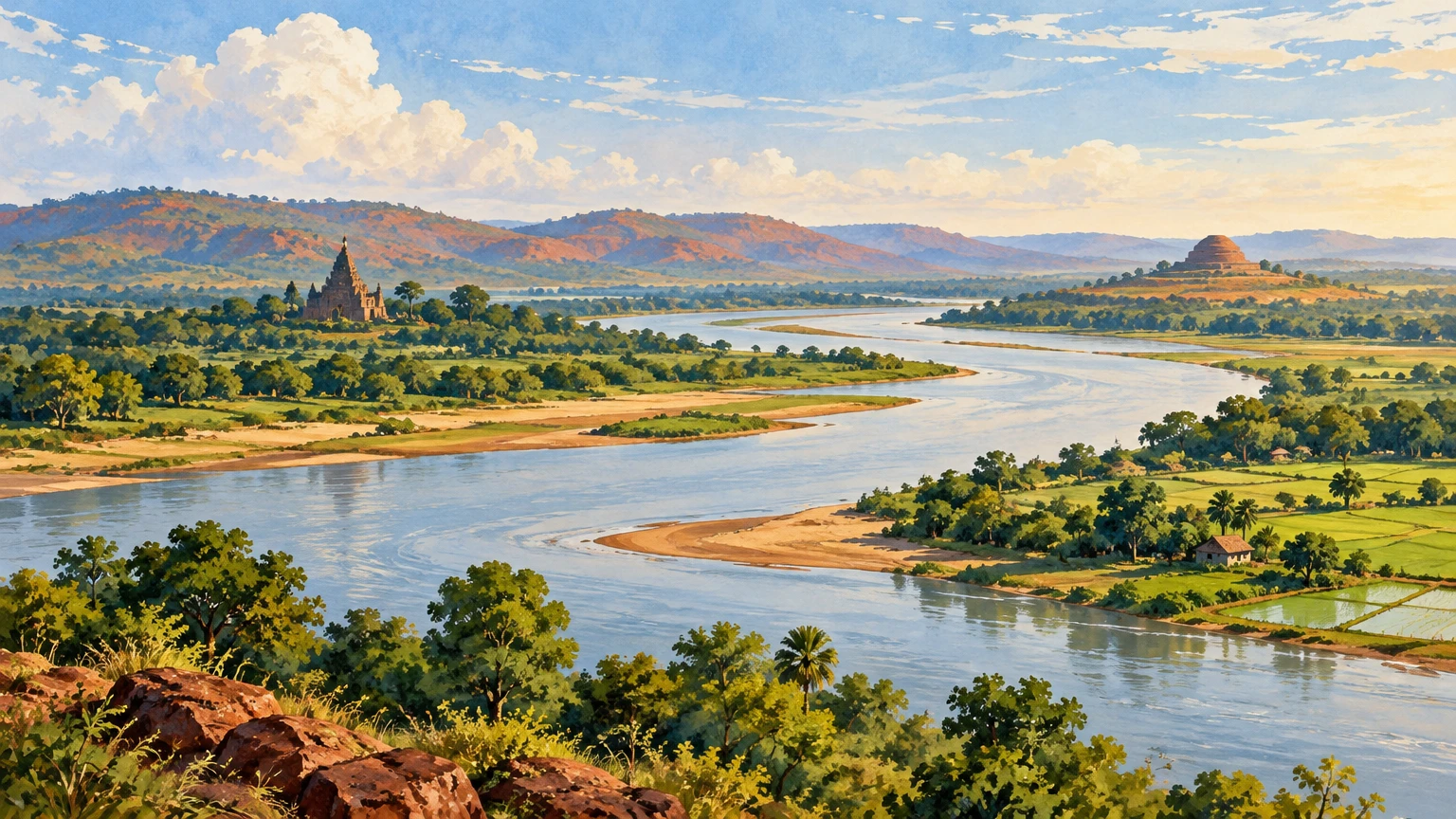
Featured illustration: Original AI-generated, text-free editorial artwork created for this article; it evokes Jajpur’s river plain and heritage landscape and is not a documentary photograph. Alt text: “Illustrated river plain with temple and Buddhist monastic silhouettes among green fields and low hills.”
Final disclaimer
This content is a collection of ancient history,books and various articles and collection of library and news and other post ; all details may not be the same. Readers are requested to verify the information themselves. Readers are not allowed to take any disciplinary action; content is only for educational purposes. If readers do not agree about the contents, they may send a personal comment to my personal email ID: achary.purna@gmail.com
