
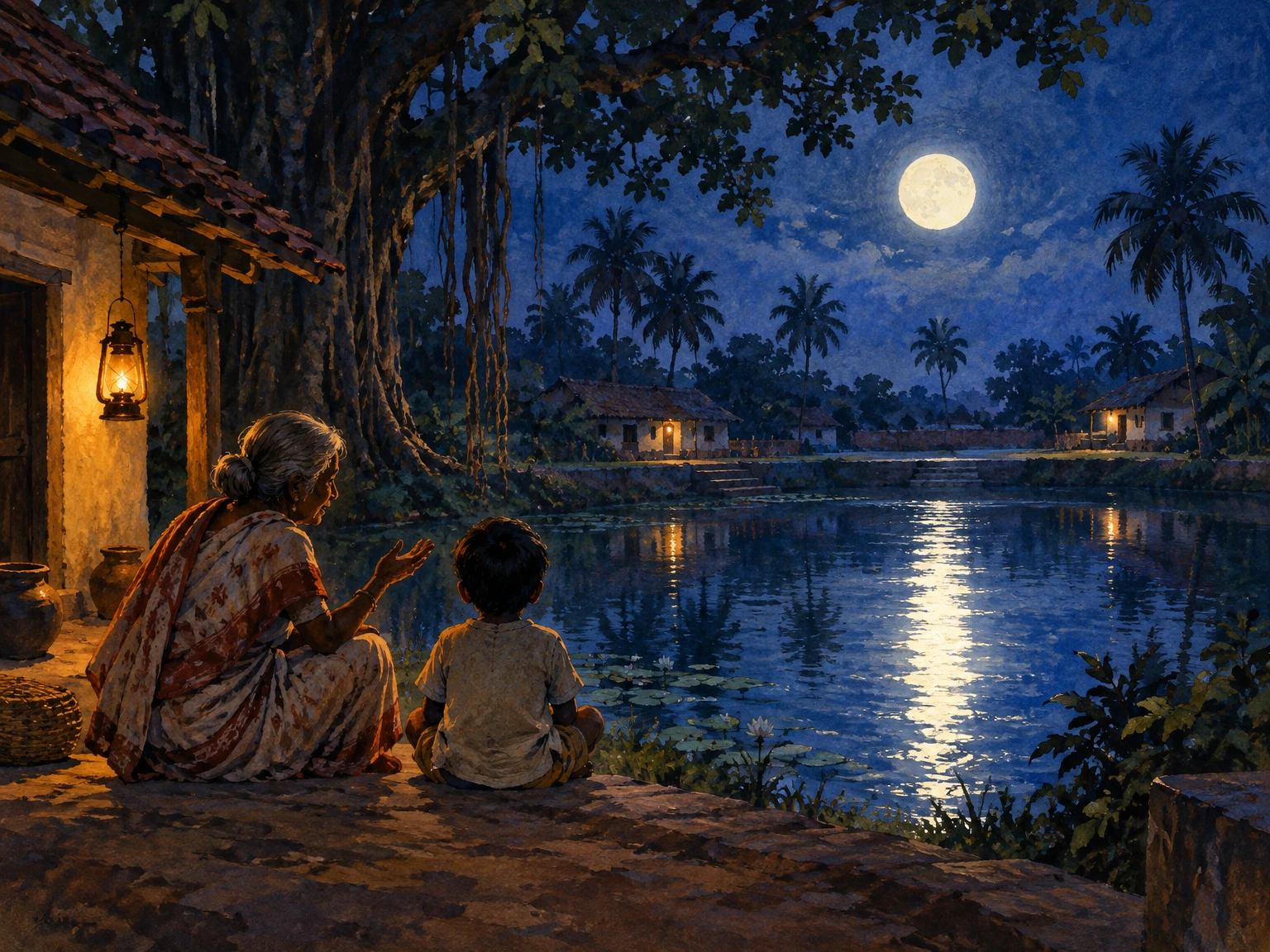
In Sakhigopal, the evening arrived softly, settling first on the tiled roofs, then in the narrow lanes, and finally over the ponds where the last daylight lingered like a ribbon of copper. A boy named Abhijit watched from the low wall outside his home as swallows dipped through the dimming sky. Behind him, his grandfather was carefully winding a small brass clock. Its hands moved with patient certainty, a sound so slight that the boy could hear it only when the village became quiet.
“Does the moon know when to rise?” Abhijit asked.
His grandfather smiled. “The moon follows no village clock. But if you watch carefully, the sky keeps its own kind of time.”
That answer was not quite an answer, and Abhijit was pleased. A question with room around it could travel farther than a quick reply. He looked beyond the roofs, where the first star had appeared, and wondered what else the night might be willing to explain.
1. A question carried home
At supper, Abhijit barely noticed the steaming rice. His thoughts were still outside, following the pale line of the moon as it lifted above the eastern palm trees. His mother asked whether he had finished his schoolwork. He nodded, though he had only copied the sums and checked them once. Now he wanted to know whether the moon moved, whether the clouds moved, or whether both were gliding together through a dark sea.
His grandmother, who had spent the day sorting lentils, set a bowl beside him. “Questions grow hungry too,” she said. “Feed them with looking, listening, and asking someone who knows.”
After dinner, she gave him a small notebook with a blue cover. Its first page was blank. Abhijit wrote: “Where does moonlight come from?” He added a little circle beside the sentence, then shaded half of it by mistake. The imperfect moon made him laugh. He decided not to erase it. A notebook, he thought, should keep the record of learning, not pretend that learning had always been neat.
2. The path to the pond
Grandmother proposed a walk to the pond before bedtime. They carried a covered lantern, though its flame was turned low; the village paths were familiar, but a stone could still hide in shadow. The air smelled of damp earth and jasmine. A bicycle bell sounded far away, and from one courtyard came the rhythm of someone washing a brass plate. These ordinary sounds made the night feel inhabited, not empty.
At the pond, the moon’s reflection trembled in the water. Abhijit leaned forward. The bright oval broke into a thousand pieces whenever a breeze crossed the surface, then gathered itself again when the water grew still.
“If I touch it, will I touch the moon?” he asked.
“You’ll touch water,” Grandmother replied. “The reflection is real as a reflection, but it is not the moon itself.”
He dipped a fingertip into the pond. Cool rings spread outward, widening and fading. The moon’s image wavered, yet the moon above remained whole. He drew two circles in his notebook: one in the sky, one in the water, and a line between them. Beside the line he wrote, “light travels.”
3. The patient fisherman
Near the far bank, an old fisherman sat beside a basket, mending a torn net. He greeted them and asked what had brought them out so late. Abhijit described his question about moonlight. The fisherman looked up, then down at the water, as if comparing two witnesses.
“The moon does not make its own light like a lamp,” he said. “It catches sunlight and sends some of it toward us. The water catches that light too, which is why we see a moon there.”
Abhijit thought about this. “Then the moon is a kind of mirror?”
“A rough comparison,” said the fisherman. “Its dusty surface reflects sunlight, but not like polished glass. Still, your idea points in a useful direction.”
Grandmother thanked him. Before they left, the fisherman showed Abhijit how a loose net knot could be found by tracing the strands rather than pulling at them. “Every puzzle has its own thread,” he said. The boy wrote the sentence down. He liked the thought that patient attention could be a tool, like a needle, a net, or a lantern.
4. A lesson from the school roof
The next day, Abhijit asked his science teacher, Meera Madam, whether the fisherman’s explanation was right. She said yes, with one helpful addition: the moon is constantly lit on one half by the Sun, but from Earth we see different portions of that sunlit half as the Moon travels around us. Those changing views create the phases—new moon, crescent, quarter, gibbous, and full moon.
She drew a Sun, Earth, and Moon on the blackboard. The diagram was simple, but the arrangement made the idea easier to imagine. She also warned the class not to confuse the phases with Earth’s shadow. Earth’s shadow falls on the Moon during a lunar eclipse, which is a different event.
Abhijit copied the drawing into his notebook. For a moment he wanted to write that the moon grew and shrank. Then he crossed out the sentence and replaced it: “The lit part we can see changes.” Meera Madam nodded. Careful words, she explained, help us keep a good observation from turning into a mistaken claim.
5. The moon’s many faces
That evening the Moon looked almost round, but a narrow darkness curved along one edge. Abhijit showed his mother the drawing from class. She asked him to predict what the Moon might look like in several nights. He made a guess and wrote the date beside it. His mother suggested that he keep checking rather than trying to remember from yesterday alone.
So he returned to the courtyard each evening. Sometimes clouds hid the Moon. Sometimes the sky was clear but the boy was busy helping with chores. He learned that a record can include “not visible” without becoming a failure. On the fourth night, the bright shape was thinner. On the next, it had shifted in the sky and changed its curve.
His little observations were not a grand discovery. They were better: they belonged to him. The Moon was no longer a picture that appeared at bedtime. It had a pattern he could notice, a route he could compare, and a story that changed from one evening to the next. His notebook began to fill with dates, sketches, and honest question marks.
6. A cloud interrupts
One night, thick clouds covered the sky. Abhijit stood at the gate for a long time, waiting for a silver edge to appear. Nothing did. He felt a small disappointment, as if a friend had promised to visit and then been delayed.
Grandfather joined him with two cups of warm milk. “Does the moon disappear when clouds cover it?” the boy asked.
“It is still there, even when we cannot see it from here,” Grandfather said. “Not seeing something is not the same as proving it is gone.”
Abhijit recognized that he had heard a version of this lesson in school. He wrote it in the notebook, then added a note: “Cloud cover is an explanation for tonight, not a new moon.” The next morning he asked his teacher if this was a fair way to put it. She agreed, and the class discussed how observations depend on where we stand and what blocks our view.
Clouds had not answered his astronomy question. They had given him another one: how do people know the difference between what is absent and what is merely hidden?
7. The old map
Grandfather kept an old village map folded inside a wooden box. It showed the pond, the school, a grove of trees, and paths that had since been widened. One line marked a footpath that no longer existed, now buried under houses and a small shop. Abhijit compared the map with the lanes he knew. The village had changed, but the pond was still there.
“A map tells you something about a place,” Grandfather said, “and something about the person who made it. It cannot show every tree, every voice, or every change.”
Abhijit wondered whether a sky map worked the same way. His teacher said astronomers use charts to locate stars, but they also record when and where they made observations. A chart was not the sky; it was a guide for finding things in the sky.
The boy drew the pond on one page and the Moon’s path on another. He marked both as drawings, not exact maps. This distinction pleased him. A picture could be useful without being the thing itself, just as the reflection was meaningful without being the Moon.
8. A story by lamplight
Grandmother had a different way of explaining the night. She told stories about travelers who used stars to find their way and children who learned courage by walking home through dark lanes. She did not claim that every story was a scientific account. Some were memories; some were playful inventions; some held a lesson inside an image.
Abhijit listened as she described a village boy who thought the Moon had followed him from the pond to the market. The boy in the tale walked faster, and the Moon seemed to keep pace. When he stopped, it stopped too. At last he asked his aunt, who showed him how faraway objects can appear to stay in the same place while nearer things slide past.
“Did that really happen?” Abhijit asked.
“The village and the boy are made for the story,” Grandmother said. “The feeling of being followed by the Moon is something many people can recognize.”
He wrote two labels in his notebook: “what we can test” and “what a story can help us feel.” He did not want one to replace the other. Both had a place, provided he knew which kind of truth he was talking about.
9. The quiet lantern
During the following week, a power cut left several houses in darkness. Neighbors brought lanterns into the shared courtyard. Their small flames made soft pools of light on the ground, while the Moon painted the rooftops with a cooler glow. Abhijit noticed that the lantern’s brightness changed the way his eyes saw the night. Beside its flame, the far corners looked darker; after he stepped away, he could see more clearly.
He asked Meera Madam about it. She explained that eyes adjust to low light, but bright lamps can make that adjustment harder. She also reminded him never to stare at the Sun, even through a telescope, binoculars, or a camera without proper certified solar equipment. The Moon was safe to look at with the naked eye, but the Sun could damage eyesight.
Abhijit added this practical note in a box. It was not part of his story, but it mattered to anyone who wanted to observe the sky. Grandmother praised the warning and said a good adventure should leave people wiser, not careless. Under the lantern’s steady glow, the boy placed his notebook beside his schoolbooks, ready for another evening of looking.
10. The reflected path
On a clear night, Abhijit and his friend Rupa walked with Grandmother along the pond embankment. The Moon was bright enough to lay a silvery track across the ripples. Rupa said it looked like a road leading straight to the far bank. Abhijit agreed that it looked like one, but he knew better than to believe the water held an actual path.
They tested the reflection from different places. When they moved left, the bright track shifted. When they stood still, it shimmered whenever a breeze touched the surface. A boat tied to a stake rocked gently, breaking the reflected line into fragments.
“The light reaches your eyes from many little places on the water,” Grandmother said. “That is why it appears to stretch toward you.”
Rupa cupped her hands as if she could collect a piece of moonlight. She caught only air, and they all laughed. The laughter did not make the observation less serious. Abhijit wrote: “A reflection changes with the observer’s position.” He added a small sketch of two children standing at different points, each seeing a different band of brightness.
11. The hidden notebook page
One afternoon, Abhijit could not find the page where he had drawn the Moon’s phases. He searched his school bag, his desk, and the shelf near the kitchen. His cousin had borrowed the notebook to draw a mango tree and had slipped the loose page between two storybooks. When he found it, the page had a smudge across the crescent sketch.
For a moment he felt annoyed. Then he saw that his cousin had drawn a tiny bird in the margin. The smudge had turned one star into a soft blur. He decided to keep the page as it was. A record of learning could show interruptions too.
He asked his cousin to help him make a sturdier folder from an old calendar sheet. Together they cut and folded it carefully. The work took longer than simply telling someone to be more careful, but it gave them something useful and made his cousin part of the project.
That night, he copied the phases into the new folder, labeling the drawings as “views from Earth.” He understood that the sky’s pattern was not changed by his missing page. But his own memory of learning had changed: it now included a small act of repair and a bird drawn by a younger hand.
12. The full round Moon
When the full Moon arrived, the village seemed newly outlined. The roofs, trees, and water tanks stood in shades of blue and silver. The pond reflected a broad bright circle, though the surface was never still enough to keep it perfectly round. Families gathered on verandas, talking quietly after the day’s work.
Abhijit’s grandfather showed him how shadows could reveal shape. The trunk of a palm tree cast a long dark mark across the dusty lane. A clay pot made a smaller shadow, softened at its edge. The Moon was not making the shadows, Grandfather said; sunlight was striking the village objects, and their forms blocked some of it.
Abhijit turned this into a small experiment. He placed a ball beside a lantern and watched its shadow move when he shifted the ball. The classroom demonstration made the Moon’s phases easier to imagine, but he took care not to claim that a ball and lantern reproduced every detail of the real sky.
“A model helps us think,” Meera Madam had said, “but it leaves things out.” He wrote that sentence beside the drawing. It became one of his favorite rules for learning.
13. A visitor from the next village
A few days later, a traveling puppeteer came to Sakhigopal with a painted cloth screen and a wooden box of figures. He set up in the school courtyard. Children gathered as he told a tale about a rabbit who tried to steal the Moon’s reflection from a well. The rabbit lowered a basket into the water, only to lift it dripping and empty.
The story made Abhijit think of the pond. After the performance, he asked the puppeteer whether the rabbit’s tale had an old origin. The puppeteer shrugged kindly. “I learned it from a storyteller, who may have learned it from another. I changed the ending for children here.”
That answer mattered. Abhijit had been tempted to record every village story as ancient. Instead, he wrote the puppeteer’s name and the date, then marked the tale “as performed today; earlier history unknown.” He realized that traditions can be living and changing. Respecting them did not require pretending to know every link in their history.
Grandmother said that recording what you know—and what you do not know—is a form of care. The boy felt proud of his question, not because it produced a grand fact, but because it helped him avoid inventing one.
14. A week of watching
Abhijit decided to watch the Moon for a whole month. He made a simple table with a date, a time, a direction, a sketch, and a weather note. Each evening he went to the same open place near the courtyard, when chores allowed. He did not use special equipment. He observed with his eyes and wrote what he could see.
On some nights, the Moon was low. On others it appeared higher by the time he finished his homework. Clouds sometimes hid it completely. His sketches were uneven, and the times were not exact, but his record showed a changing pattern. The Moon’s visible shape grew from a thin crescent to a broad bright disk and then narrowed again.
Meera Madam explained that one cycle of phases takes about 29.5 days on average. The exact timing of moonrise changes from night to night, and a simple school notebook cannot capture every detail. Abhijit added both points to his notes.
When the month ended, he could not say he had solved the whole sky. He could say he had watched patiently, kept a record, and learned to make claims only as large as his evidence.
15. The night of the missing lamp
One evening, Grandmother’s lantern would not light. The wick was damp, and the matchbox was empty. They decided to remain in the courtyard rather than search in the dark for supplies. The Moon was a thin curve, and the stars seemed more numerous than Abhijit had noticed on brighter nights.
His grandmother told him the names of relatives who had once lived in the village, pointing out the houses where they had grown up. Some of those houses were gone. The people were gone too, but their choices remained in the mango tree they had planted and the well they had helped repair.
Abhijit began to understand that darkness could hold more than one kind of absence. A person could be gone yet remembered; a moon could be hidden yet still present; a story could survive even while its exact first telling became unknown.
He did not mix these ideas into one explanation. Instead, he wrote a short poem about a lantern that failed and a family that stayed together anyway. His grandmother listened and asked whether she might hear it again the next night. He said yes, and the promise felt as warm as the light they did not have.
16. A small mistake in the classroom
For the school assembly, Abhijit prepared a short talk. He said, “The Moon shines because it reflects sunlight, and its phases happen because we see different portions of its lit half as it orbits Earth.” Then he added that the Moon moves across the sky each night because Earth rotates and the Moon also changes position in its orbit.
During practice, he accidentally said that the Moon’s shadow caused its phases. Meera Madam stopped him gently. He checked his notes and corrected the sentence. The correction embarrassed him for a moment, but his teacher reminded him that catching a mistake before sharing it was good work.
At assembly, he included a brief line: “A lunar eclipse is when Earth’s shadow falls on the Moon; ordinary phases are not caused by that shadow.” He did not make the talk longer than needed. Children listened, then asked whether a crescent Moon could be seen in the afternoon. Abhijit said yes, sometimes, depending on its position and the brightness of the sky.
He learned that a clear answer can still include the word “sometimes.” Accuracy is not weakness; it is honesty about the conditions under which an observation is true.
17. The pond after rain
A heavy rain arrived at the end of the month. Water ran down the lanes in small silver streams and gathered in the low places. The pond rose near its stone steps. The next night, clouds scattered, and the Moon appeared between them. Its reflection was broken by raindrops left on the water, each ring fading into the next.
Abhijit noticed how much the pond had changed. The water’s surface was no longer glassy, the banks were darker, and a fallen branch had lodged near the steps. The Moon above had not changed its shape because the pond changed, but the reflection looked different.
He found a dry place to sit and sketched the scene. He added the weather note: “Rain earlier; water rippled; reflection fragmented.” This time he did not draw the reflection as a perfect circle. He drew a long, broken path and marked it “appearance from this bank.”
Grandmother said the drawing made her feel as if she were standing beside him. Abhijit smiled. His sketch was not a photograph, but it carried something a photograph might miss: where he had stood, what he had noticed, and how the rain had altered the night.
18. A question for the fisherman
When Abhijit next met the fisherman, he asked whether the Moon’s reflection could help anyone find direction. The fisherman said that moonlight can make a path visible, but a reflection on moving water is not a reliable compass. For navigation, people use appropriate instruments, landmarks, maps, and knowledge of local conditions.
He showed Abhijit the net again and asked him to find a knot without tugging the mesh. The boy traced each cord until he saw a loop caught beneath another. He freed it slowly. The fisherman nodded.
“You used your eyes before your strength,” he said.
Abhijit thought of his first question. He had wanted the Moon to give him a neat answer, but the important work had happened through several people: the fisherman’s explanation, the teacher’s diagram, Grandmother’s stories, Grandfather’s map, and his own repeated observations. Knowledge had arrived like the pond’s reflection, from many angles, each one revealing something and leaving something out.
He added a new page to his notebook: “People who helped me learn.” Beside each name, he wrote what they had taught him, taking care not to claim they had said anything they had not.
19. The tale Abhijit tells
One Sunday, the younger children asked Abhijit to tell them a story. He chose the rabbit and the well, but he began by saying it was the version he had heard from the traveling puppeteer. Then he added his own ending: the rabbit stopped trying to capture the reflection and instead asked the owl how light made an image on water.
The owl did not explain everything. It invited the rabbit to watch the pond at dawn, midday, and moonrise. The rabbit returned with three sketches. At dawn, the water was rose-colored. At noon, it flashed so brightly that the rabbit had to shade its eyes. At moonrise, the reflection shimmered in a silver path.
The children laughed when the rabbit’s first sketch looked like a potato. Abhijit laughed too. Then he told them the point was not to draw perfectly but to look carefully and ask what might explain the difference. He called the story “my new version,” not an old tale, because that was the truth.
Afterward, one child asked whether the Moon really followed people. Abhijit explained how distant objects can appear to remain beside us as we move. He spoke simply, and when he was unsure about a detail, he promised to ask his teacher rather than guess.
20. What the night kept
Months passed. The seasons shifted, and the village pond reflected clouds, birds, and the changing Moon. Abhijit’s notebook grew thick. Some pages held careful diagrams; some held hurried notes written before school; some contained poems or questions that still had no answer. He kept them all.
On a bright evening, he returned to the low wall outside his home. The brass clock was ticking softly inside. His grandfather asked whether he had found out when the Moon rose.
“I learned how to keep watching,” Abhijit said. “And I learned that not every answer comes from one person.”
Grandfather nodded. Together they looked toward the eastern palms. The Moon lifted above them, not because the village was ready, but because its path continued beyond the roofs and fields. Its light reached the pond, the school, the old map, and the pages in Abhijit’s blue notebook.
He opened to the first page, where his question still sat beside a crooked circle. He did not erase it. The circle was not a perfect Moon, and the question was not a perfect beginning. But both had done their work: one had reminded him to look, and the other had given him somewhere to start.
What the story invites us to notice
This is an original work of fiction set in an imagined village. Abhijit, his family, the fisherman, and their conversations are fictional characters and events. The story uses the Moon as a reason to practice curiosity: observe more than once, record the conditions, ask knowledgeable people, and distinguish a story’s meaning from a scientific explanation.
In astronomy, moonlight is sunlight reflected by the Moon’s surface. As the Moon orbits Earth, we see different portions of its sunlit half, creating the familiar phases over a cycle of about 29.5 days. Earth’s shadow is involved in a lunar eclipse, not in the ordinary phases. Clouds, buildings, trees, local horizon, and time of observation affect whether and when the Moon is visible from a particular place. A notebook observation is useful, but it should not be mistaken for a complete astronomical measurement.
For safe sky watching, observe the Moon with the naked eye or suitable equipment used as instructed. Never look directly at the Sun through the naked eye, binoculars, a telescope, or a camera without proper certified solar viewing equipment.
Watch and learn
For a short visual explanation of the Moon’s phases, see NASA eClips’ Our World: Moon Phases. The video is linked for educational viewing; its content belongs to its creator.
Disclaimer
This content is a collection of ancient history,books and various articles and collection of library and news and other post ; all details may not be the same. Readers are requested to verify the information themselves. Readers are not allowed to take any disciplinary action; content is only for educational purposes. If readers do not agree about the contents, they may send a personal comment to my personal email ID: achary.purna@gmail.com
