
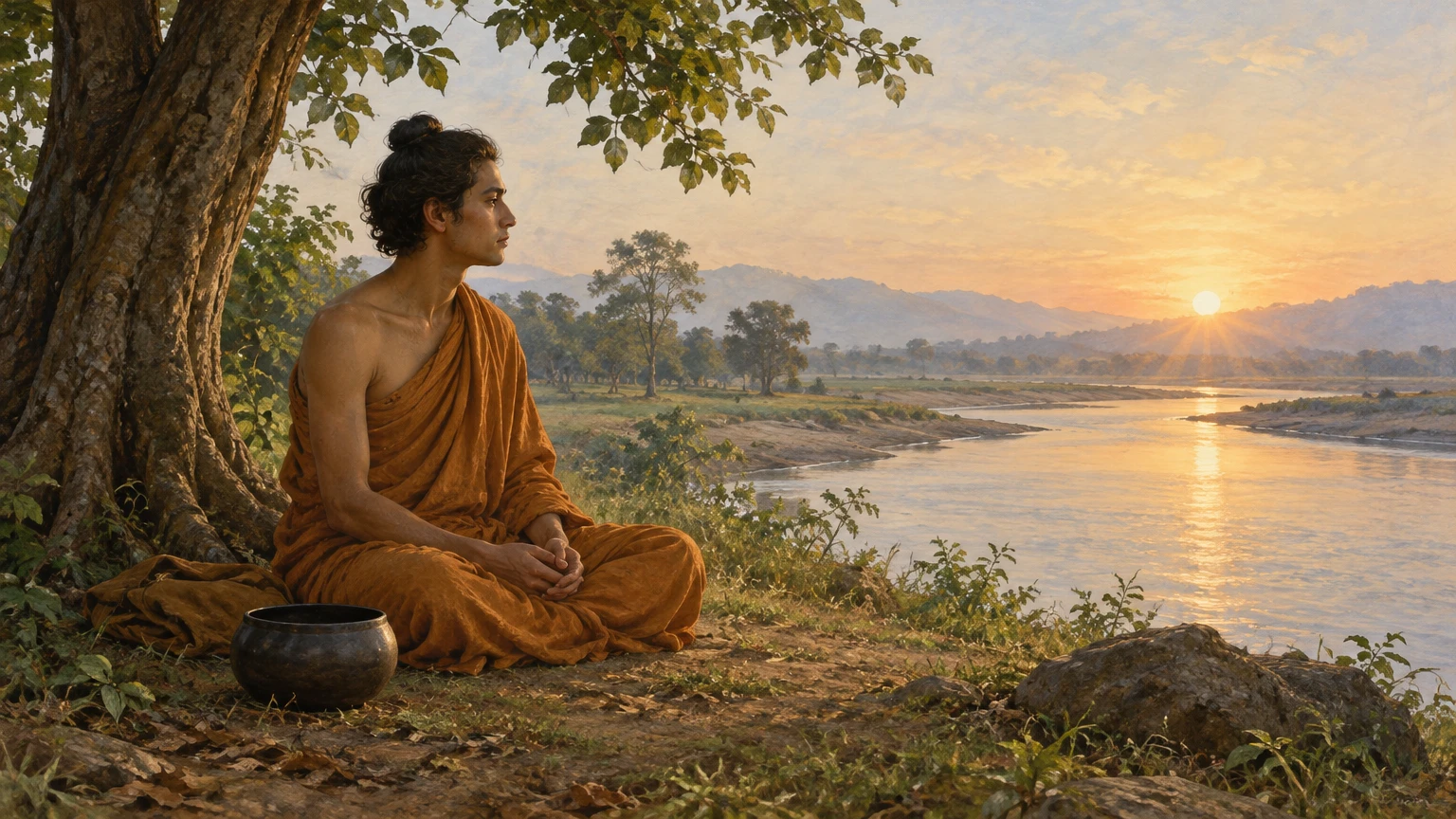
A story told in layers
The familiar story of Siddhartha Gautama’s renunciation can sound like a single dramatic scene: a prince leaves a palace, encounters suffering, and sets out to find a cure. Buddhist communities have told and retold that story in many forms. For a careful account, however, it helps to begin with the oldest available narrative strands rather than treating every later detail as one eyewitness chronicle. The early Pali discourses preserve episodes within teachings. They are not a continuous day-by-day biography, and their religious purposes matter as much as their biographical contents.
Three texts are especially useful for following the turning points. In the Ariyapariyesanā Sutta, or “The Noble Search” (Majjhima Nikāya 26), the Buddha recounts going forth while young despite his parents’ tears, then seeking instruction from two teachers. The Mahāsaccaka Sutta (MN 36) expands the account of severe ascetic practice and the remembered experience that led him to eat again and meditate. The Pabbajjā Sutta (Sutta Nipāta 3.1) gives a poetic scene in which King Bimbisāra meets the renunciant in Rājagaha. These passages overlap in theme but are not identical versions of one transcript.
The texts were transmitted in Buddhist communities, and the historical Buddha did not leave written memoirs. A first-person voice in a discourse is important evidence for how early Buddhist tradition remembered the search; it is not the same as a contemporary diary. The Pali Nikāyas preserve much more teaching than full life narrative, and scholars debate how to identify early layers. In this article, “the discourse says” marks a textual claim; “later biography tells” marks an elaboration; “historically possible” is not presented as “historically proven.” This distinction lets the story remain vivid without filling gaps with invented facts.
The noble search and the decision to go forth
MN 26 frames the search through a contrast between things subject to loss and the desire for what is not subject to loss. The speaker asks, in effect, why someone who is liable to birth, aging, sickness, death, sorrow and corruption should seek security in things that share those conditions. This is not an account of a particular battle or a sudden political crisis. It is a reflective argument: seeing vulnerability in ordinary life, the seeker looks for a way beyond the insecurity he recognizes in himself and in the world.
The same discourse says that, some time later, while his hair was still black and he was young and in the prime of life, his mother and father wished otherwise and wept with tearful faces. He shaved his hair and beard, put on ochre robes, and went forth from the household life into homelessness. The account gives family sorrow a real place in the decision. It does not specify an exact age, a calendar year, a secret midnight escape, a final farewell to a wife, or a chariot ride. Those are familiar details in later retellings, but they are not in this passage.
The language of “going forth” describes a change in social and religious life: leaving household responsibilities to become a wandering seeker. It should not be reduced to a modern career change, nor should it be turned into a claim that Siddhartha formally abdicated a throne. The early passage does not call him a ruler, name a kingdom he governed, or report a political succession. Later traditions commonly call him a prince and his father a king; that vocabulary has shaped Buddhist art and storytelling. Historical descriptions of the Shakya community, however, suggest a small clan polity rather than a large centralized empire, so a proven crown or ruling career cannot be assumed.
Teachers, attainments and an unsatisfied question
After going forth, the Noble Search says, the seeker approached Āḷāra Kālāma. He learned the teacher’s doctrine and reached what the discourse calls the dimension of nothingness. The account says Āḷāra recognized the student’s attainment and invited him to share leadership of the community. The narrative portrays this as a meaningful success: the student was not merely listening to a theory but was capable of entering a highly refined meditative state and being treated as an equal.
Yet the attainment did not answer the question that had prompted the search. In MN 26, the seeker reasons that this teaching does not lead to awakening, dispassion, cessation, peace, direct knowledge or extinguishment. He leaves, not because the teacher is depicted as foolish, but because the goal remains unmet. The episode gives the search a disciplined structure: learn carefully, test the result, and ask whether the result resolves the problem it was meant to address. The text’s portrayal of this attainment is religious language, and modern readers need not confuse it with a clinical description of a measurable state.
The second encounter is more complicated in its wording. The discourse then describes approaching Uddaka Rāmaputta, literally Uddaka son of Rāma. The narrative associates the dimension of neither perception nor non-perception with Rāma’s attainment and reports that Uddaka presents the teaching. It is therefore safer not to flatten the episode into “Uddaka personally invented the practice” or assume that every detail is a verified historical record. Again the student reaches the state but finds it does not deliver the release sought. The early account emphasizes a distinction between exceptional meditative attainment and final freedom; it does not say that concentration has no value, only that these attainments did not complete this particular quest.
What the search was—and was not—against
It can be tempting to narrate the decision to leave as a revolt against a cruel father, an oppressive palace, or a war. The early passages cited here do not establish any of those as the cause. MN 26 says that the parents opposed the going forth and wept; it does not describe abuse or political coercion. The Pabbajjā poem describes the household life as cramped and the life gone forth as open space, a contrast in spiritual orientation rather than a report of a palace prison. The available texts give us a powerful inward conflict—security and obligation on one side, the urgent search for release on the other—without confirming a violent external conflict.
Nor do these early renunciation accounts say that Siddhartha fought in battles, commanded an army, ruled the Shakyas, or led a military campaign. In the Pabbajjā Sutta, King Bimbisāra sees the mendicant, follows him to Mount Paṇḍava and offers pleasures, asking about his birth. The young renunciant identifies himself as a Sakyan and says he has gone forth, seeing danger in sensual pleasures and sanctuary in renunciation. The king’s mention of an army’s head is part of his description of the man’s appearance and possible status, not a claim that Siddhartha actually served as a battlefield commander.
This difference matters because later biographies often dramatize the contrast between an elite upbringing and renunciation with palace scenes, competitions and spectacular mastery of arts. Such material may illuminate the religious ideal of a future Buddha, but it should be attributed to the source that tells it. A small Sakyan clan polity could have had status, wealth and political institutions without being a vast monarchy. The terms “prince” and “king” in devotional narratives do not by themselves prove hereditary rulership in the modern sense. Where direct evidence is absent, the most accurate statement is that the early discourses do not narrate a battle or reign; they focus on leaving home and pursuing liberation.
The austerities of Uruvelā
MN 36 carries the narrative to Uruvelā, where the seeker describes extreme exertion. He speaks of forcefully constraining the mind, clenching his teeth, pressing the tongue against the palate, and struggling until sweat ran from his armpits. He also describes cutting off the breath and practicing severe food restriction. The text uses stark images of a body reduced to emaciation, with limbs, ribs and eyes altered by hunger. These details are offered as a first-person religious recollection within a discourse; the dramatic descriptions should be reported as what the text says, not treated as measurements independently confirmed by archaeology.
The point of the austerities is not that the seeker lacked determination. The discourse depicts an extraordinary willingness to test demanding practices. But he concludes that such pain had not produced the transcendent knowledge he sought. Extreme bodily hardship could make him weak without giving him the understanding that ends suffering. The narrative turns on a practical judgment about means and ends: intensity alone does not prove that a practice is effective, and bodily torment is not automatically a path to insight.
MN 36 does not give a calendar date for this episode or state that the practices lasted exactly six years. Later biographies and common retellings often assign a six-year period to the search, but that duration should not be attributed to this discourse as an explicit statement. Nor should the narrative be turned into a contest between traditions or a generalized judgment about all ascetic practitioners. The text is about the future Buddha’s remembered experiments and the conclusion he draws from them. Its first-person structure makes it central to Buddhist accounts of the path, while the absence of a date or duration remains an important historical limit.
The remembered shade of a tree
The decisive recollection in MN 36 is not a battle, a royal council or a supernatural instruction. The speaker recalls sitting in the cool shade of a rose-apple tree while his Sakyan father was working. He remembers entering the first absorption, a meditative state associated in the text with seclusion, rapture and pleasure. The memory prompts a question: could this be the path to awakening? He realizes that it might be. The scene supplies a different possibility from both sensual indulgence and self-punishment: a composed, attentive mind can experience well-being without being trapped by pleasure.
The discourse then says he ate solid food—rice and porridge—after deciding he could not attain the needed pleasure with a severely emaciated body. The five ascetics who had been with him reportedly left, believing he had abandoned the struggle and returned to indulgence. In the narrative, however, eating is not surrender to luxury. It restores strength so that he can practice. This is a subtle but significant turning point: the body is neither to be pampered as an end in itself nor destroyed as an instrument; it must be supported enough for sustained attention and understanding.
The text does not say that the childhood tree-sitting took place inside a palace garden, nor that it occurred during a public ceremony. It says his father was working and that he was seated in shade. Later storytelling may connect this memory to a broader picture of princely youth, but the discourse itself is more modest. The remembered ease is important not because it proves a picturesque childhood scene, but because it changes how the search is imagined. A pleasant meditative state need not be the enemy of liberation. The test is whether it supports clarity and freedom, rather than whether it is pleasurable or painful.
From an individual turning point to the middle way
The phrase “middle way” is often used as a shorthand for Siddhartha’s rejection of extremes. The Pabbajjā poem’s “cramped” household and “open” life gone forth provide one early poetic contrast. MN 36 narrates a different kind of balance: after experimenting with severe austerity, the seeker recognizes the remembered absorption as a viable path and resumes practice with nourishment. These texts do not use exactly the same framing, and we should not merge them into a single speech that never appears in either one.
A clearer formal statement appears in the first sermon, the Dhammacakkappavattana Sutta (Saṃyutta Nikāya 56.11). There, the Buddha addresses two extremes for one who has gone forth: devotion to sensual pleasure and devotion to self-mortification. The discourse presents a middle way that gives vision and knowledge and leads to peace, awakening and extinguishment; it identifies that way with the Noble Eightfold Path. This is a teaching formulation, not a line that MN 36 necessarily places in the same moment as the decision to eat.
“Middle” here should not mean an unthinking compromise between every pair of choices. The sources describe a path with ethical, meditative and wise dimensions, not a general rule that any midpoint is best. In the story, nourishment becomes reasonable because starvation has failed to bring the sought knowledge; in the first sermon, the middle way is a defined training. Together they illuminate why the turning point matters: the seeker does not abandon effort, but revises his understanding of what effort is for. The struggle changes from proving endurance through pain to cultivating conditions for insight.
Later biographies and the value of careful reading
The early discourses offer fragments of a life, not a fully staged biography. Later works expanded those fragments in distinct Buddhist settings. Aśvaghoṣa’s Sanskrit Buddhacarita, generally placed around the second century CE, is a poetic life of the Buddha. The Lalitavistara is a layered Sanskrit biography with Mahāyāna framing, while the Mahāvastu is a composite narrative associated with the Lokottaravādin Vinaya. The Pali Nidānakathā serves as an introduction to the Jātaka commentary and belongs to a later commentarial tradition. Their formation and redaction dates are not always precisely fixed, so broad scholarly ranges are more honest than false precision.
These biographies elaborate palace life, the four sights, family episodes and the great departure in ways that make the Buddha’s renunciation accessible as a story. The familiar sequence of an old person, a sick person, a corpse and a renunciant is not narrated in the cited Noble Search passage as the personal trigger for leaving home. That is not proof that no early community knew related stories; it means the evidence in these particular discourses is different. A careful writer can say “later biographies tell” and then describe the tradition without claiming that a fifth-century-BCE witness recorded every scene.
The sources also vary in names, order and emphasis. A complete modern narrative can accidentally combine details from several texts, smoothing away the historical fact that Buddhist communities preserved multiple tellings. Better to show readers where a detail comes from. The literary development is itself significant: later biographies reveal how the Buddha’s life was interpreted through devotional art, ethical teaching and evolving ideas of Buddhahood. They can be read with respect for their religious purpose and with careful attention to historical distance. Neither approach requires dismissing them or presenting them as documentary transcripts.
What can responsibly be said about the turning point
The core early-text narrative is clear in outline, even where chronology is not. MN 26 remembers a young man leaving household life despite his parents’ grief, learning from Āḷāra Kālāma and Uddaka Rāmaputta, and continuing because refined attainments had not ended the quest. MN 36 describes severe ascetic practices, bodily collapse, a recollection of first absorption beneath a tree, renewed eating and meditative practice. Sn 3.1 supplies a poetic encounter with King Bimbisāra and the renunciant’s Sakyan identity. These accounts frame renunciation as a disciplined search rather than a military or political episode.
The limits are equally clear. The cited texts do not provide a secure year, an exact age, a complete childhood timeline, or a verified claim that Siddhartha ruled a kingdom or fought battles. They do not document a palace escape scene or the popular four-sights episode as the explicit cause of his departure. Later biographies supply richer narratives, but their details should be named as later tradition. Modern scholarship can compare textual layers and archaeological sites, yet no exact palace or personal chronology has been established by the evidence discussed here.
The turning point, as the early narratives present it, is not a defeat in a war or a rejection of all discipline. It is a revision of the search after testing its methods: inherited comfort did not remove vulnerability; elevated meditative attainments did not yet bring the sought freedom; self-mortification damaged the body without producing the answer; remembered absorption offered another direction. This story remains powerful because it links conviction with self-correction. The seeker is shown persisting, but not defending a failed method simply because it was difficult. The path moves forward through discernment about what actually leads toward release.
The story’s form and the evidence it preserves
Reading these passages side by side requires attention to genre. MN 26 is a discourse about the noble search: its episodes lead toward a teaching about liberation and the danger of seeking security in things that change. MN 36 is a dialogue with the wanderer Saccaka, whose challenge gives the Buddha an occasion to recount the path of effort and awakening. Sn 3.1 is verse, not a court record: its compact exchange with Bimbisāra shapes a striking encounter between political power and renunciation. Each text selects details for a purpose. Their differences are not defects to conceal; they are part of the evidence about how the Buddha’s life was remembered and taught.
The first-person voice in a discourse deserves neither automatic dismissal nor naïve acceptance as verbatim autobiography. These texts were preserved through oral transmission and eventually written down; exact composition and redaction histories are debated. The recurring account of going forth and testing practices can preserve early community memory, while wording, arrangement and dialogue may have developed through transmission. Without independent contemporary records for the scenes, historians distinguish a tradition’s early attestation from proof of every event exactly as narrated. That distinction is especially important for dates and dramatic dialogue, where vividness can create an illusion of precision.
This approach still allows a meaningful biography. We can say that early Buddhist texts remember a young Sakyan leaving home, learning from teachers, undertaking austerities and changing course after reflection. We can also say that those texts make the search a model of inquiry: the seeker examines whether an attainment has reached its goal. But a responsible account marks the boundary between what a source explicitly reports and what a later storyteller supplies. The result is not a thinner story; it gives readers a map of the tradition’s layers, and makes clear where interpretation begins.
Bimbisāra’s offer and the renunciant’s reply
The meeting in Sn 3.1 adds a public dimension to a story otherwise focused on inward practice. King Bimbisāra sees the ascetic moving through Rājagaha, follows him and asks about his identity and origin. In the poem, the king offers wealth and enjoyment, even a share in power, and asks the young man to accept a place suited to his apparent social standing. The renunciant replies that he is a Sakyan from the foothills of the Himalaya, has gone forth from that family, and seeks what is wholesome rather than sensual pleasure. The scene stages an explicit choice between the king’s offer and the ascetic’s purpose.
The scene should be read as a poem’s account, not proof of a formal throne offered at a documented date. It does not establish that Siddhartha had ruled, commanded troops, or fought a war. Bimbisāra’s offer dramatizes the pull of status and worldly reward; the answer defines renunciation by the goal sought. The text’s presentation of Sakyan identity is valuable evidence for the tradition’s sense of origin, but it does not settle the precise constitutional structure of the Sakya community or verify every detail of the encounter.
Together, the parents’ grief in MN 26 and Bimbisāra’s offer in Sn 3.1 show two different relational costs in the early remembered story. At home, leaving hurts those who wish the young man to remain; in the royal encounter, a ruler proposes that he return to a life of advantage. The discourses do not make these people villains. Their positions help illuminate the renunciant’s resolve while leaving open the ordinary human bonds that renunciation changes. This is a more grounded conflict than inventing a battle: the tension lies in choosing a demanding search despite grief, social recognition and the possibility of comfort.
Sources
- Majjhima Nikāya 26, Ariyapariyesanā Sutta, trans. Bhikkhu Sujato
- Majjhima Nikāya 36, Mahāsaccaka Sutta, trans. Bhikkhu Sujato
- Sutta Nipāta 3.1, Pabbajjā Sutta, trans. Bhikkhu Sujato
- Majjhima Nikāya 85, Bodhirājakumāra Sutta, trans. Bhikkhu Sujato
- Saṃyutta Nikāya 56.11, Dhammacakkappavattana Sutta, trans. Bhikkhu Sujato
- Internet Encyclopedia of Philosophy, “Buddha” — historical sources and later biographies
- Oxford Academic, “The Life of the Buddha: Previous Accounts in the Buddhist Textual Tradition”
- Access to Insight, “The Origin of Buddhist Meditation” review / discussion of teachers’ historicity
This content is a collection of ancient history,books and various articles and collection of library and news and other post ; all details may not be the same. Readers are requested to verify the information themselves. Readers are not allowed to take any disciplinary action; content is only for educational purposes. If readers do not agree about the contents, they may send a personal comment to my personal email ID: achary.purna@gmail.com
