
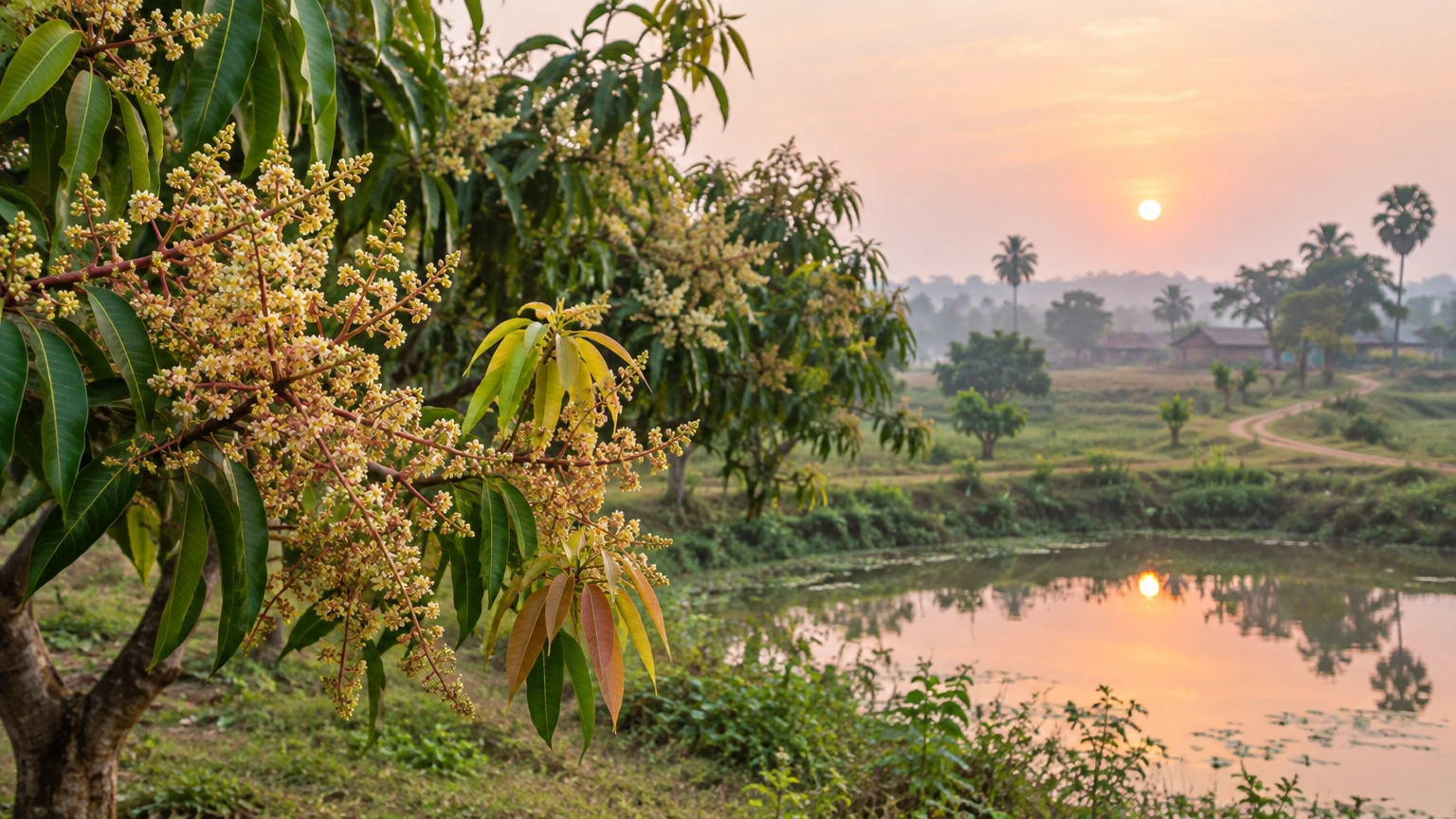
Spring as a name, not a forecast
Basanta Rutu, often written as Vasant or Basanta, is commonly understood as spring in the traditional Indian six-season cycle. This cultural-calendar convention is not a promise that every district will experience the same temperature, blossom or crop stage on the same dates. Odisha’s official climate account uses four meteorological seasons and describes substantial regional variation. Its broad climate periods are useful for weather context; the traditional calendar offers a different way to mark the year.
This distinction matters because “spring” can bring expectations borrowed from other climates: a sudden carpet of flowers, mild weather everywhere, or the same burst of green at once. Odisha’s landscape is varied, and local weather changes from year to year. One reader may associate Basanta with a festival or a family memory; another may notice a garden plant, a particular breeze or a longer evening. These experiences are all possible, but none should be passed off as a universal state-wide pattern without evidence.
The supplied essay imagines village orchards, pond edges, birds, festivals and a philosophical renewal after winter. We can retain its attention to seasonal change while avoiding unsupported claims about crop schedules, named blossoms, poet attributions, late twentieth-century schoolbooks or customs said to belong to every village. The article that follows is an original reflection grounded in public sources. It distinguishes a documented event from an imagined scene, and it treats metaphors as metaphors rather than facts about what all people feel.
A loom is a fitting image for Basanta. A season is made from many threads: the calendar, local weather, plants, work, art, memory and public celebration. They cross each other, but they do not become identical. When we describe their pattern carefully, the result can be lyrical without pretending that one place or one experience represents everyone.
A calendar thread and a climate thread
A six-season calendar gives Basanta a place within a recurring sequence. Calendar conventions and local observances can vary; a season name does not establish the precise beginning of spring in every locality. Lunar dates do not match Gregorian dates exactly, and a festival’s date can move from year to year.
The Government of Odisha’s climate profile describes a four-season meteorological pattern, including winter, a hot pre-monsoon period, the southwest monsoon and the post-monsoon period. These categories help explain broad weather patterns. They are not a translation of every traditional ritu into four exact boxes. The distinction is useful: a cultural season names a way people organize time, while a meteorological season classifies observed conditions for analysis and planning.
Climate also varies across Odisha. Coastal areas, river plains and upland districts do not experience every day in the same way. A warm afternoon in one town cannot establish the weather across the state; a flowering tree in one garden cannot establish a statewide bloom period. For current travel or safety decisions, official local forecasts and advisories matter more than a general literary description. This article is not a weather report.
A season may still be felt through small changes. A person may notice that an afternoon walk feels different from the one they took weeks earlier, or that a garden has changed after a spell of rain. These are personal observations, not a regional climate study. They can be written in a poem when the narrative makes clear whose viewpoint is speaking.
The calendar’s usefulness is not diminished by its limits. It gives people shared names and a rhythm for festivals, work and remembrance. The climate record adds another kind of knowledge. Both help us ask questions about a changing year. Neither replaces local experience, and neither should be used to force a single account onto every district.
The first signs are local
The original essay describes mango blossoms, dry sal leaves, red soil, flowering trees and bird calls as signs of Basanta. Those images may be familiar in particular places, but a specific plant’s flowering period or a bird’s seasonal behavior should be supported by botanical or ornithological evidence before it is presented as a general fact. The supplied text does not establish that each species blooms or calls across Odisha at the same time. This article does not repeat those identifications as statewide evidence.
A more careful scene begins with the observer. Imagine a person walking along a lane after a shower. The ground is still damp where shade holds the water; beyond it, the path looks pale in the sun. A branch near a courtyard has new growth, though the narrator cannot identify its species. A bird calls somewhere beyond the roofline. The scene is genuine as a literary possibility, but it does not claim that the branch is mango, that a koel is calling, or that the weather signals spring everywhere.
Specificity does not require overconfidence. A writer can say “in this garden,” “on this morning,” or “the narrator notices.” If a particular plant is important, a reliable regional flora or a botanical authority can establish the species and range. If a particular bird is named, an authoritative bird guide or conservation source can support the identification and seasonal claim. If that evidence is not available, a general description is more honest than a confident guess.
The same applies to the sense of smell. The source essay describes a sweet fragrance around mango orchards and the scent of red loam. Those can be personal impressions, but they are not independently verified as common experiences. A reader may associate the season with a different smell, or none at all. The article’s role is to invite attention, not to prescribe what everyone should notice.
Nature writing can celebrate a place without turning it into a postcard. A garden contains work as well as color; a tree is habitat as well as an image; a pond has ecological and human uses beyond its reflection. When a writer leaves room for these realities, a brief landscape can carry more meaning than a list of flowers ever could.
Agriculture beyond a seasonal postcard
The supplied essay associates Basanta with rest after harvest, orchard care, clearing irrigation channels, cattle grazing and preparation for summer crops. Those activities may happen in particular places, but the provided source offers no district-specific agricultural evidence. Crop calendars depend on the crop, variety, soil, water, rainfall, market and local practice. A broad season name cannot establish what every farmer is doing. This article therefore avoids asserting that spring is a statewide period of pruning, irrigation maintenance or field dormancy.
Agriculture is a sequence of decisions rather than a picturesque calendar. A farmer may plan around rainfall, irrigation access, seed, labor, equipment, costs and what a household intends to grow. Those conditions differ. A crop’s maturity and the next planting window are local matters. People making decisions should consult current agricultural extension guidance and district advisories, not rely on a literary essay.
A seasonal narrative can honor farming without pretending to document it. It can acknowledge that many people in Odisha work with land, water and plants; that agricultural rhythms influence the shape of the year; and that a field is a livelihood, not just a background. It should not invent a crop name or a customary practice. Nor should it romanticize agricultural labor as effortless harmony with nature. Weather and markets can bring uncertainty and risk.
The essay’s claims about paddy crops being harvested, mustard flowering, orchards receiving irrigation or cattle grazing particular grasses require evidence for each place and time. A future report could verify them with a current government crop bulletin or agricultural university source, perhaps naming a district and season-year. Until then, the article avoids presenting the details as facts. We can still speak of “a field in transition” as an image, provided the phrase is not used to make a factual crop-stage claim.
The relationship between field and city also resists a simple contrast. Food moves through markets and transport; people travel between rural and urban settings; new and older methods coexist in ways that vary. The submitted text’s claims about corporate spring festivals, university events or changes in farming methods were not independently verified and are not repeated. A concrete event or practice should be supported by a current source rather than used as a generalized sign of modernity.
Agriculture gives the seasonal poem a useful question: what does renewal mean when people must make decisions under uncertainty? The answer is not a universal lesson. It may be preparation, care, patience or adaptation. The farmer—not the visitor’s metaphor—knows the particular circumstances of a field.
Festivals with places and dates
The Government of Odisha identifies Saraswati Puja as usually held in January–February and also calls it Vasanta Panchami, associating it with the end of winter and the advent of spring. The same page describes Dola Purnima or Holi as usually occurring in March and discusses an Odisha form that can last several days, particularly in rural settings. These descriptions offer a reliable starting point, but they should be treated as broad public information, not as a complete account of every family’s observance or as a guarantee of a date in a specific year.
Odisha Tourism’s event calendar describes Pancha Dola Melana in the Parikud and Malud islands near Chilika. It says the five-day observance begins on the tenth day of the bright fortnight of Falguna, shortly after Dola Purnima, and describes decorated bimanas carrying deities from surrounding villages for a ceremonial gathering. This is a specific, place-based example. It should not be generalized into a claim that every Dola celebration in Odisha follows the same route, duration or ritual structure.
These sources allow a more grounded narrative. Basanta can be framed as a period in which the public calendar includes spring-related observances, while the particular meanings and practices belong to the communities who carry them. A festival may combine devotion, family, music, public performance, trade and travel. The official sources describe certain elements; they do not tell us how every participant feels or what every household does.
The original essay says that Dola processions “dissolve social barriers.” That is a sweeping social conclusion, not something an event description alone proves. It also states that urban offices and campuses host spring celebrations with classical dancers and poetry gatherings. Those claims need current event records and are not repeated here. Describing a festival accurately does not require making unsupported claims about its social effects or its prevalence.
Festival dates should always be checked for the year in which an article is published. Lunar dates and local calendars change in Gregorian conversion; an old date can mislead a reader planning a visit. The government and tourism calendar pages can help identify the relevant observance, but a current event notice is the better source for that year’s practical information.
It is also worth avoiding the idea that festivals are merely seasonal decorations. They have religious, social and local meanings, and those meanings are not interchangeable. One source may describe the public route; participants can describe why it matters to them. Respectful writing recognizes that a public page does not make the writer an authority on everyone’s beliefs.
A spring scene, without a false universal
Here is an original scene written for this article. The morning begins with a quiet lane and a patch of light at its far end. A person pauses beside a low wall where a small plant has put out new leaves. Beyond the lane, there is a water tank and, farther away, a line of trees whose species the narrator does not claim to know. The air seems different today, but the narrator cannot say what the whole district feels. A neighbor opens a shop. A child carries books. The season is present as a set of possible details rather than a grand announcement.
In another place, the picture might be different. A coastal breeze could carry a smell of salt; a hill district might feel cooler; a town street could be busy or nearly empty. A person working outdoors may be thinking about the next practical task, while a visitor looks for flowers. Each perspective matters, but they are not one shared experience. The article therefore does not declare a single “rural spring” or “urban spring.”
That choice preserves the difference between observation and fact. “I noticed a new leaf” is a report about one person’s experience. “The trees of Odisha bloom now” would be a much broader claim that needs evidence. “The lane felt hopeful” is a literary interpretation. “Spring improves mental well-being” would be a health claim requiring scientific support. A seasonal essay should not slide from one category to another without telling the reader.
The original essay offers vivid lines about “a sudden, riotous burst of color” and a gentle breeze. Such phrases are expressive, but a reader may experience a less dramatic shift. Rather than insist on a spectacle, this version treats change as something that can be small. A single leaf, a different quality of light, or the arrival of a festival date may be enough to prompt reflection.
The quiet scene also avoids turning a village into a stage. People in the background are not props for a narrator’s nostalgia. The reader does not know what they are thinking, what they believe or how they feel about the season. The story can show a shared lane while respecting the lives that continue beyond the frame.
Literature and the limits of attribution
The Government of Odisha’s literature overview describes Odia poetry’s development from early mystical verses through medieval forms and later literary traditions. It provides broad context for the language’s rich literary life. It does not prove that every named poet wrote about Basanta or used the images supplied in the original essay. A separate Odisha Review article discusses seasonal imagery in Jayadeva’s Sanskrit Gita Govinda; it is a modern interpretive source, not a warrant to assign an unverified Odia quotation to a particular poet.
The supplied text names Upendra Bhanja and associates his work with spring, bees, a breeze and the call of a cuckoo. That may be a useful lead for future literary research, but this article does not quote or summarize a specific poem without consulting a trustworthy edition. It also avoids assigning a revolutionary or existential message to “modern poets” as a group. Writers are individuals with different works, histories and purposes.
A new seasonal voice needs no borrowed authority. Here is an original reflection: The branch does not announce a new beginning; it simply holds a small change in its own time. We notice it because we happen to be passing. By evening, the light has moved, and the branch has not become a symbol for everyone. It remains a branch, alive in a place we have only briefly seen. This passage is newly composed for the article, not a translation or traditional verse.
Poetic language is free to make comparisons. A blossom may feel like a promise; a breeze may seem like a reply; a path may appear to open. These statements are literary interpretations. They should not be presented as quotations from folk tradition unless a source can document them. The original prompt’s phrase “the koel’s call” may be a familiar literary motif in some works, but any claim about a specific Odia text or poet requires accurate attribution.
If a future article quotes a poem, it should identify the text, edition, translator where applicable and source. It should use only the portion needed and respect copyright. “Educational purposes” in a disclaimer does not automatically authorize reproducing protected text. When the original source or rights status is uncertain, a writer can paraphrase in fresh language and name the source of the idea, or create an original image of their own.
This is not a rejection of literary heritage. It is a way to respect it. Accurate attribution gives readers a path to the actual work; invented attribution borrows a reputation while hiding the source. The season’s beauty is sufficient inspiration. It does not need an unverified line placed in the mouth of a celebrated poet.
The meaning of renewal is personal
The original essay interprets spring as renewal after a period of rest, release of old burdens and hope. These are thoughtful metaphors, but they are not universal emotional laws. People do not all experience winter as grief or spring as relief. Someone may welcome a new season; someone else may be coping with illness, loss, financial strain or a difficult work cycle. A poem should not require a reader to feel hopeful in order to understand it.
Renewal can be a question rather than a conclusion. What is beginning? What is continuing? What has changed? What remains unresolved? These questions leave space for different answers. A season can offer a prompt for reflection, but it cannot settle a person’s experience for them.
The image of trees shedding leaves, present in the original text, also needs care. Trees differ in how they respond to environmental conditions; some are evergreen, some deciduous, and leafing patterns vary with species and location. No general claim that “trees shed old leaves to make way for new buds” should be used without specifying the species and context. As metaphor, letting go may be meaningful; as botany, it requires evidence. This article keeps the philosophical possibility and omits the unsupported biological generalization.
The metaphor of balance in the spring breeze is equally a personal reading. It can suggest a desire for moderation or openness, but a breeze does not prove that an ideal emotional state is one of equilibrium. The article does not present seasonal weather as a wellness intervention. People seeking help with emotional distress need personal support and qualified care, not an essay’s seasonal symbolism.
A small, ordinary renewal might be enough: a page reopened, a path walked again, a conversation resumed, a plant tended. Even these examples should not be turned into a checklist for the reader. They are possibilities for thought, not a task the person must complete. The season’s story can stand as a quiet invitation without becoming another assignment.
Hope is sometimes described as courage, but it can also be fragile, practical or absent for a time. A flower in a landscape does not prove that hardship is over. The article’s original image of a new leaf is offered only as an image. It does not promise that every ending leads quickly to a beginning.
Public life, commerce and place
The submitted essay contrasts a village’s simplicity with modern towns and offices. Such a contrast can imply that rural life is unchanged while urban life is entirely modern. The evidence provided does not support that dichotomy. Communities differ, people move, technologies are adopted unevenly, and older practices can persist alongside new ones. A claim about a particular rural or urban custom needs a specific source, not a broad label.
A festival can bring together religious practice, public art, craft, markets and travel. The Government of Odisha and Odisha Tourism pages document certain observances and event locations. They do not establish that every town holds a spring poetry conference or that every campus stages a dance performance. If a current literary gathering or cultural program is important to the story, it should be verified through a current event page and named as a specific event.
The same applies to flowers in public spaces. A roadside tree or balcony garden might be part of someone’s spring. Without a verified botanical survey, we should not state that a particular species lines all city avenues or blooms across the state. A local park may have its own planting choices. A traveler’s photo can document a particular place and date, but cannot prove a statewide pattern.
Commerce is also part of cultural life. A festival may support artisans, vendors and transport workers, but a claim about its economic impact needs appropriate evidence. This article does not claim that one season brings an economic revival for all weavers or sweet makers. Those livelihoods deserve factual reporting, not an assumed narrative of prosperity. A named government or research source could support a more specific account in future.
By naming what is known, we can see the connections without inventing them. Pancha Dola Melana, for instance, has a specific place and event description in Odisha Tourism’s calendar. A reader can learn about it as a particular regional gathering. The article need not transform it into a state-wide symbol to appreciate its significance.
The natural world is not a set of props
Seasonal essays often identify a few signature species: the palash flower, silk-cotton tree, mango blossom, koel or butterfly. These images appear in many literary traditions, but a factual claim about a species’ local presence or timing needs a reliable source. The supplied article’s botanical details are not independently established here; this version therefore does not list them as universal signs of Basanta.
Nature writing also benefits from distinguishing a plant’s common name from its scientific identity. The same common name can refer to different plants in different languages and regions. If a story includes a named tree, it should verify the name and, where helpful, include a scientific name and a source. A flowering date can vary according to weather and site. A photo with no location or date is not enough to establish a general seasonal cycle.
Bird descriptions need the same care. The original says the koel’s call defines the season and describes birds returning or feeding among blossoms. Without a reliable local bird source, this cannot be reported as a state-wide seasonal pattern. A reader may hear birds in a particular grove; an ornithological account can verify species and migration. The article does not infer the bird’s identity from a familiar poetic image.
The ecosystem is not just a backdrop to human feeling. Trees provide habitats; wetlands support many species; agricultural areas are managed landscapes; urban gardens have their own ecological conditions. Responsible nature writing respects those relationships. It avoids calling a forest “a painter’s palette gone wild” as though the forest exists solely for human viewing, and it does not claim a tree offers sanctuary to a named species without evidence.
A good seasonal image can be small. A leaf catches the light; a shadow crosses a wall; a pond carries a reflection. These details can be seen without naming a species or making claims beyond the observation. The reader may bring their own knowledge to the image. The writer’s task is to make a careful invitation, not to claim complete ecological authority.
Six-season writing as a practice of evidence
The six-season framework can help organize a story, but a writer should check each kind of claim against the right kind of evidence. A calendar reference supports a season-month pairing. A climate agency supports a broad meteorological description. A current government event page supports a specific event date or location. An agricultural advisory can inform a crop-stage statement for its area and time. A botanical or ornithological source supports species claims. A literary edition supports quotation and attribution.
These sources are not interchangeable. A tourism page may describe an event for visitors; a literature overview may describe broad literary periods; a calendar chart may give one convention. None of them alone proves how every family experiences the season. A writer should avoid making one source carry more than it can support.
The original essay’s reference to 1985–1990 textbooks is not supported by a title, edition, class, page or archival copy. This article makes no claim about what Odisha Board students learned during that period, what poems they recited, or which moral lessons a school text conveyed. To make such a claim responsibly, a researcher would need to locate the books, verify their publication details, read the relevant pages and establish where and when they were used.
The same discipline applies to historical claims about agriculture, village tools or festivals. A remembered practice may be valuable testimony, but it should be attributed to a person, place and time. An official page may document a present event, but not prove that the event has always taken the same form. A literary motif may be common, but not universal. Saying “this source describes” or “the narrator imagines” helps the reader understand the evidence.
A disclaimer cannot replace this work. It cannot guarantee legal immunity or erase a reader’s rights. Original writing, accurate source attribution, respect for copyright, and correction of errors are the actual practices that make an article more responsible. If a video is added, it should be a relevant source with a clear lawful basis and attribution; if no suitable video is found, omit it rather than embedding an uncertain copy.
A walk toward the next season
The six-season cycle is often presented as a wheel, but the experience of moving through it is not perfectly circular. A person does not return to the same place unchanged. A family memory may attach to one spring; a public festival may be experienced differently in another year; local weather may disrupt expectation. The calendar repeats its names, but the people and landscapes within those names keep changing.
A reader walking through Basanta might notice only a few things: a morning that feels different, the date of a festival, a new leaf in a familiar courtyard. Another reader may attend a Dola observance, follow an official event listing, or remain at home. No single path is the correct way to experience the season. The article does not ask the reader to travel, purchase anything or perform a ritual.
A season can become an occasion for asking how a person relates to change. But the answer need not be optimistic. One may welcome a new beginning, feel uncertain, or simply carry on with the day. Nature’s cycle does not dictate a person’s pace. Spring may suggest a fresh start to one reader and a continuation of ordinary work to another.
It is useful to hold that openness alongside factual care. We can cite the broad calendar convention, identify what an official event page states, and avoid embellishing them with invented customs. We can describe a piece of artwork as generated illustration rather than evidence of a real location. We can call a new paragraph original rather than attributing it to a folk poet. These simple distinctions keep the writing’s claims in proportion.
The “loom of time and bloom” is therefore not a claim that the world always renews itself in a happy, predictable way. It is a way to think about how time is woven from repeated patterns and new circumstances. The threads meet, separate and return. Their pattern depends on where we stand and what we know.
Closing: a beginning without a guarantee
Basanta can be a calendar name, a broad cultural association with spring, a festival season, a local change in weather or a personal image of renewal. These meanings can coexist, but each must be described with its own scope. A calendar page does not predict a bloom; a festival listing does not speak for every participant; a metaphor does not establish a psychological fact.
The supplied essay gives us a starting point: a wish to see nature, community and inner life together. This original retelling keeps that wish while removing unsupported claims about a universal agricultural routine, named flowers and birds, social transformations, poet attributions and 1980s school lessons. What remains is not less beautiful. It is a story that knows which parts are sourced and which parts are imagined.
A branch may put out a leaf in one courtyard. Somewhere else, a festival date may arrive; a reader may notice the evening lengthening or may not notice a change at all. The state’s regions and people continue to live in different conditions. No single image can speak for them all. But one careful image can invite us to look again.
Spring is not a guarantee that every difficult thing ends. It is a name for a recurring place in one way of organizing the year, and an opportunity for a writer to consider how change feels. The reader is free to accept, adapt or leave aside the metaphor. That freedom is part of respectful storytelling.
The loom keeps moving. The calendar turns, the weather varies, and the next season comes in its own time. We can meet it with curiosity, verify what we say, and leave room for the lives and landscapes our words cannot fully contain.
Sources and further reading
- Odisha State Disaster Management Authority, “State Profile” (meteorological seasons and regional variation): https://www.osdma.org/state-profile/
- Government of Odisha, “Fairs & Festivals” (Saraswati Puja, Dola Purnima and other descriptions): https://odisha.gov.in/en/explore-odisha/fairs-festivals
- Odisha Tourism, “Events & Festivals Calendar” (place-specific Pancha Dola Melana description): https://odishatourism.gov.in/en/events
- Government of Odisha, “Literature” (overview of Odia literary traditions): https://odisha.gov.in/en/about-odisha/literature
- Odisha Review, “Rutusambhara in Sri Geetagovinda,” May 2013 (modern discussion of seasonal imagery in a literary work): https://magazines.odisha.gov.in/Orissareview/2013/may/engpdf/23-24.pdf
This content is a collection of ancient history,books and various articles and collection of library and news and other post ; all details may not be the same. Readers are requested to verify the information themselves. Readers are not allowed to take any disciplinary action; content is only for educational purposes. If readers do not agree about the contents, they may send a personal comment to my personal email ID: achary.purna@gmail.com.
