
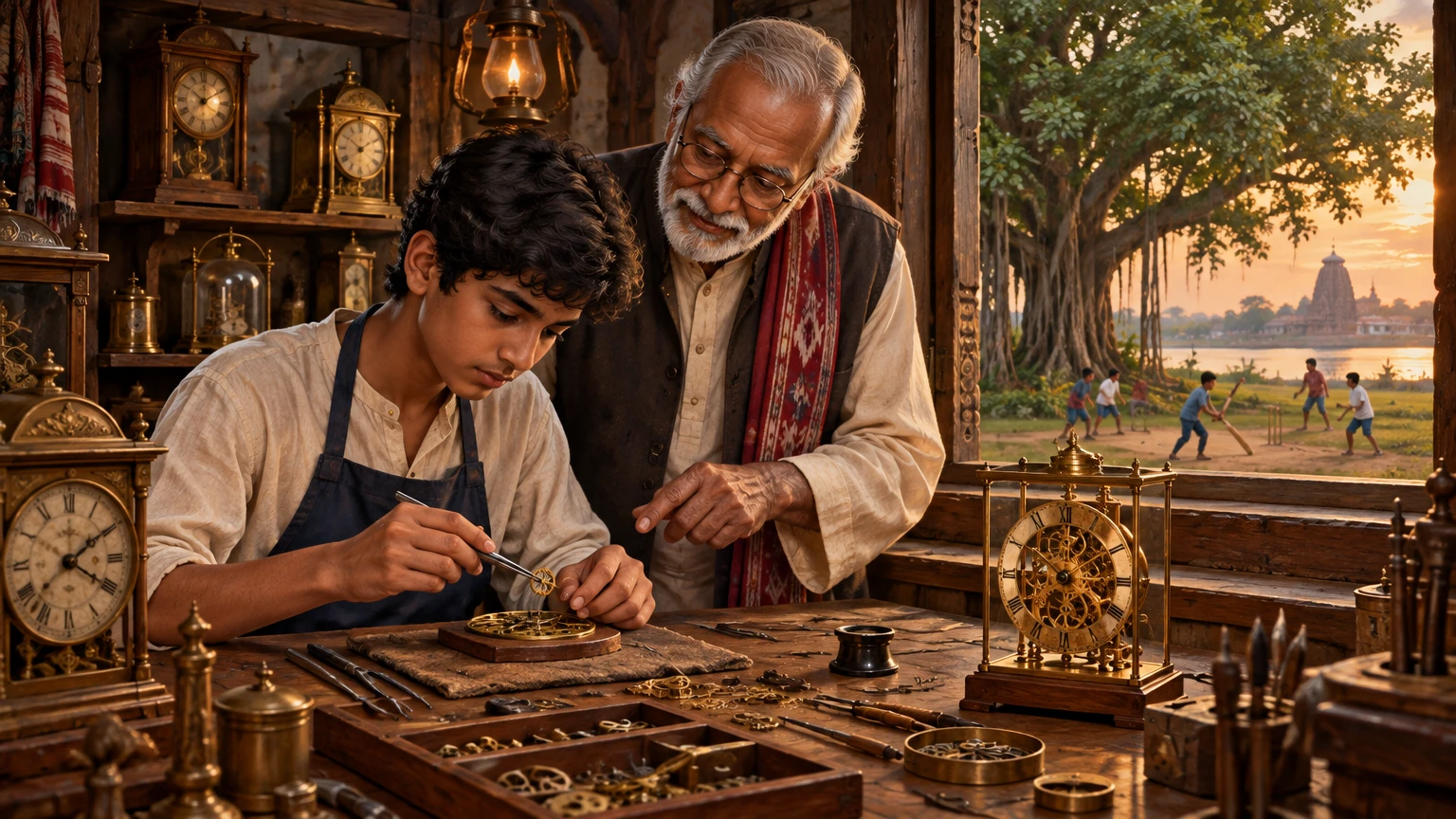
An original work of fiction about learning a careful craft, making room for rest, and giving each moment its proper attention.
1. A shop full of small voices
In a narrow lane of Cuttack, a few steps from the market, stood a repair shop with a green wooden door. Its sign read “Daya Clock Repair.” The paint had faded, but the brass letters still caught the afternoon light. Inside, clocks of many sizes kept time in their own ways: a kitchen clock clicked briskly, a tall wooden case clock spoke with a deep beat, and a little travel clock made a thin sound like a bird calling from a cupboard. To eighteen-year-old Anirban, the shop seemed less like a workplace than a room where time had taken physical form.
He had come to help Master Daya, a quiet repairer whose hands were steady and whose questions were often more instructive than his answers. Anirban had finished his school examinations and wanted to learn how things worked. His uncle brought him one morning, saying the boy was curious and willing to listen. For a week, Anirban swept the floor, sorted screws into small tins, cleaned the bench, and learned to ask before touching a customer’s clock. He expected a secret technique. Daya instead showed him how to keep a clean cloth folded nearby, label a part as soon as it was removed, and stop when he could no longer see clearly.
“Small work gets lost when the mind runs ahead,” Daya told him. “First know what is on the bench. Then decide what it needs.”
Anirban nodded, though he was unsure how a person could spend an afternoon on a few screws. Outside, boys called to each other over a cricket match. A bicycle bell rang; a tea seller announced his arrival. Every sound seemed to invite him away. Daya did not object to the street. He simply returned to the clock in front of him, as if the invitation could wait for its proper hour.
2. The clock that would not keep its promise
One humid morning, a woman brought in a small wooden wall clock wrapped in a cotton shawl. It had belonged to her father, she explained, and had stopped the previous evening. She did not ask for a miracle. She asked Daya to see whether it could be repaired without changing its familiar face. He placed it on the bench, asked permission before opening the back, and wrote the owner’s name and date on a paper tag.
Anirban watched as Daya examined the case, dial, and hands before considering the mechanism. He did not begin by pulling parts out. First he listened, looked for damage, and asked when the clock had last been wound. Its hands were fixed at ten minutes past four. Dust had gathered inside, and one small metal piece looked bent. Daya explained that a stopped clock can have many causes: a loose connection, dried lubricant, a damaged part, an uneven surface, or a problem in its power source. Silence alone was not a diagnosis.
“Is it the spring?” Anirban asked.
“Perhaps. But ‘perhaps’ is not a diagnosis,” Daya replied. “We inspect, record, and test only what is safe to test.” He showed Anirban how to lay out a tray so each piece would stay in order. The apprentice copied the labels too quickly; his handwriting slanted into a row of marks. Daya asked him to rewrite the tag, not as punishment, but because an unreadable label helps no one.
The woman had said the clock mattered to her family, not that it was rare or historically important. Daya invented no grand past for it. He respected its personal meaning while making no claim about age or maker he could not establish. Anirban found this restraint surprising. He had imagined that expertise meant knowing an answer at once. Here, it seemed to mean waiting for evidence.
3. The call from the courtyard
By late morning, the shop had grown warm. Anirban was cleaning the cover of a small brass case clock under Daya’s supervision. Each time he rubbed too quickly, the cloth slipped. He tried to keep working at the same pace, but his shoulders tightened and his eyes began to sting. Outside, the cricket game grew louder. A ball struck a wall, someone protested, and the group laughed. Anirban glanced at the door. He knew the players and could almost picture the next delivery.
Daya noticed. “What are you hearing?” “Cricket.” “And what are your hands doing?” “Cleaning the case.” “Are they doing it well?” Anirban looked down. A faint streak remained. “No.” Daya put down his tool. “Then we change something. We can take a short break, drink water, and return with clear eyes. A craft is not improved by pretending the body has no limits.”
The apprentice had expected a lecture about discipline. Instead, Daya unlocked the back door and pointed to a shaded stool. “Ten minutes. Then we decide whether the case needs more work or whether the finish is already sound.” Anirban drank water and watched the match from the shade. He did not join, but he did not feel punished for wanting to. The break was not an escape from the work; it was a boundary around it.
When the time was up, he returned with less tension in his hands. Daya showed him how to inspect the surface under the window light. The streak remained. Anirban cleaned it slowly, making small, even passes. The result improved—not because he had forced himself to continue without pause, but because he had returned ready to notice what he was doing. That afternoon, Daya explained that attention could be renewed by sensible habits: a clear bench, a written note, rest when tired, and a decision about what deserved focus next.
4. A mistake with a small screw
The following week, Daya let Anirban help with a clock he had already assessed. The apprentice’s role was limited: keep the parts in order and clean a non-delicate outer plate. He was pleased to be trusted and wanted to prove himself quickly. A customer arrived with a question. Daya stepped to the doorway to speak with him. Anirban turned his head to listen while his fingers continued working. The tiny screw in his tweezers slipped, bounced once against the cloth, and disappeared among its folds.
Anirban froze. His first thought was to sweep his hand across the bench, but he stopped himself. Rubbing the surface might push the screw into a crack or scratch another part. He called Daya over and said exactly what had happened. Daya moved the other pieces away, placed a shallow tray under the bench edge, and showed him how to search methodically. They checked the cloth folds, seams of the pad, and floor around the work area. The screw rested beside a wooden leg.
“Good,” Daya said. “You stopped before making the problem larger. Next time, pause the work before turning toward a conversation.” Anirban felt relieved and embarrassed. “I wanted to show I could do two things at once.” “Most people can glance at two things. That is not the same as doing both well. If a customer needs you, put the tool down safely. If a part is delicate, say you will answer after it is secure.”
The lesson was practical, not mystical. Daya asked Anirban to add a note to the job card: “Pause before turning away; secure the part.” The words stayed beside the bench as a reminder, not a rule meant to shame him. At closing, Daya asked what he wanted to learn next. Anirban hoped to understand how a clock’s steady beat was maintained. Daya promised to explain the general principle, but not to experiment on a customer’s mechanism without a proper assessment.
5. How the beat is shared
The next morning, Daya brought out a demonstration clock belonging to the shop. It was a teaching model, not an antique or a customer’s possession. He showed Anirban its power source, wheel train, and pendulum. The gear train carried motion onward; an escapement released that train in measured steps and gave the pendulum small impulses to keep it moving. Daya described the pendulum’s swing as a regular motion that can serve as a timekeeping regulator.
He was careful not to suggest that every clock uses a pendulum. Some use a balance wheel or other systems; designs differ by period and purpose. On this model, the anchor-shaped part rocked back and forth, alternately catching and releasing teeth of the escape wheel. Anirban asked whether a stronger spring would make a clock keep better time. Daya smiled. “More force is not the same as more accuracy. A mechanism has to suit its design and be in sound condition. Push a delicate system harder without knowing why, and you may add wear rather than solve a problem.”
They did not open or adjust the family clock to test the idea. Instead, Daya let Anirban sketch the demonstration model. The apprentice drew the pendulum too long, erased the line, then drew the anchor backwards. Daya corrected him by asking him to trace the movement slowly in the air. In his notebook, Anirban wrote three questions: What supplies the energy? What controls the rate? What carries motion to the hands?
Daya said these were useful because they divided a complicated mechanism into parts without pretending those parts were unrelated. When the explanation ended, he returned the teaching clock to its shelf. He did not claim that the family clock used the same design. They would only know after careful inspection. Anirban found that uncertainty no longer felt like failure. It was the space between a question and a reliable answer.
6. The apprentice makes a plan
The small wall clock needed more time than either had expected. Daya discovered that the bent piece was not the only concern. The mechanism showed wear and needed a careful assessment before anyone could say whether repair was practical. He explained this to the owner and asked before proceeding. She agreed to an estimate but asked that no part be replaced without her approval.
Anirban wrote the estimate in clear language, recording what they had observed, what still needed checking, and what choices the owner would have. Daya removed a confident claim that the clock was “from the 1930s,” because no mark or document established that date. It looked old to Anirban, but appearance alone was not proof. “An honest note is part of the repair,” Daya said. “If we don’t know, we say we don’t know. That protects the owner and our work.”
The owner returned two days later. She chose a limited repair and agreed to the cost. Daya recorded her decision. Anirban prepared the bench, checked the tools, and placed a container nearby for removed parts. He felt pride, and also responsibility: the clock was not merely a puzzle. It belonged to someone who trusted them with a memory.
Daya demonstrated how he examined components for obvious wear and tracked each step. Some repair techniques require training; some tasks should not be attempted by an inexperienced person. A clock may contain sharp edges, stored spring energy, glass, heavy weights, or materials needing special handling. Anirban was not asked to wind, force, or dismantle anything outside his supervised role. The work did not proceed in a straight line. One observation led to another question. Daya adjusted the plan when evidence called for it and explained the change to the owner before continuing. Anirban saw that careful craft was not a performance of certainty, but a sequence of responsible decisions.
7. The day the shop grew quiet
A week later, rain fell heavily over Cuttack. Water ran along the lane and the market thinned early. Daya covered the clock faces near the window, moved spare parts away from the floor, and checked the door. Anirban helped. The wall clock remained on its padded surface. Daya asked the apprentice to read the job card aloud. Anirban listed each step and its reason. When he reached “clean and test,” Daya asked what the test involved.
Anirban paused. He did not know. He had copied the phrase from an old note without understanding it. “Then we don’t leave it vague,” Daya said. Together they wrote a more precise description of what they had actually checked and what remained for Daya to perform. The note was modest, but useful: it distinguished the apprentice’s observations from the master’s assessment.
Rain softened the traffic outside. Anirban watched water move down the glass and thought about the weeks ahead. He had imagined learning as a ladder: each day one climbed to a higher rung. Now he saw a workshop floor: tools returned to their places, notes revised, questions asked again, and old lessons used in new situations. Daya poured tea for himself and a warm drink for Anirban. He told him not to confuse quiet concentration with isolation. A careful worker asks for help before a mistake becomes damage. A good mentor makes room for questions; a good apprentice says when something is unclear.
That evening the rain stopped. The cricket players had gone home. Anirban swept the floor and put the tools away. He felt no resentment about missing the match. It had ended, and the workday had ended too. Each had its place. He began to understand that a good craft included not only exact movement, but also a safe pace, a clear record, and enough humility to stop when he could no longer see or think clearly.
8. Learning the edge of patience
The next stage required patience, but Daya did not ask Anirban to sit motionless for hours. They worked in short, planned periods. Daya set out only the tools needed for each step. Anirban read the notes before touching a component and returned it to a marked tray afterward. At first, the routine seemed slow. Then he noticed how often it prevented confusion. When the telephone rang, he could stop without losing track. When a customer entered, he could cover the parts and explain that Daya would speak with them shortly.
When his eyes grew tired, he stepped away, drank water, and returned when he could see clearly. One afternoon he asked whether a perfect craftsperson ever made mistakes. Daya answered that people made mistakes; the important questions were whether they noticed, reported, and corrected them responsibly. Some errors could be repaired. Others could damage an object or put someone at risk. That was why a worker needed training, a safe pace, and the humility to stop.
Anirban began to understand that attention did not mean ignoring every other part of life. It meant choosing where to place attention, and when. A person could focus on a repair while doing it, rest when tired, and enjoy a game when work was finished. None of those choices had to cancel the others. Daya asked what kind of work Anirban hoped to do in the future. He was undecided. He liked solving practical problems, but also drawing and playing cricket.
Daya told him not to rush to turn every interest into a profession. For now, he could learn the craft and notice what gave him energy. The advice surprised Anirban. He had thought a mentor’s job was to choose a path for an apprentice. Instead, Daya offered tools and perspective, then left the decision with him. The workshop was not a machine that could assign a life. It was a place to practice, ask questions, and discover what mattered.
9. A clock is not a promise of perfection
After several days of supervised work, Daya reassembled the mechanism. He checked it cautiously, then left it running on the bench to observe. The clock began to tick. The sound was small and uneven. Daya waited, made a tiny adjustment, and checked it again. Anirban wanted to celebrate at once. “It’s fixed!” he said. “Maybe it is running,” Daya replied. “That is not yet the same as knowing how well it keeps time, or whether it will continue reliably.”
He explained that performance can depend on condition, setup, environment, and design. A short bench test would not establish everything about behavior in the owner’s home. The clock needed further observation, and the owner needed to know what had and had not been confirmed. Anirban amended his note: “Mechanism runs during initial workshop check; longer observation remains.” It sounded less impressive than “fully restored,” but it was true.
When the woman returned, Daya described the work plainly. He showed her the clock and explained the limits of the brief test. She was pleased to hear it running again and agreed to take it home for careful observation. Daya offered simple, nontechnical care advice appropriate to its condition, and told her to contact the shop if it stopped or behaved unexpectedly. The owner thanked them both. Anirban felt her gratitude, but understood that the point was not to win praise. Their duty was to return the clock with an honest account of what they had done.
After she left, Daya asked what he had learned. “That a ticking sound is a beginning, not a guarantee,” Anirban said. Daya nodded. “That is a useful way to put it.” They left the job card open until the agreed follow-up. The clock had a story in its case and a future in its owner’s home, but neither of them could decide in advance how long it would keep working.
10. The unfinished match
That Saturday, neighborhood boys gathered again in the courtyard. Anirban had spent the morning helping Daya tidy the shop and finish the week’s notes. At the end of the workday, Daya washed his hands and said the bench was closed until Monday. Anirban stepped outside and saw Raju holding the bat. The match had begun. There were not enough players, so Raju waved him over. Anirban jogged across the lane, laughing as someone tossed him the ball.
For the first few minutes, his thoughts drifted back to the shop. Had he put the screw tin in the right drawer? Did the customer understand that the clock needed further observation? He realized he was carrying unfinished questions into the game. Then he remembered the job card. The tools were away; Daya had reviewed the note; the owner knew what remained uncertain. The work was safe to leave until Monday.
Anirban took a breath and watched the bowler’s run-up. He played the next ball, missed it completely, and heard his friends cheer anyway. The game was not a reward earned by flawless work; it was part of a balanced day. He could care about the craft and still enjoy his friends. He could miss a shot and laugh. Nothing in the workshop demanded that he abandon play, and nothing in the game required him to pretend the shop did not exist.
After sunset he returned home tired, with dust on his shoes and a story to tell. He did not feel he had mastered time. He had only noticed that one hour could be used for one thing and another hour for something else. The workshop would be there again on Monday. The cricket match belonged to that afternoon. When he allowed each its place, the hours seemed less like a contest and more like a sequence of doors he could open one at a time.
11. A new question at the bench
On Monday, Anirban arrived early. He placed his notebook beside the bench and reviewed the open jobs. The wall clock’s owner had not called, so observation remained incomplete. Daya explained that they should wait for the agreed check-in rather than declare a final result on her behalf. Another customer brought in a small alarm clock with a loose bell. Daya decided it was suitable for Anirban to observe, but not repair alone.
The apprentice took a pencil and sketched the visible parts, labelled what he recognized, and marked what he did not know. He resisted the urge to guess what lay inside. When Daya opened the back, they saw a different arrangement from the teaching model. Anirban asked how power moved through it. Daya pointed out the parts he could identify and explained that this design did not use the same pendulum arrangement as the demonstration clock.
The sketchbook gathered observations, corrections, and questions. It was not a collection of perfect diagrams. Some drawings were rough; some labels pointed the wrong way. But each page showed what Anirban had seen then and what he learned later. Daya told him that craft grew from repeated encounters with actual objects, careful supervision, and sources that could be checked. A story about a clock may make a reader curious, but it should not be mistaken for a repair manual.
If someone wanted to work on a real mechanism, they should seek suitable training and follow the maker’s guidance. Anirban wrote that in his notebook, not as a warning meant to frighten himself, but as a reminder that practical knowledge came with responsibility. He also wrote a question he could not answer yet: how did makers decide which material would last in a particular mechanism? Daya told him they could look for reliable sources and compare designs, rather than invent a confident answer.
12. The hour at hand
Months later, the green door of Daya Clock Repair still opened onto the same narrow lane. The clocks inside still differed in sound and shape. Some arrived with their owners’ stories; others came in plain boxes with no history known. Daya continued to distinguish what he knew from what he merely suspected. Anirban was still learning. He had improved at keeping notes, preparing the bench, and asking before acting.
He could recognize some common parts and describe their roles in simple terms, but he was not a master clockmaker and did not pretend to be one. There were tasks he could do under supervision and others he could not. One warm afternoon, a ball rolled through the open shop door and stopped beside the bench. Anirban picked it up and saw Raju waving from outside. Daya looked at the work. It was covered and safely set aside; the next step could wait. “Go on,” he said. “We have finished for today.”
Anirban returned the ball. He did not rush out as if escaping a prison. He left with a clear mind because the tools were in place, notes complete, and next task written down. In the courtyard, the game resumed. The clocks continued their separate beats behind him. He had once thought attention meant locking every other thought away. Now he understood it more gently: attention was a way of meeting the present task honestly. Rest was part of good work. Play did not have to be stolen from the day.
When the day’s work was done, it was possible to leave it behind without leaving care behind. The green door swung shut. Inside, one clock ticked steadily, then another answered from the shelf. Outside, the ball rose into the evening light. Anirban watched it, judged its path, and ran. He had not learned to control every hour or to make every plan succeed. He had learned something smaller and more useful: do the next task with care, admit what remains unknown, and make room for the rest of life when the work can safely wait.
A note on clock history and mechanism
This story, its characters, workshop, customer and clock are fictional. The general mechanical description is simplified for readers. The Metropolitan Museum of Art explains that a clock escapement converts continuous motion of a wheel train into the back-and-forth motion of a regulator; its discussion of the anchor escapement describes it rocking to release and catch wheel teeth while interacting with a pendulum. The museum also describes the seventeenth-century adoption of the pendulum in European clocks. These facts do not establish the design or date of any clock in the story. See The Metropolitan Museum of Art, “European Clocks in the Seventeenth and Eighteenth Centuries”.
This tale is not a repair guide. Mechanisms vary, and repair may involve risks or require specialist training. It does not assert that a real Cuttack clockmaker, customer, antique or restoration exists. No verse from the supplied story has been reproduced.
Related video
The video “Clock Restoration: Episode 1 — Gearing Up,” from Lake Region TV, shows clocksmith Harry Hutburn describing inspection and restoration work on a clock. It is an independent demonstration from Maine, not a record of the fictional Cuttack shop or its characters, and it is not a substitute for supervised training: Watch the clock restoration video.
Disclaimer
This content is a collection of ancient history,books and various articles and collection of library and news and other post ; all details may not be the same. Readers are requested to verify the information themselves. Readers are not allowed to take any disciplinary action; content is only for educational purposes. If readers do not agree about the contents, they may send a personal comment to my personal email ID: achary.purna@gmail.com
