
District Overview & Geography
Keonjhar, officially Kendujhar, is a district where Odisha’s northern uplands become immediately legible: iron-rich ridges rise above undulating country, streams hurry through rocky channels, and the Baitarani begins its long journey eastward. It is a landscape best understood not as a string of “spots” but as a connected watershed of hills, forests, settlements, sacred places and working roads. Waterfalls are the district’s most recognisable images, yet their force comes from the same elevated terrain that has shaped farming, forest life, pilgrimage and mineral extraction.
The district lies in northern Odisha, bounded by Mayurbhanj and Bhadrak to the east, Jajpur to the south, Dhenkanal and Sundargarh to the west, and West Singhbhum district of Jharkhand to the north. The district administration’s profile records an area of 8,303 square kilometres. Its 2011 Census population was 1,801,733; that figure is useful historical context, not a current population estimate. Keonjhar town, also called Kendujhargarh, is the administrative centre, but the district’s character is dispersed across three subdivisions and many hill, forest and river settlements.
Official tourism descriptions place Kendujhar among forested hills, valleys and waterfalls, while the district profile identifies the Baitarani as a major river system. The landscape changes across the district rather than forming one uniform setting. For travellers, the practical consequence is straightforward: a destination that looks close by straight-line distance may require a longer road journey through hills and rural areas, so check the route and allow margin.
The Baitarani is Keonjhar’s defining river. District sources identify its source area at Gonasika, from where it travels through and beyond the district before eventually reaching the Bay of Bengal through the Dhamra system. Smaller streams, seasonal channels and tributaries make the rainy season dramatic and sustain the cascades for which Keonjhar is known. The Salandi is equally important in the district’s southern landscape, where Hadagarh reservoir stands in Anandapur subdivision. These waters are not merely scenic backdrops: they support irrigation, religious practice and everyday livelihoods downstream.
The climate follows a familiar interior Odisha rhythm, though elevation and forest cover give local variation. Summer can be hot and humid; the monsoon transforms the hills and fills the falls; winter is comparatively comfortable for unhurried travel. Odisha Tourism recommends October to March as a general season for Kendujhar, a sensible window for daylight exploration and road journeys rather than a promise about weather or access. The monsoon is visually powerful but also the period when wet rock, surging streams and landslip-prone roads demand restraint. No waterfall or river edge should be treated as safe merely because it is popular in photographs.
Forests remain central to the district’s visual and ecological identity. Official tourism material describes forested hills and biodiversity, while district pages repeatedly locate waterfalls and temple sites within forested settings. Visitors should take that language seriously: a forest is not an empty backdrop for a picnic. It is habitat, a source of forest produce, a place with customary meaning for neighbouring communities and, in some places, a regulated landscape. Rather than promise wildlife sightings, travel with the expectation that quiet observation, not pursuit, is the appropriate way to encounter it. Plants, birds and animals vary by season, location and disturbance; local Forest Department guidance takes precedence over online descriptions.
Keonjhar is also among Odisha’s best-known mineral districts. Iron ore-bearing hill systems have created roads, rail movement and industrial towns, especially in the northern and western parts of the district. That economic geography is part of the travel story, but it should not be romanticised or ignored. Heavy-vehicle traffic, dust, changing road conditions and active work zones can affect journeys. A responsible itinerary allows time, avoids stopping on industrial corridors, and recognises that the district’s hills carry both ecological value and the pressures of extraction.
The district is home to diverse Adivasi communities as well as Odia-speaking and other communities. Visitors often encounter this diversity in markets, farming landscapes, religious observances and languages, but it should never be reduced to a tourist spectacle. Communities have distinct histories, practices and rights. Ask before photographing people, houses, ritual spaces or forest produce; do not enter a village ceremony as an observer unless invited; and do not buy objects represented as “tribal” without knowing who made them and whether sale is appropriate. Keonjhar rewards the traveller who replaces curiosity as consumption with attention, courtesy and time.
Mythological & Historical Significance
Keonjhar’s historical record and its sacred storytelling meet frequently, but they are not the same kind of evidence. The former princely state has a documented political history; its rivers, caves and shrines also carry powerful devotional narratives. The most rewarding reading of the district allows both registers their dignity: inscriptions and administrative histories can be studied, while belief and oral tradition can be heard as living cultural practice rather than forced into literal chronology.
The official district history traces the former state to part of the older Khijjinga territory, whose headquarters it identifies with present-day Khiching. According to that district account, Jyoti Bhanja became ruling chief of a separate Keonjhar state in the first half of the twelfth century. It further records the expansion of the southern part under Govinda Bhanja in the later fifteenth century, and later territorial changes under Pratap Balabhadra Bhanja. Such chronology belongs to the administrative historical account and should be read alongside specialist scholarship rather than as a substitute for archaeological study.
The Bhanja connection matters because it places Keonjhar within the political world of northern Odisha’s hill states. The district was a princely state before its integration with Odisha, and the administration records its emergence as a district on 1 January 1948. This shift is more than a date in a gazetteer. It marks the transition from a hereditary state to modern district administration, even as older sacred geographies, local institutions and memories of rulership continued to shape how places were understood.
Sitabinji is the district’s most eloquent meeting point of art, inscription and epic memory. Set near the Sita River, the site includes a painted rock shelter often called Ravan Chhaya and a rock inscription. The district tourism page associates the paintings with a Gupta-era reading and presents a Ramayana-linked interpretation of the imagery. It also notes that the inscriptions have not been interpreted on the page. That uncertainty is important. Visitors can appreciate the site’s antiquity and visual drama without presenting every local or tourism interpretation as settled art-historical fact.
The epic associations around Sitabinji are part of its cultural life. Names such as Sita River and Ravan Chhaya invite visitors into a landscape remembered through the Ramayana, while the painted shelter and inscription anchor attention in material heritage. The Archaeological Survey of India is identified by the district page as responsible for preservation and conservation. At an archaeological site, the traveller’s task is simple: remain on permitted paths, do not touch painted or inscribed surfaces, do not carve initials, and do not treat fragile heritage as a stage set for climbing or drone footage.
Gonasika offers another kind of layered geography. It is revered as the source region of the Baitarani and is associated with Brahmeswar Mahadev. The official Gonasika page recounts the sacred understanding that the river emerges in a form resembling a cow’s nostril, disappears and reappears as Guptaganga. For devotees, this is not a decorative legend but a meaningful account of a holy river. The same page attributes the temple to the period 1654–1688. Visitors may respectfully describe these as the site’s sacred and official local account, while avoiding claims that the narrative itself is independently proven geological history.
Maa Tarini at Ghatagaon is one of Odisha’s great pilgrimage centres and one of the clearest examples of Keonjhar’s living religious culture. The district page for the shrine describes coconut offerings and the role of tribal priests, and records a local Maha Bisuba Sankranti tradition. These practices should be approached as acts of worship, not as a performance for visitors. Dress modestly, follow directions at the temple, avoid blocking queues or rituals, and ask temple authorities before making photographs. Festival observance follows lunar and local calendars, so specific future dates should be confirmed directly rather than assumed from a general calendar.
Keonjhar town’s temples, including the Baladev Jew tradition, belong to a more urban sacred map, while riverbank shrines and village deities connect faith to agricultural and forest landscapes. The district profile lists festivals including Sarhul, Sohrai, Karma Puja, Makar Sankranti, Nuakhai, Raja, Baruni Jatra, Ratha Jatra and Shivaratri. A list, however, is not an invitation to generalise. Festivals are observed differently across communities, and some are domestic or community-specific. The most respectful visitor arrives with no expectation of access and follows local guidance.
Tourist Destinations & Hidden Gems
A sensible Keonjhar itinerary begins with the places whose significance is well documented and whose location can be understood in relation to the district headquarters. The phrase “hidden gem” is often used carelessly. In a district of villages, forests and sacred sites, a place may be less publicised because it is someone else’s everyday landscape, because facilities are limited, or because access is regulated. Here, the less crowded places worth considering are not “secret” discoveries; they are known sites that deserve low-impact, well-prepared visits.
Sanaghagara and Badaghagara provide the most accessible introduction to Keonjhar’s waterfall country. Sanaghagara lies near Keonjhar town, while Badaghagara is also close to town in a forested setting. The official tourism index lists both among the district’s major natural attractions. Their appeal is immediate: rock, running water and tree cover create a sharp contrast to the built-up centre. They are well suited to a first or last stop on a town-based itinerary, particularly when time is limited.
Badaghagara needs one caution about numbers. The district page describes a fall of about 100 feet, whereas Odisha Tourism’s page gives a substantially different height. Since the published figures conflict, it is better to see the fall as a powerful rocky cascade than to repeat an uncertain measurement. The district page also notes the nearby reservoir and its role in Keonjhar town’s water supply. Visitors should keep well away from water infrastructure, barriers and unstable edges, carry drinking water rather than relying on stream water, and leave no food waste behind.
Khandadhar Waterfall in Keonjhar district is a longer excursion and must not be confused with the better-known Khandadhar waterfall in Sundargarh district. Kendujhar’s official page places its Khandadhar in Keonjhar and gives inconsistent distance descriptions from the town, roughly 50 to 60 kilometres. The practical lesson is to treat it as a dedicated road trip, verify the route on the day of travel, and not build a tightly timed schedule around a single online distance. The fall is described as descending through a mountain-ringed landscape, with a name linked to its blade-like vertical form. In the rains, distance from the gorge and adherence to barriers become especially important.
Gonasika and Brahmeswar Mahadev combine sacred geography with upland scenery. The district’s distance references vary between approximately 30 and 40 kilometres from Keonjhar town, so a traveller should confirm the current route locally. The interest lies not in rushing through for a photograph of a “source,” but in understanding why the Baitarani’s beginning is revered. Take only designated approaches, do not enter water channels or caves, and avoid bathing where water depth, current, sanitation or local rules are uncertain. During major observances, crowd management instructions deserve absolute priority.
Sitabinji is roughly 25 to 30 kilometres from Keonjhar town according to district material and merits more time than a quick stop. The rock shelter, painting and inscription are the core experience; the river landscape gives them context. Read the interpretive material on site if available, and hold two ideas together: the official page’s epic reading is culturally important, while the work of dating and interpreting early art and inscriptions is necessarily careful and evolving. Sitabinji is not a place for scrambling over rock faces, tracing paintings with a finger or making offerings on protected surfaces.
Maa Tarini, Ghatagaon is about 45 kilometres from Keonjhar town according to the district’s tourism page. It is a pilgrimage destination before it is a sightseeing stop. For many travellers it can anchor a route between the town and the southern side of the district, but its best value lies in slowing down: notice the routines of worship, the local economy around the shrine and the etiquette that keeps a shared sacred space workable. Coconut offerings mentioned by the official page should be understood as a temple custom; visitors should follow the shrine’s current procedure rather than improvising.
Hadagarh reservoir in Anandapur subdivision gives a different scale to Keonjhar’s water landscape. The district page identifies the dam as being on the Salandi and notes its irrigation role. Reservoir views can be compelling, but a dam is working infrastructure, not a guarantee of boating, swimming or unrestricted shoreline access. Seek current permission before entering any forested or protected surrounding area. Watch from legal public viewpoints, respect warning signs and keep clear of spillways, sluices and sudden changes in water level.
Keshri Kunda on the Baitarani is a site where landscape and faith are closely joined. The official page describes holes in the riverbed and a tradition of holy bathing. It also recounts adventurous practices associated with Makar Sankranti. That description is not safety advice. Riverbed openings, submerged rock and changing flow can be dangerous, so visitors should not enter holes, dive, swim or encourage others to do so. A respectful visit can mean viewing the river from a safe bank, observing worship without intrusion and leaving the water’s power undisturbed.
Murga Mahadev and Kanjipani Ghati are worthwhile for travellers who can give the road journey time. Murga Mahadev stands near the Thakurani Hills and connects shrine architecture to a rugged setting. Kanjipani Ghati is valued for its long sequence of hills and changing views rather than a single monument. Both ask for responsible road behaviour: daylight travel, a roadworthy vehicle, no roadside litter, no music at intrusive volume, and no assumption that a scenic pull-off is safe to park on. Hill roads can be shared with local traffic, work vehicles and pedestrians.
Less publicised officially recognised sites can broaden an itinerary without inventing a “secret Keonjhar.” A report in *OrissaPOST* identified Tenteinali waterfall in Telkoi, Giridibandh waterfall in Banspal, Kaijoda waterfall in Jhumpura, Kanjhari waterfall and Barhatipura Shiva temple in Ghatagaon, Dargadishila near the Baitarani in Anandapur, and Dabarchua dam in Patna among seven recognised destinations. Recognition does not prove that visitor facilities, permissions or safe access are available on any particular day. Treat these as possibilities for a locally informed return visit, not checklist targets. Ask district tourism or local authorities about conditions before leaving the main route.
Food is another way to travel carefully. In Keonjhar town and market centres, look for straightforward Odia meals: rice, dal, seasonal vegetables, leafy preparations, fish where locally offered, and sweets or snacks from established vendors. In winter, pitha and other seasonal foods may appear in homes and markets, but recipes and availability are local rather than guaranteed. Eat at clean, busy places, ask what is freshly prepared, carry a refillable bottle and avoid pressuring households or communities to provide “traditional tribal food” for visitors. Hospitality should be received as a relationship, not demanded as an attraction.
Recent News & Tourism Developments
Keonjhar’s tourism conversation in 2026 is tied to wider development planning, but it is essential to distinguish announcements, foundations, review meetings and completed visitor facilities. The most specific verified district-wide announcement found for this edition is from 13 January 2026, when reporting said Chief Minister Mohan Charan Majhi launched 71 development projects in Keonjhar worth more than ₹1,900 crore. According to Prameya News reporting of that programme, 35 projects had foundation stones laid and 36 were inaugurated, across sectors including roads, irrigation, education, urban works and tourism.
That scale is significant, but it does not establish that every tourism-related work announced on the day had been completed. A foundation stone signals a proposal or the start of a project; an inauguration can refer to a specific completed work, not an entire destination transformation. Travellers should therefore avoid arriving with assumptions about new parking, toilets, pathways, lighting, interpretation centres or accommodation at individual sites. Current conditions must be checked directly with local authorities, operators or the district administration.
The state’s 2026–27 Budget Speech provides a more precise tourism-related proposal: a Regional Plant Resource Centre sub-centre at Sanaghagara in Kendujhar, with a stated project cost of ₹91 crore from DMF funding and the state budget. The budget document presents this as a proposed establishment, not evidence that the facility is already open. Its potential importance is considerable because it could connect a popular waterfall landscape with plant research and interpretation, but visitors should not represent it as a finished attraction until an official completion notice says so.
A report by OMMCOM News dated 13 May 2026 described Deputy Chief Minister Pravati Parida inspecting beautification and development work at Maa Tarini, Sanaghagara and Badaghagara. It said she reviewed parking, paths, toilets and other work, and instructed officials to complete pending works; that account does not confirm the facilities were subsequently completed or operating. OMMCOM News, 13 May 2026
Together, the January announcement, the May inspection report and the state budget point to continuing attention to visitor infrastructure, but they document different things: some project inaugurations, pending amenity work and a proposed research centre. None establishes that a particular route or visitor service is now open. This edition treats them as evidence of direction, not as guarantees to build an itinerary around.
The most recent route-related news located for this edition is a 3 November 2026 report by The Times of India: a bus struck a roadside tree near Deuladiha Chowk under Telkoi police limits after a front tyre burst; more than 20 passengers were reported injured, one critically. The paper said police rescued injured passengers and alternative transport was arranged for other travellers; Sambad English likewise reported at least 20 injured on the Khuntapada–Telkoi road. These reports describe the incident and rescue, not a continuing closure or today’s road condition. Travellers using that corridor should confirm locally before departure. No newer, independently verified Keonjhar-specific completion of a major tourism facility was established in the research used for this edition. That absence should be stated plainly rather than filled with optimistic language. The district’s durable assets remain the ones already present: the Baitarani’s sacred headwaters, waterfalls, historic and archaeological sites, shrines, hill roads and the cultural life of its communities. Better amenities can help visitors, but they should serve these places without overwhelming them.
Traveler Essentials
Plan Keonjhar as a road-and-weather district, not a destination where every attraction can be squeezed into a single afternoon. Odisha Tourism suggests a two-day stay as general guidance, and that is a reasonable minimum for combining Keonjhar town’s nearby waterfalls with either Ghatagaon and Sitabinji or a separate northern/western excursion. Add time for Khandadhar, Gonasika, Hadagarh or multiple hill routes. A slower itinerary reduces rushed driving and gives room to change plans if rain, roadworks, worship, local restrictions or forest conditions intervene.
By air, the nearest major airport is Biju Patnaik International Airport in Bhubaneswar; Odisha Tourism gives an approximate distance of 219 kilometres to Kendujhar. By rail, Kendujhar Railway Station is the district’s principal railhead. By road, national and state highways link the district with Bhubaneswar, Cuttack, Rourkela and Jamshedpur. These are approaches, not guarantees of service frequency. Check airline, railway and bus timetables through current official booking channels, and confirm the final road leg with a reliable local operator or accommodation provider.
A useful first-day route from Keonjhar town may pair Sanaghagara and Badaghagara with time in the town. A second day can focus on Ghatagaon and Sitabinji, provided current road and site conditions support it. Gonasika, Khandadhar, Murga Mahadev, Kanjipani Ghati and Hadagarh are better treated as separate long excursions than added casually to an already full itinerary. Do not confuse Kendujhar’s Khandadhar with Sundargarh’s Khandadhar when asking for directions or booking transport.
October to March is generally the most comfortable period for travel. The landscape becomes especially green during and after the monsoon, but that is also when waterfalls and streams can be hazardous. Never cross flooded roads, climb wet rock, stand below an unstable slope, or enter a plunge pool because others appear to be doing so. Children require close supervision around every river and waterfall. Carry rain protection in the wet season, sun protection in warmer months, sturdy shoes with grip, a small first-aid kit and enough drinking water for longer drives.
Respect for religious and community settings is practical as well as ethical. At temples, follow dress expectations, queue systems and photography rules. At archaeological sites, do not touch, mark or remove anything. In forested places, stay on authorised paths and do not collect flowers, stones, timber, insects or other natural material. Do not feed animals, play amplified music, fly drones without permission or leave plastic and food waste. Avoid alcohol around waterfalls, dams and sacred sites; it worsens risk and disturbs other visitors.
An access check on 4 November found that Odisha Tourism’s destination and waterfall pages give general season and route descriptions, and publish baseline visitor information, but they are not live notices and do not verify that a site or approach road is open on a particular day. No current, date-specific district notice confirming gates or route conditions for the sites described here was found. Actual openings, road conditions, entry fees, permits, last-mile transport and services therefore remain unverified for this edition; use the official Odisha Tourism office directory to contact the Kendujhar office and confirm conditions shortly before departure, especially for remote sites. Keep cash as well as digital payment options, but do not assume either will work everywhere. Fuel up before long hill or forest drives, share your route with someone, and return before dark where local roads are unfamiliar. In an emergency, use official local services rather than relying on social-media advice.
Keonjhar is most rewarding when the traveller accepts its scale. A waterfall is not only a view; it is part of a watershed. A temple is not only a heritage stop; it is a place of worship. A forest road is not an invitation to go farther than permitted. Travel with patience, purchase locally where appropriate, ask before recording people, and leave each place quieter and cleaner than you found it. That approach does more justice to Keonjhar than any hurried list of attractions.
Sources & checks
Evidence checked 25 October 2026.
- Kendujhar district profile — Government of Odisha; includes 2011 Census figures and administrative facts.
- Kendujhar district history — Government of Odisha.
- Tourist places in Kendujhar and Kendujhar destination guide — Government of Odisha and Odisha Tourism.
- Maa Tarini Pitha, Ghatagaon, Gonasika Temple, and Sitabinji fresco painting and rock inscription — Government of Odisha.
- Badaghagara Waterfall and Bada Ghagara Waterfall — district and state tourism pages; their published height descriptions differ.
- Khandadhar Waterfall, Hadagarh Reservoir and Keshri Kunda — Government of Odisha.
- Odisha Budget Speech 2026–27 — proposed RPRC sub-centre at Sanghagara; proposal, not proof of a completed facility.
- CM Majhi launches 71 development projects in Keonjhar — Prameya News, 13 January 2026.
- Keonjhar: New tourist spots to boost tribal economy — OrissaPOST, publication date not stated in the retrieved page.
- Deputy CM reviews development works at tourist destinations — OMMCOM News, 13 May 2026; reports pending works, not their completion.
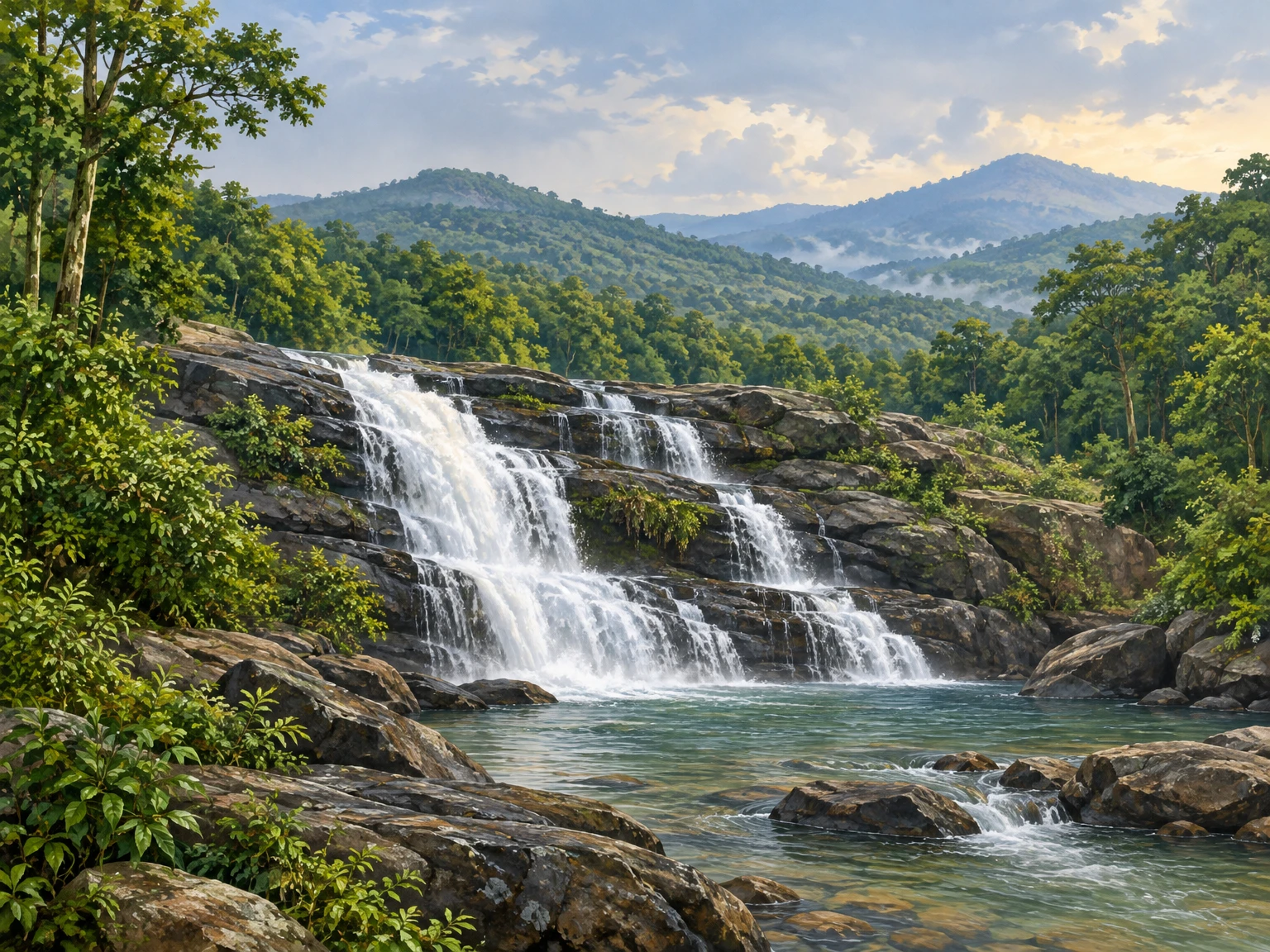
- Featured art: original AI-generated text-free Keonjhar landscape illustration created 25 October 2026 for this article; no third-party photograph used.
- Latest news and access refresh checked 4 November 2026: Kendujhar destination, Kendujhar Tourist Places, and Odisha Tourism Tourist Offices directory; the first two offer general listings, not live gate or route status.
- Over 20 hurt as bus hits tree after tyre burst in Keonjhar — The Times of India, 3 November 2026; 20 injured as bus hits tree after tyre burst in Odisha’s Keonjhar — Sambad English, 3 November 2026. Both report at least 20 injured; passenger counts differ.
Disclaimer
This content is a collection of ancient history,books and various articles and collection of library and news and other post ; all details may not be the same. Readers are requested to verify the information themselves. Readers are not allowed to take any disciplinary action; content is only for educational purposes. If readers do not agree about the contents, they may send a personal comment to my personal email ID: achary.purna@gmail.com
