
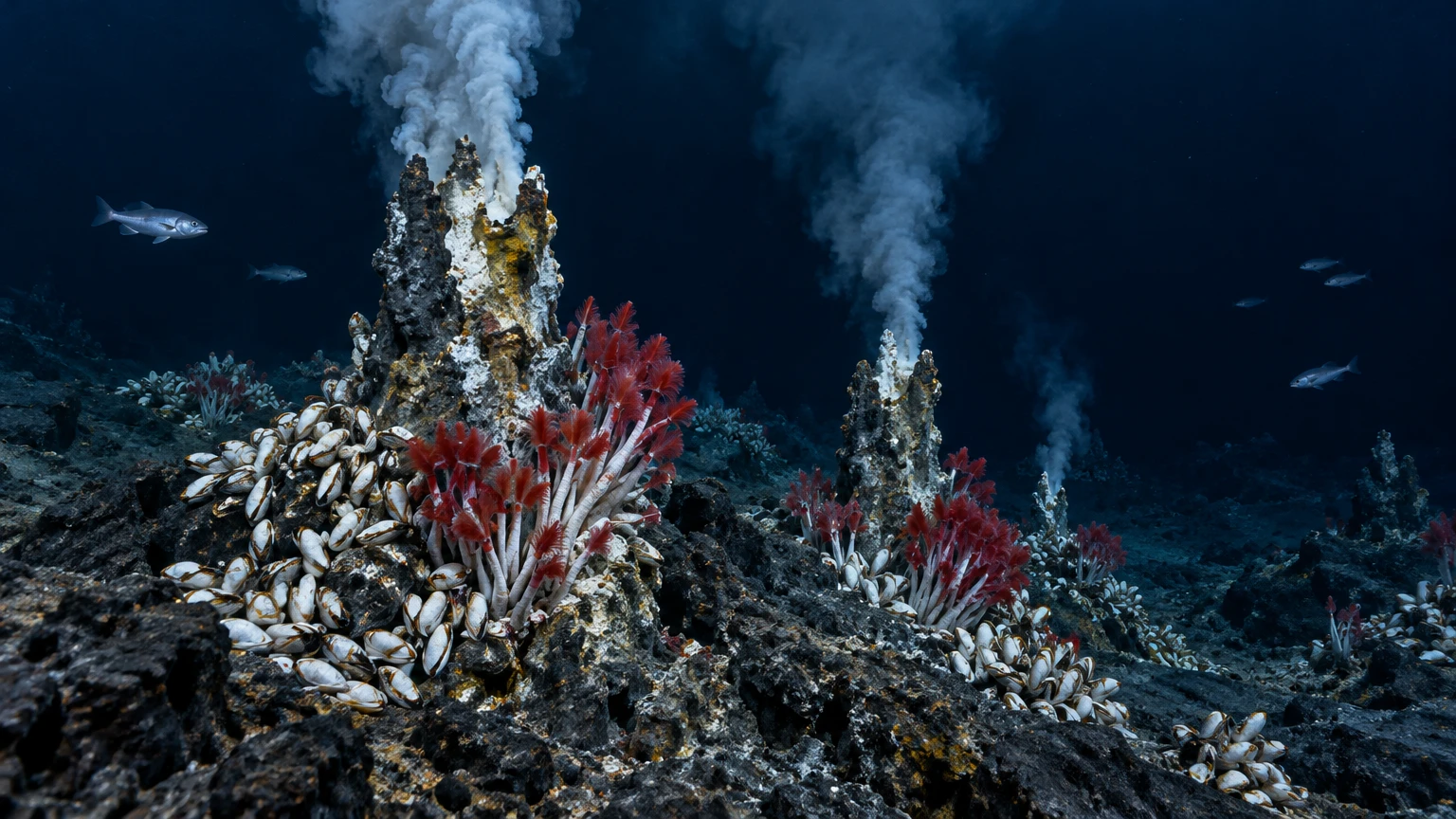
On a dark seafloor far below the reach of sunlight, water can emerge from cracks in the crust hot enough to exceed 400 degrees Celsius. Around these openings, life is not merely surviving at the edge of an ordinary food chain. Microbes use chemical energy, rather than sunlight, to build the organic matter that supports dense communities of animals. Hydrothermal vents are therefore geological features, chemical reactors, habitats, and natural laboratories all at once. Their discovery forced scientists to widen a central idea in biology: sunlight drives most familiar ecosystems, but it is not the only energy source capable of supporting a food web.
This guide follows the process from moving plates and circulating seawater to mineral chimneys, microbial metabolism, animal partnerships, exploration, and conservation. It also separates established observations from open questions. A vent is not a single kind of spring, and no one short description captures every field. Temperature, water chemistry, geological setting, and the communities present can differ sharply from one site to another.
1. What is a hydrothermal vent?
A hydrothermal vent is an opening or zone on the seafloor through which heated, chemically altered water flows back into the ocean. The water began as seawater that entered cracks in oceanic crust, traveled underground, and interacted with hot rock. At some points it rises through a focused chimney; elsewhere it escapes diffusely over a broader patch of seabed. The word “vent” can refer to the fluid outlet, the chimney, or, more loosely, the surrounding active field. Scientists distinguish these scales because a single chimney and a whole vent field are not the same habitat.
Vents are commonly associated with underwater volcanic regions, especially mid-ocean ridges where plates pull apart, and some convergent settings where one plate sinks beneath another. They are not simply underwater versions of geysers. Their chemistry is shaped by the rocks and gases encountered underground, the temperatures and pressures of circulation, and the mixing that occurs when hot fluid meets cold seawater. That interaction links deep geology to ocean chemistry and provides the raw materials for distinctive ecosystems.
2. The tectonic setting beneath the ocean
Earth’s outer shell is divided into moving tectonic plates. At divergent boundaries, plates move apart and new ocean crust forms as magma rises and cools. At convergent boundaries, plates move toward one another; in subduction zones, oceanic crust descends beneath another plate. Both kinds of setting can host submarine volcanism and hydrothermal circulation. The Mid-Atlantic Ridge and the East Pacific Rise are familiar examples of spreading systems, while the Pacific “Ring of Fire” includes many convergent margins and volcanic arcs.
These regions are dynamic rather than static. Fractures open and close, magma moves, lava erupts, and the structure of the crust changes over time. The tectonic framework supplies pathways for water and heat, but the exact vent chemistry depends on local conditions. Two nearby fields may differ because fluids pass through different rock types or follow different routes. A global map of vents is therefore a map of known and suspected activity, not an inventory of every opening: much of the seafloor remains difficult to inspect closely.
3. How seawater becomes hydrothermal fluid
Cold seawater sinks into fissures and pores in the ocean crust. As it circulates downward, it is heated by hot rock and, in some systems, by magma at depth. Heating changes its buoyancy: the warmer fluid rises, carrying dissolved substances acquired through water-rock reactions. In the process, some components of seawater are removed while others are added or transformed. The returning fluid can contain sulfur compounds, iron, copper, zinc, hydrogen, methane, and other substances in proportions that vary by field.
“Hydrothermal fluid” is a useful term because the water is no longer chemically identical to the seawater that entered the crust. It has been heated and altered underground. Some vent fluids are acidic and rich in metals; others have different compositions and temperatures. The details are important: an organism adapted to a particular chemical mixture may not thrive at another vent. Samples taken at the outlet, in the mixing zone, and in the surrounding seawater can all tell different parts of the story.
4. Why extreme heat does not mean boiling
Measurements at high-temperature vents can approach 400 degrees Celsius, or about 750 degrees Fahrenheit. At first, this sounds incompatible with liquid water. But pressure rises with depth, and the immense pressure of the deep ocean changes the conditions at which water boils. Hot vent fluid can therefore emerge without behaving like a pot of water on a kitchen stove. Scientists report both the fluid temperature and the depth and pressure context to avoid misleading comparisons with surface conditions.
The striking temperature of a chimney outlet is not the temperature of every animal nearby. Vent communities occupy steep gradients. Very hot fluid mixes with near-freezing bottom water over short distances, creating warmer but more tolerable microhabitats around the outlet. Animals and microbes live in particular portions of this gradient, not necessarily in the hottest jet. A photograph showing organisms beside a black smoker does not mean those animals are immersed in 400-degree fluid. Understanding the scale and location of a measurement is essential to interpreting life at vents.
5. The making of a black smoker
When hot, metal-rich fluid meets cold seawater, chemical conditions change rapidly. Dissolved minerals can precipitate, meaning they come out of solution as solid particles. Fine sulfide minerals darken the rising plume and help create the familiar appearance of a black smoker. As mineral particles accumulate around a focused outlet, a chimney can grow upward. Its shape records an ongoing contest between mineral deposition, fluid flow, chemical reactions, and physical breakage.
The “smoke” is not combustion or ash. It is a suspension of tiny mineral particles carried in water. The dark color is associated especially with iron sulfide, though the fluid and deposits can include other metals and minerals. The chimney is not an inert pipe fabricated in one event: it is a changing geological structure through which fluid flows, sometimes sealing, cracking, or being replaced as conditions shift. This makes the chimney both evidence of subsurface processes and a habitat surface for microbes and animals.
6. White smokers and diffuse flow
Not all vent chimneys are black. NOAA describes white smokers as structures whose deposits include minerals such as barium, calcium, and silicon, producing a lighter appearance. Their color reflects differences in mineral composition and fluid chemistry rather than a different source of heat altogether. Even within one vent field, chemistry can vary among outlets. Scientists use fluid sampling and mineral analysis to interpret those differences instead of assuming that every pale plume represents the same process.
Some venting is diffuse: fluid has mixed with cooler seawater beneath the surface or spreads through cracks before emerging across a wider area. Diffuse flow may be far cooler than the focused high-temperature outlet, yet still contain chemicals that microbes can use. These zones often matter greatly to animals because they provide warm, chemically rich water without exposing organisms to the hottest conditions. A field can include a towering chimney, lower-temperature cracks, and microbial mats over nearby rocks, all connected through an underground circulation system.
7. Chemosynthesis: making food without sunlight
At the ocean surface, photosynthetic organisms capture sunlight and use it to build organic matter. At deep vents, some microbes instead obtain energy from chemical reactions. This broad process is called chemosynthesis. Microbes use energy released by reactions involving compounds in vent fluids and combine that energy with carbon sources to make organic molecules. Hydrogen sulfide is one well-known energy source, but it is not the only one: different microbes can use different chemicals and metabolic pathways.
It is useful to avoid saying that chemosynthesis is simply “photosynthesis without light.” The organisms, energy sources, and biochemical routes are diverse. NOAA’s educational material explains one pathway in which bacteria oxidize hydrogen sulfide and use carbon dioxide and oxygen to make organic food; other microbes may use hydrogen, methane, iron, or other compounds, sometimes under different oxygen conditions. The result is the same ecological principle, not one universal chemical recipe: certain microbes convert chemical energy into biological material that can sustain themselves and, directly or indirectly, other organisms.
8. The microbes at the base of the food web
Chemosynthetic microbes can live on the seafloor, in the subsurface, on mineral surfaces, in plumes, and in association with animals. Some grow as visible mats around diffuse flow; others are microscopic and detectable only through sampling. They are primary producers in the vent food web because they convert inorganic chemical energy into organic material. Grazers can feed on microbial mats, suspension feeders can consume free-living microbes from the water, and predators can feed on the animals that rely on microbes.
This locally produced food helps explain why vent fields can support dense aggregations against the sparse background of much of the deep seafloor. Away from vents, many deep-sea communities depend substantially on organic matter sinking from the surface. At an active vent, chemical energy is available in a concentrated place. Yet “oasis” should not be mistaken for a guarantee of stability or abundance everywhere. The size, productivity, chemistry, and persistence of each field vary, and the surrounding deep ocean remains part of the wider ecological setting.
9. Partnerships between microbes and animals
Some vent animals host chemosynthetic microbes in or on their bodies. In these symbioses, microbes receive access to chemicals and a protected living environment; the host receives organic nutrients made through microbial metabolism. The partnership is not a decorative curiosity. It can change how an animal obtains food and help explain how large animals live where ordinary photosynthetic production is absent. These relationships are studied through anatomy, chemistry, physiology, and direct observation, and scientists continue to investigate how they vary among species.
Giant tubeworms are a striking example. They lack a conventional mouth and digestive tract as adults and house symbiotic microbes in a specialized internal organ. Their red plumes exchange materials with surrounding water, while their tissues provide a home for the microbial partners. Vent mussels can carry microbes in their gills. Such examples show why an ecosystem cannot be understood by looking at the largest animal alone: the unseen microbes and the chemical conditions enabling their metabolism are central to the community.
10. Animals that graze, filter, and hunt
Vent communities can include shrimp, clams, mussels, crabs, snails, limpets, scale worms, fish, octopods, and tubeworms. Their strategies differ. Some graze on bacterial mats, others filter microbes or organic particles from water, and predators consume grazers and smaller animals. Species composition changes from one region to another. A list of familiar vent animals is therefore a guide to possible members of the community, not a promise that every species appears at every site.
Not every animal is a symbiotic partner, and not every organism directly uses vent chemicals. Food webs have multiple pathways. Microbes may be eaten directly, transferred through host animals, or incorporated into prey consumed by predators. Larvae and small organisms also move between the vent and surrounding waters. Ecologists reconstruct these connections using observations, gut contents, chemical signatures, experiments, and molecular methods. The resulting food web is an interacting network, not a simple ladder in which one organism feeds on exactly one other organism.
11. Adaptation to darkness, pressure, and chemical gradients
At depths where sunlight does not reach, visual conditions differ from those in shallow water. The environment is also under high pressure and can include abrupt changes in temperature and chemical composition. Animals are adapted to the conditions of their particular habitats; microbes have their own physiological limits. Some organisms tolerate compounds that would be harmful to many surface-dwelling species, but this does not mean all vent life is immune to toxicity. The same compound may be essential at one concentration and damaging at another.
Adaptation is often specific and carefully tuned. A species can live in a narrow zone where a useful chemical is present but the temperature remains within its tolerance. Vent animals may use specialized feeding structures or partnerships; larvae may disperse on currents before settling at a new field. These observations help scientists ask how organisms persist through local change. But the term “extremophile” should be used thoughtfully: it describes organisms suited to conditions that are extreme relative to human experience, not creatures that can withstand every extreme without limit.
12. Vents are not the same as cold seeps
Hydrothermal vents and cold seeps both release chemically rich fluids from the seafloor and can support chemosynthetic life, but their drivers and typical conditions differ. Hydrothermal vents are commonly linked to volcanic heat and can release high-temperature fluids. Cold seeps generally release cooler, often hydrocarbon-rich fluids more slowly. Their seepage can persist for long periods, while volcanic activity can make vent systems more variable. Shared reliance on chemical energy does not erase those geological differences.
The distinction matters when comparing animals, rates of change, and ecosystem duration. Species that thrive at a seep may not be found at a hot vent, and vice versa. Some organisms occur in both kinds of habitat, but their local partners and resources can differ. When reading a general account of chemosynthetic ecosystems, check whether it is discussing vents, seeps, or both. Combining all chemically fueled seafloor habitats into one category can obscure the processes that create them and the protections each may need.
13. A discovery that changed expectations
Scientists first discovered hydrothermal vents in 1977 while exploring a spreading ridge near the Galápagos Islands. The finding was surprising not only because hot, mineral-rich water was emerging from the seafloor but also because diverse animal communities clustered around it. The discovery challenged the assumption that sunlight-dependent photosynthesis had to underlie every substantial ecosystem. Instead, vent microbes could use chemical energy, and animals could build food webs around those microbes.
The discovery did not show that sunlight is unimportant to life on Earth; photosynthesis remains the foundation of most familiar food webs. It showed that biology has more than one energy pathway. It also opened new questions about the range of environments where life can persist and how geological processes shape habitats. Researchers have since found vents in multiple ocean basins, but new discoveries still occur. Exploration remains challenging because vent fields are deep, often remote, and small compared with the ocean as a whole.
14. Chimneys as records of changing chemistry
A chimney’s mineral layers can preserve evidence of changing fluids and conditions. As fluid composition shifts or mixing changes, different minerals may accumulate. Some deposits can be chemically altered after formation by seawater. Geologists analyze mineral assemblages and structures to understand how fluids moved, how chimneys grew, and how the surrounding crust interacted with them. Such interpretations must account for the fact that a sample represents a particular place and time in a dynamic system.
Hydrothermal processes also help explain some ancient mineral deposits found on land. Geological research compares modern seafloor processes with mineralized rocks preserved in the crust. This is an analogy grounded in evidence, not a claim that every ore body formed at a modern-style vent. Tectonic setting, age, rock type, fluid chemistry, and later geological history all matter. The modern seafloor offers scientists a chance to observe mineral formation directly, while ancient deposits offer a record of processes no longer visible in their original setting.
15. Vents and ocean chemistry
Hydrothermal circulation moves heat and dissolved substances between crust and ocean. As fluids emerge and mix, minerals may precipitate and chemicals may enter or leave the surrounding water. These flows contribute to geochemical cycles: the movement and transformation of elements through rocks, water, and living systems. Scientists measure vent fluids, plumes, and surrounding seawater to estimate these contributions and understand the chemistry of particular regions.
It is easy to overstate the influence of a dramatic local plume on the entire ocean. Vents can have important effects on nearby waters and contribute to global chemical cycling, but the scale of an effect must be established through measurements and models. A visible black plume does not by itself tell us how much of any element enters the ocean or how long it remains there. Geochemists combine field sampling, laboratory work, and circulation models to connect a small outlet to larger ocean processes.
16. How scientists find vent fields
Scientists can search for indirect clues before seeing a vent itself. Chemical or temperature anomalies in the water column may point toward a hydrothermal plume. Ship-based surveys map seafloor topography and collect water measurements. Towed cameras, remotely operated vehicles, autonomous underwater vehicles, and human-occupied submersibles then provide closer views or collect samples. Different tools have different strengths: a broad survey can cover more ground, while a submersible can inspect a precise site and interact with it.
Finding a vent does not instantly reveal its ecosystem or history. Researchers must identify where fluid emerges, measure temperature and chemistry, document organisms, and sample rock and water while minimizing disturbance. Repeat visits can show whether a field has changed, but repeated sampling is expensive and logistically difficult. A map may distinguish confirmed sites from suspected ones. That distinction should be preserved in public explanations; “known vent locations” does not mean all vents have been found or that every listed location is equally well characterized.
17. Seeing and sampling the deep seafloor
Deep-sea vehicles allow researchers to photograph and video habitats, measure conditions, and collect samples that would otherwise be out of reach. Remotely operated vehicles are controlled from a ship and can carry cameras, lights, sensors, and sampling arms. Autonomous vehicles follow programmed routes and can survey the seafloor without a tether. Human-occupied submersibles let scientists observe directly, though they are complex and costly to operate. Each approach supports different kinds of questions and must be interpreted in light of its sampling limits.
Images are powerful but incomplete. A camera sees only the areas it passes over, and lighting, sediment, plume movement, or equipment can affect what appears in a frame. A clear image of a tubeworm cluster cannot identify every microbe supporting it. Samples help, but they are also small snapshots of a heterogeneous field. Modern vent science therefore combines visual evidence with fluid chemistry, mineralogy, genetics, incubation experiments, and mapping. No single instrument or photograph stands in for the whole ecosystem.
18. How communities colonize changing fields
Vent activity can wax and wane as volcanic and tectonic conditions change. A chimney may become inactive, a flow path may shift, or new lava may cover an existing habitat. Biological communities can be affected as well. Some fields may persist for a long time; others may be relatively short-lived. NOAA’s educational fact sheet notes that new life can recolonize an area after volcanic disturbance if a suitable heat source and conditions return. The timing and exact sequence depend on the site.
Many vent animals have life stages that disperse. Tiny larvae can travel in ocean currents and settle when they encounter a field with suitable conditions. This helps explain how separated vent communities can be connected, even when adult animals remain attached to one location. But dispersal does not guarantee successful colonization: larvae must reach a suitable habitat, survive, find partners or food, and reproduce. Connectivity is a research question involving currents, life histories, genetics, and the spacing of vent fields.
19. What vents may teach about life’s beginnings
Hydrothermal vents attract interest in origin-of-life research because they bring together water, minerals, chemical gradients, and energy sources. Some scientists hypothesize that environments resembling parts of the early seafloor could have supported chemical steps relevant to the emergence of life. Current vents provide places to study how geochemical reactions can fuel microbial metabolism. These are valuable clues about possible pathways, not direct observations of life’s first moment.
The earliest origin of life remains unresolved. Vents are one family of hypotheses among several, and researchers debate which settings, molecules, and sequences could have mattered. Evidence that modern microbes thrive on chemical energy does not prove that the first organisms arose at a vent. Nor do living vent animals represent primitive organisms simply because their habitat is unusual. Scientific writing should make the difference clear: a plausible mechanism and a compelling research site are not the same as a settled historical conclusion.
20. Connections to worlds beyond Earth
Hydrothermal systems also enter discussions of icy moons that may contain subsurface oceans. If an ocean exists beneath ice and rock-water reactions provide chemical energy, then sunlight may not be the only possible source of biological energy. This makes Earth’s vents useful analogues for investigating habitability: they help researchers ask what chemical environments might sustain microbes and what instruments could detect relevant signals.
An analogue is not proof of life elsewhere. No extraterrestrial vent has been directly observed, and the chemistry, water composition, temperature, and geological history of another world may be different. Scientists use Earth systems to develop hypotheses and test methods, then compare those ideas with spacecraft measurements and planetary models. The responsible conclusion is conditional: hydrothermal processes make some ocean worlds scientifically interesting places to investigate, but whether life exists there remains unknown.
21. Minerals and the question of deep-sea mining
Vent chimneys and nearby deposits can contain metals such as iron, copper, and zinc, and some deposits may include other economically interesting elements. This has led to research and public discussion about potential deep-sea mineral resources. A geological deposit is not automatically an accessible or viable mine. Scientists study where minerals form, how quickly deposits accumulate, how much is present, and what a mining operation could do to the seafloor environment.
Vent ecosystems can be small and geographically isolated, and the deposits that build their habitat are part of the ecological structure itself. Removing a chimney or disturbing surrounding seabed could affect organisms, microbial communities, and the physical setting. The degree and duration of impacts depend on the proposed activity, location, equipment, sediment, plumes, and recovery conditions. WHOI’s overview notes concern that mining could damage small and uncommon vent fields. This article does not decide a policy question; it explains why biological and geological evidence must both be considered before decisions are made.
22. Conservation and responsible research
Protecting a vent field requires knowing what is there, how the community functions, and how connected it may be to other habitats. Some organisms may be highly localized; others may disperse between sites. Researchers and policymakers must consider direct disturbance, sediment movement, chemical plumes, cumulative effects, and uncertainty in baseline data. Conservation is complicated by the depth and remoteness of the seafloor, but those challenges do not make the habitats expendable.
Research itself can disturb a site, so expeditions plan how to collect samples and where to place instruments. Many scientific questions can be advanced through observation and non-destructive measurements; some require collecting organisms, fluids, or rocks. Responsible practice documents methods and limitations, preserves records, and distinguishes observations from interpretations. Public discussion benefits when it avoids both extremes: portraying every vent as an untouched paradise or treating a mineral deposit as an empty resource. The same place can be a geological archive, a living community, and a potential target of human activity.
23. Common misconceptions
First, the “black smoke” is not smoke from fire; it is mineral-rich water carrying fine particles. Second, the surrounding animals are not all living in superheated fluid; they occupy cooler mixing zones and have particular tolerances. Third, chemosynthesis is not one reaction used by every vent microbe. Different organisms use different chemicals and pathways. Fourth, hydrothermal vents and cold seeps are related in their chemical basis for life but differ in their geological drivers and fluid conditions.
Another misconception is that a vent discovery settles the origin of life. It does not. Modern vent ecosystems show that life can thrive without sunlight as the local energy source, and they offer clues for origin-of-life research. Those are important findings in their own right. Likewise, the existence of mineral-rich chimneys does not demonstrate that mining is harmless or inevitable. Clear explanations preserve the distinctions among observation, mechanism, hypothesis, and decision.
24. A useful way to read vent science
When evaluating a claim about vents, ask what was measured and where. Was the temperature taken at a focused outlet, in a plume, or among animals? Is the site a black smoker, a diffuse-flow zone, a white smoker, a cold seep, or a broader field? Does the claim come from a direct sample, an image, a model, or a comparison with another geological setting? These questions help keep a dramatic fact in proportion without diminishing its significance.
Also check the date and scope of the source. A particular expedition can describe one field but cannot establish what all vent ecosystems do. A count of known animal species may depend on taxonomy and discovery effort. A global map may show confirmed and suspected locations together. Reliable science communication states those boundaries in ordinary language, while linking readers to the original institutions and publications where methods and context can be examined.
25. Why these ecosystems matter
Hydrothermal vents connect processes that are often taught separately. Plate tectonics creates pathways; hot rock changes seawater; mineral reactions build chimneys; chemical energy sustains microbes; microbes feed larger organisms; and the movement of water transports heat and elements through the ocean. Each link can be studied with geology, chemistry, biology, oceanography, engineering, and deep-sea exploration. The result is a vivid example of how Earth’s interior and its living systems interact.
The broader lesson is not that life is easy to find wherever there is heat or chemistry. It is that living systems can exploit more than one energy route, and that the environments supporting them depend on precise local conditions. Vents expand our picture of habitability while reminding us how much remains unknown. Continued exploration can reveal new species and processes, but it should also improve the evidence available for decisions about the seafloor.
Conclusion: a living boundary between rock and ocean
A hydrothermal vent begins with water moving through fractured crust and returning altered by heat and rock. At the ocean floor, mixing builds mineral structures and creates chemical gradients. Microbes use those gradients to make organic matter, and animals build varied feeding relationships around the microbial foundation. The same processes influence ocean chemistry and create a mineral record of changing geology.
Vents are not proof of every theory about life’s origins, a single uniform habitat, or an inexhaustible resource. They are observable systems that help scientists test ideas about energy, ecology, geochemistry, and planetary habitability. Their most enduring surprise may be the way they join the seemingly distant worlds of deep Earth and deep-sea biology. In darkness, the planet’s heat and chemistry can support a community whose existence was once thought impossible.
Sources and further reading
NOAA National Ocean Service, “What is a hydrothermal vent?” https://oceanservice.noaa.gov/facts/vents.html
NOAA Ocean Exploration, “Hydrothermal Vents” fact sheet, https://oceanexplorer.noaa.gov/wp-content/uploads/2022/10/hydrothermal-vents-fact-sheet.pdf
NOAA Pacific Marine Environmental Laboratory, “Chemosynthesis,” https://www.pmel.noaa.gov/eoi/nemo/explorer/concepts/chemosynthesis.html
Woods Hole Oceanographic Institution, “Hydrothermal vents,” https://www.whoi.edu/ocean-learning-hub/ocean-topics/how-the-ocean-works/seafloor-below/hydrothermal-vents/
U.S. Geological Survey, “Marine Minerals and Offshore Energy,” https://www.usgs.gov/science/science-explorer/ocean/marine-minerals-and-offshore-energy
Smithsonian Ocean, “The Microbes That Keep Hydrothermal Vents Pumping,” https://ocean.si.edu/ecosystems/deep-sea/microbes-keep-hydrothermal-vents-pumping
This content is a collection of ancient history,books and various articles and collection of library and news and other post ; all details may not be the same. Readers are requested to verify the information themselves. Readers are not allowed to take any disciplinary action; content is only for educational purposes. If readers do not agree about the contents, they may send a personal comment to my personal email ID: achary.purna@gmail.com
