
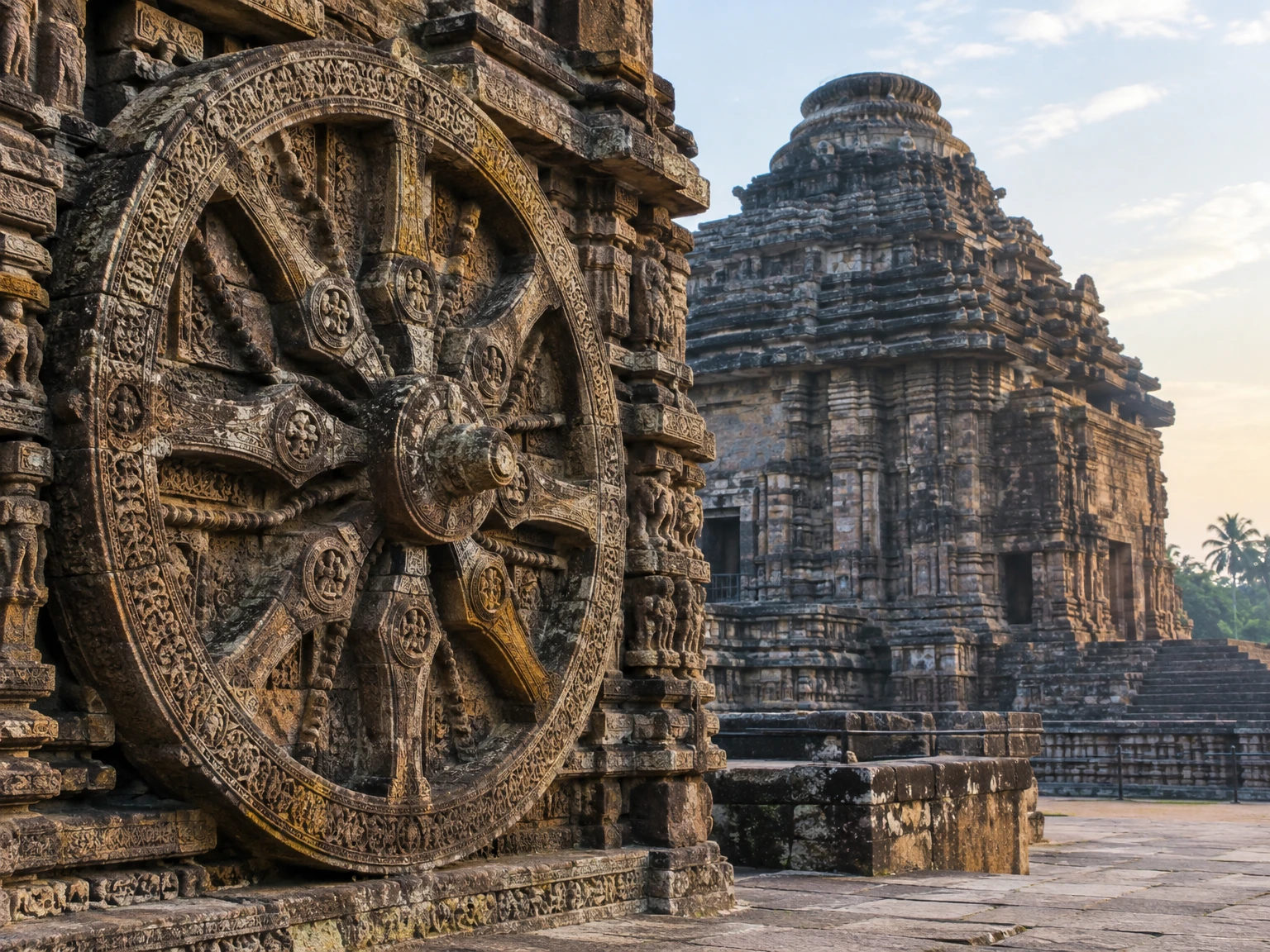
Konark’s Sun Temple is often introduced through a striking image: a stone chariot carrying Surya across the sky. That image is accurate, but it is only the beginning of how to read the monument. Its surviving buildings, carved wheels, sculptural bands, missing tower and coastal setting together make an unusually rich record of architecture, worship, craft and change. They also ask us to distinguish what can be seen today from what must be reconstructed from evidence, and what a living monument requires from what a visitor may wish to imagine.
This guide follows the temple from its broad plan to its carved details, then turns to conservation: why preservation is not simply a matter of making old stone look new. The Sun Temple is a protected World Heritage property, and the Archaeological Survey of India carries out its conservation programmes. The discussion below relies chiefly on UNESCO’s World Heritage Centre description and protection information, with visitor context from Odisha’s official tourism pages. Where those sources differ or leave a question open, that uncertainty is stated rather than filled with a confident-sounding legend.
Begin with the whole complex, not a single photograph
When people say “Konark Temple,” they often mean the familiar group of carved wheels and the great pyramidal hall behind them. Yet the World Heritage Centre describes a complex made of several spatial units, arranged from west to east. The principal sanctuary, or vimana, once carried a high tower capped by a shikhara. The audience hall, called the jagamohana in the UNESCO description, remains the most visually dominant mass in the ruins. Farther east is the natmandir, or dance hall, now open to the sky and raised on a platform. Subsidiary buildings and sculptural remains occupy the enclosed precinct as well.
This sequence matters. A temple is not just a facade to be admired from one angle; it is a designed relationship between approach, threshold, gathering, ritual and the central sacred image. At Konark, the visitor sees an incomplete but still legible arrangement. The missing tower does not erase the plan, and the surviving hall does not stand alone. Looking across the complex helps make sense of how architectural mass and open space were intended to work together. It also guards against treating the most photogenic carving as the entire monument.
A monument of the Eastern Ganga period
UNESCO identifies the Sun Temple as a thirteenth-century monument and an exceptional physical testimony to the Hindu kingdom of Odisha under Narasimha Deva I, whose reign it gives as 1238–1264 CE. The architectural achievement is therefore also historical evidence: it reflects the resources, beliefs and organized craftsmanship of a powerful medieval kingdom. UNESCO describes the building as part of the culmination of Kalingan temple architecture, linking its form to an established regional tradition rather than presenting it as an isolated wonder.
That historical frame is useful, but it does not answer every question about the people who designed, quarried, moved, fitted and carved the stones. A monument can show the scale and refinement of a court-sponsored project while leaving many individual names and working conditions unrecorded. Popular accounts often supply vivid details about the master builder, the number of workers or the exact duration of construction. UNESCO itself records a dramatic construction legend, but a legend is not the same kind of evidence as a dated inscription or a documented archaeological finding. Readers should enjoy the story as part of the temple’s cultural memory while keeping its evidentiary status clear.
The chariot as an architectural idea
The central design conceit is both simple and ambitious: the temple represents Surya’s chariot. The wheels and horses make the building seem to move through cosmic time, even though it is fixed in stone. UNESCO’s statement of Outstanding Universal Value describes twelve pairs of wheels and seven horses as part of that celestial image; its short introductory description, however, refers to a team of six horses. The official district tourism page also says that six of the seven horses still stand. Rather than pretending these pages agree on every count, it is better to note the difference and focus on what the monument makes unmistakable: the chariot is a powerful organizing metaphor for the whole structure.
That metaphor unites religion and architecture. Surya is not merely a figure placed inside a building; the building itself becomes a vehicle for depicting the sun’s journey. Its scale gives the divine idea civic and public presence. The temple’s sculptural programme, proportions and overall layout make the concept readable from a distance, while closer details reward careful looking. As a visitor moves through the precinct, the chariot image can be understood as an invitation to think about recurring movement—day and night, seasons, ritual cycles and human life—rather than as a literal machine made of stone.
What the wheels communicate
The twenty-four carved wheels are among the temple’s most memorable features. UNESCO places them on the north and south sides, describes each as about three metres in diameter and notes symbolic motifs associated with seasons and months. Their repetition is not monotonous: each wheel is a sculptural composition whose spokes, rim and surrounding decoration organize patterns within patterns. The wheels allow a visitor to grasp the chariot idea at once, but they also ask for a slower second look at the ways repeated forms can carry variation and meaning.
Wheels are often described as sundials. Odisha Tourism uses that interpretation, and the design certainly encourages attention to light, shadow and the sun’s path. It is safest, however, not to turn that broad interpretive description into a promise that every wheel functions as a precise clock under any conditions. A sundial’s reading depends on orientation, sunlight, season and a clear method of observation. At the site, the more durable point is that the wheel form makes time visible as part of the monument’s design. Visitors can notice how a fixed carved object evokes rotation and passage without needing to claim a modern measurement accuracy that official descriptions do not establish.
Carving as a narrative surface
UNESCO describes the plinth between the wheels as richly decorated with reliefs of lions, musicians, dancers and erotic groups, and identifies the sculptures as an invaluable window into religious, political, social and secular life in the period. These are not decorative extras pasted onto an otherwise complete building. Sculpture is integral to the architecture: it animates the base, marks transitions and turns the temple’s surfaces into an expansive visual narrative. A visitor might notice the difference between repeated ornamental patterns and figures that suggest a story, a performance or an aspect of daily life.
Reading those carvings well means resisting two opposite mistakes. One is to treat every image as a transparent photograph of ordinary life; sculptural conventions, ritual symbolism and artistic choices shape what is shown. The other is to reduce the entire programme to a single sensational subject. UNESCO’s description names musicians, dancers, lions and erotic imagery among a much wider range of representations. The temple’s visual world is plural. It brings together sacred reference, courtly presence, performance, abundance and human experience, and it cannot be summarized by one motif or one visitor’s reaction.
Three architectural parts, three different experiences
The lost vimana, surviving jagamohana and unroofed natmandir each help explain how the complex once worked. The principal sanctuary was the sacred focus, and UNESCO notes that its high tower was razed in the nineteenth century. The audience hall’s pyramidal mass now dominates the ruins, giving visitors a strong sense of architectural weight even though the original ensemble is incomplete. The dance hall, farther east, remains on a raised platform without its roof, so sky and weather are now part of the experience of viewing it.
These differences are more than a checklist of building names. They show how a religious complex could combine a central sanctuary, a gathering or audience space, and a place associated with dance and performance. They also clarify why conservation decisions must be specific to each structure. A roofless platform, a surviving massive hall and a lost tower present different questions about drainage, structural stability, the protection of sculpture and the limits of reconstruction. A responsible description acknowledges the missing parts without treating them as permission to invent a complete original appearance.
Understanding absence without filling it with fantasy
The tower’s loss is visually powerful, and it naturally prompts questions about when and how the principal sanctuary collapsed. The sources used for this article establish that the tower was razed in the nineteenth century; they do not settle a single dramatic cause or a precise sequence of events. A careful account should therefore avoid stating a popular explanation as proven. The surviving buildings and sculptures are enough to tell a compelling story about the temple’s design, even when some chapters in its physical history remain uncertain.
Absence also changes how a visitor reads the present site. A ruin is not simply a damaged version of a finished monument. It has become a historical record of construction, survival, loss, excavation, protection and later interpretation. UNESCO recognizes both surviving structures and dislodged remains preserved in situ as part of the property’s integrity. That recognition matters: fragments and incomplete features can retain historical and artistic value. Conservation is not always about restoring a building to an imagined original state; it can mean stabilizing what remains and preserving the evidence that lets future generations understand change.
Materials, workmanship and what we can responsibly say
Official descriptions emphasize the scale, proportion, refinement and sculptural quality of the temple. Odisha’s government heritage material names khondalite among the stones associated with Konark, while other public accounts discuss multiple stone types. Because the sources consulted here do not provide a full technical inventory of every block or a detailed engineering account, this article does not assign a precise stone type to each architectural element. That restraint is important: the colour of a weathered surface or a general description of the monument cannot establish the geology of every component.
What can be discussed confidently is the artistic result. The builders and sculptors made architecture and carving work together at monumental scale. Repeated wheel forms, carefully composed reliefs and the ordering of halls and platforms imply coordinated planning and highly skilled labor. UNESCO calls the temple a masterpiece of creative genius and highlights its conception, scale, proportion and sculptural narrative. Those terms describe the recognized cultural value, not a substitute for technical documentation. When conservation specialists study stone, joints, metal cramps or structural behavior, their measurements and reports—not casual visual guesses—should guide precise claims.
Construction stories and historical evidence
Konark has a memorable story associated with its building: UNESCO records a legend involving a master builder, his son and the completion of a cupola. The World Heritage Centre places this among legends affiliated with works of art, which is a useful clue about how to read it. It is part of the monument’s cultural storytelling, but its dramatic narrative should not be presented as a verified event unless supported by independent historical evidence. This distinction does not make the story unimportant; it helps readers understand that cultural memory and documentary proof answer different questions.
Stories of twelve years and twelve hundred artisans also circulate in official and popular descriptions. UNESCO’s brief synthesis mentions an evocative legend of construction over twelve years using 1,200 artisans. That passage itself frames the account as a legend, not as a payroll or project record. Such stories may express the scale of collective effort and the wonder the temple inspired. A careful writer can explain their symbolic significance while making clear that the cited source transmits them as legend. This is a stronger way to honor both oral tradition and historical method than either dismissing a story or repeating it as literal fact.
Religious meaning and cultural life
The temple is dedicated to Surya, the Sun God, and UNESCO links it to Brahmanism and tantric belief systems and to the historical diffusion of Surya worship. The chariot conceit gives this religious dedication an architectural form that is immediately legible: the deity’s movement is imagined across the heavens, while the structure anchors that movement on earth. The temple’s importance is not only aesthetic. It is a material record of religious ideas, artistic practice and political culture in medieval Odisha.
At the same time, a heritage site is not frozen in the thirteenth century. UNESCO notes living cultural practices associated with the property, including the Chandrabhaga festival. Odisha Tourism highlights the Konark Dance Festival as a major cultural event. These continuing practices connect present communities and audiences to the monument, though they should not be confused with proof that every historical ritual continues unchanged. The temple’s meaning has accumulated over centuries: worship, local memory, scholarship, conservation, performance and tourism all shape how people encounter it today.
Why UNESCO recognition is about more than fame
Konark was inscribed on the World Heritage List in 1984. UNESCO’s Outstanding Universal Value statement explains why: the temple is an exceptional example of temple architecture and art, an important testimony to the thirteenth-century kingdom of Odisha, and a major monument linked to the history of Surya worship. Recognition is therefore not merely a popularity label. It sets out cultural values that management and conservation are expected to sustain over time.
The statement also identifies attributes that carry those values: the surviving structures, their placement within the complex, sculpture integrated with architecture, the setting and the remains preserved in situ. This way of thinking encourages a broad view of preservation. Protecting a carved panel is not enough if the structure around it becomes unstable; protecting the main hall alone is not enough if development or environmental change erodes the setting that helps explain it. World Heritage status does not mean the site is invulnerable or that all conservation questions are settled. It provides a framework for understanding what is at stake and why ongoing care matters.
Conservation is not cosmetic restoration
It can be tempting to define conservation as making a monument look complete or newly built. For an archaeological site, that approach can be misleading. The priority is to safeguard original material, structural stability, significant relationships between buildings and sculptures, and the evidence that reveals the site’s history. UNESCO states that sustaining Konark’s Outstanding Universal Value requires continuing structural and material conservation of the main jagamohana and its sculptures. That wording emphasizes long-term care, not a claim that the temple can or should be rebuilt to a conjectural original form.
Conservation choices involve trade-offs. A treatment that changes a surface may protect it from one kind of deterioration while affecting its appearance or future study. Replacing a missing element can make a site easier to visualize but may blur the line between original fabric and modern reconstruction. Leaving a feature exposed may preserve its honest historical state but increase weathering. These questions call for specialist assessment, documentation and legal oversight. Visitors can help by distinguishing a visible conservation intervention from an ancient feature and by avoiding claims about what a restoration “must” do without consulting the responsible heritage authorities.
The coastal environment and cumulative threats
UNESCO lists several pressures that may affect the property’s integrity: saline breeze, sand blasting, microbiological growth, monsoon rain and associated soil erosion, cyclones and flooding, vehicular movements, development pressure, tourism pressure and population growth. These factors can interact. Salt-bearing air may affect materials; water can enter or move through vulnerable areas; vegetation and microorganisms can grow on surfaces; heavy visitation increases wear and demands careful management. A single storm or tourist season is not the only story. Conservation concerns often emerge through cumulative exposure over time.
It is important not to turn this list of identified threats into a claim that a specific part of the monument is currently failing. UNESCO describes threats and past concerns, not a live engineering inspection for today. The right inference is that ongoing monitoring and maintenance are necessary. Conservation teams need to distinguish active damage from old marks, and environmental exposure from structural movement. That requires on-site documentation and technical expertise. For readers, the key lesson is that weathering is not just an aesthetic issue: it can affect the integrity of stone, sculpture and the relationships among structural elements.
Why the surrounding setting matters
A monument’s setting helps people understand its scale, orientation and relationship to the landscape. UNESCO identifies development pressure and urban growth as concerns and recommends attention to the larger landscape setting and regulated areas. This makes sense because a World Heritage property does not end intellectually at the edge of its stones. Roads, buildings, traffic, landscape changes and visitor facilities can affect the way the monument is experienced and the conditions under which it is preserved.
Protecting a setting involves public planning, local participation and coordination among institutions. It is not a simple choice between heritage and ordinary life. Residents, workers and visitors all use the surrounding area, and a sustainable approach must consider those needs while respecting the significance of the site. UNESCO notes several management-related plans, including safety, environment, master planning, environmental development and tourism. The presence of plans does not by itself prove that every pressure has been resolved; it shows that management has multiple linked responsibilities and needs continued attention.
Protection and responsibility
UNESCO states that the Sun Temple is protected under India’s Ancient Monuments and Archaeological Sites and Remains Act of 1958 and its Rules of 1959. It describes a prohibited zone extending 100 metres outside the property and a further regulated zone extending 200 metres beyond that, where development or similar activity may be controlled to avoid adverse effects on the site’s Outstanding Universal Value. UNESCO identifies the Archaeological Survey of India as the body undertaking conservation programmes through national, regional and local representatives.
These legal and institutional arrangements make conservation a public responsibility. Visitors should follow posted rules, remain within authorized visitor areas, and avoid touching, climbing on or marking the stone. Tour operators and event organizers also have a role in respecting access restrictions and the monument’s capacity. If a visitor notices a safety or conservation concern, the appropriate step is to alert site staff or the relevant authority rather than attempt an intervention. Responsible access supports both enjoyment and preservation; it recognizes that the site is not a prop but a protected cultural property.
A practical way to read the monument during a visit
Begin by taking in the overall plan and asking what survives, what is open to the sky and what has disappeared. Then look at the relationship between the jagamohana’s mass, the platform of the natmandir and the wheel-decorated base. Move from the broad silhouette to one wheel, then to the carved bands between wheels. Notice how repetition establishes a rhythm while individual sculptures vary it. This sequence helps a visitor see architecture and relief as one design rather than as separate attractions.
Next, ask what kind of statement each interpretation makes. “The building represents Surya’s chariot” is a central documented interpretation. “This exact shadow tells the time to the minute” is a stronger technical claim and would require specific evidence about the wheel’s orientation and method. “The tower fell because of one named event” is a historical claim that should be checked against reliable records. Slowing down to separate observation, interpretation and evidence makes a visit more rewarding. It also keeps the monument from being flattened into a set of viral facts.
Visiting with care and checking current details
Odisha Tourism lists Konark in Puri district and provides travel context, while the district portal describes road access from Puri and Bhubaneswar. Published opening hours, light-and-sound timings, ticket rules and transport availability can change. Check the latest official visitor information before setting out instead of relying on an old article or a copied screenshot. If a particular hall, route or sculpture is temporarily closed, respect the restriction; access can be adjusted for safety, conservation or site operations.
For photography, choose views that do not require climbing, leaning on fragile surfaces or obstructing other visitors. Avoid flash or equipment use where site rules prohibit it. A respectful photograph can show the scale of a wheel or the pyramidal outline of the audience hall without implying that a visitor has access to areas that are closed. If you are visiting during a festival or a busy season, allow for crowds and follow staff guidance. A thoughtful visit is not measured by how many close-up images you collect but by how well you notice the monument and leave it undisturbed.
What is known, and what remains open
The strongest source-grounded picture is clear: Konark is a thirteenth-century Sun Temple associated with Narasimha Deva I; it is conceived as Surya’s chariot; it contains twenty-four carved wheels; its complex included a principal sanctuary, audience hall and dance hall; the tower of the principal sanctuary was lost; and its sculptural programme has exceptional artistic and historical value. UNESCO recognizes the surviving architecture and sculpture, the wider setting and the remains preserved in situ as part of the property’s integrity. These are substantial facts, not a thin outline.
Other details need more qualified treatment. UNESCO’s short description and value statement differ on the number of horses, and popular accounts vary on construction details. A current structural diagnosis cannot be inferred from a general World Heritage page. A precise material inventory cannot be inferred from the colour of stone in a photograph. An official schedule can change after publication. The responsible approach is to identify the source, date and scope of each claim, and to let a real uncertainty remain visible until better evidence resolves it. That practice does not weaken cultural writing; it makes it more trustworthy.
Why Konark still matters
Konark’s lasting force comes from the way it brings several scales together. It is a regional architectural achievement and a monument of a medieval kingdom; a religious image made into stone and a sculptural record of social life; a ruin whose losses are visible and a living heritage site connected to present cultural practice. Its wheels make the idea of time tangible, while its conservation needs remind us that stone does not stand outside time. The monument is not a frozen object but a place that continues to be interpreted, cared for and visited.
To read Konark well is to hold wonder and caution together. The chariot metaphor is extraordinary; the carvings invite sustained attention; the surviving structures show the power of Kalingan architecture. At the same time, legends should be labeled as legends, technical conclusions should come from experts, and conservation must protect authentic material rather than substitute an attractive guess. Visitors, researchers, communities and public authorities each meet the monument in a different way. The common responsibility is to keep its evidence, beauty and living significance available for the next generation.
Sources and further reading
- UNESCO World Heritage Centre, Sun Temple, Konârak: Outstanding Universal Value, integrity, authenticity and protection/management requirements.
- Odisha Tourism, Konark Sun Temple: visitor context and access information (check current details before travel).
- Puri District, Government of Odisha, Konark: district-level heritage and travel description.
This content is a collection of ancient history,books and various articles and collection of library and news and other post ; all details may not be the same. Readers are requested to verify the information themselves. Readers are not allowed to take any disciplinary action; content is only for educational purposes. If readers do not agree about the contents, they may send a personal comment to my personal email ID: achary.purna@gmail.com
