
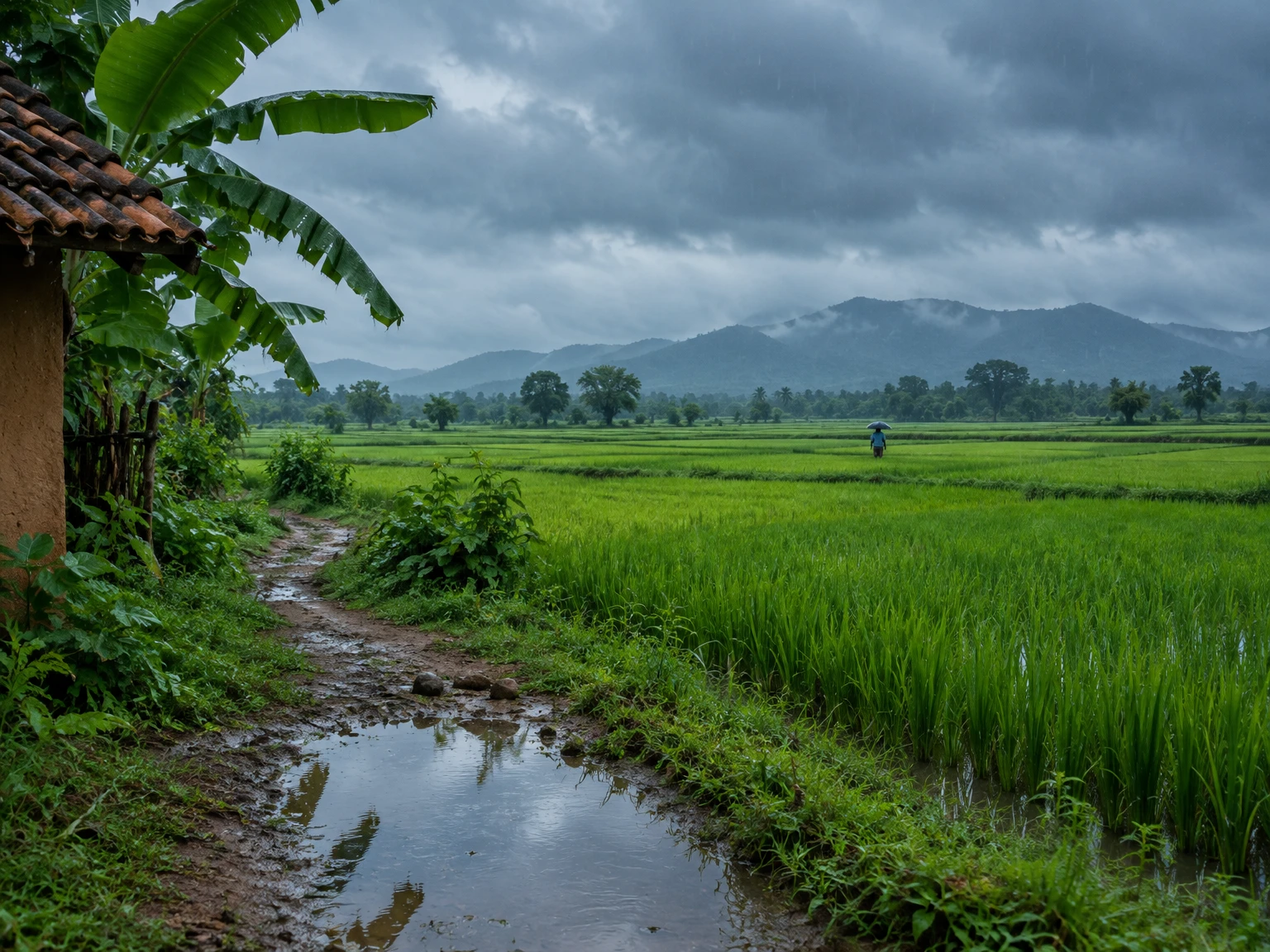
An original literary essay on rain, memory, farming, festivals and the many ways Odisha lives with the monsoon.
At the edge of a hot afternoon, the first rain does not arrive as an idea. It arrives as a darkened patch on dust, a sudden coolness on the skin, and the changed sound of a roof. A child may run to the veranda; a farmer may look toward a field; a commuter may search for shelter. From these small differences grows the great seasonal image of Barsha Rutu, the rainy season as it is named in Odia seasonal language. The word can open a poem, but it does not make every person’s experience the same. Rain may refresh a parched garden, interrupt a journey, fill a pond, flood a lane or fall too lightly to help a crop. This essay follows the monsoon as a meeting of weather, work, culture and imagination, keeping documented facts distinct from metaphor and local belief.
“The earth remembers its poetry” is a literary thought, not a meteorological statement. A season can seem to return an old memory: the smell of wet soil, a green field glimpsed from a bus, or the small silver lines of rain beyond a courtyard. Yet Odisha is not one landscape with one climate or one tradition. Its coastal plains, river basins, hills, plateaus, towns and villages receive and respond to rain in different ways. A careful poem can make room for those differences. It can celebrate beauty without turning hardship into romance, and it can speak of cultural belonging without pretending that every family observes the same custom.
1. Naming a season, reading a sky
Barsha Rutu belongs to the traditional vocabulary through which many people imagine the turning year. Seasonal names in literature and culture carry associations, stories and rhythms that do not function like a forecast. Weather agencies, by contrast, describe observed conditions and issue forecasts for a defined time and place. Both ways of speaking are useful, but they answer different questions. A literary calendar asks what a season feels like, what it evokes and how people place it within the year. A meteorological bulletin asks what conditions have been observed or are expected. Confusing the two can make poetry sound like a scientific claim, or make science seem to deny the value of memory.
The metaphor of clouds as a curtain lowering over the hills can help a reader picture a changing sky. In the real atmosphere, cloud formation and rainfall depend on moisture, circulation, temperature and many other factors. A dark cloud over one district does not tell us how much rain another district will receive. Nor does a poem about the first shower establish the official onset of the southwest monsoon. Onset dates are determined through defined meteorological criteria, not by a single dramatic afternoon. When we describe a cloud as a messenger, we are offering an image. When we describe its movement or expected rainfall, we should use current observations and forecasts.
Odisha’s official agricultural statistics provide a useful scale for the season. The state profile reports average annual rainfall of 1,451.2 millimetres, with most precipitation occurring during the monsoon. In the 2023 rainfall table, June–September monsoon rain is listed at 1,098.8 millimetres against a normal of 1,144.3 millimetres, a four per cent shortfall for that period. The same report shows that the state average conceals variation among districts and months. These figures describe a particular reference and year; they do not predict a coming season or describe each household’s water supply. Their importance is that a statewide total can be both substantial and unevenly shared across time and place.
That unevenness is one reason the monsoon cannot be reduced to a single emotional meaning. A shower can be welcome after heat, while a long break between rains can unsettle agricultural plans. A heavy spell can replenish some water bodies and overwhelm a blocked drain elsewhere. A river carries water from its catchment, not just from the rain falling beside a town. Hill slopes, soil, channels, wetlands, reservoirs, embankments and settlement patterns all affect how water moves. A lyrical account that notices only green fields misses the planning and maintenance that make rainfall safer and more useful.
2. The first rain as a sensory poem
There is a reason people remember the first rain after a dry spell through more than sight. The ground changes colour; leaves shine; the air seems to gather a new weight. The scent that rises when rain meets dry soil is commonly called petrichor. In Odia, a writer may describe it as mati ra gandha, the earth’s smell, while another person may simply say that the courtyard smells of rain. Such words are not identical scientific measurements; they are ways of holding an experience close. The first drops can awaken a remembered street, a school holiday, a journey to a village or the sound of rain against a childhood roof.
Sound changes too. Rain on a tiled roof is different from rain on a tin awning, a leaf, a pond or a concrete balcony. A sudden shower can briefly soften the traffic noise of a city; a steady rain can make the surrounding world quieter, while thunder and wind make it louder. Frogs may call from wet ground in some places, and birds may seek cover or resume activity as conditions shift. None of these observations should be presented as a universal soundtrack. What a person hears depends on the place, the hour, the nearby habitat and the density of human activity. A poem becomes more truthful when it names its own scene instead of claiming to speak for every village.
Colour is another form of seasonal memory. A field that was brown may turn green as plants grow, but the change is gradual and depends on crops, water, soil and timing. A hillside may appear misty beneath cloud; a city road may reflect lamps and shopfronts; a roadside ditch may fill and then drain. The phrase “emerald Odisha” can be attractive, yet it can also flatten the state into a postcard. Rain does not make every area green at once, and not all water is clean or safe. It is better to let a particular field, tree or riverbank carry the image and leave room for other landscapes beyond the frame.
In a story, the first umbrella opened at a bus stop can be as meaningful as a wide view of cloud-covered hills. One person offers a little space to a stranger; another lifts a bicycle onto higher ground; a vendor draws a sheet over a stall. These are not grand gestures, but they show how weather is met through ordinary cooperation. The monsoon is sometimes described as a dialogue between sky and earth. In a human scene, it is also a conversation among people: Who has a dry place to wait? Which lane is passable? Does a neighbour need a hand carrying something indoors? The answers differ, but noticing them keeps the poem grounded.
3. Fields, seed and careful decisions
For many agricultural communities, the rainy months are inseparable from the kharif growing season. Rice is a major crop in Odisha, and rainfall is important to many rice-growing areas. But there is no single timetable that describes every farm. Planting and transplanting depend on local rainfall, water availability, seedling readiness, soil, crop variety, labour and the specific advice available to farmers. A lowland paddy plot with reliable water does not face the same choices as a rain-fed upland field. A household may combine crops, livestock, wage work and other livelihoods. A sentence such as “the farmer waits for rain” may be poetic, but it should not erase the skilled decisions farmers make before, during and after a shower.
When rainfall is timely and well distributed, it can support soil moisture and crop growth. When it is delayed, erratic or excessive, the same agricultural calendar becomes more difficult. A dry interval can stress young plants; very heavy rainfall may cause waterlogging, erosion or damage to field edges. Floodwater can bring sediment in one setting and loss in another. The effect depends on crop stage, duration, drainage, soil and topography. That is why “rain is a blessing” is better understood as a cultural expression of gratitude than as a complete description of weather. The practical question is not only how much rain fell, but where, when, how intensely and with what consequences.
Public advisories turn broad weather information into local guidance. The India Meteorological Department’s Bhubaneswar centre issues district-oriented forecasts and agricultural advice, while agricultural universities and extension services may provide crop-stage recommendations. A bulletin is time-bound: its forecast refers to stated dates and locations and must not be treated as permanent advice. For example, an IMD agromet bulletin dated 30 October 2026 included guidance about clearing blocked drains and moving excess water from fields under the conditions described in that bulletin. That advice is not a timeless instruction for every farmer. It illustrates a broader point: good seasonal decisions depend on current information, not just on an annual average or a remembered proverb.
There is poetry in agricultural preparation, but it should not be mistaken for a romantic tableau. A seed packet, a repaired bund, a cleaned channel or a nursery of young plants represents knowledge and labour. The person tending a plot must consider costs, available time, water, tools and weather uncertainty. Some farmers can irrigate; others rely heavily on rain. Some can change a planting schedule; others face constraints. A writer can honour patience without suggesting that patience alone is enough. The land may be described as listening for rain, but the farmer is not passive: they assess, plan, adjust and share information with others.
It is also important not to make unsupported scientific claims in the name of seasonal wisdom. Dry cracked soil does not automatically become healthier; a crack is not proof that pests have been eliminated or that the soil has been “reset.” Soil structure and biology vary, and changes should be described with agricultural evidence. Likewise, the rains do not guarantee a good harvest. A fairer image is of a field shaped by many conditions and by human care: rainfall, drainage, seed, soil, labour, infrastructure and decisions all meet there. The poem may celebrate a green shoot while acknowledging that farming remains a work of uncertainty.
4. Village life in rain, without the postcard
A village during the monsoon is not simply a stage set of mud lanes and bullock carts. Homes may be built from different materials; roads may be paved or unpaved; families may depend on farming, services, trade, public employment or work beyond the village. One household might gather on a veranda to tell a story during a downpour. Another may be checking a roof, keeping goods dry or finding a way to reach school. Children may play with paper boats, but that is one possible memory, not a universal custom. The details of rain belong to the people who experience them, and their experiences are as varied as the places they live.
Still, a rain-washed veranda can hold a lovely kind of community life. A cup of tea may be shared while a neighbour waits for the shower to pass. An elder may tell a tale that has travelled through generations, altered slightly each time it is retold. Someone may describe a river in flood as it looked years earlier, while a younger person checks a phone for the latest warning. These moments make tradition feel alive rather than frozen. Storytelling, like weather, is shaped by where it occurs: the language used, the listeners present, the season in which it is told and the details each person remembers.
Rural life is often described through closeness to nature, but people are not outside nature and they are not protected from its risks simply because they live near fields. Heavy rain may affect a road, a home, a school or a source of drinking water. Access to shelter, transport, health care and reliable information matters. Some community networks help people respond quickly; public infrastructure and preparedness matter too. A compassionate literary essay can notice both the warmth of shared life and the material conditions that make a rainy day easier or harder. It should not turn vulnerability into scenery.
Animals are part of many rural landscapes, but their care also changes with weather. Livestock need shelter, food and access to clean water; flooded paths or wet enclosures may create practical challenges. We should avoid asserting that every farmer follows one ritual or treatment unless the practice is sourced. A poetic image of a farmer checking a cattle shed can be both vivid and modest: it depicts an act of attention without claiming that one custom represents all of Odisha. The bond between people and animals can be written as a relationship of responsibility, shaped by care and daily work rather than by a single sentimental gesture.
5. The city and the routes water takes
In Bhubaneswar, Cuttack, Rourkela and other towns, monsoon rain meets roads, roofs, drains, bus stops, markets and river systems. The city can look newly polished when wet, its lights reflected on dark pavement; it can also reveal where water has nowhere to go. A low-lying junction may hold water longer than a higher street. A blocked drain may turn a brief shower into a local problem. A paved surface sends water along a different route than soil or vegetation. The sight of a flooded lane is therefore not merely a dramatic image; it raises questions about drainage, maintenance, land use and the connection between built areas and natural waterways.
Odisha’s river networks include the Mahanadi and its tributaries, as well as waterways that cross urban and rural landscapes. Rain falling on a catchment can travel far from the place where it first touched the ground. Water management is consequently more complex than clearing a single roadside ditch. Drainage channels, wetlands, ponds, reservoirs, culverts and riverbanks form connected systems. Construction, waste, silt, vegetation and maintenance can influence their capacity and flow. A poem need not become an engineering manual, but it can make a city feel accountable to the water it receives rather than imagining that concrete has made the weather irrelevant.
Rain can be welcome and hazardous at the same time. A tourism guide may describe July to September as a lush season and point to waterfalls and scenic drives; that is an invitation to enjoy the landscape, not a guarantee that every route is open or safe on every day. Current weather alerts, local travel conditions and official access information should be checked before a trip. The same principle applies to residents: general descriptions of monsoon conditions cannot replace a current local forecast or emergency notice. The beauty of water does not erase the importance of preparation.
From a bridge, one can watch a river change colour and speed after rain. The view may inspire awe, but it does not reveal the full hydrological story. Flow depends on the wider catchment and other conditions, including upstream rainfall and water management. A river should not be called “swollen” simply because a photograph looks dramatic; a claim about flood levels needs reliable data. As a literary image, a river moving beyond its usual edge can suggest change or emotional overflow. As a factual report, it needs a place, time and trustworthy measurement. That small distinction protects both the accuracy and the power of the writing.
6. Festivals, rest and cultural meaning
Seasonal festivals offer another way of meeting nature through shared time. Odisha Tourism describes Raja Parba as a three-day festival observed across Odisha, associated with womanhood, fertility and the cyclical rhythms of nature. Its account says that the festival symbolises the menstruation of Mother Earth and that agricultural activities are paused; swings, traditional games, new clothes and festive foods are among the practices it highlights. This description is a useful public account, but lived customs can vary by place and family. A short article cannot speak for every community or every participant. It can, however, respect the festival’s emphasis on dignity, rest, fertility and collective celebration.
Raja is sometimes narrated as a time when the Earth rests. That image can invite reflection on human relationships with land and labour, but it should not be presented as a scientific explanation of soil processes. Symbolic rest is cultural language. It does not prove that the ground literally menstruates, nor does it settle how all families interpret the festival. Respectful writing can hold the symbol in its own register: a festival gives shape to a community’s ideas about womanhood, renewal and a pause from agricultural work. It can also prompt a present-day conversation about how rest and dignity are valued in human life.
Ratha Jatra at Puri is one of Odisha’s best-known religious festivals. Odisha Tourism describes the annual journey of Lord Jagannath, Balabhadra and Subhadra from the temple toward Gundicha Temple, with the chariots moving along the Grand Road. The festival’s meaning includes devotion, procession, craftsmanship and a public gathering that draws participants from many places. In the official calendar for 2026, the festival began on 16 July. That date is a dated example, not a permanent date for future years. The calendar follows the traditional Odia Hindu calendar, so readers should check a current official listing for future observances.
Ratha Jatra should not be treated as a signal that the monsoon has begun. Its calendar and the meteorological onset of monsoon are different systems, and their timing need not coincide. Nor should a writer state that rain during a procession is always a divine blessing or relief for pilgrims; such a statement would assign one belief to everyone and could ignore real discomfort or safety concerns. A devotional interpretation may be meaningful to particular worshippers, and it can be identified as their belief or tradition. A general article should not turn it into a verified weather fact or claim universal agreement.
Other seasonal observances, including Gamha Purnima and Jhulan traditions, are named in many accounts of Odia cultural life, but details and prominence vary across regions and communities. When discussing a specific observance, the safest approach is to identify the place and source rather than assume a single statewide form. Where reliable documentation is not at hand, it is better to keep the reference brief than to invent ritual details. Culture is not diminished by careful phrasing. On the contrary, acknowledging local difference gives each custom its own dignity and prevents a broad festival name from becoming a careless catalogue.
Festivals also create spaces for art: songs, stories, food, swings, decoration, procession and conversation. Those forms can change over time and across generations. A child may remember a festival through a particular sweet or a family trip; an artisan may remember the work that prepared a chariot; a devotee may remember a chant or a moment in the crowd. These memories need not be ranked against one another. Each is one entry into a shared cultural event. A literary essay can give each person’s recollection a voice without claiming it is the only authentic one.
7. The philosophy of a changing season
The monsoon invites philosophical language because it makes change visible. A dry patch darkens; a seedling rises; a pond reflects a different sky. One can see renewal in these scenes, but renewal does not mean that every loss is repaired or every hardship passes quickly. The idea that “nothing stays parched forever” may comfort a reader, yet it should remain a hopeful metaphor rather than a promise about individual suffering. A person’s difficult period cannot be compared casually with a drought, and the arrival of rain does not automatically resolve human problems. Poetry can offer companionship without pretending that nature guarantees a happy ending.
Another image is surrender: the soil receiving rain, the leaf bending beneath a drop, the cloud dissolving into water. In philosophy, surrender may suggest acceptance or a willingness to change. In practical life, however, acceptance does not require passivity. People prepare, repair, organize, ask for help and protect what they can. A farmer may welcome rain while clearing a channel. A city resident may admire the storm while choosing a safer route. A festival may honor rest while people continue the work of care. The deepest form of wisdom is not simply yielding to conditions; it is noticing which conditions can be changed and acting with others where possible.
Interdependence is perhaps the monsoon’s clearest lesson. A drop becomes part of a stream; a stream connects to a river; rivers and rainfall are part of a larger water cycle. The exact path depends on the geography and the time. The philosophical idea that a part belongs to a larger whole can be called interconnectedness; if a writer uses a religious concept such as Advaita, it should be identified as a philosophical lens rather than as a scientific conclusion. The river’s connection to the sea can inspire reflection, but it does not prove that every individual is identical or that social differences disappear. A metaphor can open a question without settling it.
In a community, interdependence is also practical. A clean drain affects neighbours downstream. A warning shared in time may help someone avoid a dangerous route. A farmer’s knowledge of a local field can complement a forecast. A public shelter, maintained road or functioning water system can make a whole area safer. These relationships are not abstract: they are built through work, institutions, trust and resources. The phrase “we are all connected” becomes more meaningful when it leads us to see who carries responsibility, who has access to information and whose needs are overlooked. A monsoon poem can hold that question as gently as it holds the sound of rain.
8. A season remembered through writing
Literature gives a season a second life. A short verse can preserve the slap of rain against a courtyard; a school essay can make a child notice clouds; a story can hold the memory of a road that changed after a storm. The details of an old textbook or a family’s remembered monsoon may be precious, but memory is not the same as a verified historical record. If a writer refers to a particular book, edition, year or curriculum, those details should be checked against that source. If the writing simply evokes an earlier rural mood, it should say so as an imaginative scene rather than attribute it to a specific historical textbook without evidence.
Language matters because some seasonal words carry several shades of meaning. Barsha, Rutu, mati ra gandha and other expressions may be transliterated in different ways. A writer can include a familiar Odia phrase and explain its intended meaning, while avoiding the claim that one spelling is the sole correct form for every speaker. Translation is a bridge, not a perfect replacement. A reader who knows the language may hear a rhythm or association that an English rendering cannot fully carry. Keeping an original term alongside an explanation allows the words to remain audible without requiring them to bear more meaning than the writer can support.
The best seasonal writing also knows when to leave silence. It need not explain every cloud, assign a moral to every field or make every festival illustrate a lesson. A small scene can stand on its own: water gathering at the edge of a leaf; a bus window fogged by rain; the first green line appearing in a plot; a family waiting together until a shower eases. When a writer slows down, the reader can notice that a season is not only a backdrop. It is a set of conditions that people inhabit, interpret, remember and alter through their choices.
There is room for wonder without exaggeration. The first shower may feel like a conversation between sky and earth; that is a poetic perception. The official rainfall total may show a deficit or excess relative to normal; that is a statistical comparison. The same reader can value both. A measured account does not have to flatten beauty, and a poem does not have to invent certainty. When their boundaries are respected, the factual and imaginative voices can sit beside each other, like two listeners watching the same rain from different doorways.
9. Looking ahead after the rain
At dusk, clouds may lift and leave a street glistening. The smell of wet earth lingers; a field takes on a darker shade; the nearest drain murmurs as water moves through it. Somewhere, a family may begin the evening meal; elsewhere, someone may still be clearing a flooded threshold or waiting for a road to reopen. The end of a shower is not the end of its effects. Rain travels on through soil, channels, ponds and rivers. The landscape keeps changing after the sound fades, and people continue adjusting their plans.
The monsoon is therefore not merely a season of beautiful weather, nor only a problem to be managed. It is a relationship among atmosphere, land, water, living beings, infrastructure, memory and work. It can be generous and difficult, sometimes in the same place on the same day. To call it Barsha Rutu is to give that relationship a cultural name; to watch the forecast is to attend to its changing conditions; to write about it is to decide which details deserve care. No single view can contain all of Odisha’s rains. The most honest essay offers a few situated windows and lets readers know what they show.
When rain reaches a dry courtyard, it can seem to awaken a story already waiting in the soil. But the story is not identical for everyone, and it does not end with the first green shoot. It continues in choices about cultivation, in festivals that make room for rest and community, in urban efforts to live with water, and in the memories people pass to one another. The clouds do not promise an easy future. They do invite attention: to where the water goes, who is affected, what people celebrate, and what care the next season will require. In that attentive space, the monsoon becomes both a poem and a practical shared world.
Sources and scope
This original essay uses official public sources for the limited factual statements noted in the text. Odisha Agriculture Statistics reports the state’s average annual rainfall and the 2023 rainfall comparisons: Odisha Agriculture Statistics. Odisha Tourism describes Raja Parba and its cultural significance: Events and festivals. Its Ratha Jatra page gives the 2026 calendar and festival description: Ratha Jatra 2026. Its seasonal guide describes the general monsoon period and travel context: Best time to visit Odisha. For changing weather and agricultural guidance, consult current IMD and local agricultural advisories; the 30 October 2026 bulletin cited as a dated example is IMD Bhubaneswar agromet bulletin. These sources support the specific facts attributed to them, not every cultural detail or poetic image in this essay.
This content is a collection of ancient history,books and various articles and collection of library and news and other post ; all details may not be the same. Readers are requested to verify the information themselves. Readers are not allowed to take any disciplinary action; content is only for educational purposes. If readers do not agree about the contents, they may send a personal comment to my personal email ID: achary.purna@gmail.com
