
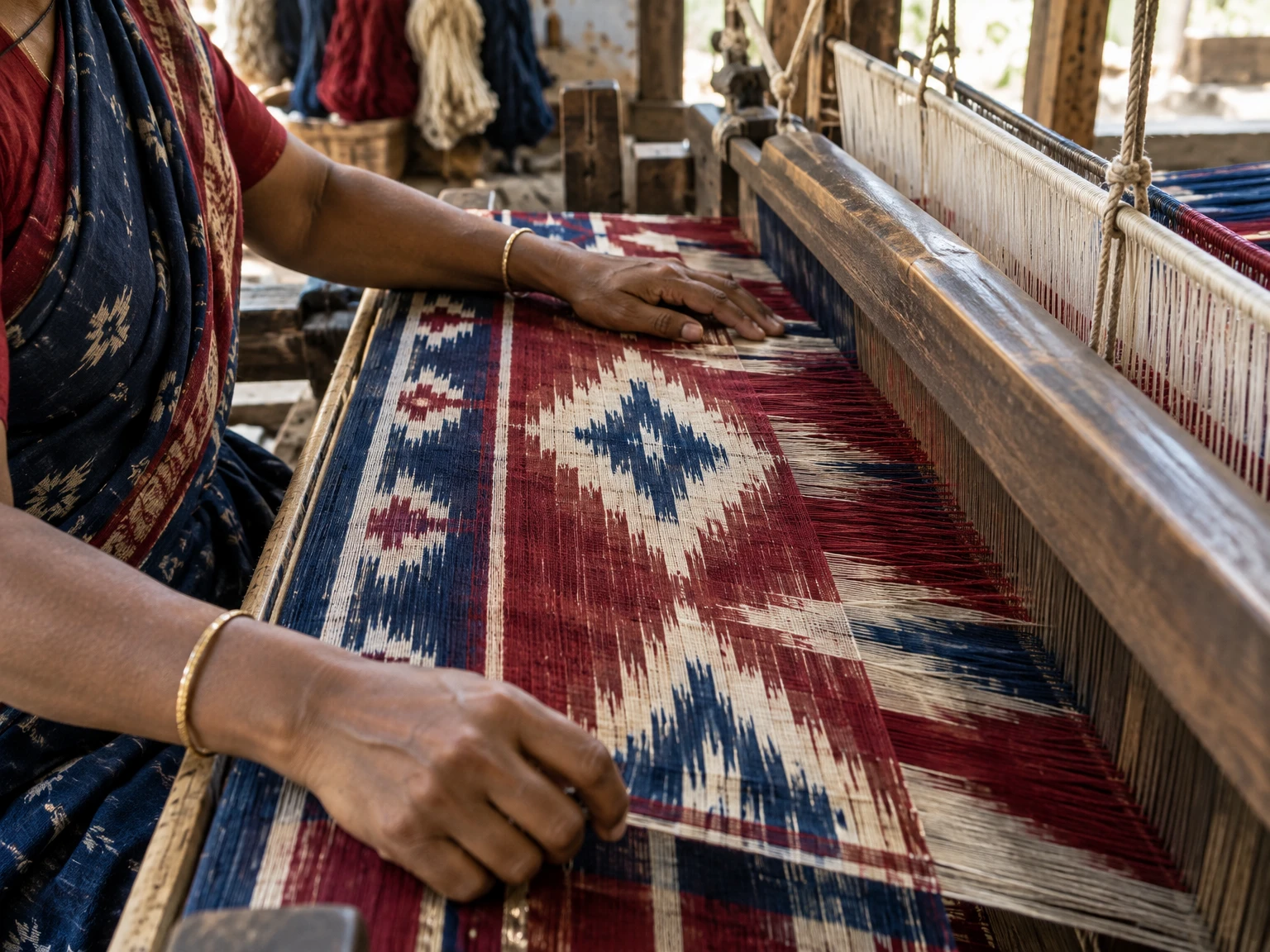
Across Odisha, the word “Bandha” names a family of textiles in which sections of yarn are tied against dye before weaving. When those carefully coloured threads meet on the loom, they create a pattern that is not printed on finished cloth: it is built into the yarn itself. Sambalpuri Bandha is one particularly celebrated tradition within this wider world. Its striking motifs and alignment are only the visible result of planning, counting, tying, dyeing and weaving—work that links a cloth to a place and to the people who make it.
This article looks closely at Sambalpuri Bandha without treating every Odisha handloom as Sambalpuri. It explains what ikat means, how a design travels from a drawing or plan to warp and weft, why alignment is so demanding, and how a regional craft can be understood through both official records and living practice. The history is not a simple, fully documented line from antiquity to today; the sources preserve different kinds of evidence and different degrees of certainty. The aim is to make the process and the distinctions clear, while leaving room for the knowledge and choices of weavers themselves.
What “Sambalpuri Bandha” means
Bandha is the Odia term used for tie-and-dye woven cloth. In ikat, the yarn—not the finished fabric—is protected in selected places before it is dyed. After dyeing, the tied sections resist the colour. The weaver then arranges the yarn on the loom so that those coloured and uncoloured lengths form a pattern as the cloth is woven. This order matters: a design that looks like a line or a flower on cloth begins as a set of calculated intervals on threads.
“Sambalpuri” refers to a regional and registered product designation, not a convenient adjective for every handloom from Odisha. The Government of India’s Geographical Indications Registry lists Sambalpuri Bandha Saree & Fabrics as a registered GI, application 208. The registry records the Directorate of Textiles & Handloom as applicant, class 24 and 25, goods as handicraft and geographical area as Odisha. Its page lists certificate 175 dated 17 July 2012 and validity through 12 July 2030. That is an official administrative record of the named registration; it does not mean that every textile made in the state is this product, or that a GI record alone tells a buyer who actually wove a particular piece.
Odisha has several distinct handloom traditions, and “ikat,” “Bandha,” “Odisha handloom” and “Sambalpuri” should not be collapsed into one label. Dr Anita Sabat’s article in Odisha Review explicitly cautions that Odisha Handloom, Orissa Ikat and Sambalpuri Bandha are not synonyms. It describes Sambalpuri Bandha as a type of double ikat, and notes other Bandha traditions such as Khandua. The distinction is useful: a textile can share a broad technique with another regional tradition while differing in its center of production, visual vocabulary, materials, history and name.
The Impart article on Odisha ikat describes western centers including Sambalpur and Bargarh, and separate weaving areas in the Cuttack region, notably Nuapatna and nearby villages. It emphasizes that production centers have their own styles and motifs. This is why a careful description names the tradition when evidence supports it, rather than using “Sambalpuri” as a generic synonym for an ikat-like pattern. A printed imitation may resemble a woven motif at a glance, but the method and the resulting cloth are not the same.
Why the pattern is woven, not printed
In a printed textile, a design is applied to the surface of a woven fabric. In ikat, pattern planning happens earlier, while the yarn is still separate. Selected sections are bound tightly enough to resist dye; other sections are left exposed or dyed in another stage. When the yarn is woven, the planned colour divisions meet in a particular sequence. The image is therefore distributed along lengths of thread, and it must be brought into alignment across the width and length of the cloth.
This is a resist-dyeing process, but the name alone does not tell us which yarns are dyed. In weft ikat, the weft threads—the threads that cross from side to side—carry the colour pattern. As each weft is passed through the warp, the weaver must position the design in relation to the earlier picks. In warp ikat, the lengthwise warp carries the design, and the weft may be comparatively plain or serve another function. Double ikat involves patterning both warp and weft so their motifs meet. The Impart account characterizes Odisha ikat as strongly associated with weft ikat and describes Sambalpuri Bandha as a type of double ikat in the Odisha Review account. These are related descriptions, not an excuse to claim that all Odisha fabrics use the exact same structure.
The word “ikat” is commonly traced to a Malay root meaning to tie, knot or wind around. The Odisha Review article uses that explanation and relates the technique to the broader history of tie-dye textiles. Etymology can help explain the word, but it does not by itself prove a particular route by which a community, a design or a loom practice arrived in a specific village. Craft history requires dated objects, documents, oral histories and local knowledge, and each source type answers different questions.
From design to tied thread
Every woven pattern has to be translated into a plan that can survive dyeing and loom preparation. A design may be organized as a repeat, a border, a central field or a sequence of motifs. The plan must take account of the width of the textile, the number of threads available and the way the cloth will be woven. A repeat that appears simple on paper may require the weaver to mark dozens or hundreds of points with precision. If the design is to meet across two thread systems, their spacing and sequence must be coordinated before the weaving begins.
The Impart article’s process description outlines how a warp-based design can be transferred to yarn, with sections tied to resist dye before colouring. Once dyed, the warp is starched and mounted on the loom. The weft can be prepared on a frame with upright sticks or separating cords. Groups and subgroups of yarn are organized, marks are placed, and ties protect the areas that should not receive dye. For small areas needing a different colour, the account says dye may be applied by hand with a brush. After dyeing, the weft threads are wound onto pirns in the order that corresponds to the design. This is a useful account of a documented technique, not a universal instruction that every present-day workshop follows in exactly the same way.
Tying is a form of drawing with constraints. The artisan must know which parts of each thread will show in the finished cloth, how a tie will prevent dye from reaching those sections, and how the thread will later line up with its neighbors. A tie that is too loose may let colour seep into a protected area. A tie in the wrong position can shift a motif. The sequence of tying and dyeing also matters when more than one colour is required: earlier protected areas may need to remain protected while later sections take another shade. The source describes these basic principles, but the exact materials, tools, number of dye baths and workshop practices can vary by textile, design, equipment and artisan.
Colour is not only decoration; it is part of a technical sequence. The order in which colours are applied has consequences for which parts of the yarn are protected and which are exposed. A light ground may be dyed before a darker one, for example, but a particular design can use a different order or local technique. Historical accounts of dye materials should not be presented as a description of every contemporary practice. The process has changed over time, and the use of a dye depends on the maker’s materials, intended palette and method.
Setting up the loom and aligning the image
After the dyed yarn is prepared, it must be brought to the loom in the correct order. The warp forms the lengthwise structure; the weft passes across it. A loom’s setup establishes the tension and spacing that allow the threads to interlace. Any disturbance in that arrangement can affect the motif, the fabric’s balance or its feel. On a patterned ikat, the warp itself may already contain a sequence of coloured areas, so preparing it is not simply a matter of stretching plain thread onto a frame.
When patterned weft is passed through the warp, each pick has to be placed so that the shapes continue across the cloth. In a simple plain weave, the weft alternates over and under successive warp threads. That familiar interlacing becomes a visual system when colour changes are built into the threads. The artisan reads the warp, the incoming weft and the motif together. A design may be slightly feathered at its edges because the colour boundaries on yarn do not necessarily meet as a sharp, printed line. That soft, blurred outline is one visual feature commonly associated with ikat, but its appearance depends on the pattern, yarn and weaving method.
Where both warp and weft are patterned, the alignment challenge multiplies. The artisan must make the two prepared systems meet so the intended motif emerges through interlacing. A slight shift in one thread group can alter a contour, open a gap or move a colour boundary. Some irregularities can be part of the textile’s handwoven character; others may be unwanted. It is important not to romanticize every flaw as a mark of authenticity, or to judge a handwoven textile solely by the expectation of machine-like uniformity. The relevant standard depends on the maker’s intent, the design and the quality promised to the buyer.
Impart notes both pit looms and frame looms in its account of Odisha production, and describes different shuttle arrangements for weft and warp ikat. Those details help readers understand that “ikat” is not one fixed machine or a single patterning trick. Equipment, loom configuration and the artisan’s practiced decisions all shape the result. A photograph of a loom can reveal something about the setting, but it cannot alone establish the particular technique, origin or identity of the person who made a cloth.
Motifs, repetition and visual rhythm
Bandha designs can be built from geometric forms, repeated units, checks, borders and figurative or floral motifs. The arrangement can look like a rhythm: a shape appears, changes scale, meets another shape, then returns as a repeat. Small variations in the edge of a motif may make the cloth feel lively rather than mechanically exact. The visual effect is inseparable from the way the threads were tied and dyed. In a printed design, an identical motif can be duplicated rapidly across fabric; in a woven design, each repeat is the result of a plan that has to correspond to yarn and loom.
A motif does not have one universal meaning simply because it resembles a flower, animal, conch or other familiar shape. Meanings may be attached by particular makers, wearers, communities or contexts, and those associations can change. Unless a source records a specific interpretation, it is safer to describe the form and its placement rather than claim a fixed symbolic meaning. The same care applies to religious or epic imagery: a pattern may be associated with a story or ritual use in one context, but that does not automatically describe all textiles with a similar form.
Colour choices also carry practical and aesthetic dimensions. A palette can distinguish the ground from the motif, strengthen a border, or create contrast between repeated forms. The specific colours available depend on fibre, dye, process and the maker’s choices. A textile shown online may look different under another light or screen, so an image cannot substitute for viewing the actual cloth when colour is a material purchase condition. Nor should a buyer assume that a traditional name means a particular fibre: descriptions should state whether a piece is cotton, silk or another material, based on the seller’s reliable product information.
Design changes over time. Weavers and designers may adapt scale, colour and motif to respond to wearers and markets. Change is not the opposite of tradition; it can be one way that a practice continues. At the same time, a new item should not be described as an unchanged ancient pattern unless a source supports that historical claim. The most informative account names the tradition and the actual design features visible in a particular textile, and distinguishes present-day creative decisions from documented history.
Regional traditions and careful naming
Odisha has multiple textile centers, and the sources underline their differences. The Impart account identifies the Sambalpur-Bargarh area in western Odisha and a separate Cuttack-area center around Nuapatna and nearby settlements. It describes distinct styles and motifs in each center and notes that silk ikat has also been adopted by weavers in regions traditionally associated with cotton. This summary matters because a state-wide label can conceal local expertise and a product’s specific identity.
The Odisha Review article is especially direct: Sambalpuri Bandha is not a synonym for every Odisha handloom or every Odisha ikat. It says that Nuapatna Bandha is distinct and notes Khandua among the other Bandha traditions. A label such as “Sambalpuri” should therefore be applied only when the product’s origin and designation support it. A printed fabric inspired by ikat is not the same as a resist-dyed woven Bandha textile, even if the motif is visually similar. A generic product description can leave the buyer uncertain about construction, fiber and provenance.
Regional variation also means that no single account should be used to flatten a community’s craft into a list of motifs. The Impart article names communities in its description of western and Cuttack-area production. Those statements are useful as the article’s account, but the many villages, workshops, families and individual artisans involved should not be reduced to one community or one historical narrative. An article about a technique should center the actual making process and keep claims about social identity within the evidence.
When talking about a particular piece, the strongest description is concrete: who made or sold it, where it was made if known, what fiber it uses, how the pattern was created, and what the label says. A GI register records a protected product name and application details; it does not, on its own, independently authenticate every item offered in a shop. Consumers can ask the seller for the product’s GI identification, maker information, material, care instructions and receipt. They should treat unsupported guarantees cautiously and use recognized channels where available.
What official records can—and cannot—tell us
The GI Registry’s record is valuable because it provides specific, checkable details for Sambalpuri Bandha Saree & Fabrics. The current registry page shows registered status, application number 208, applicant Directorate of Textiles & Handloom, class 24 and 25, handicraft, Odisha as the geographical area, certificate number 175 and a validity date of 12 July 2030. It also lists renewal documents. These are appropriate facts to report as the current record’s contents, rather than relying on an older article for the legal status.
The registry record is not a complete history of weaving in Odisha. It does not answer every question about when a technique began, which designs are oldest or how each artisan learns the skill. For that, researchers use objects, dated documents, community histories and technical studies. The Odisha Review paper provides an overview of GI products and distinctions among them. The Impart article provides a process-focused account, including production centers, yarn preparation and loom work. Each source has its own publication date and purpose, so claims should be matched to the source that can support them.
It is also useful to separate legal recognition from economic outcomes. A GI registration may identify a named regional product and provide a framework for its recognition, but the register alone does not show that every weaver receives a higher price, that counterfeits have disappeared or that the practice is free of commercial challenges. The Impart article, published in 2022, describes a strong local market and competition from cheaper printed imitations. Those statements belong to that publication’s account at that time; they should not be treated as a precise present-day market survey without newer data.
When describing how a product is protected or promoted, avoid claiming that a registration automatically guarantees quality, ethical production, fair compensation or authenticity in every transaction. Those are separate questions requiring evidence. A responsible cultural article can explain the registration, describe what it names, and note what additional information a buyer or researcher would need to verify a particular textile.
Material, care and the life of a cloth
The Sambalpur district administration’s handicraft page describes handloom fabrics in cotton and “tusser” silk and refers to tie-and-dye Bandha as part of the region’s craft tradition. This official local overview is useful context, but it is not a specification for any one item. A buyer should rely on the product’s own material label or a clear statement from the seller rather than infer fiber from the word Sambalpuri, the appearance of the weave or a regional description.
Care should follow the maker or seller’s instructions for the specific piece. Different fibers, dyes, finishes and construction methods may require different handling. Without a reliable label, avoid presenting one universal washing rule as safe for all Bandha textiles. A cautious owner can ask whether the fabric is colorfast, whether it should be dry-cleaned or gently hand-washed, and whether it should be kept away from direct prolonged sunlight. These are questions, not a substitute for the care advice provided with the cloth.
Storage affects textiles as well as use. Clean, dry storage and protection from moisture and pests are broadly sensible, but delicate or valuable pieces may need expert advice. Folding can create creases; hanging can put strain on some fabrics. No single method suits every textile. If a cloth has historical, ceremonial or financial significance, a textile conservator is better placed to recommend handling and display than a generic online guide.
The life of a woven garment also involves the person who wears it. A textile may be chosen for a ceremony, work, gifting, daily wear or simply because a wearer enjoys its colour and feel. Not every piece needs a grand symbolic explanation to be meaningful. It is possible to appreciate a geometric border, the way a motif repeats or the labor embedded in a finished sari without inventing a cultural meaning that the maker has not described.
Weavers, knowledge and continuity
The district administration page credits master weavers and designers with keeping artistic practice alive while continuing to work with intricate patterns and delicate designs. It portrays the tradition as inherited and also changing through innovation. That description helps resist a static picture in which heritage is imagined as frozen at one historical moment. A craft can be passed between generations while artisans also respond to changing tools, materials, designs and customers.
However, a broad government page cannot tell the full story of every workshop or household. It does not document wages, hours, access to raw materials, the terms of middlemen, or how income is divided among the people involved in a textile. Those topics matter, but they require direct reporting and current evidence. Readers should not infer a worker’s economic condition from a textile’s price, a GI registration or a general statement about popularity.
Respectful writing should identify artisans when a source supports the attribution, and should not invent quotations, family histories or personal experiences. A photograph of a person at a loom needs a reliable caption and consent where required; a generated illustrative image should be identified as an illustration, not documentary evidence of a named village or maker. This article’s illustration is an original editorial image, not a photograph of an identified Sambalpur workshop or artisan.
Knowledge of a textile technique is distributed across many decisions: how a motif is planned, how threads are grouped, where ties are placed, what sequence of dye is chosen, how the yarn is arranged, and how the woven result is judged and finished. A short description such as “tie-dyed sari” can hide that depth. Equally, an outsider’s technical explanation cannot replace the practical knowledge of those who work with the threads every day. The best public account makes the process legible without claiming to exhaust what a weaver knows.
Visiting Sambalpur and seeing handloom
The Sambalpur district administration’s tourist-attractions page says the town’s market is known for Sambalpuri Ikat work and mentions government and private shops selling handloom products. It also describes Kardola weaving village, about two kilometres from Chiplima, and says live demonstrations on a traditional tanta are an attraction. This is a statement on the district’s public page, not a confirmation that a demonstration is operating today, that visitors may enter any workshop, or that transport and opening hours are unchanged.
Anyone planning a visit should check current access, opening hours and whether a demonstration is available directly with the relevant local tourism or district office before travelling. Ask permission before photographing people, looms or work in progress. If a demonstration is offered, consider buying from the maker or a locally recognized outlet when that is feasible, and ask what the price includes. Respect the fact that a workshop is a workplace, not simply a tourist display.
In a shop, useful questions include: Is the textile woven or printed? What is the fiber? Where was it made? Is the seller able to provide the GI or maker details for this item? How should it be cared for? The answers may vary, and a seller may not know every detail; that uncertainty is better than pretending a generic label proves everything. A GI name is most informative when combined with clear material and provenance information.
It is not necessary to buy the most elaborate textile to appreciate the technique. A small woven piece may make the arrangement of the threads easier to see. A visitor can notice how the border differs from the field, how repeated shapes line up, whether outlines appear soft or sharply defined, and how the reverse of the cloth looks. These observations do not authenticate a product, but they encourage attention to construction rather than judging only by a photograph or a broad regional name.
Reading a pattern with care
Looking closely at a Bandha fabric is a way to understand the relationship between plan and accident. The viewer can follow a motif across the cloth and ask how coloured lengths of yarn may have met. Is the pattern repeated in a grid, mirrored across a center, or organized as a border? Do the edges appear feathered? Does a small shift recur consistently or vary from one section to another? These visual questions can lead to a richer appreciation of the textile without assuming that every detail is a deliberate symbol.
It is worth distinguishing three things: what is visible, what a source documents, and what a viewer imagines. A red-and-white diamond is visible. A museum or maker may document a name or use for that design. A viewer may associate it with a familiar object. Only the first observation follows directly from looking; the second needs a source; the third is a personal response. Keeping those categories separate makes a cultural account more accurate and still leaves space for enjoyment.
The pattern also invites a different idea of precision. It is not simply perfect repetition; it is the coordinated placement of many dyed sections so a design becomes readable as the cloth grows. The fabric’s surface records decisions made before the loom was fully prepared. It carries the results of choosing, binding, colouring, arranging and correcting. That is why the process can be technically demanding even when a finished motif looks calm and uncomplicated.
History without invented certainty
The origins of a craft are tempting subjects for a neat story. Yet the sources consulted here do not establish one single origin date for Sambalpuri Bandha. The Impart article notes uncertainty around the earliest history and points to surviving objects from the early decades of the twentieth century; it also discusses a 1719 document concerning a Bandha Gitagovinda associated with Nuapatna. Those are different pieces of evidence about different things, and the Nuapatna reference should not be casually turned into proof that a specific Sambalpuri textile existed in the same form at that date.
Likewise, historical connections between Odisha maritime trade and textile exchange are discussed in the Odisha Review article. Such connections can be part of a regional history, but they do not establish that every motif or technique travelled along one simple route. Trade, migration, local adaptation and the survival of particular objects are separate questions. An article can report that scholars and public accounts discuss these connections while acknowledging that a complete, uncontested chronology is not available in the sources reviewed.
One useful distinction is between an old technique, a named regional product, a particular pattern and the age of a surviving object. A technique may have a long history without every contemporary design being ancient. A GI registration has a filing and certificate date, but those dates mark legal administration, not the invention of weaving. A modern textile can draw on inherited skills and still be newly designed. This vocabulary helps readers appreciate continuity without overstating what is known.
Historical humility is not a failure of storytelling. It gives the reader a more honest picture of how knowledge is built. It also keeps attention on the evidence: official registry details for the GI; a 2020 overview for the relationships among Odishan GI textiles; and a 2022 process article for weaving centers, technique and historical qualifications. Later research or new catalogued objects could refine the account. A responsible writer leaves that possibility open.
Printed imitation and informed buying
The 2022 Impart article says Odisha Bandha faces competition from cheaper imitation fabrics with printed rather than woven ikat patterns. The distinction is important for an informed buyer because the word “ikat” is sometimes used loosely in retail descriptions. A printed imitation may be attractive and affordable in its own right, but it should not be represented as yarn-resist woven Bandha if it is not. The issue is not that printed textiles have no value; it is that a buyer should know what process and provenance are being offered.
At the point of sale, ask the seller to explain whether the motif is woven into the yarn or printed after the fabric is made. Ask about fiber content and the location of production. If a GI claim is made, ask what documentation or label supports the claim and whether the seller can identify the product category accurately. A product’s appearance alone cannot settle those questions. Nor does this article certify any individual seller, shop or item.
Price is another point where assumptions can mislead. A complex textile may involve planning and skilled labor, but a high price does not prove that a textile is handmade, locally woven or fairly compensated. A low price does not prove that it is printed. Without a current comparison of materials, labor and market conditions, avoid treating one price as a reliable authenticity test. Consumers can make a more informed choice by comparing transparent descriptions from sellers and deciding which qualities matter to them.
The broader conversation about craft markets should include current voices from weavers, producer groups and researchers. The published 2022 account is a useful starting point, not a live market survey for 2026. This article therefore does not claim a current counterfeit rate, average earnings or market share. Those numbers would require newer and clearly defined evidence. The distinction between woven and printed work remains meaningful, but present-day scale and economic effects should be documented separately.
Why the tradition matters beyond the finished garment
A finished cloth is easy to admire; the chain of work behind it is less visible. A design must be translated into thread positions. Ties have to be placed and secured. Dye must reach the intended areas. Yarn must be sorted and mounted. During weaving, the artisan has to keep the emerging design in relation to the prepared threads. Every stage depends on material knowledge as well as manual skill. The final motif is the visible record of a sequence of decisions made across time.
That sequence makes Bandha a form of design and engineering as well as a textile art. It involves spatial reasoning, pattern repeat, color sequencing and the relationship between thread systems. It also involves aesthetic judgment: how much contrast to use, how the border should frame a central field, and how a design should sit on the body or in a household setting. Such knowledge does not belong only to the finished object; it lives in the process and in the people able to carry it out.
Public recognition can help make a tradition legible to buyers and audiences, but it is only one part of continuity. Learning, access to materials, working conditions, fair exchange, design freedom and the choices of younger artisans all influence what survives. The sources cited here do not provide a full current evaluation of those conditions. They do, however, offer a clear reason to look beyond the surface: a textile is not merely a motif, but a way that material, place and human knowledge meet.
For readers, attention is a good first step. Learn the difference between a broad technique and a regional name. Notice the structure before assigning meaning. Ask what the seller knows about a piece and where that information comes from. When possible, listen to makers and use their own descriptions. Admiration is strongest when it does not overwrite the distinctions or certainty that the evidence actually supports.
Conclusion: a pattern made through patience
Sambalpuri Bandha is part of Odisha’s diverse handloom landscape, and its identity is clearer when it is not used as a catch-all label. The GI Registry records Sambalpuri Bandha Saree & Fabrics as a registered Odisha handicraft, while Odisha Review and Impart describe the wider family of Bandha and ikat traditions, their regional distinctions and technical processes. Together, these sources show why the name, the place and the method all matter.
The central idea is simple: a pattern is planned and dyed into yarn before the yarn is woven. The actual work is anything but simple. Threads must be marked, tied, coloured, arranged and aligned; the result depends on a careful relationship between design and loom. That process helps explain the characteristic visual rhythm of ikat without pretending that one description covers every workshop or every textile.
History and contemporary life should both be approached with care. The available accounts do not establish a single definitive origin date for every part of Sambalpuri Bandha. Official local pages describe the continuing handloom tradition and mention visitor interest, but current demonstrations or access should be checked before a trip. The GI record confirms the registered designation and dates, not the authenticity of every retail item or the economic conditions of all makers.
In the end, the most respectful way to see a woven pattern is to ask what it took to bring it into being—and to let the evidence, the maker’s own voice and the cloth itself answer as far as they can. The design is not simply on the fabric. It is the meeting point of dye, thread, knowledge and time.
Sources and provenance
- Government of India, Geographical Indications Registry, “Sambalpuri Bandha Saree & Fabrics,” application 208, registered record: https://search.ipindia.gov.in/GIRPublicSearch/Application/Details/208 (accessed 5 November 2026).
- Dr Anita Sabat, “Geographical Indications (GIs) of Odisha,” Odisha Review, April–May 2020: https://magazines.odisha.gov.in/Orissareview/2020/Apr-May/engpdf/GIs.pdf.
- Impart, “Odisha Ikat,” first published 21 April 2022: https://imp-art.org/articles/odisha-ikat/.
- District Administration Sambalpur, “Handicraft”: https://sambalpur.odisha.gov.in/en/tourism/handicraft.
- District Administration Sambalpur, “Tourist Attractions”: https://sambalpur.odisha.gov.in/en/tourism/tourist-attractions. The visitor demonstration detail is reported as the page’s description; current availability was not independently confirmed.
Illustration note: Original generated editorial illustration of handloom weaving; it does not depict an identified artisan, workshop or documented event.
This content is a collection of ancient history,books and various articles and collection of library and news and other post ; all details may not be the same. Readers are requested to verify the information themselves. Readers are not allowed to take any disciplinary action; content is only for educational purposes. If readers do not agree about the contents, they may send a personal comment to my personal email ID: achary.purna@gmail.com
