
A Crow, a Pitcher, and a Patient Idea
An original retelling inspired by the traditional fable, followed by notes on its history, natural science, and moral. This version is newly written for this article; it is not presented as a transcription of an old schoolbook or as a claim that every detail belongs to one ancient source.
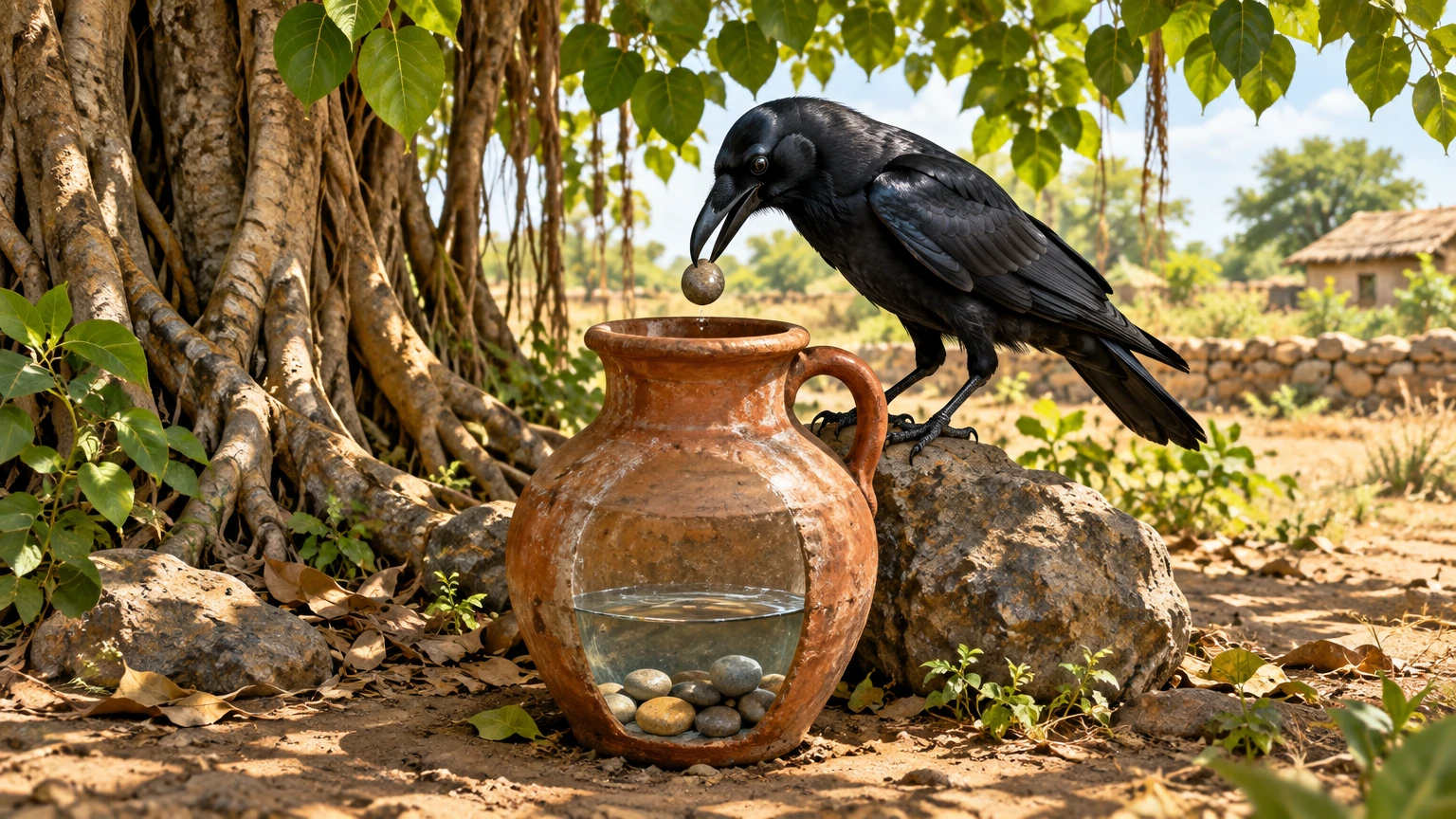
THE STORYA dry afternoon had settled over the fields. A crow left the branch where it had been resting and searched the hedges, ditches, and garden edges for water. The small pools had shrunk under the sun. When it found a clay pitcher beneath a tree, it landed on the rim and peered inside. A little water glimmered far below. The crow stretched its neck, but its beak could not reach.It tried to push the pitcher over. The vessel was too heavy, and the bird stopped before exhausting itself. Then it looked around. Several pebbles lay scattered on the dusty ground. The crow carried one to the pitcher and dropped it in. The stone sank, and the water rose slightly. That small change gave the bird a reason to continue. It brought another pebble, then another, watching the level after each one. The work was slow: fly down, pick up a stone, return, release it, and check. Nothing about the first few trips promised success, but the water kept climbing. At last it rose within reach. The crow drank, rested in the shade, and flew away.That is the familiar outline of “The Crow and the Pitcher.” The short version is deliberately spare. This retelling does not claim that its invented setting, dialogue, or description occurs in every historical witness. It emphasizes the observable problem and the sequence of attempts, rather than adding dramatic events that the sources do not establish.THE CLUE INSIDE THE OBSTACLEThe pitcher makes the difficulty visible. Its depth leaves the water below the crow’s reach, while its opening permits small stones to pass through. The container is both barrier and part of the solution. The crow first tries to change the outside of the problem by tipping the vessel; when it cannot move it, it notices a way to change what is inside. That shift—from brute force to a testable adjustment—is why the story remains easy to discuss.A good reading need not call the first attempt foolish. Tipping the pitcher is a reasonable idea. What matters is that the crow notices it is not working and changes course. Persistence in this story is not endless repetition of one failed action. It is continuing toward a goal while learning from results. The first pebble offers feedback: it sinks, and the water rises. The crow now has evidence, though not certainty, that more stones may help.The fable compresses the process into a few lines, but readers can slow it down. What did the crow know before acting? What did it predict? What observation followed the first stone? What would count as evidence that the plan was not working? These questions distinguish a reasoned experiment from a lucky guess. They also let learners see how a small test can reduce uncertainty before a larger effort.The stones are not magic. They occupy space in the vessel, pushing some water upward. Whether this succeeds in a real container depends on details the fable leaves out: the pitcher’s width and shape, how much water remains, whether the objects sink, and how many fit through the opening. A few small stones might raise a shallow pool only a little. The story chooses a clear ending, not a universal engineering guarantee. Its simple physical mechanism helps explain the action, while the details remain open to examination.RESOURCEFULNESS WITHOUT A PROMISEThe crow’s solution is an example of adapting available materials to a particular need. It does not become stronger or change its beak; it changes the water’s level by adding objects. This kind of thinking is useful in classrooms and ordinary tasks: look at what is available, ask how it behaves, and test a low-risk idea. But the fable should not be used to claim that every difficulty can be overcome by individual willpower. Some barriers require other people, expertise, safer tools, time, or a change in circumstances. A person who cannot solve a problem alone has not failed a moral test.The crow also has conditions that make the plan possible. It can carry the stones, the stones are near enough, and the pitcher is shaped so that they can enter. It has enough time and strength to repeat the journey. These details matter. Resourcefulness is not a substitute for access to resources; it often means recognizing and using what is genuinely available. The story is most helpful when it encourages attention and experimentation without turning a fortunate outcome into a judgment about everyone else.The tale is similarly modest about success. The crow drinks, regains strength, and leaves. It does not acquire a crown or defeat an opponent. The reward is simply meeting an immediate need. Readers may find that satisfying because the bird’s effort is proportionate to its goal. Stories about problem-solving need not end in status or triumph over others. Sometimes the meaningful outcome is relief, safety, and the ability to continue one’s day.A note on the moral: “Where there is a will, there is a way” is a familiar saying associated with many versions of the tale, but it can overstate what this example proves. Determination can sustain a useful plan; it cannot guarantee an outcome. A more careful lesson is that observation, modest testing, and persistence can reveal options that were not obvious at first. When the evidence changes, a thoughtful solver can change the plan too.HISTORY AND RETELLINGAesop is the traditional name attached to a wide body of fables, but the surviving stories do not constitute one fixed book written in a single moment. Fables moved through oral performance, manuscript collections, translations, school readers, and later adaptations. Wording and details can change as storytellers fit a tale to new audiences. Therefore it is safer to say that the Crow-and-Pitcher story is commonly associated with the Aesopic tradition than to claim that every sentence in a modern version came directly from a historical Aesop.Folklore scholar William Hansen examines the early tradition of this story and discusses a short poem by Bianor, generally placed around the first century BCE, as an early attestation of a related motif. Hansen notes that the early witness concerns a raven and a clever action; it is not identical to every later version framed as a moral fable. This distinction matters: an early appearance of a motif does not prove that all details, characters, or moral statements existed in the same form at that time. The history is a trail of related tellings, not a single unchanging text.The Library of Congress provides a useful English-language comparison in its 1919 edition of The Aesop for Children, including “The Crow & the Pitcher.” Its collection page identifies the book as a public-domain item in that collection. That information is useful for understanding the specific edition and its U.S. collection status. It does not determine the legal status of every translation, later illustration, adaptation, or edition in every country. Readers intending to reuse a particular text or image should check the rights information for that work and the law relevant to their use.This post is newly worded commentary and retelling, not a transcription of that book or any modern school reader. It uses the familiar plot as a starting point and attributes historical claims to the sources below. Traditional subject matter and a particular modern expression are different things: a story may be old while a translator’s sentences, an artist’s illustration, or an editor’s notes remain separately protected. This article is educational information, not legal advice, and it does not certify that every possible reuse is lawful.
FROM THE FABLE TO A QUESTION ABOUT BIRDSThe idea of a bird raising water with objects is so memorable that it invites a natural question: can birds solve a similar task in an experiment? A fable and a scientific study, however, answer different kinds of questions. The story arranges a problem so that the reader can follow the crow’s reasoning. A study defines a task, records what animals do, and compares possible explanations. One can inspire the other without being interchangeable evidence.In 2009, Christopher R. Bird and Nathan J. Emery published a study titled “Rooks Use Stones to Raise the Water Level to Reach a Floating Worm.” The title describes the tested animals and reward: rooks, stones, and a floating worm. Rooks belong to the corvid family, as do crows, but the species and the experimental conditions matter. The paper is evidence about the birds and task that its authors studied. It does not show that the fable is a factual diary of a wild crow, nor that all crows routinely use stones to drink.This distinction is useful when talking about animal intelligence. A single successful action does not tell us exactly what an animal understood. Researchers consider whether a behavior may result from learning, trial and error, sensitivity to object properties, prior experience, or other factors. To distinguish explanations, scientists vary parts of a task, observe repeated behavior, and compare outcomes. A story has no need to conduct those controls; it aims to make a lesson memorable. Calling the fable “scientific proof” would blur a boundary that both literature and science deserve to keep.Readers can still enjoy the connection. The fable poses a question in a child-friendly way: what might happen if an animal drops objects into water? Modern experiments can investigate related questions in a structured setting. The science becomes more engaging when the story sparks curiosity, and the story becomes more layered when readers learn that real research asks careful questions rather than simply confirming a familiar moral.HOW TO READ THE STORY CLOSELYA useful discussion can begin with sequence. First the crow needs water. Then it notices that the water is out of reach. It tries to move the vessel, recognizes that this will not work, notices the pebbles, and tests one. The result is small but visible. Only then does it continue. Asking learners to retell this sequence in their own words helps separate what happens in the story from what a reader assumes.Next, ask what information each action produces. Pushing the pitcher tells the crow that it is not easily moved. The first stone shows that a sinking object changes the water level. The crow’s decisions are tied to observations. Readers can discuss what evidence would persuade them to keep going or to try something else. This is more precise than asking only whether the crow is clever, because it identifies the behaviors that support that interpretation.A drawing can make the physical relationship easier to see. Learners might sketch the pitcher before the stones are added and after the water has risen, labeling the water line. A simple, adult-supervised demonstration with a clear container, water, and large clean stones can show displacement. Avoid small objects around young children or animals, do not drink from a demonstration vessel, and do not put wildlife through a test. The point is to observe a physical idea safely, not to imitate the crow’s thirst or involve live animals.The demonstration also provides room for honest uncertainty. Ask whether the same number of stones would work in a wider vessel. What if the stones were too large for the opening? What if the water were already near the top? What if some objects floated? Students can make predictions, observe a safe test, and revise their explanation. The fable’s ending is clear, but the real world may produce different outcomes depending on the container and materials. Learning includes noticing when a simplified story leaves details out.Language and art offer further ways to explore the tale. A class can compare how different retellings describe the crow’s search, the pitcher, or the moment of discovery. Students can write a new version in original wording, identify that it is inspired by a traditional fable, and create their own illustration. They should not copy a modern translation’s sentences or reuse an illustration without checking permission. Acknowledging a source and making an original expression can go together.WHAT THE MORAL CAN OFFERThe familiar lesson is often phrased as perseverance or cleverness: do not give up too quickly; think about the tools around you. A fuller reading adds that the crow is not merely persistent. It watches the effect of each action and continues because the plan appears to work. The story suggests a practical sequence: define the problem, examine the setting, try a small action, observe, and then decide what to do next.That sequence transfers best to problems where a person has safe choices and useful information. It does not mean someone should continue a dangerous task, ignore an expert, or blame themselves when circumstances are beyond their control. Sometimes the most thoughtful action is to ask for help, use a different resource, or stop. The fable can encourage agency without pretending that every barrier has a simple individual solution.The crow’s repeated journeys also show why small efforts can matter. One pebble makes little difference; many pebbles change the level enough to reach. In daily life, steady steps may build a skill or move a project forward. But the story does not say that every small action accumulates toward success. If an action produces no useful evidence or causes harm, a person may need to change course. Effective perseverance includes attention to results.The ending is intentionally quiet. The crow drinks and leaves. It does not use its success to dominate the other animals or claim a reward beyond meeting its need. This can prompt a discussion about what counts as success. Is success always public recognition, or can it be solving a private, practical problem? The crow’s outcome is enough because it answers the original need.The saying “where there is a will, there is a way” may be inspiring, but it is not a guarantee. Strong motivation cannot by itself create access to water, time, safe tools, or assistance. Readers can honor the crow’s initiative while remembering the role of circumstances. A fair moral might be: careful observation and patient experimentation can reveal a workable option when one is available; when it is not, seeking support is also resourceful.A fable’s short form leaves space for a reader’s own interpretation. Some focus on ingenuity, others on patience or changing strategy. No single sentence exhausts the story. A conversation about what the crow knew, what it tried, and what changed can be more valuable than memorizing a moral. It connects reading with reasoning and helps learners see that thoughtful action rests on evidence, not just confidence.RELATED READ-ALOUDEvergreen Tales has a short read-aloud of the 1919 “The Aesop for Children” version at https://www.youtube.com/watch?v=2pWAStY5obw. This is an external link for comparison; the video, narration, and artwork belong to their respective creators. This article links to the video but does not reuse its audio or images.
A CLOSER LOOK AT THE CROW’S CHOICES. The familiar sequence contains several decisions, not one flash of genius. The crow recognizes a need, searches its surroundings, evaluates a container, and tries a direct solution. When pushing the pitcher does not work, it changes its approach. Then it tests a pebble and watches the outcome. Readers can trace each decision and ask what the crow learned at that point. That makes the tale a useful prompt for discussing how a plan develops through observation rather than appearing fully formed. The story does not tell us that the crow calculated an exact number of stones or measured the water. It simply presents a visible change that encourages another attempt. Keeping that distinction helps a retelling remain both vivid and careful: we can describe the character’s apparent reasoning without pretending to know what a real animal thinks.A problem-solving map for readers can use five simple questions: What is needed? What is stopping progress? What resources are actually available? What small, safe test could help? What did the result show? The crow’s need is water; the obstacle is a low level in a deep vessel; pebbles are within reach; the first stone is a small test; and the rising water provides feedback. Learners can apply the same questions to a fictional puzzle or a classroom challenge. They should also ask what could make the plan unsafe or ineffective. A good method includes a way to notice when conditions change.Try comparing two possible strategies. One is to repeat the attempt to tip the vessel, increasing effort each time. Another is to stop, look around, and choose a different action. The story favors the second because the first approach has produced no change and the stones provide a new possibility. This is not a rule that persistence is bad. It is a reminder that persistence can be paired with reassessment. A plan that is working may deserve continued effort; a plan that is not working may need revision.THE PHYSICAL IDEA, MADE PRECISE. When a stone sinks into water, it occupies space below the surface. The water must move around it, so the surface can rise. The amount of rise depends on the volume of the submerged object and on the shape and width of the vessel. A narrow vessel can show a more noticeable level change than a broad one for an equal submerged volume. In an actual pitcher, irregular interiors, water already absorbed by the clay, and stones that vary in size can complicate the result. This explanation describes the basic displacement principle, not a promise that any collection of pebbles will raise water to a reachable height.A classroom model can make the principle observable with an adult guiding the activity. Use a stable transparent container, a small amount of water, and several large clean objects that are too large to swallow. Mark the starting water line on the outside, add one object at a time, and record each new level. Keep the setup away from very young children and pets, do not use a fragile vessel, and do not drink the demonstration water. If a teacher chooses a different material, it should be safe for the age group and easy to retrieve. The exercise is about measurement and prediction; no live bird needs to be tested or disturbed.Learners can make the activity more scientific by writing a prediction before adding anything. Would a large object raise the water more than a small object? Would a floating object have the same effect as a sinking one? What measurements could answer the question? After the trial, they can compare the observation with their prediction and describe what they would test next. Results may differ because container shape and object density matter. Recording an unexpected result is not failure; it is part of learning.A STORY WITH MANY TELLINGS. Fables are commonly retold, translated, illustrated, shortened, and adapted for different readers. As a result, a story title may refer to a family of related versions rather than one single wording. “The Crow and the Pitcher” is a familiar English title; some sources use “The Crow and the Pitcher,” “The Crow and the Pitcher” with a different moral, or a related bird such as a raven. That variation is one reason this post identifies its own text as an original retelling rather than a historical transcription. The narrative here uses a minimal plot: a thirsty crow encounters water it cannot reach, tries adding stones, and drinks after the level rises. The extended setting and commentary are newly written for this page.When students compare versions, they can note what changes and what stays constant. Is the bird called a crow or a raven? Does it notice the stones immediately or only after trying another idea? How does the author describe the water? What moral is stated, and does the story itself support it? These questions teach close reading and attribution. They also help readers recognize that an editor’s or translator’s language is a particular creative expression, even when the underlying traditional plot is much older.A simple ethical retelling practice is to read the plot from a source, set that text aside, and then write a fresh version from memory using one’s own structure and sentences. A writer may add original commentary, but should clearly separate it from source facts and avoid reproducing distinctive phrasing from a modern edition. Images and recordings are separate works with their own creators and permissions. A link can point readers to another version without copying that creator’s picture, voice, or video into this article. When reusing a specific edition or image, check the terms that apply to that material and the intended use; copyright rules vary by jurisdiction and facts.QUESTIONS FOR A READER. What does the crow need before the story begins? Which attempt fails, and what does that failure reveal? Why might the first stone change the crow’s decision? What conditions must be true for the stones to raise the water? Could a different container change the result? Which details are part of this new retelling, and which claims are supported by the sources? Does the moral “where there is a will, there is a way” fit every real problem? What could a person do when effort alone is not enough? Asking these questions invites readers to think beyond a slogan while still enjoying the story.The tale can be understood as an invitation to notice, test, and adjust. It celebrates a clever solution but leaves room for practical limits. The crow is helped not only by determination but by a suitable pitcher, accessible stones, and a physical process that works in that setting. A reader can admire the bird’s patience while remembering that success depends on circumstances as well as effort. That balanced interpretation makes the fable more useful: it encourages curiosity, discourages reckless repetition, and treats asking for assistance as a legitimate response to a hard problem.SOURCES AND FURTHER READING. The Library of Congress hosts the 1919 edition The Aesop for Children and its story “The Crow & the Pitcher”: https://read.gov/aesop/012.html and the collection record is https://www.loc.gov/item/19014083/. This identifies a particular historical edition and its collection information, not the worldwide rights status of every adaptation. William Hansen, “The Early Tradition of the Crow and the Pitcher,” Journal of Folklore Research 56, discusses the early tradition and Bianor: https://static1.squarespace.com/static/590bf9389f74560ebc723a80/t/5de5314d1b24f4303d624508/1575301457594/JFR%2C+Vol+56%2C+No+2-3.pdf. Christopher R. Bird and Nathan J. Emery, “Rooks Use Stones to Raise the Water Level to Reach a Floating Worm,” Current Biology (2009), reports an experiment with rooks, not proof of the fable’s historical truth: https://www.sciencedirect.com/science/article/pii/S0960982209014559. The related read-aloud above is an external work linked for comparison only.DISCLAIMER. This content is a collection of ancient history,books and various articles and collection of library and news and other post ; all details may not be the same. Readers are requested to verify the information themselves. Readers are not allowed to take any disciplinary action; content is only for educational purposes. If readers do not agree about the contents, they may send a personal comment to my personal email ID: achary.purna@gmail.com
