
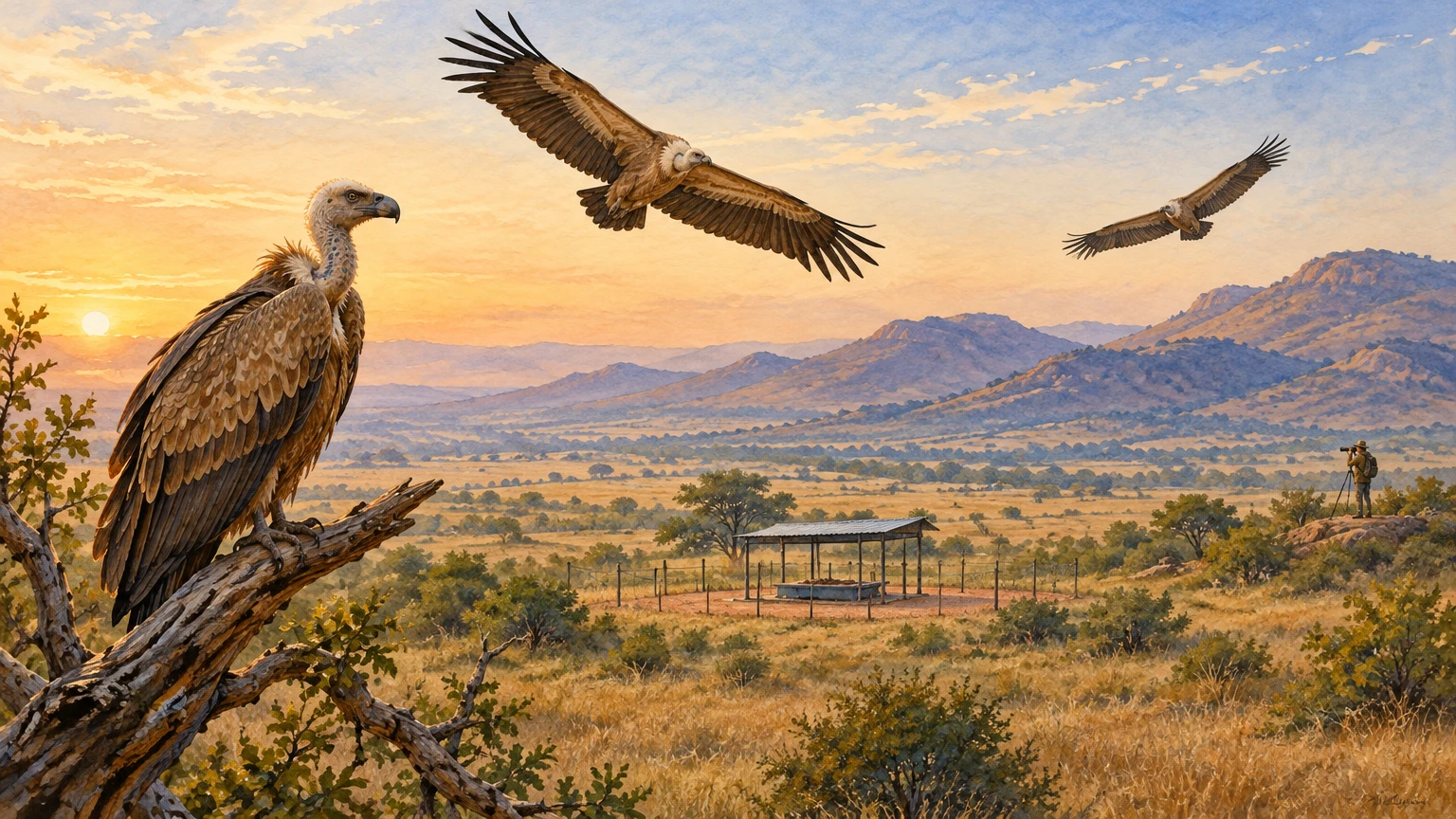
An educational guide to the ecology, evidence and recovery work surrounding India’s endangered vultures
Why vultures matter
Vultures are often described through the work they do rather than the way they look: they locate and consume animal remains, rapidly returning nutrients to the ecosystem. In landscapes where livestock and wildlife carcasses are abundant, this specialised scavenging can limit the time those remains persist in the open. A healthy vulture community is therefore part of the ecological infrastructure of a region, alongside predators, decomposers and the people who manage livestock and waste. Vultures do not replace sanitation systems, veterinary care or safe carcass disposal, but their feeding behaviour is one natural pathway through which organic material is processed.
The importance of this role became visible in India when several vulture populations collapsed. The birds’ decline was not a simple story of a species becoming rare for one reason. It involved a highly vulnerable group of animals exposed to a toxic veterinary drug, together with the difficulty of detecting and removing that risk across a large country. The conservation challenge now is equally layered: protect birds from harmful medicines, maintain breeding populations, monitor trends across a wide range, and connect policies to everyday veterinary and livestock practices.
A clear account must also distinguish three things that are often confused: a count of nests, a population estimate, and a population trend. They answer different questions. Recent Indian evidence includes a focused nest assessment, a long-running road-transect index and older national estimates. Read together, they describe a severe continuing conservation problem and meaningful monitoring work, but they do not justify a claim that the birds have recovered.
The birds commonly meant by “India’s vultures”
India has several vulture species, but the sharpest conservation emergency concerns the resident Gyps vultures. The White-rumped Vulture (Gyps bengalensis), Indian Vulture (Gyps indicus) and Slender-billed Vulture (Gyps tenuirostris) are classed as Critically Endangered by the IUCN. The Red-headed Vulture (Sarcogyps calvus) is also a resident species of serious conservation concern and was included in the recent Wildlife Institute of India breeding-nest assessment. Other species, including Egyptian, Bearded, Himalayan and Cinereous vultures, have different distributions and conservation circumstances; they should not be folded into one undifferentiated “vulture population.”
This distinction matters when readers encounter a number. A figure may refer to one species, a particular region, a breeding survey, a group of road-transect routes, or a modelled national estimate from a past year. These are not interchangeable. A total for nesting sites in a selected study area cannot be treated as the number of birds in India, and a historic estimate cannot be presented as today’s census. The words around a statistic—species, method, area and year—are part of the statistic itself.
Gyps vultures are large soaring scavengers. Their broad wings allow them to travel across extensive areas while using rising warm air to gain height with little flapping. Their ability to locate food depends on both landscape conditions and the presence of other scavengers: a bird can benefit from observing the movements of others, while competition and food availability shape where it feeds. These features make vultures impressive fliers, but they also mean that a local threat can affect birds over a broad range. A dangerous carcass can be encountered by birds that have travelled from far beyond the farm where the animal was treated.
A rapid decline with a human-made trigger
The dramatic decline of South Asian Gyps vultures was linked to veterinary diclofenac, a non-steroidal anti-inflammatory drug used to treat livestock. When a treated animal died while residues remained in its tissues, vultures feeding on its carcass could ingest the drug. Research established that exposure could cause severe kidney damage and visceral gout in susceptible vultures. The birds could die after feeding on a contaminated carcass; because vultures feed communally, a single unsafe carcass could expose more than one individual.
The key ecological point is that the drug did not need to be given to a vulture. It entered the food chain through treated livestock, then reached scavengers after the animal died. That pathway made ordinary livestock treatment decisions relevant to wildlife conservation. A medicine useful to an individual animal could become a population-level hazard when residues persisted in a carcass and a large, long-lived scavenger consumed them. The risk was made worse by the fact that vultures naturally exploit carcasses, so avoidance of every potential exposure is not a practical behavioural solution.
India prohibited the veterinary use of diclofenac in 2006. Subsequent action also addressed the large multi-dose human formulations that could be diverted to veterinary use. Regulation was essential, but a legal restriction alone does not demonstrate that every risky product has disappeared from practice. The remaining challenge is to keep monitoring what drugs are actually used, what residues occur in livestock carcasses, and whether approved or commonly available alternatives are safe for vultures at realistic exposure levels. Policy, pharmacy supply, veterinary advice and farmer access all matter to the real-world outcome.
Why the decline cannot be reduced to one drug
Diclofenac is the best-known cause of the Gyps collapse in South Asia, but conservation policy cannot assume that banning one substance eliminates every pharmaceutical risk. Some other non-steroidal anti-inflammatory drugs have also raised concerns, while the safety evidence differs by compound and may change as new research appears. Researchers and conservation organisations have repeatedly called for robust testing of veterinary drugs before broad use, as well as surveillance of products available in the field. A medicine should not be described as vulture-safe merely because it is not diclofenac.
At the same time, it would be inaccurate to imply that every veterinary anti-inflammatory medicine is dangerous. Conservation work has identified options such as meloxicam as safe for vultures under tested conditions, and BNHS describes research and outreach on safer alternatives, including meloxicam and tolfenamic acid. “Safe” here is a scientific and regulatory judgment tied to the substance, dose, exposure pathway and evidence—not a blanket assurance about every formulation or every use. Veterinarians should follow current professional and regulatory guidance rather than an article’s simplified summary.
A further complication is that drug safety is not static. New compounds enter veterinary practice; old products may remain in circulation; the same ingredient can be sold in different strengths and presentations. Monitoring should therefore include both the label and the actual product, and researchers need to test whether residues in carcasses can harm scavengers. Conservation measures work best when they give animal-health professionals practical alternatives, not merely prohibitions. The aim is to protect wildlife while still allowing livestock to receive effective, humane treatment.
Historical research illustrates why follow-up is necessary. A 2011 study of India found that after restrictions, diclofenac residues in livestock carcasses declined over the study period, but lethal residues remained detectable. The authors estimated that the rate of vulture decline slowed compared with the earlier catastrophic phase, yet the population was still falling rapidly in the period they studied. These findings are evidence about a historical intervention and its limits; they are not a current estimate of vulture numbers. They show why a ban needs enforcement and continued measurement, rather than an assumption of success based on the date a rule was introduced.
What the long-term road-transect evidence shows
A 2024 analysis in Bird Conservation International examined a series of road-transect surveys from 1992 through 2022. The researchers used repeated counts along routes to track changes in the relative number of vultures observed. Such an index is useful because a consistent method applied over time can reveal large-scale direction, especially when a species is difficult to count exhaustively across an entire country. It is not the same thing as a precise census of every individual in India, and the authors’ conclusions must be read as conclusions about the survey index and its coverage.
The paper describes steep declines followed by a period in which the survey data did not show a consistent trend. It does not find clear, consistent recovery for the three Critically Endangered Gyps species. For the 2003–2022 period, the reported average index ratios relative to the 2002 index were 0.3278 for White-rumped Vulture, 0.5162 for Indian Vulture and 0.1087 for Slender-billed Vulture. These ratios are relative survey indices, not percentages of the national population remaining, not counts of individual birds, and not forecasts. In ordinary language, they indicate that the measured average index during that later period was lower than the chosen 2002 reference index, with the amount differing among species.
The paper’s wording matters: a period without a consistently detected decline is not equivalent to a demonstrated recovery. An index may flatten because a decline has slowed, because a population is persisting at a low level, because sampled routes have changed in how birds are encountered, or because real changes are difficult to distinguish from variation. The analysis is valuable precisely because it does not overclaim. It gives conservationists evidence to maintain action and improve monitoring rather than announce victory.
Road transects also have limits. They sample visible birds along specified routes, not every habitat or every part of a species’ range. Survey design, observer effort, season, visibility and the distribution of birds influence what can be detected. A strong trend analysis controls for as many of these factors as possible, but readers should still ask what population and area the index represents. Long-running standardized surveys are indispensable; pairing them with nest monitoring, carcass toxicology and other field methods makes the overall picture stronger.
What the 2025 WII nest assessment counted—and did not count
The Wildlife Institute of India’s 2025 final report, “Pan India Assessment and Monitoring of Endangered Species: Vultures,” presents a targeted breeding-nest assessment carried out during 2023–2025. It covered four resident endangered species: White-rumped, Indian, Slender-billed and Red-headed Vultures. The report documents 2,410 nests across 216 sites in 17 states, of which 1,994 were active. Those are important results about the nests found in the surveyed sites and the breeding activity recorded during the assessment.
They are not an estimate of the total number of vultures in India. The report is explicit that the assessment is focused on breeding nests and does not provide an overall population estimate. A nest is evidence of a breeding site or attempt; it is not a one-to-one count of adult birds, young birds and non-breeders. Some birds may travel widely or use different sites, and a nest survey’s coverage depends on where and how it is conducted. The 2,410 figure must therefore be described as nests, not birds.
The survey’s geographical breadth is useful, but 17 states do not mean every possible breeding locality has been fully enumerated. Targeted monitoring can identify concentrations, new sites, threats and conservation priorities. It can also establish a baseline against which future assessments can be compared if methods and coverage remain sufficiently consistent. Repeated surveys are especially valuable: a single national exercise tells us what was documented in that period; comparable surveys over time are needed to assess changes in breeding activity.
The WII report and road-transect analysis answer complementary questions. The WII assessment asks where the targeted species’ breeding nests were recorded during a defined period. The transect study asks how relative observations along surveyed routes changed over decades. Neither alone settles the full national population question. Together they show both the existence of nesting activity across many sites and the continuing need for careful trend monitoring. The presence of nests is encouraging as evidence that birds still breed, but the number of nests does not by itself demonstrate a population rebound.
Why old national estimates must be labelled by year
A parliamentary response from India’s Ministry of Environment, Forest and Climate Change dated 5 December 2024 cites estimates from 2017: 26,500 Long-billed (Indian) Vultures, 1,000 Slender-billed Vultures and 6,000 White-backed (White-rumped) Vultures. These numbers are useful historical context if their date and species names are retained. They are not current counts simply because the response was published in 2024. The date of a government answer and the date of the underlying estimate are two different facts.
The same parliamentary response says that state-wise or habitat-wise vulture populations are not assessed or collated centrally in the way the question requested. That is an important limit on what can be claimed. A national number can sound more exact than the underlying information permits, especially where estimates combine different methods, years or regions. When a newer survey counts nests rather than all individuals, it does not automatically update an older population estimate. The measures are different and should not be merged into a single apparent time series without a scientifically justified method.
Responsible reporting should put the year next to a number every time it appears, specify the species and the type of evidence, and state when a figure is not a current census. It is better to say “the ministry’s answer cited 2017 estimates” than to write “India has 26,500 vultures” as if the figure described today. It is better to say “the 2023–25 assessment recorded 2,410 nests at surveyed sites” than to imply that 2,410 birds were counted nationally. Precision is not just a matter of decimal places; it is a matter of accurately describing what was measured.
A conservation response has several linked parts
India’s National Vulture Conservation Action Plan 2020–2025 set out a programme for reducing poisoning risks, expanding conservation breeding, monitoring wild populations and strengthening vulture-safe zones. The plan’s stated period ended in 2025; whether measures have been continued or updated after that period should be established from a current official source before claiming a new plan is in force. The framework remains useful for understanding the types of coordinated work conservation requires, but the plan period itself must not be silently extended in a present-tense claim.
Drug safety is one part of the response. Another is maintaining assurance that suitable habitat and food sources remain available without exposing birds to toxic residues. Captive breeding and conservation breeding centres can preserve birds, develop husbandry expertise and potentially support carefully managed releases. These programmes take time: birds must breed, young must survive, release sites must be safe, and released birds must be monitored. The existence of a breeding centre is a conservation resource, not proof that wild populations have recovered.
Monitoring is a third part. Researchers need to know where birds nest, where they feed, how many are observed along repeated routes, what is in carcasses, and which veterinary products are being used. Those strands can be integrated to distinguish an improving local breeding colony from a broader regional change. They can also identify when a promising result is only a short-term or site-specific signal. Conservation decisions should be based on converging evidence, with uncertainty stated rather than hidden.
Finally, implementation depends on cooperation. Regulators, wildlife agencies, veterinarians, livestock keepers, pharmaceutical suppliers, researchers and local communities each influence a different part of the exposure pathway. A restriction that is not understood, accessible or monitored may not translate into safer carcasses. A safe alternative that is unavailable or unaffordable may be less likely to be used. Effective conservation therefore combines enforcement with practical advice, training and a credible means of reporting suspected harmful products.
Vulture-safe zones and carcass surveillance
A vulture-safe zone is an area where conservation teams work to reduce the risk that birds encounter unsafe veterinary-drug residues in carcasses. The concept is not simply to draw a circle on a map and declare it safe. It requires engagement with pharmacies, veterinary practitioners and livestock owners; sampling and monitoring; information about which drugs are being used; and repeated checks that risks have not returned. Birds range across landscapes, so the area around breeding sites matters as well as the precise place where a nest is located.
BNHS describes work on vulture-safe zones, including monitoring over areas around colonies, drug-safety research, breeding and community outreach. The scale of a programme should be attributed to the organisation and dated when possible, rather than reported as an independently verified current status. A monitoring network can reveal a drug problem that would otherwise stay invisible. It can also establish whether safer treatment practices are being adopted across the landscape, instead of relying on a few individual success stories.
Carcass surveillance is a practical bridge between wildlife and veterinary medicine. Researchers can test tissues from livestock that died, review the treatment history when available, and look for residues associated with vulture mortality risk. A carcass that tests negative for one compound is not automatically safe from every potential hazard; the testing scope must be specified. Likewise, detecting a residue is a reason to investigate its concentration, context and toxicological significance, not a license to make an unsupported claim about every animal in the region.
Food provision schemes sometimes called vulture restaurants can offer monitored carcasses under controlled conditions. Such sites may support observation and reduce exposure to unknown carcasses, but they are not a substitute for reducing unsafe drug use throughout the landscape. Their effectiveness depends on careful sourcing, reliable monitoring and appropriate management. A safe feeding site surrounded by untreated risk does not make the wider environment safe. These projects should be described as one tool among several, not as a complete solution.
Breeding programmes and the return to the wild
Conservation breeding can safeguard individuals when wild populations are critically low and can preserve the expertise needed to support future recovery. Vultures are long-lived birds with slow reproductive rates compared with many smaller species. Building a population in captivity therefore requires sustained investment, specialist veterinary care, suitable enclosures, careful pairing, and patient monitoring of eggs, chicks and fledging. The number of birds held at a centre is not equivalent to the number of wild birds, and a successful breeding season is a valuable milestone rather than a national recovery indicator.
A release programme faces additional questions. Before release, conservationists need evidence that the target landscape is sufficiently safe from toxic drugs and other serious threats. Birds need suitable nesting and roosting sites, access to food and a method of tracking their survival after release. If a released bird dies, investigators need to establish why; otherwise the programme cannot learn whether the main constraint was poisoning, collision, disease, food shortage or another cause. The process is more complex than transporting captive-bred birds to a location and letting them go.
Breeding centres can also contribute to conservation in ways that are not immediately visible in wild population totals. They can train staff in husbandry and veterinary care, help develop protocols for rescue and rehabilitation, and raise public awareness. These benefits should be recognised without exaggerating the scale of their impact. A breeding programme complements the protection of wild birds and their habitats; it cannot compensate indefinitely for continuing mortality in the wider environment.
The strongest indicators of progress would connect captive and wild work: safe release sites, survival and reproduction of released birds, stable or increasing numbers in repeated wild surveys, more nests or successful breeding across comparable areas, and declining evidence of exposure to dangerous drugs. Each measure has limitations, so a set of indicators is more informative than one headline count. A population can show local improvement while remaining critically threatened at the species level.
What communities and animal-health professionals can contribute
Vulture conservation is often presented as a technical field, yet many of its practical decisions happen locally. Livestock owners choose where to obtain treatment and what to do when an animal dies. Veterinary practitioners advise on effective medicines and appropriate doses. Pharmacy supply chains determine which products are easy to find. Wildlife organisations and agencies can share current guidance, provide avenues for reporting suspected poisonings and support safe carcass management. None of these actors can solve the crisis alone, but their choices can reduce or increase the probability that birds encounter harmful residues.
For veterinarians, the basic conservation principle is to follow current official rules and evidence-based guidance, use tested safer alternatives where appropriate, and avoid treating a wildlife article as a substitute for clinical judgment. A drug’s conservation risk is specific to the compound and exposure scenario. For livestock owners, obtaining treatment advice from qualified professionals and following withdrawal and disposal guidance can support animal health and reduce risks to scavengers. The purpose is not to discourage necessary care; it is to make care compatible with the protection of species that feed on carcasses.
People who find a sick or dead vulture should avoid handling it unless trained and instructed by an authorised wildlife responder. An observation can be useful if reported promptly to the relevant forest or wildlife authority, rescue centre or conservation organisation. Record the location and visible circumstances from a safe distance, but do not disturb nests, move carcasses or attempt treatment on your own. Local rules and emergency contacts differ by state, so practical instructions should be sought from the responsible authority rather than guessed from a general article.
Education can also correct two common misconceptions. First, vultures are not simply “dirty” birds; they are highly specialised scavengers that have evolved to feed on carcasses. Second, a conservation concern is not evidence that every vulture species in every region is declining at the same rate. Readers should look for the named species, survey year and method before generalising. Accurate public understanding makes it easier to support interventions that target the actual risks.
Measuring meaningful progress
A credible recovery assessment should use indicators that match the question. To know whether breeding activity is changing, repeat nest surveys using comparable definitions and coverage. To understand broader relative abundance, maintain standardized transects and account for survey effort. To identify poison exposure, test carcasses and investigate mortality. To evaluate drug policy, monitor what products appear in veterinary supply chains and how rules are enforced. To judge breeding programmes, follow survival, reproduction and the contribution of released birds. One number cannot answer every one of these questions.
Time also matters. Vultures’ life histories mean that a real recovery may take years to appear in population-level measurements. A decline that has slowed is progress in one sense—fewer losses than before—but it is not the same as an increase in numbers. A stable index at a very low level may still represent a species at serious risk. Conversely, a short-term increase at one site may not establish a national trend. Conservation reports should distinguish “the decline slowed,” “the index was stable during the sampled period,” “nesting was recorded,” and “the population increased” as separate claims.
The 2024 road-transect paper and 2025 WII nest assessment demonstrate why triangulation is important. The first provides a long time series of relative indices and finds no consistent recovery; the second maps breeding nests across many sites in a defined assessment period and explicitly does not estimate total national population. The older 2017 figures cited in the 2024 parliamentary answer add historical context but should not be treated as a current census. These sources are not contradictory simply because their numbers differ: they measure different things.
A useful conservation dashboard would show the data’s date, species, geographic coverage, method, uncertainty and source alongside each trend. It would separate raw observation from interpretation and identify gaps in areas not surveyed. It would also make follow-up possible: when a new survey is released, readers could compare like with like rather than place a nest total beside an old population estimate and infer a false trend. Clear data practices are part of conservation because they help direct scarce resources toward real needs.
The next steps for conservation
The immediate priority is to keep harmful veterinary-drug exposure as close to zero as possible. That requires current evidence on drug toxicity, enforcement of existing restrictions, surveillance of carcasses and veterinary products, and practical access to safe alternatives. Because new medicines and formulations may create new risks, a precautionary but evidence-based approach should test likely hazards before widespread use and communicate results to the people who prescribe or supply those medicines.
A second priority is sustained, comparable monitoring. The WII assessment provides a valuable documented baseline for nests at surveyed sites during 2023–2025; future surveys can build on it. Long-term transects should continue, with methods and effort recorded clearly. Local mortality investigations and toxicology should connect observed changes to possible causes. Monitoring does not itself protect birds, but it tells conservation teams whether their interventions are working and where to adjust them.
A third priority is to strengthen and connect field protection, safe zones and breeding work. Nesting colonies need protection from disturbance and habitat loss, while feeding landscapes must be monitored for poisoned carcasses. Breeding centres need long-term support and release planning grounded in site safety. Communities near colonies can be partners in reporting, stewardship and safe livestock practices. The best plans link all these elements rather than funding isolated projects that cannot share information.
Finally, public communication should be careful with both hope and alarm. There are signs of continuing conservation effort: national assessments, drug-safety research, breeding centres, safe-zone work and sustained scientific monitoring. These are real activities and worth describing. But they do not erase the evidence that the three Critically Endangered Gyps species remain at very low levels relative to past abundance and that recent survey analysis has not shown consistent recovery. The honest message is that action is underway, the challenge remains severe, and progress must be demonstrated by repeated evidence.
A careful conclusion
India’s vulture crisis is a case study in how a human activity can create a large ecological consequence through an indirect pathway. Veterinary medicines intended for livestock reached scavenging birds through carcasses. The response has required regulation, science, breeding, monitoring and cooperation across professional and community boundaries. The result cannot be judged by the existence of a policy, a breeding centre or a single encouraging count alone.
The most defensible summary of current evidence is precise rather than dramatic: the 2023–2025 WII assessment recorded 2,410 nests of four target species at 216 sites in 17 states, including 1,994 active nests, and explicitly did not produce a national population estimate. A 2024 analysis of road-transect indices through 2022 found no consistent recovery in three Critically Endangered Gyps species. The Ministry’s 2024 parliamentary answer cited population figures estimated in 2017, not a new 2024 census. Together these findings call for continued protection and better comparable data—not a declaration that the crisis is over.
Vultures are visible reminders that ecosystem health depends on relationships among species, landscapes and everyday human decisions. Protecting them means preserving safe feeding opportunities, preventing toxic exposure and maintaining evidence strong enough to distinguish a genuine recovery from a temporary or local change. That work is long-term, but its purpose is simple: allow these remarkable scavengers to return to the skies and landscapes where they belong.
Sources and further reading
- Wildlife Institute of India, Pan India Assessment and Monitoring of Endangered Species: Vultures, final report (2025): https://wii.gov.in/uploads/media/publications/research-reports/IDWH_Vulture_Report_2025.pdf
- S. C. Prakash et al., “Recent trends in populations of Critically Endangered Gyps vultures in India,” Bird Conservation International (2024): https://www.cambridge.org/core/journals/bird-conservation-international/article/recent-trends-in-populations-of-critically-endangered-gyps-vultures-in-india/F7D6AD16C6B5482D426789912BCB9443
- Press Information Bureau, Ministry of Environment, Forest and Climate Change, “Population of vultures” parliamentary answer, 5 December 2024 (the cited estimates are from 2017): https://www.pib.gov.in/PressReleasePage.aspx?PRID=2081361
- Bombay Natural History Society, Vulture Conservation programme: https://www.bnhs.org/Vulture-Conservation
- Government of India, Action Plan for Vulture Conservation in India 2020–2025: https://raptors.cms.int/sites/default/files/document/India-National-Vulture-Action-Plan-2020-25.pdf
- C. G. Pain et al., “Effectiveness of Action in India to Reduce Exposure of Gyps Vultures to the Toxic Veterinary Drug Diclofenac,” PLOS ONE (2011): https://journals.plos.org/plosone/article?id=10.1371/journal.pone.0019069
This content is a collection of ancient history,books and various articles and collection of library and news and other post ; all details may not be the same. Readers are requested to verify the information themselves. Readers are not allowed to take any disciplinary action; content is only for educational purposes. If readers do not agree about the contents, they may send a personal comment to my personal email ID: achary.purna@gmail.com.
