
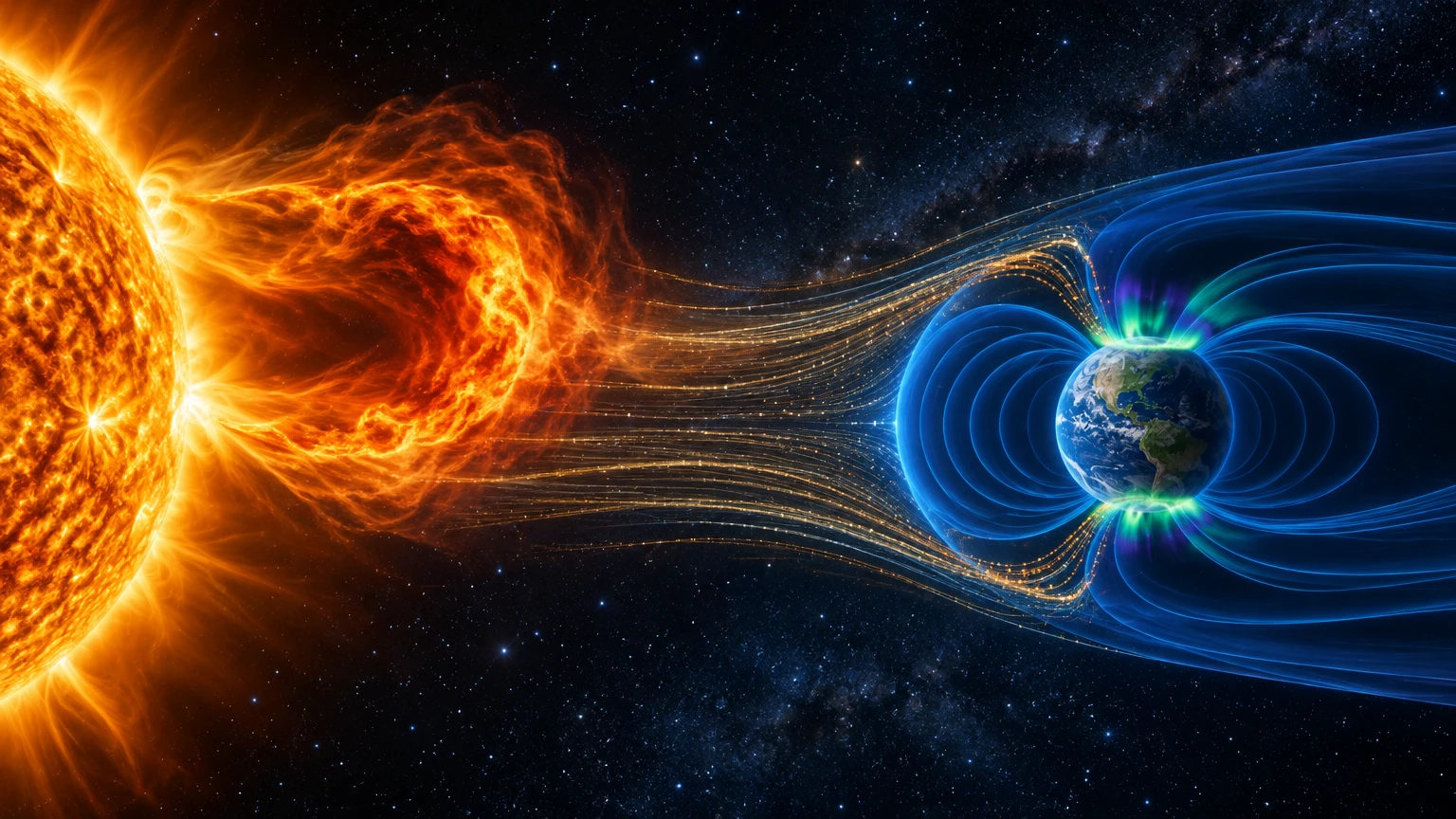
Image: Original AI-generated editorial illustration, created for this article; no text or labels in the image.
The Sun is not a quiet lamp in the sky. It is a magnetic star whose outer atmosphere continually sends charged particles into space, sometimes in great eruptions. Most of the time, Earth’s atmosphere and magnetic environment absorb or redirect the effects. But the same activity that paints auroras can also disturb radio signals, satellite operations, navigation, and long electrical systems. Scientists call these changing conditions space weather.
The phrase can sound like a dramatic forecast of disaster. In practice, space-weather science is about measuring a chain of events, estimating which parts of that chain may affect Earth, and giving operators useful notice. A flare, a cloud of solar plasma, a stream of energetic particles, and a geomagnetic storm are related phenomena, but they are not interchangeable. Knowing the difference is essential to understanding both the risks and the limits of a forecast.
1. A magnetic star makes changing space weather
The Sun is a ball of electrically conducting plasma: matter so hot that electrons are separated from atomic nuclei. The plasma moves, and its motion carries magnetic fields with it. Unlike a solid object with a fixed surface, the Sun’s visible layers and atmosphere are in constant motion. Different parts of the Sun rotate at different rates; magnetic field lines are stretched, twisted and carried by flows beneath and above the visible surface. Sunspots are visible markers of concentrated magnetic fields, not holes or cool gaps in the Sun.
When magnetic fields become strongly stressed, they can reorganize. In a process called magnetic reconnection, field lines change their connections and release stored magnetic energy. The result can include a solar flare, a coronal mass ejection, or both. A flare is a sudden brightening across the electromagnetic spectrum, especially prominent in X-rays and extreme ultraviolet. It sends radiation outward at the speed of light. A coronal mass ejection, or CME, is a much larger expulsion: a cloud of magnetized plasma launched from the Sun’s corona, its outer atmosphere. It carries matter and magnetic field into interplanetary space.
The two can occur together, but they are not the same thing. A powerful flare does not guarantee that an Earth-directed CME will follow, and a CME can occur without a conspicuous flare. The direction matters. An eruption on the far side of the Sun may be spectacular in images and have little direct effect on Earth. A CME aimed toward Earth may still miss, graze, or arrive with properties that produce a weaker disturbance than first expected. A coronagraph image, which blocks the bright solar disk to reveal the faint corona, helps forecasters estimate a CME’s apparent width, speed and direction. It does not give a perfect three-dimensional view: projection can make an eruption’s path and speed difficult to infer.
The Sun also produces a continuous solar wind, a flow of plasma and magnetic field extending throughout the solar system. It is not simply a stream of particles from eruptions. Some regions of the corona, called coronal holes, have magnetic field lines that open outward and can feed faster solar-wind streams. When a high-speed stream catches slower wind ahead of it, the interaction can create a corotating interaction region. These recurring structures can disturb Earth’s magnetic environment too, even without a dramatic CME.
Solar activity follows an approximately eleven-year cycle in which the number of sunspots and many kinds of activity generally rise and fall. This is a statistical rhythm, not a calendar of guaranteed storms. Solar maximum does not mean that a severe storm will strike on a particular day; quieter intervals can occur, and major events are possible at other phases. The solar cycle describes changing odds and background conditions, while a forecast for an individual event depends on observations of the specific eruption and the conditions between the Sun and Earth.
Understanding the Sun as a changing magnetic system helps avoid a common error: treating every solar headline as a prediction of a geomagnetic storm. A flare may cause an immediate radio effect on the sunlit side of Earth. A CME may take many hours or days to arrive, if it is Earth-directed. A coronal-hole stream can produce a later, more gradual disturbance. Forecasters therefore track several linked but distinct kinds of space weather rather than assigning one single “storm” label to all solar activity.
2. Three routes from solar activity to Earth
Space weather is often grouped into three event types because they have different causes, travel times and effects. NOAA’s R, S and G scales communicate radio-blackout, solar-radiation-storm and geomagnetic-storm severity, respectively. They are useful shorthand, but an impact depends on location, technology, shielding, operating conditions and the exact event. A scale level is not a promise that every system will fail or that every place will notice an effect.
Radio blackouts (R scale) are usually associated with solar flares. The flare’s X-rays and extreme ultraviolet reach Earth in about eight minutes, ionizing the sunlit side of the upper atmosphere. The ionosphere is a region containing charged particles that influence radio propagation. During a sufficiently strong disturbance, high-frequency radio signals can be absorbed or altered, and some low-frequency navigation signals can degrade. The affected region is principally on the daylight side, so the geometry changes as Earth rotates. These effects can begin quickly and may last from minutes to hours, depending on the flare and the ionosphere’s response. They do not mean that all radio, mobile-phone or internet service everywhere is lost.
Solar radiation storms (S scale) involve energetic particles, especially protons, accelerated near the Sun or by shocks associated with eruptions. These particles travel much slower than light but can still arrive far ahead of a CME’s bulk plasma. Earth’s magnetic field guides many charged particles toward polar regions, while the atmosphere shields people at the surface from most of the event. The greater concern is for astronauts outside the protection of Earth’s atmosphere and magnetosphere, spacecraft electronics, and some high-altitude or high-latitude aviation operations. Particle events can also cause satellite sensor noise and affect radio communications. The biological risk is not the same for every person in an aircraft; flight operators assess route, altitude, duration and current conditions and decide whether adjustments are warranted.
Geomagnetic storms (G scale) occur when the solar wind and its embedded magnetic field transfer energy into Earth’s magnetosphere, the region shaped by Earth’s magnetic field. Earth-directed CMEs are important drivers, as are high-speed solar-wind streams. The response depends not just on how fast or large a CME is but also on the orientation of its magnetic field as it arrives. A sustained southward field can couple more effectively with Earth’s northward field and enable energy transfer. The storm then involves changing electric currents in the magnetosphere and upper atmosphere. Those changes can affect satellite operations, radio propagation, navigation signals and, through geomagnetically induced currents, long conducting systems at ground level.
The three categories can overlap in one solar episode, but they are not interchangeable. A flare can cause an R-scale radio blackout without producing a severe G-scale geomagnetic storm. A CME can create geomagnetic activity after its arrival even if the flare itself was not unusually strong. An energetic-particle event can begin before the main CME arrives. Headlines that combine all of these into “a solar flare will knock out power” skip the crucial steps between cause and impact.
Auroras are a visible sign of energy entering Earth’s upper atmosphere. Charged particles are guided along magnetic field lines toward high latitudes, where collisions excite oxygen and nitrogen atoms and molecules. As those particles return to lower-energy states, they emit light at characteristic wavelengths. Oxygen can produce green or red emission, while nitrogen contributes blue and purple hues. The colors and shapes depend on altitude, particle energy, atmospheric composition and the evolving electric currents. An aurora forecast is therefore related to geomagnetic activity, but a forecast of a strong geomagnetic storm does not guarantee that a particular person will see an aurora: darkness, cloud cover, local light pollution and viewing latitude matter.
The NOAA scales put potential effects into public-facing categories, from minor through extreme. They help operators and observers discuss severity consistently, but do not replace detailed, sector-specific assessments. A G-level describes a global geomagnetic disturbance category; it does not directly predict voltage at every substation. An R-level describes radio-blackout severity; it does not say all communications are down. An S-level summarizes energetic-particle conditions; it does not establish an individual passenger’s exposure. Understanding these distinctions makes space-weather warnings more useful, not less serious.
3. The long journey—and the short warning window
Different signals travel at different speeds. Light from a flare reaches Earth in roughly eight minutes, so the brightening itself cannot provide much advance warning of its arrival. Solar energetic particles may follow within tens of minutes to hours, though the timing and intensity vary. The bulk plasma and magnetic field of a CME usually take longer: many hours to several days. NOAA notes that the fastest Earth-directed CMEs can arrive in as little as about 15–18 hours, while slower ones can take several days. A forecast issued soon after an eruption is therefore an estimate made before the most important details of the CME’s magnetic field at Earth are directly measured.
Remote observations help identify and track eruptions. Solar observatories image the Sun in visible, ultraviolet and X-ray wavelengths, revealing active regions and flares. Coronagraphs hide the solar disk and record expanding CME clouds. Multiple viewing angles can improve estimates of direction and speed, but each instrument has a finite field of view and sensitivity. The farther a CME travels, the harder it can be to distinguish its structure from the background solar wind. A single two-dimensional image may show an apparent halo around the Sun, yet the geometry and true trajectory still need interpretation.
The NASA and NOAA observing network combines these remote views with measurements made in space and from the ground. Near Earth, satellites monitor X-rays, energetic particles and magnetic fields. Ground-based magnetometers measure changes in Earth’s magnetic field; radio instruments and ionospheric observations help track changes in the upper atmosphere. Each measurement is a piece of a larger picture. Models use those observations to estimate how solar-wind structures move and how Earth’s magnetosphere may respond.
One important measurement point is the Sun–Earth L1 region, about 1.5 million kilometres (roughly one million miles) sunward of Earth. A spacecraft there samples the solar wind before it reaches our planet. Depending on the flow speed, this can give forecasters roughly 15 to 60 minutes of warning before a CME-associated shock or disturbed solar wind reaches Earth. That is valuable for operators who can make rapid adjustments, but it is not a day-long warning. The spacecraft is a monitor in the incoming flow, not a barrier or a device that stops the storm.
The L1 measurement also helps answer an especially important question that cannot be settled from a distant solar image alone: what is the magnetic field orientation in the arriving solar wind? The north–south component, often called Bz, influences how effectively the solar wind couples with Earth’s magnetosphere. A CME can be fast yet produce a less intense geomagnetic response if its orientation and interaction are less favourable for energy transfer; a slower structure can still matter if conditions are right. Measuring the approaching field improves short-term estimates, but the storm’s evolution can change after arrival.
NASA’s PUNCH mission adds a different view of the journey. Its four small spacecraft, launched in 2025, are designed to observe the corona and inner heliosphere together, using a constellation of imagers to follow how the solar atmosphere becomes the solar wind. PUNCH’s polarimetric observations use the polarization of scattered light to help reconstruct three-dimensional structure, rather than relying only on a flat image. NASA has reported early observations and images of CMEs from the mission. These data can help scientists understand how eruptions expand and evolve between the Sun and Earth; they should not be described as eliminating forecast uncertainty or guaranteeing an exact arrival time.
The forecasting process is thus layered. Scientists first see an eruption and estimate its trajectory. They compare the CME’s evolving motion with models and other observations. When the solar wind reaches a monitor near L1, direct measurements sharpen the short-term picture. After the disturbance interacts with Earth, ground and space observations reveal its actual effects. Each stage answers a different question. A headline saying “a storm is coming” can refer to an early possibility, a watch, a forecast or an observed event; those words should not be treated as equivalent.
4. Earth’s shield is powerful, but not a force field
Earth is protected by two interacting shields: the atmosphere and the magnetosphere. The atmosphere absorbs much of the high-energy radiation and charged-particle activity that would otherwise reach the surface. The magnetosphere, created by Earth’s internal magnetic field, deflects many charged particles and reshapes the flow of solar wind around the planet. It is not a rigid shell. Under a strong solar-wind disturbance, it compresses on the sunward side and stretches into a long magnetotail on the nightside. Energy and particles can enter through complex processes, driving auroras and geomagnetic activity.
This protection explains why a dramatic aurora can occur without direct danger to people standing beneath it. The visible glow is produced high in the atmosphere, not by a beam that burns the ground. For most people on the surface, the immediate effects of space weather are more plausibly mediated through technology and infrastructure than through direct radiation exposure. That statement is not a claim that the Sun is harmless: astronauts beyond Earth’s protective environment face a different radiation problem, and aviation operators consider elevated radiation at high altitudes during some particle events.
The atmosphere’s charged upper layers also make radio and navigation systems sensitive to space weather. Satellite navigation signals pass through the ionosphere on their way to a receiver. Changes in electron density can delay, bend or scatter those signals. Many everyday devices can compensate for modest changes, but precision uses—such as surveying, timing, aviation approaches or some scientific measurements—may need more careful monitoring. Severe or rapidly changing conditions can reduce accuracy or availability. The degree of impact differs by location and system, so “GPS will fail” is usually too broad a statement without a specific event and service context.
Geomagnetically induced currents are a separate pathway. A changing magnetic field can induce electric fields in the ground and currents in long conductors such as power lines and pipelines. The possibility depends on storm strength, local geology, grid design, line length and configuration, transformer characteristics, and how operators manage the network. High-latitude regions are often more exposed, but the geography and infrastructure matter. The 1989 storm that caused a major blackout in Quebec is a well-known example of a geomagnetic disturbance affecting an electric grid. It illustrates a real vulnerability; it does not prove that every severe storm will cause a continent-wide blackout.
Satellite systems face their own combination of hazards. Energetic particles can affect electronic components or produce single-event errors. Changes in the upper atmosphere during geomagnetic storms can increase drag on satellites in low Earth orbit, changing orbit estimates and increasing the need for tracking and corrections. Charging of spacecraft surfaces and internal components can create operational challenges. These are engineering and operations problems managed with shielding, redundancy, fault protection, forecasting and careful procedures; they are not all-or-nothing predictions that a satellite will be destroyed.
The growing dependence on interconnected technology makes space-weather resilience important. A navigation signal can support transport, agriculture and surveying. Satellite links carry communications and weather data. Electric grids supply power to facilities that in turn support communication and computing. Risks can propagate through dependencies, but that does not mean one solar event automatically shuts down every service. Operators assess vulnerabilities, maintain backup procedures and respond to warnings according to their systems. The practical message is preparedness and monitoring, not panic.
It is also important not to confuse space weather with climate change or ordinary terrestrial storms. Space weather describes variable conditions in the Sun–Earth environment, from solar activity through the magnetosphere and ionosphere. It can affect near-Earth space and technology, and sometimes ground infrastructure. It is not a forecast of rain, temperature or a direct explanation for routine weather on Earth. Keeping the scale of the phenomenon clear helps the public understand where evidence is strong and where dramatic claims outrun it.
5. From measurements to warnings and useful decisions
A space-weather forecast is not one prediction made from one telescope. It is an operational synthesis of observations from the Sun, the solar wind, the magnetosphere, the ionosphere and Earth’s surface. Forecast centres monitor active regions, identify flares and CMEs, estimate their likely direction and speed, and compare those estimates with models. They also track coronal holes and high-speed streams, which can produce recurrent geomagnetic activity. As fresh observations arrive, forecasters update the outlook. A forecast can become more precise with time, but its uncertainty should not be hidden.
NOAA’s Space Weather Prediction Center is the official United States source for space-weather forecasts, watches, warnings and alerts. Its products include alerts for different phenomena, forecasts of geomagnetic activity, and explanations of the NOAA Space Weather Scales. The audience includes power-system operators, satellite operators, airlines, communication providers, government agencies, researchers and members of the public. A warning is most useful when the recipient knows which system is exposed and what actions are available.
The R, S and G scales reflect different physical measures. R-scale radio-blackout levels are associated with solar X-ray flux and the potential for radio impacts on the sunlit side of Earth. S-scale solar-radiation-storm levels are based on energetic-particle conditions. G-scale geomagnetic-storm levels describe geomagnetic activity and potential impacts such as induced currents, satellite operations and aurora visibility. The scales provide shared language; they are not a universal severity score for every technology. An operator may need a local measurement, a route-specific aviation assessment or a system-specific engineering model before deciding what to do.
A useful alert should be read with its time and geography. A radio blackout on the daylight side does not have the same footprint as an energetic-particle event concentrated toward polar regions. A geomagnetic storm can be stronger at some latitudes than others. An aurora forecast concerns visibility under the right sky conditions, not the probability of a power failure. The forecast period matters as well: a watch means conditions may occur within a specified interval; a warning can mean an event is imminent or underway; an observed alert reports that a threshold has already been reached. The definitions and products can evolve, so readers should consult the issuing agency’s current product rather than rely on a simplified social-media graphic.
Different users have different response options. A satellite operator may switch equipment to a safe mode, adjust orientation or postpone a manoeuvre. An airline dispatcher may evaluate high-latitude routes, communications and radiation forecasts. A power-grid operator may increase monitoring, adjust network configurations or prepare for voltage-management actions. A surveyor or precision-navigation user may compare multiple signals and ground-based corrections. The public generally does not need to unplug appliances or take special shelter because a routine space-weather alert has been issued. Advice to the public should come from relevant authorities and be specific to the actual event.
Forecasts also improve through coordinated observation and research. Parker Solar Probe samples the corona and the young solar wind close to the Sun, measuring fields and particles where some of the physical processes begin. PUNCH observes the transition from the corona to the solar wind over a much wider field. DSCOVR, stationed near L1, has supported real-time solar-wind monitoring and warning lead time. Ground-based magnetometers and ionospheric measurements show how Earth responds. These are complementary vantage points: close-up measurements help explain mechanisms, wide-field imaging follows structure, upstream monitors provide short-term warning, and Earth-based observations check the outcome.
The goal is not perfect prediction. Solar eruptions are three-dimensional, their magnetic structure can be difficult to infer remotely, and the space between the Sun and Earth is dynamic. An eruption may interact with other solar-wind structures, change speed, or arrive with an orientation that differs from early estimates. Earth’s response also depends on the coupling between the incoming field and the magnetosphere. Forecasts therefore describe probabilities, ranges, categories and update times. An honest forecast is not weakened by naming uncertainty; it is more useful because it tells decision-makers what is known, what is not, and when the next observation may change the assessment.
6. What the next generation of solar observations can—and cannot—do
Modern heliophysics is moving toward observing the whole connected system rather than studying the Sun, interplanetary space and Earth as isolated subjects. That is the central idea behind missions such as PUNCH. Its constellation of four spacecraft combines a coronagraphic view near the Sun with wide-field views farther out. By observing polarized light scattered by particles, scientists can extract clues about three-dimensional structure and motion. In principle, such observations can improve understanding of how a CME expands, how fast it travels and how it interacts with the ambient solar wind.
This matters because the space between the Sun and Earth is not empty. A CME expands, is shaped by magnetic forces and encounters the solar wind already in its path. Two eruptions can interact, and a fast one can overtake a slower one. The CME may change shape and speed as it moves. A model that treats the disturbance as a simple ball flying through a vacuum misses important physics. Continuous imaging across a wider field can help bridge the gap between a CME near the Sun and its arrival near Earth. NASA has described PUNCH as a mission intended to image the corona and solar wind together and provide observations useful for studying space-weather events.
Parker Solar Probe contributes by going close to the source. It has flown through the Sun’s corona and measures magnetic fields, plasma and energetic particles in situ. Those measurements help answer long-standing questions about why the corona is so hot and how the solar wind accelerates. They also sample the environment in which energetic particles and magnetic structures develop. The probe does not forecast Earth impacts by itself: its measurements are made at a different place and time, and they need to be interpreted alongside remote observations and other spacecraft data. A scientific mission can improve physical understanding without being an operational warning service for every event.
At Earth’s upstream boundary, L1 monitors remain crucial because they provide direct readings of the solar wind just before it reaches Earth. Their short warning interval is especially valuable for rapid operational decisions. The next improvements may come from combining upstream data with better estimates of CME structure and localized models of Earth’s response. More detailed prediction would require not only an accurate arrival time but also the magnetic orientation, the duration of the field, the density and speed of the plasma, and information about how the magnetosphere and ionosphere respond region by region.
The transition from a global storm category to a local consequence is a difficult scientific and engineering problem. Two places at similar latitudes may experience different induced currents because local geology and network design differ. Two satellite operators may face different hazards because their spacecraft occupy different orbits and use different electronics. A single forecast scale cannot provide every organization with a tailored operational plan. The value of improved forecasting depends on good communication between scientists and users: operators need the data in the format, geographic detail and lead time that can actually inform a decision.
The public can contribute by learning to distinguish an alert from a rumor. Check the issuing agency, event type, forecast period, geography and update time. Ask whether a claim is about a flare, energetic particles, a CME, a geomagnetic storm or an observed service disruption. Be cautious when a post jumps from “the Sun produced a flare” to “the internet will go dark.” Look for a named authority and a specific impact statement. If the story promises a precise, guaranteed consequence without explaining the uncertainties or location, it is probably simplifying beyond what the evidence supports.
Space-weather awareness can still inspire wonder. The aurora is a visible reminder that Earth is connected to the Sun by magnetic fields and streams of charged particles. Solar storms show that our technological society operates within a changing natural environment. The scientific response is not to treat the Sun as either harmless or apocalyptic, but to measure it, understand its processes, communicate what is likely, and improve the resilience of the systems people depend on. Every new spacecraft adds another perspective to a puzzle whose pieces are moving. The better those views are joined, the more clearly we can follow an eruption from its first brightening to its eventual interaction with Earth.
Sources and further reading
- NOAA, “Space Weather: Storms from the Sun”: https://www.noaa.gov/explainers/space-weather-storms-from-sun
- NOAA / NWS Space Weather Prediction Center, “Coronal Mass Ejections”: https://swpc-drupal.woc.noaa.gov/phenomena/coronal-mass-ejections
- NOAA / NWS Space Weather Prediction Center, “NOAA Space Weather Scales”: https://www.swpc.noaa.gov/noaa-scales-explanation
- NOAA NESDIS, “DSCOVR: Deep Space Climate Observatory”: https://www.nesdis.noaa.gov/our-satellites/currently-flying/dscovr-deep-space-climate-observatory
- NASA Science, “NASA’s PUNCH Mission to Revolutionize Our View of Solar Wind”: https://science.nasa.gov/science-research/heliophysics/nasas-punch-mission-to-revolutionize-view-of-solar-wind/
- NASA Science, “Parker Solar Probe”: https://science.nasa.gov/mission/parker-solar-probe/
- NASA Science, “The Heliopedia”: https://science.nasa.gov/reference/the-heliopedia/
- NOAA NCEI, “What Is Space Weather?”: https://www.ncei.noaa.gov/news/what-is-space-weather
This content is a collection of ancient history,books and various articles and collection of library and news and other post ; all details may not be the same. Readers are requested to verify the information themselves. Readers are not allowed to take any disciplinary action; content is only for educational purposes. If readers do not agree about the contents, they may send a personal comment to my personal email ID: achary.purna@gmail.com
