
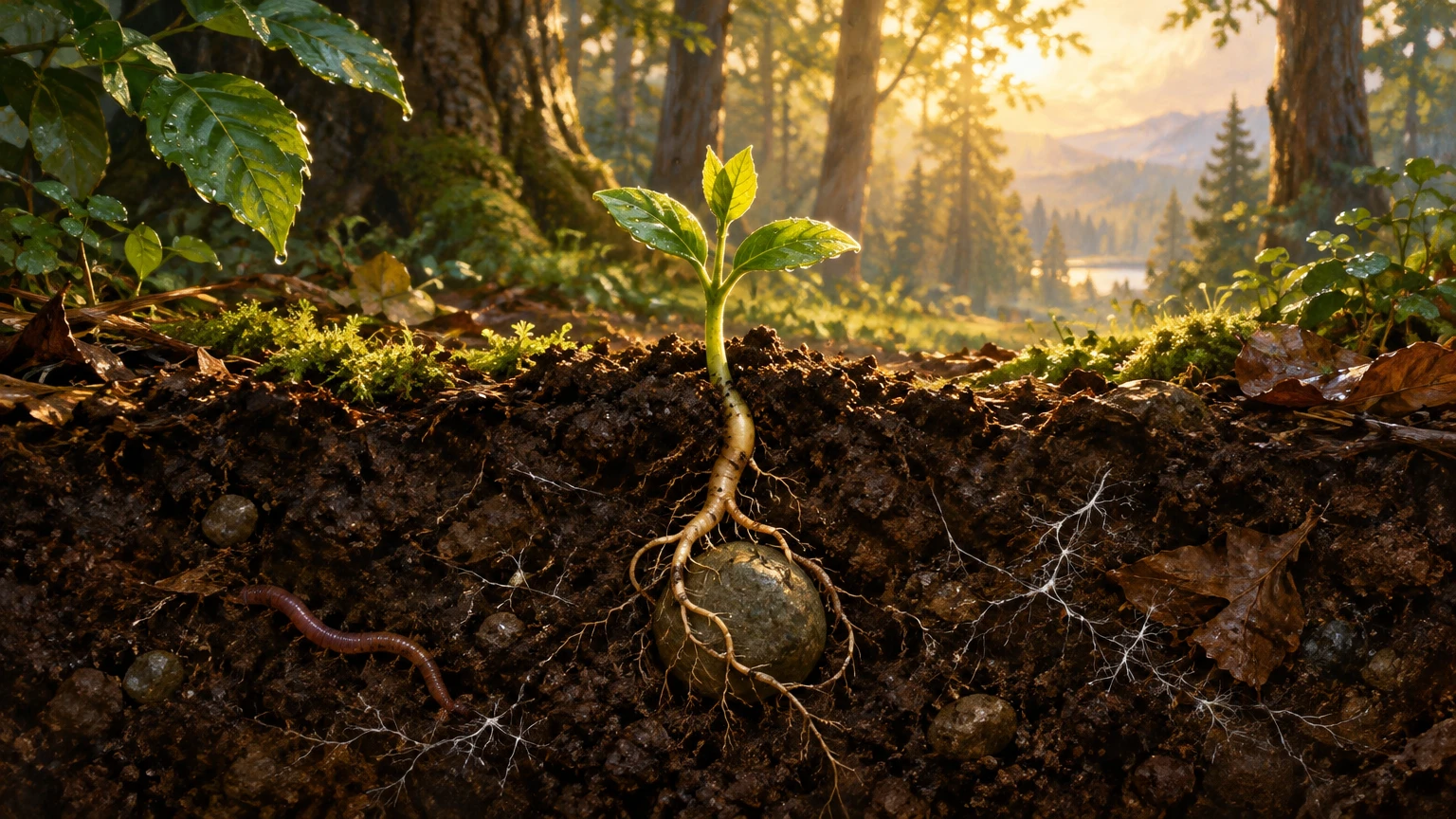
This is an original work of fiction inspired by the familiar image of a seed awakening underground. Its speaking earth, imagined thoughts, and conversations are poetic inventions, not claims about what plants, fungi, or earthworms consciously say.
Chapter 1: The Smallest Room
Far below a hillside meadow, under a quilt of leaves and the dark brown soil, a seed rested in a small chamber. No window opened into that chamber. No clock hung on its wall. It could not see the moon pass, count the rainstorms, or know that the seasons were changing above. The seed had only the world close around it: the firm shell that protected its living center, the coolness of the earth, and a quiet stillness that seemed to have no beginning or end.
If the seed could have spoken, it might have asked whether the darkness was all there was. But it had no voice, no eyes, and no human kind of thought. It was not a tiny person waiting impatiently for a door to open. It was a living beginning, held in reserve. Inside its coat were an embryo and stored food, a promise made by the plant that had come before it. The promise was not a guarantee. Seeds can remain dormant, be eaten, dry out, rot, or simply never find the conditions they need. Yet this one had reached the soil intact, and for now, it waited.
Aboveground, the meadow lived through changes the seed could not name. Dry grasses leaned in the wind. Insects visited blossoms, birds searched the stems, and clouds crossed the sky. Leaves fell and softened. Their remains mixed with the soil, where countless organisms broke them down. Beneath that busy surface, the seed was not alone in a human sense, but it belonged to a place full of life. Fine roots passed nearby. A threadlike fungus stretched between crumbs of earth. An earthworm moved through a damp passage. Each had its own way of living, none aware of a story being narrated.
Then came a stretch of dry weather. The topsoil grew brittle, and the deeper earth held on to its coolness. The seed’s chamber remained dim and still. It did not need to hurry. The meadow would have called the pause winter, even if the air was mild; the seed knew no calendar at all. For the moment, its work was simply to remain what it was: small, protected, and unfinished.
Chapter 2: Rain at the Surface
One evening, clouds gathered over the hill. Their first drops darkened the dust; soon a steady rain pattered on grass and leaf. Water slipped between blades, ran along the slope, and soaked into the ground. Some flowed away. Some lingered in the upper soil. A portion traveled through small spaces between soil particles until it reached the seed’s chamber.
The shell took in moisture. In the language of plant biology, this early water uptake is called imbibition. The seed swelled slightly as water entered, and internal processes began to stir. There was no sudden trumpet blast, no tiny hand pushing against a door. The change was gradual: stored resources became available, cells became active, and the embryo began the work of growth. The imagined voice of the rain in this story is a literary device. In reality, water is part of the environment a viable seed may require, alongside conditions such as oxygen and a suitable temperature. The exact requirements differ among species.
The rain continued through the night, but the soil did not become a lake. That mattered. Germinating seeds respire; they need access to oxygen. If growing medium is waterlogged or compacted, air exchange can be poor. The seed’s fictional chamber had a loose, crumbly soil around it, with enough moisture to soften its coat but enough open space for air. It was a storybook balance, not a recipe for every garden or every seed.
By morning, a crack had appeared in the seed coat. The opening was small, but it marked a threshold. Inside, the young plant had begun to use energy stored in the seed. Nothing about this change promised success. A seedling would still face obstacles, drought, shade, hungry animals, and competition. Yet a first movement had taken place. The seed had not conquered the world; it had begun to respond to the conditions around it.
Chapter 3: The First Root
A pale tip emerged from the split shell. It was the radicle, the embryonic root. In many familiar seedling stories, the root appears before the shoot, though details and timing vary with the kind of plant. The tiny root grew into the soil rather than toward the open sky. Its first task was not to admire the view, but to establish contact with the ground and begin taking up water and dissolved nutrients.
The root met grains of sand, a fragment of old leaf, and a pebble that blocked a straight path. In the fable, the pebble seemed like a wall. In actual soil, roots respond to physical conditions and chemical signals; they do not hold conversations with stones. The root’s tip pressed forward, paused, and curved around the obstruction. It found a softer gap between the pebble and a decaying piece of plant matter. A root can grow around obstacles when local conditions permit, but no seedling can be promised an easy route.
Nearby, an earthworm passed through its tunnel. It did not guide the root like a mentor. Its movement and feeding can contribute to soil structure and the mixing of organic matter, though the effects depend on the environment and species. In the story, the worm’s passage leaves a loosened channel, and the young root reaches into it. The worm continues on its own path, while the root continues its own. Their lives cross without needing to understand one another.
As the root branched, fine root hairs extended into the surrounding soil. These delicate structures increase the surface area available for absorption. The seedling still depended on its stored reserves, but the root was beginning to connect it with the environment beyond its shell. It was not yet strong. It could be damaged by rough handling or unfavorable conditions. Still, the small root held fast, and the seedling’s first lesson was not a moral sentence but a physical fact: growth begins by making contact.
Chapter 4: A Question Above
While the root explored the soil, the seedling’s shoot began to develop. It pushed in the opposite direction, toward the surface. Somewhere above lay air, light, and a wider world, but the shoot had never seen any of them. It followed the pattern written into its growth, responding to gravity, light and other cues in ways that depend on the plant. In our fable, the shoot felt a longing to rise. That longing belongs to the story, not to a claim that the plant experiences emotion as a person does.
The first obstacle was a flat pebble. The shoot pushed upward and met a firm underside. It bent; the soil pressed close around it. For a moment, the young plant seemed to have reached the end of its path. It could not simply command the stone to move. The rock had been there long before the seed arrived, and its weight did not change because a green shoot had a plan.
The seedling’s imagined question drifted into the dark: “Is every hard thing a stop sign?” The story answered through the silence of the soil. Not every barrier can be passed. Some roots fail to find a way through; some shoots never reach the surface. But sometimes a small shift makes a route possible. The shoot curved to one side, finding a narrow seam between the pebble and a root from an older plant. It bent around the edge and resumed its upward course.
What looked like detour was still movement. The shoot did not become brave in the human sense; its cells responded to their surroundings. Yet to a reader, that bending can stand for patience. Patience is not pretending that obstacles are harmless or that every effort will succeed. It can mean observing what is actually in front of us, resting when needed, and trying a different approach when force alone is not working. The little seedling’s story begins to offer that thought without pretending nature exists merely to teach people lessons.
Chapter 5: The World Changes
Above the buried seed, the meadow moved through its own chapter. A cold spell faded. Water ran down the slope after a storm, then sunlight warmed the upper ground. The grasses made room for new shoots; a bird carried a dry stem to its nest. The life of the meadow was not arranged around the seedling. It was a community of many organisms, each responding to its own needs and conditions.
In the soil, fungi formed networks of fine filaments. Some fungi interact with plant roots in ways that can help exchange nutrients and water, while others have different relationships with plants. These partnerships are varied, not a universal promise that every seedling receives a helping hand. For this story, the fungal threads are a symbol of connection: a reminder that an individual’s life often depends on relationships it cannot see. The symbol is imaginative; the underlying ecology is real and complex.
Rainwater reached the deeper soil, carrying dissolved materials. The seedling’s roots took up what was available. Too much water, too little oxygen, unsuitable temperatures, poor seed viability, or other stresses could have changed the outcome. A fictional tale can move neatly from problem to solution, but gardens and forests do not follow a script. Every species has its own needs, and even seeds of the same kind may not all germinate at once.
The seedling continued its slow work. It was not racing toward a prize. It had no idea that the light above might be beautiful. Its leaves were not yet open, and its stem remained protected by soil. When the next shower came, the earth around it grew damp again. The shoot extended a little farther. When it met a clod that crumbled under pressure, it passed through. When it met a firmer clump, it followed a softer edge. Small advances added up, though none could guarantee the final emergence.
Chapter 6: The Narrow Opening
At last the shoot reached a mat of fallen leaves near the soil’s surface. One leaf had folded over the place where it pushed upward. The leaf was not a locked door, only a thin cover of last season’s growth. The shoot pressed against it. For a while, nothing seemed to change. Then the leaf shifted, and a small wedge of daylight appeared.
The first air above the soil felt different from the darkness below. The seedling’s curved stem emerged into the morning. It was pale and tender, and the breeze made it sway. It had not become a tree in a single leap. It was a seedling that had reached one crucial threshold. Its seed leaves opened, and the green parts began to meet the light. Depending on the plant, the seed leaves may appear above the ground or remain below it; this story follows one imagined seedling and does not describe every species.
Sunlight did not feed it like a spoon. Leaves capture light energy that helps drive photosynthesis, a process through which plants make sugars from carbon dioxide and water, releasing oxygen. The seedling also continued to take up water and mineral nutrients through its roots. Its early growth was supported by reserves within the seed, and as it developed, it increasingly relied on its leaves and roots working together. The world above was not a magical reward; it was a new set of conditions and challenges.
A breeze bent the stem. The seedling leaned, then returned partway upright. It was small enough to be overlooked. A heavy footstep could crush it; a dry day could strain it; shade could limit its growth. Still, it stood. In the story’s language, it remembered the pebble. In biological terms, it had simply grown through the conditions it encountered. The two descriptions can sit beside each other as long as we know which is metaphor and which is observation.
Chapter 7: A Morning Among Giants
From the ground, the meadow seemed enormous. Tall grasses moved like a forest. A dew drop rested on a blade nearby, and the sky stretched above the low hill. The seedling’s first open leaves caught the morning light. Around it, established plants already occupied much of the space. Some roots reached deeper; some stems rose higher. The newcomer was not the center of the landscape, but it had become part of it.
An earthworm surfaced briefly after the rain, then slipped back beneath the soil. A beetle walked between clods. Neither came to congratulate the new plant. Their presence made the meadow feel busy and full, not staged for a single hero. The seedling’s survival depended on conditions beyond its control. It could not choose the weather, command pollinators, or guarantee a fertile season. It could only continue the work possible at each stage: roots absorbing, leaves opening, stem strengthening.
In time, the seedling’s first leaves were joined by others. It grew taller, though not at the same speed in every week. Growth depends on the plant’s species, age, resources, temperature, water, light and other conditions. The image of a steady, upward line is comforting, but real growth often pauses, changes direction, or suffers setbacks. A bend is not always failure; rapid height is not always strength; and a quiet period may be part of development.
Somewhere within its seed, the plant had carried the energy of a previous season. It had not created itself from nothing. It depended on the parent plant, on the soil, on water and air, and on countless processes that preceded its arrival. Its first green leaves were a beginning, not an ending. The seedling’s story invites us to see beginnings as both vulnerable and connected: a small life can matter without being self-sufficient or destined for greatness.
Chapter 8: What the Seedling Cannot Promise
Later, a dry week came. The topsoil lost moisture, and the seedling’s leaves drooped during the warmest hours. In the fable, the plant might have wished for rain. In the meadow, survival would depend on its own traits and the conditions around it. Some plants cope with dry periods better than others. Some seeds wait for a particular combination of temperature, moisture, light or other cues. There is no single rule that can be applied to every plant.
The rain returned after several days, but the story does not claim that it always will. A drought can kill seedlings; a flood can deprive roots of oxygen; insects and animals may feed on leaves; disease may spread. A seed that begins germinating has not signed a contract with the future. This uncertainty is important. Hope becomes more honest when it does not pretend that effort controls every outcome.
What, then, does the seed teach? Not that every person who persists will triumph, or that every obstacle is secretly a gift. A pebble can be a useful metaphor for a manageable barrier, but some barriers require help, resources, or a change in conditions. Sometimes the wise response is to pause, ask for assistance, or choose another path. The story’s small shoot does not replace those choices; it makes room for them.
The seedling’s modest achievement was real: it had emerged, rooted, and opened its leaves. It was enough for that day. It did not need to be a tree already. Its life remained unfinished, and that was not a flaw. The meadow had no audience keeping score. Dawn arrived, light reached the leaves, and the seedling met the morning as a small, living plant among many.
Chapter 9: The Lesson in the Soil
From above, a seed may look like a tiny object, sealed and still. Yet it carries a living embryo and stored reserves, and under appropriate conditions it can begin a sequence of changes. Water uptake, internal metabolic activity, and the emergence of a root are part of a complex process. The story translates that process into a journey so readers can picture what is hidden beneath the ground.
Its central image is not an instruction to endure everything silently. The seedling did not succeed because it never felt strain, because it was uniquely chosen, or because it made the ground obey. It moved through a particular setting in a particular way. The root found space; the shoot bent around an obstacle; the surface offered enough light and moisture for this imagined plant to continue. A different seed in a different place might have had a different story.
For people, the fable’s gentler suggestion is that beginnings often unfold in stages. Preparation can be invisible. Progress may look like a small adjustment rather than a dramatic breakthrough. We can learn to distinguish what we can influence from what we cannot: our next careful step is ours, while weather, luck, other people’s actions, and many larger forces are not. Patience does not mean giving up on support or pretending hardship is beautiful. It means giving a process room while staying attentive to what it needs.
The seedling did not know the morning was waiting. It did not need to know. It responded to the water it received, made a root, and grew toward an opening. When it reached the surface, it met a world far larger than its hidden chamber. The next day would bring new conditions. The story ends here, not because the plant’s life is finished, but because this first chapter of its life has found its light.
Plant Notes: The Real Science Behind the Fable
This narrative is a fictional retelling, not a record of a real seed, place, or event. In plant biology, germination commonly begins when a viable seed takes up water and resumes internal activity. A root or radicle often emerges first, followed by shoot growth, but details differ by species and seed structure. Seeds generally need appropriate moisture, oxygen and temperature; light requirements vary. Too much water or compacted growing medium can limit air exchange, while too little water can prevent germination. Seedlings also need suitable light after emergence, but the exact needs depend on the plant.
For a clear visual introduction, see “How Do Seeds Become New Plants | Seed Germination” by Letstute. The linked video belongs to its publisher; it is shared here as a related learning resource, not as our content.
Further reading: Penn State Extension, “Seed and Seedling Biology”; University of Illinois Extension, “Great Plant Escape: Germination”. These educational references explain germination conditions and the emergence of roots and shoots; consult species-specific guidance for practical growing decisions.
Disclaimer
This content is a collection of ancient history,books and various articles and collection of library and news and other post ; all details may not be the same. Readers are requested to verify the information themselves. Readers are not allowed to take any disciplinary action; content is only for educational purposes. If readers do not agree about the contents, they may send a personal comment to my personal email ID: achary.purna@gmail.com
