
District Overview & Geography
Jagatsinghpur is Odisha in miniature: a district where river-water, cultivated earth, shrine culture and the sea meet within a remarkably compact area. Formed from the former Cuttack district on 1 April 1993, it covers 1,759 square kilometres. The 2011 Census population recorded on the district website was 1,136,971; that number should be read as a census-era figure, not a present-day estimate. Administratively, the district has one subdivision and eight blocks and tehsils. Its eastern edge meets the Bay of Bengal, while Kendrapara lies to the north, Cuttack to the west and Puri to the south. District profile
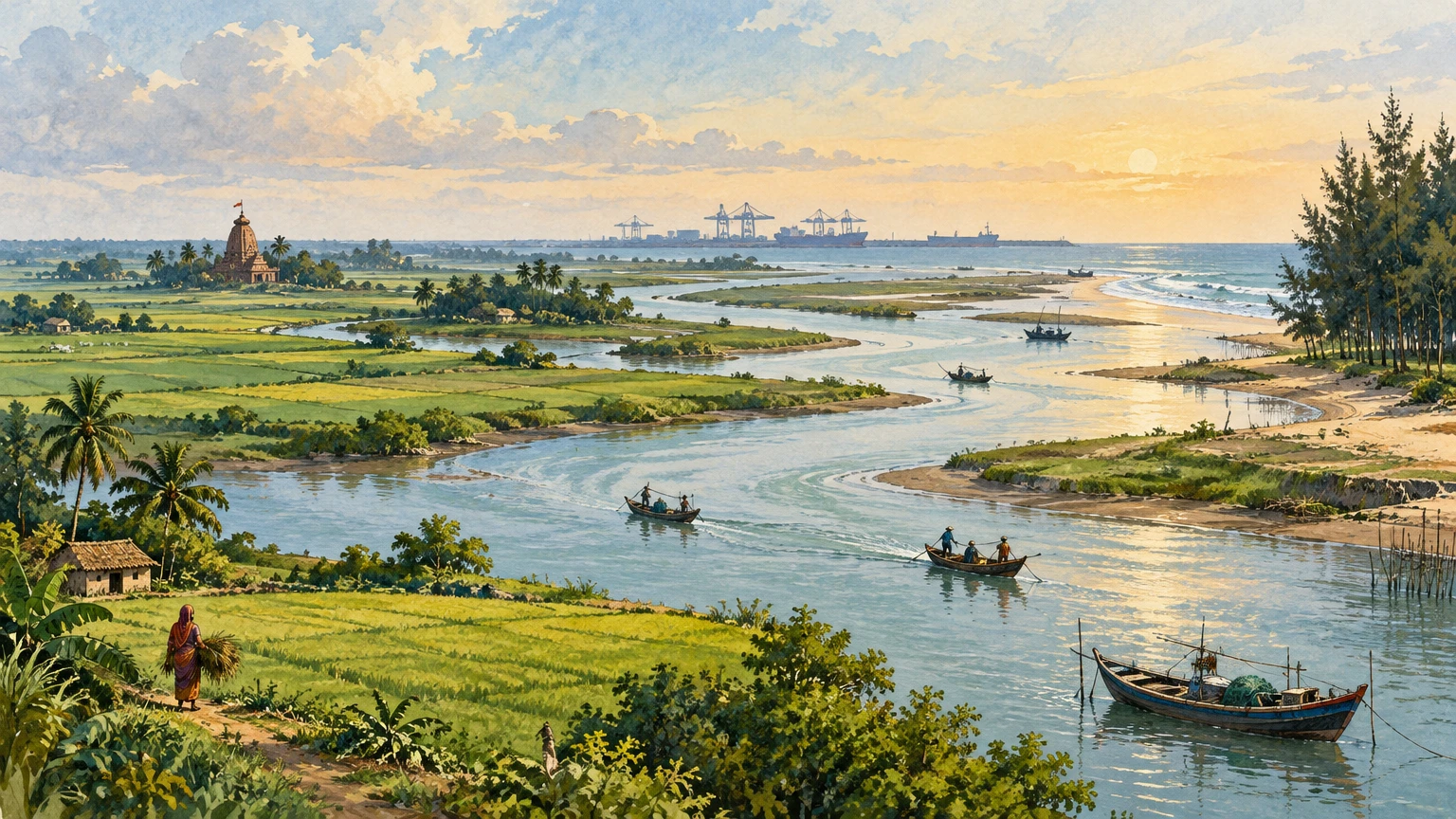
The defining geography is a low, fertile alluvial plain shaped by the Mahanadi system.
Reading the delta. Rivers here are not merely blue lines on a map. Their channels, distributaries, embankments and canals form a working landscape in which cultivation, settlement and travel respond to water. Mission Shakti’s district profile provides a useful named inventory of the Mahanadi, Alaka, Biluakhai, Hansua, Devi and Paika rivers, as well as the Taladanda and Machhagaon canals. It is a district-level description, not a current hydrological survey; readers should not infer that every channel is navigable, that water levels are stable, or that a listed canal is a visitor attraction.
The broad plain helps explain why the district’s cultural map is dispersed. A shrine, weekly market, ferry crossing or port-oriented road belongs to a network of everyday movement rather than to an isolated monument. Paddy fields and fishing livelihoods sit alongside roads and industrial activity, and the same journey may pass through very different settings within a relatively short distance. This combination rewards slow observation: note the changing vegetation, settlement pattern and river crossings, not just the destination name.
For visitors, the practical lesson is to plan around conditions, not a static map. Heavy rain or high water can affect low-lying routes, while coastal weather can alter plans farther east. An official district profile offers background, not a live route or flood bulletin. Check current road and weather information before travelling, and ask locally about access where a small road, embankment or village path appears to lead toward a river or shore. Treat riverside landscapes as working places with local rules, not as open recreation areas by default.
Here the river does not merely pass through the landscape: its distributaries, canals and tidal influence determine settlement, cultivation and movement. The district’s Mission Shakti profile names the Mahanadi, Alaka, Biluakhai, Hansua, Devi and Paika rivers, alongside the Taladanda and Machhagaon canals. Their waters sustain a countryside associated with paddy cultivation, fishing and an intimate dependence on changing river levels. Mission Shakti’s district page is useful for this riverine overview, though it should not be treated as a hydrological forecast.
This is not a hill district. Its visual drama comes from horizontals: paddy fields in the interior, broad river channels, embankments, palms and casuarina near the coast, and the open Bay beyond Paradeep. A traveler looking only for monumental stone architecture can overlook the region’s more subtle beauty. Jagatsinghpur rewards attention to watercourses, market roads, temple courtyards and the interplay of agricultural and maritime work.
The coastal setting also brings exposure. The southwest monsoon makes the landscape green and water-rich, but heavy rain, tidal weather and cyclonic conditions can disrupt travel. Winter, broadly October to March, is promoted by Odisha Tourism as the more comfortable visiting season. That is broad seasonal guidance rather than a promise of good weather on a particular day. Before a coastal trip, visitors should check official weather and local advisories, especially during the monsoon and cyclone season.
Forest in Jagatsinghpur is best understood as a mosaic rather than a vast wilderness. Coastal casuarina belts, river-edge vegetation, village groves and the Dhalatangada forest locality appear in official district-oriented listings. The tourism directory describes Sandhakuda in terms of casuarina vegetation, beach, creek and island scenery. District tourism listings do not establish open access to every natural patch, nor do they justify entering creeks, dunes or vegetated areas without local permission. Birdlife and aquatic life may be observed from appropriate public places, but this is not an invitation to disturb nesting, fishery or shore habitats.
A geographical clarification matters. Bhitarkanika is in neighbouring Kendrapara district, not Jagatsinghpur. Some broad destination pages place it in a wider coastal itinerary, but travelers should not describe it as a Jagatsinghpur attraction or assume that its protected-area access rules apply here. Jagatsinghpur’s character is its own: a Mahanadi-delta district with an industrial harbour town, religious centres and a living agricultural coast.
Mythological & Historical Significance
Jagatsinghpur’s past is preserved in different registers: official accounts, literary memory, local practice and devotional legend. They should not be collapsed into one certainty. The district history page describes the older name Hariharpur and recounts Company, Maratha and British-era associations, including a narrative that connects the later name Jagatsinghpur with Jagat Singh, a Maratha revenue official. The same page contains inconsistencies in chronology and phrasing, so its name-history should be presented as the district’s inherited account rather than as a settled reconstruction. Read the district history page.
What is firmly visible is the district’s position within a long coastal world.
That coast is not a single story. In the west, rivers and canals organize inland movement; toward the east, the Bay and the port turn attention outward. The familiar language of Odisha’s “maritime heritage” gathers together archaeology, historical writing, oral memory and present-day ritual, but those forms of evidence answer different questions. A community’s boat-launching observance can show how people remember a seafaring past; it cannot, by itself, prove the date or route of a particular ancient voyage. Likewise, a modern port’s scale speaks to contemporary trade, not automatically to the identity of every medieval harbour named in regional lore.
Keeping those distinctions in view makes a visit more rewarding rather than less romantic. At a festival, notice the songs, boats, offerings and stories as living cultural practice. In a museum or archive, ask what the displayed object actually documents and how it was dated. In a village, listen to local accounts without turning each legend into a claim of fact. Jagatsinghpur’s importance lies in the conversation among these memories: literary, devotional, agrarian and maritime. The district is not a museum of an ended age; it is a place where contemporary livelihoods and ceremonial remembrance still meet the water.
River routes, cultivated hinterlands and proximity to the Bay made this region part of Odisha’s maritime imagination. Today’s Kalinga Bali Jatra and Boitabandan observances at Paradeep and Chelitola keep that imagination alive. They are cultural commemorations of seafaring memory, not independent proof for every popular claim about ancient voyages, cargoes or ports. Their value lies in how communities continue to remember the sea as a route of exchange and departure.
The most influential cultural figure associated with the district is Sarala Dasa, revered as Adikabi, or the first poet, in Odia literary tradition. The Odia Virtual Academy places him in the fifteenth century and associates him with Kanakavati Patana or Kanakapura in present-day Jagatsinghpur. It records his major works as the Odia Mahabharata, Vilanka Ramayana, Chandi Purana and Laxmi Narayana Vachanika. His exact birth date and much of his early biography remain unknown. This uncertainty does not diminish his importance; it is a reminder that literary stature often exceeds the precision of surviving biographical records.
Sarala Dasa’s place in Odia letters is best understood through the scale and ambition of the works attributed to him. The Odia Mahabharata brought epic material into a language and literary world that readers could inhabit directly; it was not simply a word-for-word substitute for a Sanskrit source. Vernacular retelling can reorganize emphasis, idiom and moral attention, making familiar narrative speak to a new audience. The titles recorded by the Odia Virtual Academy also point beyond one epic: the Vilanka Ramayana engages the Ramayana tradition, while the Chandi Purana and Laxmi Narayana Vachanika connect literary imagination with devotional themes.
These works belong to a wider history of regional languages becoming vehicles for sophisticated literature, public memory and religious interpretation. Their continuing significance does not depend on a precisely documented birthplace or an exact birth year. It rests on the enduring circulation of Odia narrative and on the way readers, performers and worshipping communities have kept these works in conversation with later generations. For a traveler, even a short encounter with a reliable edition or a locally curated exhibit can deepen the visit to Jhankad: the poet’s association is not a decorative label but a link between landscape, language and sacred memory. The academy’s profile is a starting point for literary orientation, not a substitute for a critical edition or specialist study.
A much-loved legend tells of the young ploughman receiving the grace of Goddess Sarala and becoming a poet. The academy identifies this as legend. Visitors should therefore encounter it as devotional-cultural memory, not as documentary biography. Sarala Dasa’s achievement is nevertheless historical in a broad literary sense: his Odia retelling of epic material helped give sacred and ethical narratives a powerful vernacular home.
Maa Sarala’s shrine at Jhankad is the district’s central sacred destination. The official tourism page calls her a synthesis of Durga and Saraswati and describes the Sarala tradition as drawing together Vedic, Tantric and Vaishnavite strands. It also identifies the deity as an eight-armed stone image in a Mahishasura Mardini form. The official shrine page attributes construction to the Bhauma rulers in the eighth century and recounts an association with Parashuram’s arrow. These are important temple traditions, but neither should be treated as archaeological proof without independent inscriptional or excavation evidence.
The shrine’s deeper significance is cultural. Sarala is simultaneously goddess, source of learning and centre of local belonging. The surrounding pilgrimage landscape has helped make Jhankad a place where literary remembrance and Shakta devotion meet. Visitors who enter should dress and behave with the restraint expected at an active religious institution, follow directions from temple authorities and avoid treating worshippers as photographic subjects.
Jagatsinghpur also holds a twentieth-century public history. The district account identifies Alaka Ashram on the Alaka river as a site associated with the freedom movement and later Bhoodan activity. It is often called the “Sabarmati of Odisha,” a respectful regional comparison rather than a literal equivalence. The association evokes the district’s contribution to political mobilisation, constructive work and social reform. A visit is most meaningful when paired with reading about the people and movements involved, rather than reducing the place to a quick stop between temple and coast.
Tourist Destinations & Hidden Gems
Begin at Jhankad, where Maa Sarala Temple gives the district a spiritual centre of gravity. The experience is less about ticking off a monument than understanding the relationship between ritual, language and place. Sarala Dasa’s association gives the shrine a literary resonance unusual even in temple-rich Odisha. Arrive with time to observe the outer precincts and the rhythms of worship, but do not presume unrestricted access to every enclosure. Temple procedures, photography rules and queues can change, especially on observance days; confirm locally before setting out.
Jagatsinghpur town itself is useful as a base for the district’s cultural geography. The district tourism page groups the town with nearby heritage locations including Alaka Ashram and Somanath Temple. Its local tourism entry presents Somanath as a Shiva shrine whose lingam is popularly called Muchukunda Somanath. The link with Muchukunda is local tradition, not a documented dating of the shrine. That distinction makes the visit richer: one sees how Puranic memory takes root in a particular Odia landscape.
Alaka Ashram is a quieter stop for travelers interested in modern history rather than spectacular architecture. The district’s historical narrative links it to freedom struggle activity and the Bhoodan movement. Its appeal is contemplative. Read the official account beforehand, visit respectfully and ask locally whether any area is privately managed or has a programme underway. Such places are meaningful because they are lived repositories of civic memory, not because they imitate a museum.
Garh Kujanga offers another important religious circuit. The district tourism directory identifies the presiding deity at Gada Kujanga as Kunja Behari and notes the nearby Raghunath Jew Matha. The official Gada Kujanga page also uses the name Subhadra Kshetra. This is a place to appreciate the dense local geography of Vaishnava worship: temple, matha, processional memory and settlement are interconnected. Do not assume that the word “garh” guarantees visible fort ruins, nor that a devotional title settles an early historical date.
Gorakhnath, Chandapur, Astasambhu, Siddheswar, Ambasal and other sacred localities are named in the district’s Mission Shakti listing.
The names suggest breadth, not a guaranteed tourist circuit. Some places may be best known within a nearby cluster of villages; others may have a regular annual observance but only modest visitor facilities. Before setting out, identify the exact shrine and village rather than relying on a similarly named place in a map result. Ask a local contact which approach road is usable, whether a festival or ritual affects access, and whether the site is open to visitors at the intended time. A district directory is useful for discovering names, but it does not establish current hours, transport or permissions.
Travelers can make a richer day by choosing one or two places and allowing time for the road and the people who maintain them. At a small shrine, modest dress and quiet conduct matter more than elaborate photography. Remove footwear where asked, keep clear of private or ritual spaces, and ask before taking pictures of priests, worshippers or offerings. If no one is available to answer questions, treat that as a reason to keep your visit brief and unobtrusive, not to wander into an inner area. Such courtesy is especially important where tourism is not the main purpose of a site.
These are rewarding additions for travelers with time and a local host or clear directions. They should not be marketed as “secret” destinations. Small temples and village religious spaces are often active community institutions, with limited visitor infrastructure and no obligation to accommodate unannounced tourism. The best approach is curiosity tempered by courtesy.
Paradeep is Jagatsinghpur’s most visible modern contrast. It is a working port town on the Bay of Bengal, where industrial logistics and coastal scenery occupy the same horizon. The official district page identifies Paradeep Port as a major sea port; Odisha Tourism emphasises that the port itself is restricted for security. Its Paradip Port and Beach page is clear that visitors should enjoy publicly accessible seafront spaces rather than seek entry into operational port zones.
The value of Paradeep lies partly in that contrast. From an appropriate public beach or promenade area, distant vessels and harbour infrastructure make visible the contemporary maritime economy behind Odisha’s coastal identity. This is not a wilderness coast and should not be romanticised as one. Keep away from restricted facilities, cargo areas, jetties and industrial boundaries. Never enter water merely because the sea looks calm: currents, tide, weather and local restrictions matter more than appearance.
Sandhakuda, listed by the district administration, is associated with casuarina shade, golden beach, creeks and coastal scenery. It is the kind of site best experienced slowly, without a demand for elaborate amenities. Its natural features are fragile. Carry drinking water, take all litter back, avoid disposable plastics and do not enter creeks or mudflats without local knowledge. Casuarina-lined shorelines can feel secluded, but that is not a safety guarantee; visit in daylight and heed any local warning.
The district’s coast supports livelihoods as much as leisure. Fishing activity, settlement, agriculture and industrial infrastructure coexist along a vulnerable shore. Responsible travel therefore means resisting the urge to claim empty beaches as private playgrounds. Give working boats and nets space, do not fly drones around people or sensitive infrastructure without permission, and do not treat fishermen or worshippers as scenery. A respectful traveler helps preserve the dignity that makes these places worth visiting.
Food offers another way into Jagatsinghpur’s coastal culture. Odisha Tourism lists machha besara, prawn preparations, bara with aloo kasa, pakhala, dalma and chhena-based sweets among foods associated with the destination. Its culinary overview is a useful starting point, not a guarantee that every dish is available everywhere. In town and coastal markets, ask what is freshly prepared and seasonal. Rice, dal, vegetables and fish are the everyday grammar of many meals; pakhala can be especially welcome in warm weather, while mustard-based fish dishes speak to the regional palate.
Recent News & Tourism Developments
As of this edition dated 29 October 2026, the most consequential verified development affecting Jagatsinghpur’s future visitor geography is a road project that remains planned, not completed. On 3 June 2026, the Union Cabinet approved the 160.18-kilometre Rameshwar–Paradeep coastal highway project through Khurda, Puri, Kendrapara and Jagatsinghpur. The official release describes a planned 79.40-kilometre four-lane Rameshwar–Konark section and an 80.78-kilometre two-lane Konark–Paradeep section, with approved cost of ₹8,300.79 crore. PIB’s 3 June release should be read carefully: approval is not an opening date, and expected travel-time gains are projections rather than present conditions.
On 4 October 2026, The New Indian Express reported tourism investment proposals or intents worth ₹525 crore for Jagatsinghpur, within statewide proposals announced at Odisha Travel Bazaar. The report does not establish that new hotels, resorts or visitor facilities have been approved, built or opened in the district. Travelers should therefore book only accommodation they can independently confirm and should not plan around proposed projects.
Paradeep’s recent port news is substantial but should not be mistaken for tourism development. Paradip Port Authority reported a single-day loading record of 140,022 metric tonnes of coal at the mechanised coal handling plant on 10 October 2026. The authority’s report is evidence of port operations, not public access to the port. Likewise, the authority’s account of FY 2025–26 cargo throughput and Western Dock progress describes a working industrial complex and ongoing development, not a new visitor attraction. Read the port authority update.
No independently verified district-specific announcement of a newly completed tourism facility, new protected-area opening or changed temple access arrangement was identified in the research used for this edition. That absence is important. Jagatsinghpur is already visitable for its living heritage and coastline; it does not need speculative infrastructure claims to be interesting.
Traveler Essentials
Jagatsinghpur is approachable by road from Bhubaneswar, Cuttack and the coastal belt, while Paradeep has rail connectivity and Biju Patnaik International Airport in Bhubaneswar is the principal air gateway commonly used for the district. Odisha Tourism’s destination page gives broad orientation on these approaches. Do not rely on older distance figures, service claims or suggested itineraries as real-time transport information. Check current trains, buses, road works and local vehicle availability before departure.
A sensible first visit can combine Jhankad’s Sarala tradition, Jagatsinghpur town or Alaka Ashram, and an overnight or day visit toward Paradeep, depending on confirmed transport and weather. Add Gada Kujanga or smaller shrine circuits only when time allows. Trying to compress every temple, beach and river landscape into one day turns the district into a checklist and overlooks the very texture that makes it distinctive.
October to March is generally the more comfortable window for outdoor travel, but coastal Odisha cannot be reduced to a calendar label. Monsoon rain, heat, cyclone alerts, tide and local events affect actual conditions. Carry sun protection and rain cover as season requires, use safe drinking water, and choose clothing suitable for religious sites. At temples, follow the local rules on dress, footwear, photography and entry. At the coast, observe notices and do not venture into the sea, creeks or industrial areas without explicit permission and reliable local guidance.
Accommodation and dining options are likely to be broader in and around Paradeep and the district headquarters than near smaller religious sites, but availability changes.
A practical itinerary starts by choosing a base according to the purpose of the trip. A traveler focused on Sarala Temple and village shrines should confirm the day’s transport before committing to several stops; someone interested in port-side scenery may find Paradeep more convenient, subject to verified lodging and road connections. These are planning principles, not claims that a particular bus, taxi, hotel or attraction is currently operating. Use current railway, bus and local transport sources for the exact date, and allow margin for the final road segment to smaller settlements. A plan that depends on one unconfirmed connection can turn a calm pilgrimage into a rushed journey.
Keep a flexible schedule around weather and local observance. Check alerts before departure, especially if rain or cyclone conditions are reported; ask accommodation staff or local authorities about coastal restrictions and road closures. Save offline directions for the route but confirm the last turn with a local source, since rural access may be described inconsistently online. Carry water, essential medicines, modest cash where appropriate and a charged phone, while avoiding assumptions about signal coverage or services at remote sites. Do not rely on an old tourist listing for opening times, prices or safety. A short confirmation with the temple office, tourist contact or accommodation provider is more useful than treating a static webpage as a live operating notice.
Confirm directly before travel, particularly during festivals, official events or weather disruptions. The government’s Jagatsinghpur tourist office listing provides an official point of contact for current orientation.
Buy locally where possible: a modest meal, seasonal produce or a legitimate small business purchase supports the places being visited more meaningfully than disposable souvenirs. Avoid taking shells, plants, ritual objects or anything from temple and coastal landscapes. Ask before photographing people, worship, boats or homes. Jagatsinghpur is not a blank edge of the map; it is a populated delta whose rivers, shrines and port continue to shape Odisha’s cultural life.
Featured illustration: Original AI-generated editorial artwork made for this Jagatsinghpur article; it is an evocative composite, not documentary imagery. Alt text: “Illustrated Mahanadi delta fields, an estuarine creek and coastal shore, with distant port and temple silhouettes.”
Disclaimer
This content is a collection of ancient history,books and various articles and collection of library and news and other post ; all details may not be the same. Readers are requested to verify the information themselves. Readers are not allowed to take any disciplinary action; content is only for educational purposes. If readers do not agree about the contents, they may send a personal comment to my personal email ID: achary.purna@gmail.com
